











































































The former secretary of state said a new Israeli government could open the door to more constructive progress, and said peace in the region would require 'tough love’ from Washington
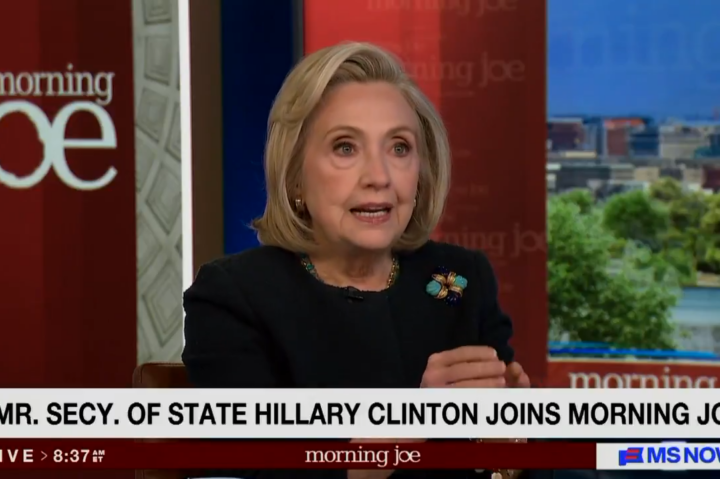
Former Secretary of State Hillary Clinton on "Morning Joe" on Sept. 10, 2026.


 Add JewishInsider on Google
Former Secretary of State Hillary Clinton said Thursday that the U.S. should take a “very tough position” if Israeli voters reelect the government led by Prime Minister Benjamin Netanyahu in Israel’s upcoming elections, but said a new Israeli government could provide opportunities for more constructive progress.
“If the Israelis want to vote for that again, then I think the United States has to take a very tough position,” Clinton said during an appearance on MS NOW’s “Morning Joe.” “I think we could work with a new government.”
She argued that it “really does make a difference” who leads the Israeli government and who is in the coalition, highlighting the issue of settler violence in the West Bank.
“There should be no impunity for that kind of violence. It is not just about the death and destruction of the Palestinians, their property, and all the rest of it,” Clinton said. “Any time you let people have that level of violence in a society that you don’t stop, that creeps into the whole society. So it’s unfair, bad and wrong for the Palestinians, and it’s also very dangerous to Israel.”
"If the Israelis want to vote for [Netanyahu] again, then I think the United States has to take a very tough position," former Secretary of State Hillary Clinton said on MS NOW’s “Morning Joe.” “I think we could work with a new government.”
— Jewish Insider (@jewishinsider) September 10, 2026
Read more: https://t.co/xVSAkOpe90 pic.twitter.com/ksUIsfWclQ
The former secretary of state highlighted a report this week in Haaretz that alleged that Netanyahu had been warned that Hamas was planning an attack, and said that Netanyahu “either … didn’t believe it or he — it’s horrible to say — he wanted to see what they could plan so that he could then come down hard and it would enhance his position.” Netanyahu has vehemently denied the reporting.
She called the result a failure of “imagination,” “leadership” and to protect the Israeli people.
Clinton emphasized, “I love Israel and I hate Netanyahu’s government and his policies,” arguing that the current state of affairs is bad for both Israel and the United States.
She said that securing peace would require “tough love” from Washington, “not rejection and not total agreement.”
Clinton also emphasized efforts by her and her husband, former President Bill Clinton, to broker agreements between the Israelis and the Palestinians, which were consistently rejected by the Palestinians.
“We did a lot over many years to try to resolve this very difficult situation,” Clinton said, pointing to her husband’s efforts to broker a two-state solution which were rejected by Yasser Arafat, the late chairman of the Palestine Liberation Organization, and her own work to secure a settlement freeze during her time in office which was met largely with silence from the Palestinians.
“They could not figure out how to take advantage of this opportunity, like they couldn’t figure out how to take advantage of a state that would have been in existence now for 25 years,” she continued.
The former Biden secretary of state wrote on X: ‘For the record, this is false. Complete fiction’

Haim Zach/GPO
Secretary of State Tony Blinken meets with Israeli Prime Minister Benjamin Netanyahu in Israel on Monday, Aug. 19, 2024.
Former Secretary of State Tony Blinken categorically denied a report in Haaretz that he delayed an offer from Hamas immediately after the Oct. 7, 2023, attacks on Israel to free civilian hostages taken by the terrorist group.
In an article published Tuesday alleging that Israeli Prime Minister Benjamin Netanyahu ignored warnings from the United Arab Emirates about the attacks, Haaretz reported that Qatari Prime Minister Mohammed bin Abdulrahman al-Thani had called Blinken on Oct. 7, conveying a message from Hamas offering the unconditional release of hostages under 18 and over 50 years old from Gaza, which he said Israel had refused.
The outlet reported that Blinken had told al-Thani that he wanted to wait three days to discuss the offer with Netanyahu in person when he would travel to Israel, telling al-Thani, “Right now, the situation is complex. Israel is still under attack, and there’s no one to talk to.”
Haaretz further reported that, when Blinken arrived in Israel, around a week after the attack, he told al-Thani that he did not receive a clear answer on hostage negotiations from Netanyahu. The next day, Blinken reportedly told al-Thani that Netanyahu wanted the Qatari leader to mediate talks with Hamas.
Ryan Grim, a founder of the Hamas-sympathetic Drop Site News, reposted an excerpt of the article on X, asserting, “Blinken had the opportunity to free every single civilian hostage and de-escalate the situation. Instead he wanted war.”
Blinken responded, “For the record, this is false. Complete fiction.”
Blinken is the second top Biden administration official to champion Khanna, a likely 2028 presidential prospect and outspoken critic of Israel

Andrew Caballero-Reynolds/AFP via Getty Images
Secretary of State Tony Blinken speaks at the Atlantic Council in Washington, D.C, on January 14, 2025.
Former Secretary of State Tony Blinken offered support for Rep. Ro Khanna’s (D-CA) stance on the Iran war and the U.S. deal with Iran in a post on X on Tuesday.
Blinken praised the “wise words from my friend [Khanna],” reposting a Fox News op-ed by the congressman making the case that “stopping the Iran war is good. But Trump’s deal is worse than the JCPOA.”
He’s the second prominent former Biden administration official to draw closer to Khanna in the lead-up to the 2028 presidential primary, joining former White House Chief of Staff Ron Klain, who has reportedly been advising Khanna behind the scenes as he prepares for a presidential run.
The comments also come as some progressive presidential contenders call for the Democratic Party to purge its ranks of foreign policy advisors who served in the Biden administration, given its general support for Israel.
Khanna, in the op-ed published on Fox News’ website, praised the “welcome news” of the end of the war in Iran, but called the war “a self-inflicted disaster that cost American lives and burned through taxpayer dollars” and said the deal reached is more favorable for Iran than the 2015 Joint Comprehensive Plan of Action from which President Donald Trump withdrew.
“The details of the ceasefire released this week show that Vice President [JD] Vance woefully misled Americans on at least five accounts when he claimed the administration’s deal was better than the JCPOA that President Obama negotiated in 2015,” Khanna continued. “A better deal for ending this war would have been anchored in tough diplomacy and economic pressure rather than blunt force.”
The only times in the op-ed Khanna mentioned Israel — a frequent target of criticism by the congressman — were to argue that “through tough diplomacy” the U.S. could have worked with Lebanon to disarm Hezbollah so it could not threaten the Lebanese people or Israel, and “used Iran’s temporary loss of military capabilities as an opportunity to restart negotiations over a two-state solution for Israelis” along the lines of the Arab Peace Initiative.
Trump’s former top diplomat sat down with JI to discuss the U.S. war in Iran, backsliding support for Israel among young Americans, and how he’s looking at the midterms

Siavosh Hosseini/SOPA Images/LightRocket via Getty Images
Former Secretary of State Mike Pompeo speaking at a conference titled "Iran: Organized Resistance, Key to Overthrow" held at the National Council of Resistance of Iran (NCRI) headquarters in January 2025.
Former Secretary of State Mike Pompeo is keeping the door open to a possible 2028 presidential run, saying “only the good Lord knows” what comes next as he continues to reestablish himself in the private sector and policy world after serving in the first Trump administration.
In a wide-ranging interview with Jewish Insider, Pompeo emphasized that there will be a “donnybrook” of competing visions for both parties in the next election cycle, and urged candidates to focus on “important issues” rather than online theatrics. He also praised Columbia University, where he now teaches at the School of International and Public Affairs, for “beg[inning] to get back the correct leadership … in a way where more voices can be heard.”
The conversation came one day after Pompeo made a brief visit to the State Department for a private ceremony unveiling his official portrait. The gathering included an appearance by Secretary of State Marco Rubio, who delivered remarks to the crowd on his predecessor’s tenure as the chief U.S. diplomat.
This interview has been condensed and edited for clarity.
Jewish Insider: What’s your message to the current Iranian leadership if you were traveling to Islamabad, Pakistan, on behalf of President Trump to negotiate an end to the war in Iran?
Mike Pompeo: My message would be that you’ve lost. You’ve lost the people of your country, who no longer want you to lead. You’ve lost the capacity to project terror around the world. You’re about to lose any capability to use nuclear weapons to continue to blackmail the world. The Strait [of Hormuz] is going to be reopened. You’re going to miss payroll in just a few weeks, because you’re not going to be able to ship product and receive currency that is usable in foreign exchange, and people will stop doing their jobs.
You miss payroll enough times and all of a sudden, Hezbollah decides it’s not as great a fighting force, or the Shia militias, or the knuckleheads in Yemen, the Houthis. They’ve all become hooked on Iranian money.
There is a solution that is different to that. It’ll mean you’re not in power. It will mean that you lose. It will mean that you personally lose power, but the other alternative is that you will be killed.
JI: Do you think that the president made the right decision by reentering negotiations with the Iranians when he did, or do you think there are targets he should have hit beforehand, for military or diplomatic leverage?
Pompeo: I think the blockade is sufficient to merit another try. Look, I’m deeply skeptical. I’m not sure there is a decision maker in Iran today. I think there are multiple fractured decision making processes and lots of confusion.
I don’t know that he needed to go after additional targets. The denial of their capacity to move product through the strait is a very significant impact on them, but I do think it’s the case if, in fact, the Iranian regime cannot coherently present a resolution that will look and feel to them like surrender … — because they’re going to give up the entirety of their nuclear program, they’re going to have to stop funding their proxy forces, their ballistic missile program is gone, their industrial base will have to be shut down and redirected towards commercial activity, not terror; that will feel like surrender to them — then I think the president will have to begin to go back at some of those industrial targets that continue to pose risk to Israeli and American servicemembers that are in the region, and more broadly, to commercial activity that needs to move through the region as well.
JI: We’re seeing a lot of reporting about various terms that the Trump administration has purportedly offered Iran in these talks, specifically when it comes to the enrichment of uranium. There have been reports suggesting the U.S. proposed a 20-year moratorium on Iran’s enrichment program, while others allege a 10-year pause is being discussed. What do you make of these reported offers and, more broadly speaking, what would a good deal look like to you?
Pompeo: Color me cynical, but having lived as a secretary of state for two and a half years, when I see that reporting — and I don’t have first hand knowledge — I suspect that is someone playing games.
I put no credit in anything that I read in The New York Times or The Washington Post, only in the sense that they don’t know or they heard from a single individual that wasn’t actually representing the holistic view of the U.S. government. I spend no time thinking about those. I do spend a lot of time thinking about what “good” looks like. Good is infinity.
I’m also practical as someone who was a practitioner. I get it. You don’t ever get forever, but you don’t put external constraints on duration when it comes to something as serious as a regime that is in power with the capacity to inflict enormous harm on the world, with a conventional force that is serious and a nuclear capability that is real.
There’s two things. One, you can’t pay them. That’s what President Obama, then President Biden tried to do, send pallets of cash to buy your way out of this solution. The regime is not for sale. Second, I think it’s also the case that you can’t falsely give them hope that says, ‘You’re going to be able to return to status quo in five years, 10 years, 20 years from now. I think it’s the case that we’ve reached the moment where now this is a durational change in the nature of the regime.
Maybe some of the names will be the same, maybe the good spirit will move them and they will become a normal nation again. These are the things we hope and pray for as Jews and Christians, but we also do it with the knowledge that it is unlikely, and that means we have to change the leaders that are actually directing activities inside of the country.
JI: Do you think NATO has handled this moment and responded to President Trump deciding to take action in Iran well? The president is vocally frustrated with them and thinks they’ve been a thorn in the administration’s side.
Pompeo: We all know that you figure out exactly who’s with you in times of stress. This is true in our personal lives. It’s true in our professional lives. It’s certainly true in sovereign interactions.
Putting aside NATO for the moment, the way some of the European nations have behaved is absolutely abhorrent. I get that they weren’t brought in at the beginning and how that makes it complicated and it creates hurt feelings, but this isn’t about feelings. This is about national sovereignty and the safety of their own citizens.
Whether it was Spain or another nation that wouldn’t do so much as to be quiet and allow our aircraft to fly through their space, for someone who has been a staunch defender of NATO, because I believe deeply it has been important to the United States of America and to global security, to watch a leader of a country cozy up to China while the United States is doing its level best to save the very security for his own citizens is deeply indecent.
I hope there will come to be an understanding that America is indeed the good guy in this all throughout Europe and many nations in Europe, that’s why I hesitate to broad brush NATO. Many nations in Europe have actually been great and have done their best with the tools that they have available. Others have chosen a path that is very different from that. I think that will be something that takes a long time to rebuild — the trust with those countries — and they’ll have to demonstrate that they are worthy of partnership with Israel or the United States or the West.
JI: Are you still facing death threats from Iran or has your standing with Tehran changed as a result of the war?
Pompeo: As far as I know, they have not lifted the fatwa on me, so yes. We still do our level best to have adequate security to keep me from being killed by the Iranians, who have repeatedly said that they would like to see me go away.
JI: How would you grade Israel as an ally, both historically and in the last few years in the post-Oct. 7, 2023, landscape?
Pompeo: First, the United States and Israel have sovereignty, they’re independent of each other, and a different set of priorities and a different set of understandings on particular matters, very full stop. Second, they are the most fundamentally important ally and a great partner and enormous friends and important to the United States in so many deep ways.
As a Christian, this matters to me, but more importantly as a security matter, I had no better partner than the Israeli intelligence services when I was CIA director and Prime Minister Netanyahu and the foreign policy and security team inside of Israel when I was secretary of state. They did so many things to help America, often when it was difficult and much more in our interest than theirs.
That doesn’t mean we’re not going to have knock down, drag out fights over certain things. I’m sure that’s going to be true. We’ll have different target priorities, and that’s normal. It would be odd if you didn’t find that, but boy, I don’t know that the United States has ever had a closer military and security relationship than today between the United States and Israel, and I think the Iranians found that out the hard way.
They saw us flying together. They saw us intelligence sharing together. They saw the hard work that is the logistical tail that sits behind all of this. It doesn’t get much glory, but you’ve got to move a lot of ammo, a lot of fuel, a lot of people, a lot of stuff. We did that alongside Israel, and it would have been very difficult for either of us to have achieved what’s been achieved today without the other.
JI: With that in mind, we’re seeing a real shift in attitude, especially with young people, both in the Democratic and Republican parties on supporting Israel. What’s your reaction to this and what do you think was the catalyst for this change? Do you attribute it to negative feelings about the war on terror in the 2000s? What role do you think antisemitic figures in the podcast space play?
Pompeo: The causation is so difficult to identify. I think probably each of those has some element of impact and shaping. Israel has always been a flashpoint because of the conflict between Israel and the terrorists, but it’s been framed as a Palestinian-Israeli conflict, with Israel pitched to most of the world as the bad guy in that. My judgment is nothing could be further from the truth.
Israel has simply wanted to live as a sovereign, independent nation. It’s made many offers. The Palestinian Authority rejected them for decades. I think that has worn on a certain piece of the intelligentsia, the American left and some pockets on the right for sure. Some of it’s rooted in antisemitism, almost certainly. Some of it’s rooted in that it’s popular. It’s cool on a campus because the faculty is all talking about the genocidal horrors inflicted by Israel, which, I mean, it’s just patently false. I think each of those things contribute to it.
My prayer and my hope is, and I think this will prove to be true, that in the end, decent people who are part of Western civilization can identify evil from good, and will see the difference between the two. They may not like a particular strike that the United States takes somewhere where innocent civilians are killed — it’s true, as collateral [damage], it happens — but they will be able to see the difference between genocidal intent, that is driven by the Iranian regime around the world, and a desire for peace, which is driven by nations like the United States and Israel.
That means those of us who see it that way have a duty to try and articulate it, to explain it, to be relentless in articulating why that’s true, not to call people names, not to mock them, but rather to make the arguments, to use reason to convince them of reality and of the truth about what’s really taking place there. I pray one day that the bad guys will lay down their weapons, because the moment they do, the reality will be before us all. There will be peace.
JI: Staying on politics, there’s a lot of trepidation from Republicans on Capitol Hill about how the November midterms are going to play out. Do you share that concern?
Pompeo: Having served in Congress, having been elected four times, I’m always mindful that this conversation isn’t that important. What’s really important is that you work your tail off, and you, the candidates, have the first responsibility, and the rest of us try our best to help them.
It is the case, I think, that there’s a lot of energy in the progressive movement on the left today. I think that energy is there that sometimes has been more on our side. When I got elected in 2010, we had 74 brand new Republicans in districts we hadn’t won in years and years, so there was more energy. I think the next six months require us to go build that energy. If we build that energy, I think we’ll do better than the mean.
These midterms are always tough for the party that’s in control. No reason to think that historical change will take place, but if you work hard and tell a story properly, which is that these conservative ideas will deliver better outcomes for America, then we’ll do better than I think some of the fearmongers are predicting.
JI: Do you worry about the situation in the Middle East hurting Republicans in November?
Pompeo: You’ve seen that already. You’ve seen Sen. [Chris] Murphy (D-CT) do this. You’ve seen Sen. [Bernie] Sanders (I-VT) do this. They’re already trying to say: ‘This was a war of choice. President Trump failed. This is a disaster. Look how expensive gasoline is.’ So yes, this will be part of the political conversation, but that just means you have to go and articulate the why of this.
I know how people are struggling, and I feel bad when I see gas prices high for everybody too, especially the least amongst us, but I’d remind them we just have lived in this false state for so long where we thought we could just ignore this problem when it had to be solved. If the price of that, of solving that and keeping Americans for decades to come from Iran with a nuclear weapon, then to pay a little bit more at the gas pump for a little while is an acceptable cost, in my view.
I think most Americans actually get that, and they just need to understand the why and the how. When explained, I think they’ll come to the same conclusion I do, that this was a noble and important decision that President Trump made, and that it is, in the long run, better for them and their children and their grandchildren. We [Republicans] shouldn’t play politics with it either, because this is about national security, but we should articulate the rationale for why this is the best outcome for every American, Democrat and Republican alike.
JI: How are you looking at the 2028 Republican presidential bench? Do you see yourself being a part of that race?
Pompeo: It’s gonna be a donnybrook on both sides. I think there will be lots of candidates who present themselves, and I love that. As for what comes for the Pompeo family next, only the good Lord knows. We’ll see. I have a brand new grandson, I’m loving life, but we’ll see.
But I will say something that I do think is really important about the 2028 election. I hope it’s fought over important issues in a rational way. I hope the progressives show up and make their best arguments to the American people, and that the center-left and center-right do the same, and the MAGA folks and the right wing, just everybody don’t do memes, don’t tell fibs, don’t think, ‘Gosh, I was really good. I owned a lib on X.’ That might bring a sugar high, but what it doesn’t do is really deliver for the American people. I hope the campaign will turn out to be about things that really matter and be discussed in a serious way, and if so, I always have confidence the American people will get it right.
JI: What are the next steps for you in your career?
Pompeo: I’m back in the business world. It’s what I did for most of my life, before I ran for Congress. I’m involved with a private equity firm. I’m helping a couple other businesses as a board member, back in the capitalist mode, and that’s great because there’s lots of risk but lots of joy. … I’m keeping my hand in the policy space too. I teach at Columbia University and at Liberty University, two very different institutions, and I love them both, each in their own way. Then I’m trying to help some candidates be successful in these midterm elections as well.
JI: We’ve covered Columbia closely at JI since Oct. 7, and it’s notable for them to have a voice like yours join their faculty. On that front, what’s your take on the lack of campus protests or encampments against the Iranian regime? We’re not seeing the same type of protests we saw against Israel taking place against Iran.
Pompeo: It’s a great question. It got out of control because of failed leadership. The institution’s leaders failed those students. They didn’t keep the students safe. They didn’t set the correct boundaries.
We all want to protect First Amendment freedoms. That’s what college is about. Knock yourself out. You can say crazy stuff, but you can’t threaten and you can’t put other students at risk, and you can’t blockade classrooms so the students can’t enter. That’s just functionally terrible leadership.
I think what you’re seeing is some of these institutions have begun to get back the correct leadership, and I think they’ve actually done it in a way where more voices can be heard.
I was at another liberal campus a few weeks back, and some of the conservative students were still saying to me that they felt like it was still difficult to speak up in class, and that the faculty was, they didn’t use the word oppressive, but they felt the faculty was difficult. I hope that veil will be lifted, and I hope those students and all students that have different views will all feel comfortable saying, ‘Here’s what I think, and here’s why I think that.’ Then somebody will challenge them and say, ‘Well, have you thought about X or Y,’ or ‘I see it differently.’ That’s what these institutions are all about. It’s what Columbia was when it was at its finest. That’s what Harvard and Dartmouth and Liberty all should aspire to.
The former secretary of state also said he questions whether the U.S. could have done more to save lives in Gaza

Kevin Dietsch/Getty Images
Then-Secretary of State Antony Blinken delivers remarks during a NATO public forum as part of the 2024 NATO Summit on July 10, 2024 in Washington, DC.
Former Secretary of State Tony Blinken said at a Harvard Kennedy School event this week that he warned Israeli Prime Minister Benjamin Netanyahu a few months into the war in Gaza that Israel was going to lose support among not just Democrats, but also Republicans and evangelical Christians.
“Israel was mostly seen as the David and other forces were seen as the Goliath. That is now flipped,” Blinken said. “One of the things that I told Netanyahu was, ‘You may not care that you’re losing the Democratic Party, but trust me, you are going to lose young Republicans. You’re going to lose young evangelicals. This is generational.’ And he moved on to something else.”
The conversation took place early in 2024, a few months after the Oct. 7 Hamas attacks that killed 1,200 people in Israel. During his remarks at Harvard, Blinken said he wonders if there is more the U.S. could have done to protect Palestinians in Gaza. But he also called on people not to be “binary” in their thinking about the Middle East.
“Of course, for me, coulda-woulda-shoulda is something that will always be there when it comes to Gaza. It could not help but be given the level of human suffering,” said Blinken.
“But where did we start? We started with Oct. 7. We started with the most horrific massacre of Jews since the Holocaust,” Blinken added. “It’s very easy to say, ‘Oh, yeah, that’s a given.’ Except it wasn’t a given for Israelis and Israeli society. It became one for the rest of the world, but not for Israelis.”
Blinken was being interviewed by New York Times reporter David Sanger, who said that history books written about President Joe Biden will show his administration as “strongest on Ukraine and weakest on Gaza.”
Asked whether the Biden administration could have done things differently in Gaza to save lives, Blinken said, “Could we, should we have done things differently such that the suffering that people endured, the loss of the children you just listed and so many others could have been averted? The short answer is: Maybe yes.”
“We had to make judgments in real time about how to try to get to a better place. We made those judgments. People will make their own judgments about what we did and what we didn’t do,” said Blinken.
Despite the humanitarian crisis that emerged in Gaza, the U.S. pushed Israel to do more for Palestinians and to allow more aid into Gaza, Blinken said.
“That didn’t just happen. It happened because every single day we were on the Israelis to try to get assistance in, to open more crossing points, to flood the zone. They did that profoundly inadequately. They did that in ways that were not the way I would like to have seen it done, but we got some of that done,” said Blinken. “But yes, of course, you couldn’t be and I wouldn’t be human if I didn’t ask myself every day, could we have done things differently.”
Blinken said that the trauma Israelis experienced after Oct. 7 was so severe that Israel’s war in Gaza would have continued, even without American support — and that cutting off American weapons sales to Israel may have actually lengthened the war.
“Cutting off arms, sure, that was an option. But I don’t actually believe that at least in the near term, it would have changed things,” said Blinken. “I also believe it would have led to an even wider war as Israel’s enemies, and they were multiple, jumped in, and that only would have extended the war in Gaza, not ended the war in Gaza.”
The main focus of the Biden administration, according to Blinken, was to reach a ceasefire, “with hostages coming out and with aid going in.” He acknowledged the pain of people who were angry about the situation in Gaza, but questioned why so little anger was directed at Hamas.
“I empathize with people who felt this so deeply,” said Blinken. “I do remain with a question in my mind about why barely a word was spoken in all those months about Hamas, which was an actor too, and is responsible for so much of what happened.”
Former secretary of state says he told the president that Netanyahu was tricking him

State Department
U.S. Secretary of State Rex Tillerson shakes hands with Israeli Prime Minister Benjamin Netanyahu before their working dinner at the U.S. Department of State in Washington, D.C., on February 14, 2017.
Former Secretary of State Rex Tillerson claimed during a campus talk this week that Israeli Prime Minister Benjamin Netanyahu “played” President Donald Trump.
In an interview at the Harvard Kennedy School on Tuesday, the former top diplomat argued that Netanyahu — whom he described as an “extraordinarily skilled” politician — would share “misinformation” in meetings to get the Trump administration on board with his policy goals. “They did that with the president on a couple of occasions, to persuade him that ‘We’re the good guys, they’re the bad guys,’” Tillerson charged.
Tillerson, who clashed with Trump on decisions including moving the U.S. Embassy to Jerusalem and withdrawing from the Iran deal, explained that he “exposed” Netanyahu’s tricks to the president “so he understood: ‘You’ve been played.’”
“It bothers me that an ally that’s that close and important to us would do that to us,” Tillerson added.
Please log in if you already have a subscription, or subscribe to access the latest updates.
 Continue with Google

 Continue with Apple