











































































The Jewish civil rights group pointed to $737 million in Qatari funding and communications showing Qatar Foundation officials trying to shape Northwestern's post-Oct. 7 messaging

Bonnie Jo Mount/The Washington Post via Getty Images
Students cross a sky bridge in the temporary campus of Northwestern University in Qater on the Education City campus in Doha, Qatar, on November 2, 2015.


 Add JewishInsider on Google
A leading Jewish civil rights group is urging Attorney General Todd Blanche and the Justice Department’s Foreign Agents Registration Act Unit to investigate whether Northwestern University’s longstanding ties to Qatar violate FARA, Jewish Insider has learned.
In a letter sent to Blanche on Wednesday, the Louis D. Brandeis Center for Human Rights Under Law cited $737 million the government-run Qatar Foundation has sent to Northwestern in connection with the school’s Doha campus, arguing the relationship extends beyond ordinary academic activity.
The Brandeis Center asserts that “officials of Northwestern, acting in their official capacity using university resources, have acted for and on behalf of Qatar.”
The group points to communications uncovered by the House Committee on Education and Workforce showing Qatar Foundation officials pushing to shape Northwestern’s response to Hamas’ Oct. 7, 2023, terror attacks — including talking points sent to the dean of Northwestern Qatar, two weeks after the attack, on Qatar’s “diplomatic role and mediation efforts in Palestine/Gaza.”
Northwestern’s Qatar campus (NU-Q) opened in 2008, and has since faced scrutiny for faculty ties to Hamas. The NU-Q contract states that students, faculty and staff are subject to “applicable laws and regulations of the State of Qatar” including cultural, religious and social customs.
The contract is set to expire at the end of the 2027–2028 academic year. In an interview published in May with The Daily Northwestern, the university’s student newspaper, then-President Henry Bienen said the NU-Q review process to potentially renew the relationship is “ongoing” and would be left up to the university’s new leadership. Mung Chiang, who assumed the role of university president on July 1, has not publicly stated how he plans to address NU-Q and shape the long-term trajectories of both the Doha and Evanston, Ill., campuses.
“When a foreign government funnels hundreds of millions of dollars into one of America’s most prestigious universities and then seeks to shape the school’s actions and messaging, the public has a right to know the full extent of that relationship,” said Kenneth Marcus, chairman and CEO of the Brandeis Center.
“We are urging the Department of Justice to investigate Northwestern’s relationship with Qatar and determine whether the university has been acting on behalf of a foreign government without the transparency federal law requires. Academic freedom and the civil rights of students, faculty members, and their families should never be beholden to the purse strings of a foreign government, especially one that has so openly sought to spread anti-Semitism and embolden extremism in the United States,” he said.
Qatar is the leading foreign funder of American higher education — as well as a major source of funding in K-12 classrooms. As of July, it had provided some $9 billion to elite universities including Northwestern, Cornell and Georgetown.
The bill would require social media personalities to register under the Foreign Agents Registration Act when receiving payments from foreign governments for their work
Getty Images
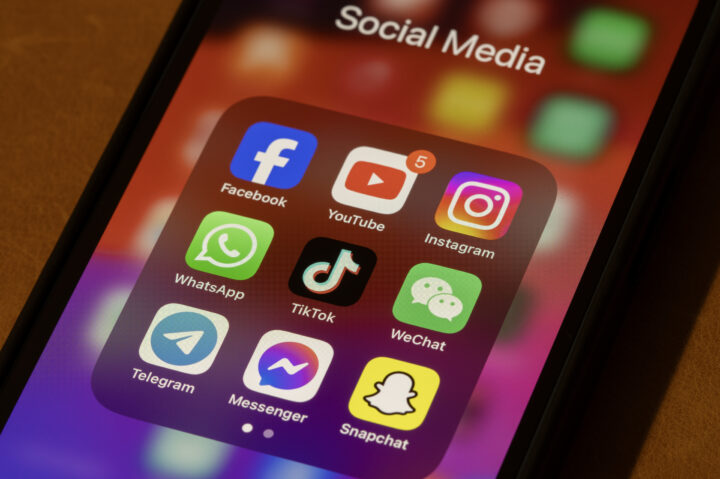
Some of the most popular social media apps by number of monthly active users, including Facebook, YouTube, Instagram, WhatsApp, TikTok, WeChat, Telegram, Messenger, and Snapchat, are seen on an iPhone.
A bipartisan group of House members introduced legislation on Monday that would require influencers to register under the Foreign Agents Registration Act when receiving payments from foreign governments for their work.
The Foreign Propaganda Disclosure Act comes amid suspicion and scrutiny, particularly among different online factions of the conservative movement, about foreign governments driving social media conversation, including accusations of Qatari, Turkish, Ukrainian and Israeli influence.
The bill is sponsored by Reps. Anna Paulina Luna (R-FL), Vicente Gonzalez (D-TX), Derrick Van Orden (R-WI) and Jared Moskowitz (D-FL).
It would explicitly add social media influencers to existing FARA registration requirements.
“There is a big difference between having an organic opinion and secretly acting on behalf of foreign interests to push propaganda to Americans,” Luna said in a statement. “Foreign adversaries have been actively using disinformation and psychological operations to divide America, erode our national security, and undermine U.S. foreign policy. Americans deserve to know when the voices shaping what they see online are working on behalf of foreign interests.”
She added that, “Americans should be able to know when the people shaping conversations online are acting on behalf of foreign interests.”
Gonzalez emphasized the need to update existing regulations to keep up with the changing nature of the internet.
“Federal law must adapt to an ever-changing digital media landscape, especially as more Americans turn to social media for news consumption and public discourse,” Gonzalez said. “Our bill increases public transparency around paid partnerships between social media influencers and foreign governments to prevent deceptive practices that may hinder audiences from building a fully informed opinion.”
Luna herself has faced scrutiny over her relationships with leaders in Russia and her efforts to promote diplomatic engagement with Moscow, as well as disseminating alleged KGB files on the assassination of former President John F. Kennedy, as well as her meetings with members of Germany’s far-right AfD party.
She has made various claims about foreign influence in Washington, including asserting recently that an impending FBI investigation would reveal that a foreign government had placed interns to serve as agents on Capitol Hill.
She has also questioned the loyalty of unnamed dual citizen members of Congress, and has at times called for the U.S. to end aid to Israel and other foreign countries..
The Network Contagion Research Institute found that DSA trips abroad coincided with increases in the group’s promotion of U.S. adversaries’ priorities
Spencer Platt/Getty Images
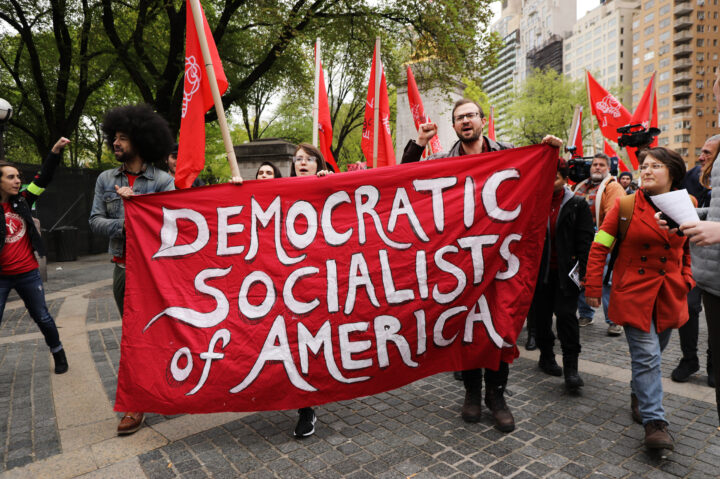
Members of the Democratic Socialists of America May 01, 2019 in New York City.
The Network Contagion Research Institute accused the Democratic Socialists of America, in a report released in late January, of activities that may run afoul of the Foreign Agents Registration Act — alleging that the far-left group may be acting as an unregistered agent of various U.S. adversaries.
The report points to foreign trips by DSA members to Venezuela, Cuba and China which have included access to top level officials and, the report alleges, lodging, transportation and other services provided by the host governments “that may constitute in-kind benefits from foreign government-linked entities” and “participation in quasi-official functions.”
The report claims that the DSA’s foreign engagements are followed by brief upticks in the group’s promotion of U.S. adversaries’ priority issues, such as removing sanctions on Cuba and Venezuela, “consistent with campaign-style political activity rather than incidental commentary.”
The NCRI alleges that the DSA’s “pattern of conduct across multiple countries raises material questions as to whether certain political activities were undertaken with foreign support, facilitation, or expectations of continued engagement.”
Noting that the DSA itself has stated its desire to create formal partnerships with foreign governments, the report suggests that a FARA investigation could look into “whether these stated partnership goals remained aspirational or were operationalized through material coordination, facilitation, or support, and whether any resulting activities required registration or remedial compliance.”
The report acknowledges that none of the activities described “conclusively establish that DSA or its members acted as agents of a foreign principal” but argues that the “pattern of conduct,” taken in sum, “meets the threshold for a good-faith FARA compliance inquiry.”
Adam Sohn, the co-founder of NCRI, is set to testify at a House Ways and Means Committee hearing on Tuesday on foreign influence in U.S. nonprofit organizations.
The former U.S. secretary of education wrote a column last year dismissive of the connection between Qatari money and antisemitism
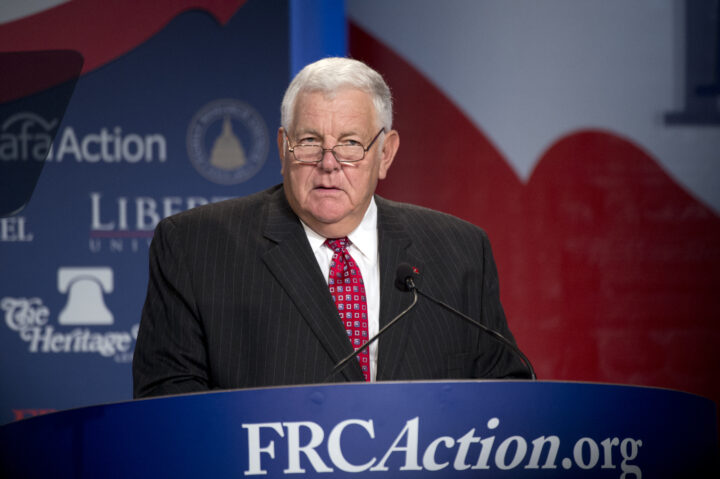
Tom Williams/CQ Roll Call
Bill Bennett, former education secretary, addresses the Values Voter Summit at the Omni Shoreham Hotel in Woodley Park on Sept. 14, 2012.
William Bennett, a former U.S. secretary of education under former President Ronald Reagan, registered in early July as an agent for Qatar, to advocate for the country on education-related issues.
The registration comes as Qatar works to fight back against growing concerns among the pro-Israel community and lawmakers on Capitol Hill that the country’s massive funding of elite U.S. colleges and universities is fueling anti-Israel and antisemitic ideology and activism on campuses.
Bennett, according to a Foreign Agents Registration Act filing first highlighted by analyst Eitan Fischberger, will receive a total of $210,000 over seven months to serve as a “senior education advisor” to the Qatari Embassy to “make efforts to publicize the fact that Qatari higher education efforts to do not support radical Islamicist movements or positions, and his engaging in publicized efforts — potentially including communications to U.S. political office holders — would help dispel contrary notions.”
“The purpose of this engagement is to provide [Bennett] with information relating to American universities offering curriculum in Qatar, to allow him to review and understand funding decisions made by the Qatari government relating to these schools, to promote Western understanding of the nature of these expenditures and the nature of the curriculum, and, most broadly, to promote economic and cultural understanding between Qatar and the United States,” the filing reads.
Bennett, after his time as education secretary, served as drug czar in the George H.W. Bush administration. Currently, he hosts a podcast, “The Bill Bennett Show,” and serves as the chairman of Conservative Leaders for Education, a group that describes itself as “a campaign comprised of leading state lawmakers and education chairs focused on ensuring conservative principles gain traction in state policy decisions as states begin to develop accountability plans under the new Every Student Succeeds Act.”
Bennett did not respond to a request for comment submitted through Conservative Leaders for Education.
The Qatari government pays millions to a vast army of lobbyists to advocate for its interests in Washington.
Bennett wrote in a Fox News op-ed last year, also first highlighted by Fischberger, that claims that Qatari or other foreign funding are connected to antisemitic activity on college campuses are “unfounded, conspiratorial speculation,” and downplayed the scope of Qatar’s involvement in U.S. higher education.
He praised Qatari Sheikah Moza Bint Nasser, the mother of Qatar’s emir who is an outspoken opponent of Israel and has praised the mastermind of the Oct. 7, 2023 Hamas attacks on Israel, as “an impressive Qatari woman.”
“The irony of the false accusations about Qatar’s supposed influence at American universities is that the real foreign influence runs in the opposite direction,” Bennett wrote. “At the Qatari branches of these six American universities there have been no reports of anti-American or antisemitic protests. Some of the main campuses of American universities could learn from their Qatari branches. That would be a better course and a wiser one than denigrating Qatar as it seeks to strengthen its relationship with the United States.”
Recent reporting from the Free Press’ Jay Solomon and Frannie Block concluded that free speech and academic freedom of any kind are suppressed at Qatari campuses of U.S. universities under Qatari law, and that their students have promoted terrorism.
The Free Press also reported that Bennett received two calls from a top Qatari lobbyist days before that op-ed was published.
Bennett has spoken out in the past against antisemitic activity on college campuses, calling it “shameful” that college administrations have failed to adequately respond to antisemitic activity, saying the anti-Israel agitators should be arrested and identified and that colleges should not appease them.
He said that federal funding should be withheld from colleges in response to anti-Israel activity.
Please log in if you already have a subscription, or subscribe to access the latest updates.
 Continue with Google

 Continue with Apple