














































































Asked at a press conference on Wednesday if he intends for the body to replace the U.N., Trump said it ‘might’
KARIM JAAFAR/AFP via Getty Images
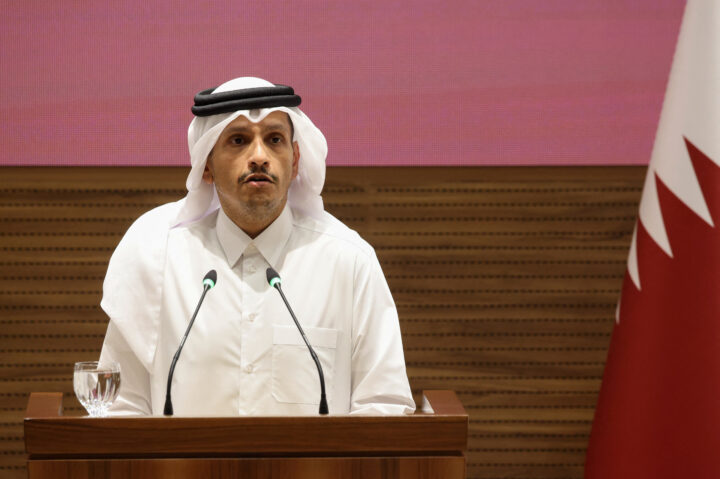
Qatar's Prime Minister and Minister of Foreign Affairs Sheikh Mohammed bin Abdulrahman Al-Thani speaks during a press conference in Doha on April 27, 2025.


 Add JewishInsider on Google
Sheikh Mohammed bin Abdulrahman Al Thani, Qatar’s prime minister and foreign affairs minister, said on Tuesday that President Donald Trump’s proposed Board of Peace represents the only viable path forward for Gaza, confirming that Doha has been invited to join the initiative.
“Yes, we were invited to the board,” Al Thani said at the World Economic Forum in Davos, Switzerland. “We are happy to be a contributor to peace and stability in our region. There are a lot of challenges in the implementation, but we have no alternative paths to seek right now.”
Al Thani emphasized that any participating countries would need to “work hard” to ensure the board functions effectively and serves as a stabilizing force.
“President Trump has proposed this path to move forward. We have a lot of work to be done,” said Al Thani. “I think that the most important thing right now is to ensure that Gaza is stabilized and we ensure that the withdrawal of the Israeli forces happens as soon as possible, and ensure that the people can get their life back as soon as possible. That should be the key focus for the Board of Peace.”
Trump has invited a range of countries to join the board, including the U.K., Canada, France and Jordan, as well as China and Russia. As of Wednesday, confirmed participants included Israel, Kosovo, Azerbaijan, Argentina, Hungary, Kazakhstan, Morocco, Belarus, Bahrain and the United Arab Emirates.
Under Trump’s 20-point Gaza peace plan, the board was initially created to oversee post-Hamas governance in Gaza and supervise a committee of Palestinian technocrats. However, the group’s new charter does not mention Gaza or the United Nations. Critics have argued that the board’s expanded mandate, along with Trump’s ramped up criticism of the U.N., are signs the group could evolve into a larger international authority intended to rival or sideline existing institutions.
Asked at a press conference on Wednesday if he intends for the body to replace the U.N., Trump said it “might.” “Wish the United Nations could do more, wish we didn’t need a Board of Peace,” he said.
Al Thani also addressed rising tensions with Iran, urging regional leaders to remain “cool-headed” and “resort to wisdom” amid the unrest inside the country in recent weeks. Earlier this month, Israel and regional partners watched closely as the Trump administration weighed — and ultimately held off on — military strikes in response to Tehran’s crackdown on protesters, which Trump had described as a red line.
While the president has not specified what steps the U.S. may take next, reports have indicated that Israel and Arab states, including Qatar, conveyed concerns about military action. Asked whether Doha had clashed with Washington over the issue, Al Thani suggested otherwise.
“We didn’t argue with the Americans,” he said. “What we offer, as a partner and as an ally of the United States, is honest advice that the best way forward is to find a diplomatic solution.”
Al Thani said Qatar and the U.S. remain in “continuous dialogue,” but reiterated Doha’s opposition to military escalation, even as a means of addressing Iran’s nuclear ambitions.
“We don’t want to see military escalation in our region,” said Al Thani. “We always believe that there is a room for diplomacy, and that’s been our approach in the State of Qatar, and we will always keep advocating for peaceful resolution. We need to understand that any escalation will have consequences.”
A Trump administration source characterized Netanyahu's statement to JI as a minor issue that would likely be smoothed out within days
Taylor Hill/Getty Images
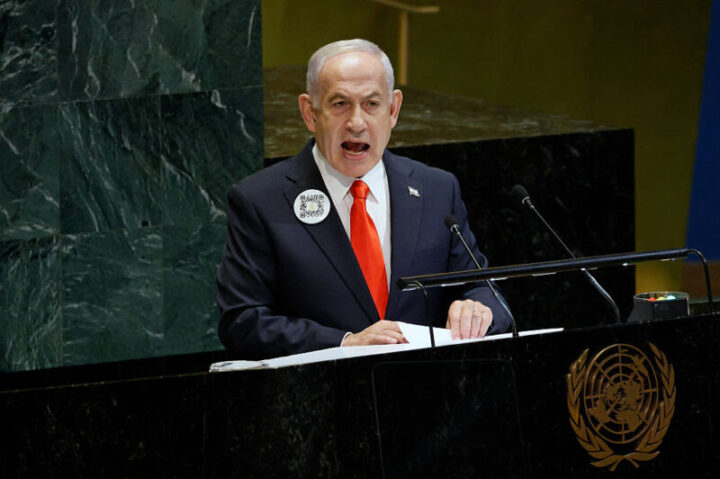
Prime Minister of Israel Benjamin Netanyahu speaks during the 80th session of the UN’s General Assembly (UNGA) at the United Nations headquarters on September 26, 2025 in New York City.
Israeli Prime Minister Benjamin Netanyahu opposes the composition of the executive board meant to oversee the rebuilding of Gaza, his office said on Saturday.
“The announcement regarding the composition of the Gaza Executive Board, which is subordinate to the Board of Peace, was not coordinated with Israel and runs contrary to its policy,” the Prime Minister’s Office stated. “The Prime Minister has instructed the Foreign Affairs Minister to contact the U.S. Secretary of State on this matter.”
Netanyahu emphasized his objection in a speech to the Knesset on Monday, saying that “there will be no Turkish or Qatari soldiers in Gaza. We are currently in a dispute with the U.S. over the makeup of the advisory council for Gaza.”
Though Netanyahu said the board was not coordinated with Israel, he spoke with President Donald Trump twice in recent days, and Mossad Chief David Barnea met with White House Special Envoy Steve Witkoff on Friday. The calls and meetings were reportedly about Iran.
The White House announced on Friday that several committees to govern Gaza and oversee its reconstruction and administration had been formed, including the Gaza Executive Board.
The Gaza Executive Board is meant to support the office of the high representative for Gaza and the National Committee for the Administration of Gaza, which is made up of Palestinian technocrats. It includes Witkoff, Jared Kushner, former U.K. Prime Minister U.K. Tony Blair, Apollo Global Management CEO Marc Rowan, Israeli-Cypriot businessman Yakir Gabay, head of Egyptian intelligence General Hassan Rashad, UAE Minister for International Cooperation Reem Al-Hashimy, U.N. Special Coordinator for the Middle East Peace Process Sigrid Kaag, and the previous holder of that position, Nickolay Mladenov, who will serve as the high representative for Gaza.
The board also includes Turkish Foreign Minister Hakan Fidan and Qatari diplomat Ali Al-Thawadi. Israeli officials have previously spoken out against Turkish involvement in Gaza’s reconstruction. Qatar has funded Gaza reconstruction in the past, with significant funding and dual-use materials reaching Hamas; the terrorist group’s leaders have also resided in Doha.
A Trump administration source characterized Netanyahu’s statement to Jewish Insider as a minor issue that would likely be smoothed out within days.
The source noted that Turkish and Qatari representatives were key to negotiating the ceasefire in Gaza, which took effect in October, and that they call Witkoff and Kushner daily, and therefore have an influence on the process regardless of the titles they are given. He also added that Netanyahu has a direct line to Trump.
“It’s all based on whether Hamas demilitarizes or not,” he added. “If Hamas demilitarizes, that is what’s most important [above the composition of the board]. If Hamas doesn’t demilitarize, none of this matters. … The prime minister has a commitment from the president that Hamas will demilitarize.”
Israeli Opposition Leader Yair Lapid said that “Netanyahu is allowing Turkey and Qatar into Gaza. That endangers Israel’s security. That is not what our brave soldiers fought for for two years.
“Instead of releasing panicky statements of protest, Israel should offer a clear alternative, for Egypt to administer Gaza for the next 15 years, for Hamas to be disarmed, and work with American partners to strengthen Israel’s border,” Lapid added.
Israeli National Security Minister Itamar Ben-Gvir said that he supports Netanyahu’s “important message.”
“Gaza does not need an ‘executive board’ that will supervise its ‘rehabilitation,’ it needs to be cleaned of Hamas terrorists who should be destroyed, along with encouraging massive voluntary emigration, in accordance with President Trump’s original plan,” Ben-Gvir said. “I call on the prime minister to instruct the IDF to prepare to go back to war in Gaza using great force in order to achieve the central goal of the war, the destruction of Hamas.”
The White House also announced the members of the founding executive board of the Trump-chaired Board of Peace, whose purview is not limited to Gaza. Netanyahu told the Knesset on Monday that the board is meant to serve as an alternative to the United Nations, 66 of whose organizations the U.S. left earlier this month. The board is composed of Secretary of State Marc Rubio, Witkoff, Kushner, Blair, Rowan, World Bank President Ajay Banga and Deputy National Security Advisor Robert Gabriel.
Canadian Prime Minister Mark Carney and Argentinian President Javier Milei also accepted invitations from Trump to join the board, while Egyptian President Abdel Fattah al-Sissi and Turkish President Recep Tayyip Erdogan had yet to respond. French President Emmanuel Macron declined to join. Netanyahu was invited to join or send an Israeli representative, according to Ynet. Russian President Vladimir Putin was invited, as was President Alyaksandr Lukashenka of Belarus; Ukrainian President Volodymyr Zelensky received an invitation on Tuesday, Ukrainian Ambassador to Israel Yevgen Kornichuk told JI. China, Germany, Australia, Albania, Jordan, Egypt and Bahrain reportedly received invitations, as well.
Membership on the Board of Peace is for three years; Trump asked countries to pay $1 billion for a permanent seat, Bloomberg reported.
Trump appointed Aryeh Lightstone and Josh Gruenbaum, members of Witkoff’s team, to be special advisors to the Board of Peace, “leading day-to-day strategy and operations, and translating the Board’s mandate and diplomatic priorities into disciplined execution,” the White House stated.
Please log in if you already have a subscription, or subscribe to access the latest updates.
 Continue with Google

 Continue with Apple