













































































The terror group has reportedly rejected a Board of Peace proposal to disarm
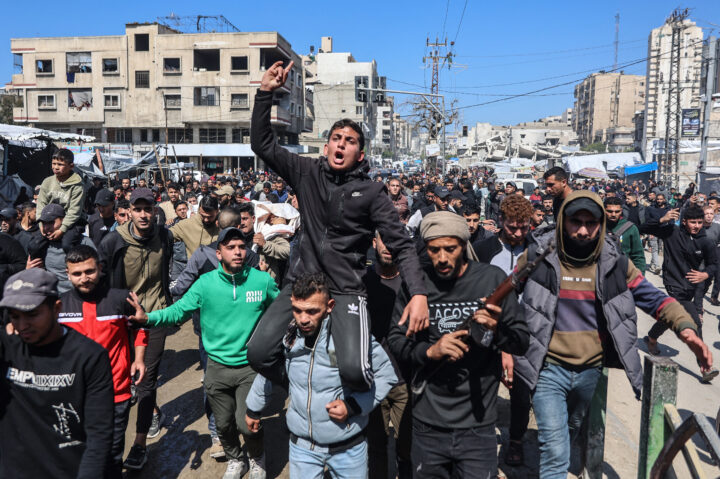
Omar AL-QATTAA / AFP via Getty Images
Mourners react at a funeral in Gaza City's Shujaiya neighbourhood on March 28, 2026.


 Add JewishInsider on Google
As Hamas reportedly continues to reject the U.S.-led Board of Peace’s disarmament framework and fails to comply with key demilitarization deadlines, the future of the fragile Gaza peace process remains uncertain.
Disarming Hamas is a central pillar of President Donald Trump’s 20-point peace initiative, which secured the release of the remaining Israeli hostages and included a partial Israeli military withdrawal from eastern Gaza. Its second phase has hinged on Hamas laying down its arms — a step that is expected to pave the way for further IDF withdrawal from the enclave and a transition to governance by the 15-member National Committee for the Administration of Gaza, led by Ali Shaath and operating under the Board of Peace.
Last month, Nickolay Mladenov, the Board of Peace’s high representative for Gaza, presented a framework for demilitarization and set a deadline for the end of last week for Hamas to disarm. Reports indicate the group rejected the proposal, accusing Mladenov of bias toward Israel and blaming Jerusalem for not completely fulfilling its obligations under the first phase of the plan.
U.S. and Hamas negotiators held the first direct talks between the parties since the announcement of the Gaza ceasefire in October 2025 on Tuesday night, CNN reported. Senior U.S. advisor Aryeh Lightstone and Mladenov met with Khalil al-Hayaa, a chief Hamas negotiator, in Cairo, where Mladenov communicated that Hamas must accept the terms of the demilitarization agreement “or face a return to war.”
Former White House officials are split over the path forward and whether the Trump administration should escalate pressure on Hamas or stay the course.
Dan Shapiro, who served as U.S. ambassador to Israel under President Barack Obama and was appointed by then-President Joe Biden in 2021 to serve as special liaison to Israel on Iran, said Hamas is unlikely to disarm voluntarily, arguing the group would only do so “under duress.” One potential avenue, he said, would be renewed Israeli military action, though he emphasized that such a move would be both costly and unlikely.
“[Israeli military action] would come at an enormous price in civilian casualties, given Hamas’ embedded position within Gaza’s population,” Shapiro said, adding that it is “highly unlikely the Trump administration would lend its support to such an operation” and that it would deal “further blows to Israel’s international support.”
Instead, Shapiro pointed to regional pressure as a more viable path, particularly from Qatar and Turkey, which he said have previously used their leverage to influence Hamas.
“The other source of pressure on Hamas would be the threat of Qatar and Turkey to withdraw their political, financial and hosting support of the organization,” Shapiro said. “They were the parties who used their unique leverage with Hamas after the Israeli strike in Doha to convince Hamas to release all hostages. Trump should engage their leaders, as he did in that period, to convince them to use their leverage again, this time to pressure Hamas to disarm.”
However, Shapiro cautioned that the war in Iran has diverted U.S. attention and “may have reduced Trump’s ability to influence key regional leaders, like [Turkish President Recep Tayyip] Erdogan and the emir of Qatar, to take this necessary action on Hamas disarmament.”
Elliott Abrams, a former Iran envoy under the first Trump administration, similarly noted that Hamas “hasn’t changed its spots.” He said that Hamas leaders “obviously think a disarmed Hamas is a dying Hamas; without ‘armed struggle’ they believe they will disappear and become just another political party.”
“What Mladenov and the U.S. government need to figure out is what happens to the Board of Peace and to U.S. policy if Hamas won’t disarm,” Abrams said. “I think the answer is to prevent any arms and money from being smuggled into the half of Gaza that Hamas still controls, and to develop the half of Gaza under Israeli control.”
“No one seems to want to invade and conquer western Gaza, including the IDF,” Abrams added. “Perhaps over time, Gazans will begin migrating to the parts of Gaza where life can be lived without Hamas.”
Meanwhile, Alexander Gray, former chief of staff to the National Security Council during Trump’s first term, offered a more supportive view of the administration’s current strategy, calling it “realistic.”
“While we must continue to work with Israel to ensure Hamas is unable to wage war against our partners and allies and terrorize the region, we must also be realistic about the nature of the organization and its leadership,” Gray said. “The administration’s vision for a prosperous Gaza and secure Israel must continue apace, while appropriate and realistic steps are taken to prevent Hamas from acting true to its charter and perpetrating further death and destruction.”
To mark the second anniversary of the Oct. 7 attacks in Israel, the Jewish Insider team asked leading thinkers and practitioners to reflect on how that day has changed the world. Here, we look at how Oct. 7 changed the U.S.-Israel relationship

Adobe Stock
two flags: American and Israeli waving in the blue sky
The former envoy on Iran during the Trump administration joins JI's 'Limited Liability Podcast' this week

U.S. Department of State
Elliott Abrams
Elliott Abrams, the former special envoy on Iran and Venezuela during the Trump administration and a current fellow at the Council on Foreign Relations, joined Jewish Insider’s “Limited Liability Podcast” hosts Jarrod Bernstein and Rich Goldberg to discuss violence in Israel and negotiations with Iran.
Eye on Israel: “Is it Intifada 3.0? I don’t think so,” predicted Abrams of the current conflagration between Israel and Hamas in Gaza. “I think Hamas has gotten pretty much what it has wanted, and I don’t think that this will turn into another major war in Gaza. And I’m inclined to think things will quiet down a bit in Jerusalem as well.” Abrams suggested that Hamas is motivated at least in part by the cancellation of the Palestinian national elections by Palestinian Authority President Mahmoud Abbas last month. “Mahmoud Abbas cancels those Palestinian elections, and what does Hamas do to show, ‘Well, he’s doing nothing, but we’re here, we’re active, we’re leading the Palestinian people’?” Abrams asked. “They do what you see in the last few days in Israel. A lot of violent attacks.”
Regional turmoil: Abrams said that the violence in Israel puts the Arab countries that recently normalized relations with Israel via the Abraham Accords in a difficult situation. “It does put them in a tough spot,” he said. “And you’ve seen several of them make statements decrying the violence and asking Israel to make sure its police do not, any longer, go into East Jerusalem.” But he added that they ultimately want to see “Hamas defeated — so does Mahmoud Abbas and the PLO, the Palestinian Authority and Fatah leadership, whatever they say, because Hamas is their enemy.” The UAE, Bahrain and other nations are “judging Israel now. They’re wondering how are the Israelis going to handle this? Are they in a kind of crisis where they can’t make decisions? Are they unable to hit back the way they normally would? Is this going to be a defeat for the Israelis? If the Israelis come out of this looking weak, their attractiveness to the Arab governments as a friend is greatly diminished.”
Tehran talks: Abrams rejected the Biden administration’s suggestion that Trump’s “maximum pressure” campaign on Iran failed. “It clearly didn’t fail,” he said. “Our view was that had President Trump won the election, had we been able to face Iran with four more years of the same and actually increasing sanctions, they would have had to make a deal, because of the condition their economy is in right now.” Tehran didn’t make a deal, Abrams suggested, because they were waiting to see who won the 2020 presidential election. Abrams laid out four potential options on Iran: “A successful negotiation with Iran… giving up, finally, the path to a nuclear weapon”; regime change in Tehran; Iran attaining nuclear capability; and the possibility that “someone steps in militarily.” He added: “I don’t think it’s the JCPOA or war. I think it’s the JCPOA or a tougher, better policy.”
Kerry critic: “When you talk to European diplomats, which of course I did, you find that they had—I want to be careful with my language and be diplomatic here—minimum high regard for John Kerry’s negotiating skills. I mean, it’s pretty widely known that the French were near contemptuous of his negotiating skills. For one thing he desperately wanted to deal. That’s obvious. We all know that. So I don’t see any reason to believe that this was the only deal possible. As a matter of fact, if carried out his way, it would have been worse. It’s well known in the State Department that there were moments when Wendy Sherman, for example, or the French, were trying to pull him back from further concessions…it could have been worse.”
Lightning round: Favorite Yiddish word? “Machatunim.” Favorite Jewish food? “Pot roast with kasha varnishkes.” Book recommendation? A Savage War of Peace: Algeria 1954-1962 by Alistair Horne. Favorite boss in government? “It’s a toss-up for me between George Shultz and George W. Bush.”
Please log in if you already have a subscription, or subscribe to access the latest updates.
 Continue with Google

 Continue with Apple