














































































State Del. Adrian Boafo was backed by retiring Rep. Steny Hoyer and other state leaders and received more than $5.7 million in support from AIPAC’s super PAC
Tom Williams/CQ-Roll Call, Inc via Getty Images
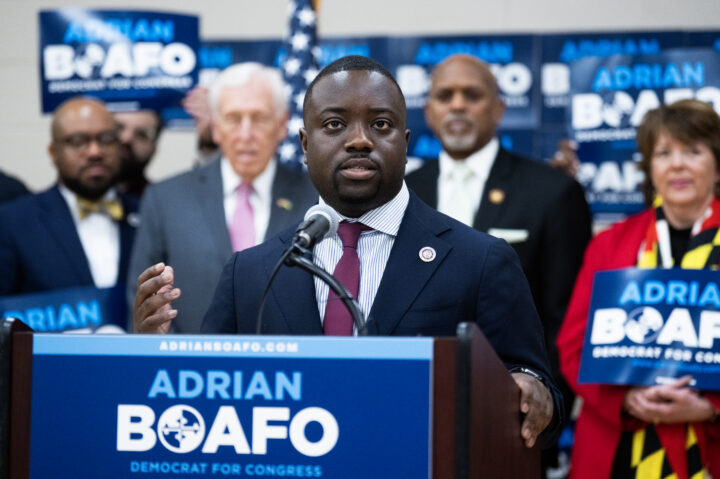
Del. Adrian Boafo, Democratic candidate for Maryland's Fifth Congressional District, speaks during a press conference to kick off a series of meet-the-voter events, at Kenhill Center in Bowie, Md., on Monday, March 2, 2026.


 Add JewishInsider on Google
Maryland state Del. Adrian Boafo prevailed on Tuesday in the crowded Democratic primary to replace retiring Rep. Steny Hoyer (D-MD), who endorsed him, marking a legacy-burnishing victory for the veteran congressman and his pro-Israel allies.
The Associated Press called the race after Boafo had secured 32% of the vote with about one-half of ballots counted Tuesday night. His nearest competitor, businesswoman Quincy Bareebe, lagged well behind with 19% of the vote.
Boafo’s win came after a forceful push by Hoyer, pro-Israel groups and establishment Democrats to help elevate the congressman’s hand-picked former campaign manager in a race that featured two dozen candidates vying to represent Maryland’s 5th Congressional District.
AIPAC’s super PAC, United Democracy Project, was the biggest spender in the race, investing more than $5.7 million on ads boosting Boafo, including one featuring Hoyer in a direct-to-camera appeal in the closing stretch of the primary. Boafo was also backed by Gov. Wes Moore and Sen. Angela Alsobrooks (D-MD), among others.
UDP’s involvement was a risk for the group, as well as a test of its influence, as it has faced scrutiny from Democrats over its engagement in recent primaries. But the super PAC’s support for Boafo demonstrated that it could still play a significant role in Democratic races, even as its brand has become toxic to a growing number of Democrats.
The group’s spending drew criticism in Maryland, most notably from Sen. Chris Van Hollen (D-MD), who accused AIPAC and crypto-aligned interests in the race of “trying to buy” the seat. But Van Hollen did not make an endorsement in the race as the left failed to unite behind one candidate.
In the final days of the race, three other Democratic contenders — Capitol Police officer Harry Dunn, former Prince George’s County Executive Rushern Baker and Bareebe — teamed up to decry the flood of outside spending that shaped the race. Barebee came in second on Tuesday, while Dunn came in third.
Their pushback was not enough to thwart Hoyer’s choice for the nomination in a moderate district that has been amenable to the congressman’s close ties to AIPAC. Boafo, 32, was also endorsed by Democratic Majority for Israel’s super PAC, which is led by Brian Romick, a former senior aide to Hoyer, who is retiring after 45 years in the House.
In a statement to social media, AIPAC said that Boafo’s victory had “made clear his vision to carry forward the strong pro-Israel legacy of Rep. Steny Hoyer, one of Congress’s most steadfast champions of the U.S.-Israel relationship.”
“United Democracy Project was proud to support Boafo and help ensure this seat remains represented by pro-Israel leadership,” AIPAC added.
Jewish organizations across the political spectrum question whether the deal will curb Iran’s nuclear program or its support for regional proxies
Tom Williams/CQ-Roll Call, Inc via Getty Images
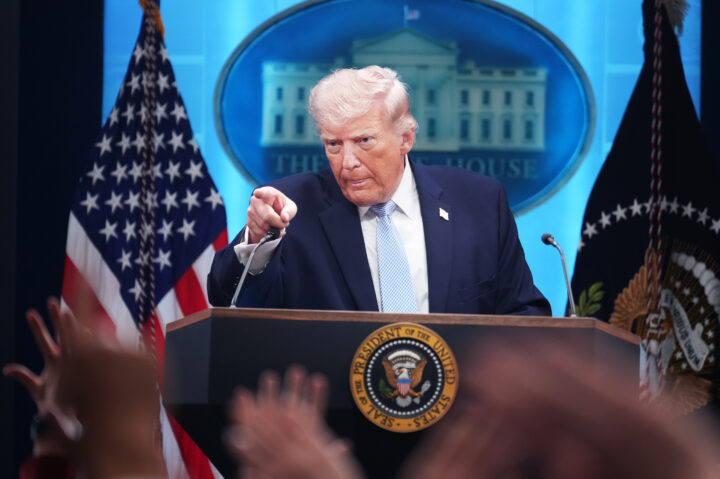
President Donald Trump conducts a news conference in the White House briefing room about the war in Iran on Monday, April 6, 2026.
As details begin to emerge about the Trump administration’s agreement with Iran to end the war and lift the U.S. blockade of the Strait of Hormuz, some mainstream Jewish organizations are treating the deal as a preliminary step — focusing on the 60-day negotiating period ahead, while others are expressing skepticism about the contours of the agreement.
AIPAC, in a statement that came late Monday afternoon after many other organizations had already spoken out, framed the current MOU as a preliminary step, focusing more on the upcoming negotiations, while emphasizing the need for more details about how the current deal affects Israel.
“The announced MOU kicks off a new 60-day window for talks. We look forward to learning the full details of the framework for these negotiations, including whether the deal preserves the sovereign right of our democratic ally Israel to respond to the security threats it confronts,” AIPAC said in a statement.
The group also emphasized that “Congress will play a critical role in working with the administration throughout these negotiations and in reviewing the ultimate agreement.”
It said any deal should require the removal of all enriched uranium from Iran, the dismantling of its enrichment capacity and should address Iran’s missile and drone programs and end its support for terrorist proxies.
The American Jewish Committee also did not take a definitive position on the current agreement, saying on X that the organization “await[s] developments about the reported 60-day ceasefire agreement” but emphasized the need to continue to focus on Iran’s long-running threats.
The AJC said that any ultimate deal with Iran at the conclusion of the upcoming 60-day negotiating period should ensure Iran cannot obtain a nuclear weapon, rebuild its ballistic missile program, continue to support terror proxies, threaten U.S. allies and partners or hold the Strait of Hormuz hostage.
“AJC also strongly supports the legitimate aspirations of the Iranian people for greater freedom, opportunity and dignity, and hopes that those aspirations are eventually realized,” the statement continued. “As the contours of this and future agreements become more clear, we will continue to engage with our partners in the U.S., the Middle East, and around the world to make this vision a reality.”
Other groups offered a more directly negative reaction to the emerging details of the MOU.
The Zionist Organization of America, which has been strongly supportive of Trump administration policies and President Donald Trump himself, praised the president for carrying out military operations against Iran but said that “the pending deal with Iran is concerning.”
“The deal appears to be an ‘agreement to negotiate’ — which enables the Iranian regime to obtain massive oil revenue and time to build up its military and terror arsenals, while leaving the genocidal Iranian regime and its nuclear and missile stockpiles in place, and positioning the Iranian regime to continue and strengthen its 47-year war to destroy the U.S., Israel, and the West,” ZOA National President Mort Klein said. “[T]he little that we know is deeply problematic.”
Klein said it “makes no sense” for the U.S. to let up on its blockade of Iran unless Iran fully gives up its nuclear program and missile stockpile. He also expressed concerns that the deal will allow Hezbollah to regroup and rearm, and that Trump demanded that Israel stand down against Hezbollah.
“Pressuring Israel to not respond to threats of annihilation and attacks on her people is not, as the president called it, a ‘Great Deal [that] will bring Peace and Security to the whole Region,’” Klein said.
“Disturbingly, the interim Iran deal does not appear to be even close to the U.S.-Israel war goals of eliminating the existential dangers of Iran’s nuclear program and ballistic missiles, ending the Iranian regime’s support for its terror proxies, and helping the Iranian people overturn the brutal, genocidal Iranian regime,” he continued.
Democratic groups are also skeptical.
Democratic Majority for Israel CEO Brian Romick criticized the administration’s “incoherent and erratic strategy” and said that “there are concerning details about what is and isn’t in this deal.” Romick called on the administration to lean on “experienced negotiators and technical experts” in the next phases of talks, “rather than relying on friends, family, and donors.”
He said that any deal must permanently end Iran’s nuclear program, constrain its ballistic missiles, address Iran’s support for terrorism and ensure that the Islamic Revolutionary Guard Corps and Iran’s terrorist proxies do not receive additional support as a result of sanctions relief or the unfreezing of assets, and that it must be thoroughly vetted by Congress.
“Despite this tentative deal, the reality is Israel still faces constant threats from Iranian-backed terrorist groups like Hamas and Hezbollah. President Trump must not limit or interfere with our ally’s ability to defend itself from very real threats along its border,” Romick continued.
The Jewish Democratic Council of America’s CEO Halie Soifer took an even more strident tone.
“Donald Trump’s deal with Iran isn’t a deal at all. At best, it’s a statement of intention — a ‘concept of a plan’ — lacking details. At worst, it’s an admission of defeat by the United States,” Soifer said, describing it as a weaker deal than the 2015 Joint Comprehensive Plan of Action.
She argued that the “reckless war” gave Iran a “chokehold” on the U.S. and global economy that it will continue to exercise in the future, gave Iran a stronger hand in nuclear negotiations, solidified the current regime, harmed the Iranian people and gained the U.S. nothing.
“Today, Iran is unquestionably further from regime change — and this Iranian regime is stronger — than before the war,” Soifer said. “Trump repeatedly berated the Obama administration for offering sanctions relief and unfreezing Iranian assets as part of the JCPOA. The amount of financial benefit Iran received from the JCPOA will be dwarfed by the amount of money going to Iran following Trump’s defeat.”
Soifer also criticized Trump for sidelining and ignoring Israel throughout the talks.
J Street has thus far been an outlier in expressing support for the deal.
The group’s president, Jeremy Ben-Ami, said J Street “welcomes” the announcement, while also criticizing the war effort as a whole.
“The lesson is the same one many experts and former security officials have warned about for years: There is no sustainable military solution to the challenge posed by Iran’s nuclear diplomacy,” Ben-Ami said. “Durable constraints on Iran’s nuclear activities can only be achieved through pragmatic and sustained diplomacy.”
Ben-Ami argued that the deal would be largely similar to the JCPOA, adding, “We urge lawmakers to support this agreement to end the fighting and push to ensure future diplomatic efforts address the security threats presented by Iran.”
The Republican Jewish Coalition has not issued a full statement of its own on the deal, but has indicated support thus far, sharing on its X account two Truth Social posts from Trump about the Strait of Hormuz being reopened and the lifting of the U.S. blockade. RJC did not immediately respond to a request for comment.
Please log in if you already have a subscription, or subscribe to access the latest updates.
 Continue with Google

 Continue with Apple