














































































Israeli Ambassador Yechiel Leiter said the two sides are working to ensure Hezbollah's permanent removal from the border area, warning fighters who remain will ‘know exactly what's coming.’
Oliver Contreras/AFP via Getty Images
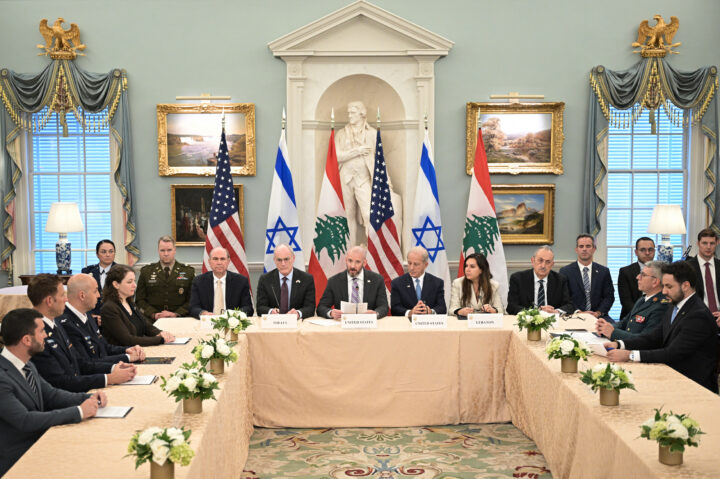
Israeli Ambassador to the US Yechiel Leiter, State Department Chief of Staff Daniel Holler, US Ambassador to Lebanon Michel Issa and Lebanese Ambassador to the US Nada Hamadeh attend a meeting between Israeli and Lebanese delegations hosted by the United States at the State Department in Washington, DC, on June 3, 2026.


 Add JewishInsider on Google
Israel and Lebanon agreed on Wednesday to extend their ceasefire — which in practice has been tenuous — on the condition that Hezbollah disarms and withdraws from Israel’s northern border, and to jointly establish “pilot zones” where the Lebanese Armed Forces “will take exclusive control of the territory.”
The parties, together with the U.S., announced the developments in a joint statement at the conclusion of the second and final day of the fourth round of peace talks between Israeli and Lebanese officials at the State Department.
State Department Counselor Dan Holler, Israeli Ambassador to the U.S. Yechiel Leiter, Lebanese Ambassador to the U.S. Nada Hamadah, U.S. Ambassador to Lebanon Michel Issa and several U.S. military representatives participated in Wednesday’s talks. The group will reconvene for the next round of talks the week of June 22 “with a view toward reaching a comprehensive agreement,” the statement said. A State Department official told JI that the exact time and venue for the upcoming discussions have not yet been decided.
Speaking to reporters in Foggy Bottom, Leiter touted Wednesday’s agreement as a “relatively unprecedented” achievement.
“Israel entered Lebanon after Hezbollah decided to join the war of Iran against Israel, and we’re pushing Hezbollah back. We’ve brought the people of Lebanon to the understanding that we’re not the enemy, Hezbollah is,” Leiter said in response to a question from Jewish Insider. “Now, we’re going to work together to rid the country of this Iranian proxy on Israel’s border, which deprives Israel of its security and the Lebanese people of their freedom.”
On the creation of the “pilot zones,” Leiter said the effort “will be guided by the United States. Special units in the Lebanese army will take control of various areas and gradually spread out throughout the south, so we don’t go into another pattern where Israel leaves, Hezbollah comes back and we go through the same thing from the last 40 years.”
Leiter also noted that Israel would allow Hezbollah terrorists to evacuate from southern Lebanon to the country’s north for a brief, unspecified period of time.
“The first step is that the Hezbollah fighters, these terrorists who have come down to the south, have to go back to the north. They came down recently. We’re talking about some 2,000-plus terrorists,” the Israeli ambassador said. “So we’re going to see them go back to the north. We will guarantee them safe passage as long as they leave, but after a certain amount of time, which is not very long, if they don’t make their way back to the north, then they know exactly what’s coming, and Lebanon understands what’s coming.”
Asked by JI what Israel believes President Donald Trump’s red line is when it comes to their ability to go after Hezbollah in Beirut or elsewhere in Lebanon, Leiter said that Trump, Israeli Prime Minister Benjamin Netanyahu and Lebanese President Joseph Aoun are in agreement about Israel’s right to respond to attacks from the Lebanese terrorist group.
“If Hezbollah is intent on disrupting the ceasefire, the result is going to be on them, and that’s something that President Trump, Prime Minister Netanyahu and President Aoun have made very clear,” Leiter said. “We are together on this agenda to see to it that Iran is not to be allowed any longer to facilitate violence against Lebanon, against Israel through Hezbollah.”
The Israeli ambassador credited the Lebanese government for “trying for several weeks now to get Hezbollah to stop firing” at Israel and “to assert within Lebanon that there is a legitimate government, they are in control and Iran doesn’t control Lebanon.”
Leiter dismissed the suggestion that Trump and Netanyahu’s tense phone call on Monday, during which the president referred to the Israeli prime minister as “f***ing crazy” over Israel’s military escalation in Lebanon, impacted the outcome of this week’s talks or indicated a split between the two on the security concerns posed by Hezbollah.
“Prime Minister Netanyahu and President Trump have met seven times over the past year, more than any other foreign leader, and President Trump visited Jerusalem. They’ve spoken on the phone about 60 times, so we’re talking about hours and hours and hours of conversation,” Leiter said. “Taking out one ‘bleep’ from all those conversations and making that the hallmark of their relationship is a mistake. Lovers have spats. They may have had a little lovers’ spat this week, that’s OK.”
“When we’re so close, we’re going to have conversations that sometimes are heated, but the bottom line is that America, Israel, Lebanon are united on keeping Iran out of the equation. That’s the most important thing,” he continued.
The vice president’s comments echo a warning from President Donald Trump that the terror group would face ‘elimination’ if it doesn’t abide by the terms of the ceasefire agreement
FADEL SENNA/AFP via Getty Images
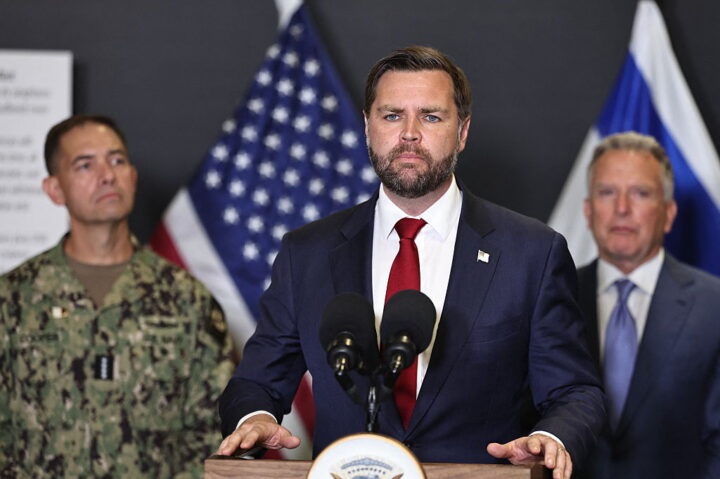
Vice President JD Vance listens to a question during a press conference following a military briefing at the Civilian Military Coordination Center in southern Israel on October 21, 2025.
Visiting the new U.S.-run Civilian Military Cooperation Center in southern Israel, Vice President JD Vance said on Tuesday that he is “very optimistic” about the advancement of the peace plan, but warned that Hamas must disarm and cooperate with international interlocutors, or else it would be “obliterated.”
The vice president’s comments came shortly after President Donald Trump, in a post on his Truth Social site, threatened Hamas with “elimination” should the terror group continue to carry out violence in Gaza and violate the terms of the peace deal.
“Numerous of our NOW GREAT ALLIES in the Middle East … have explicitly and strongly, with great enthusiasm, informed me that they would welcome the opportunity, at my request, to go into GAZA with a heavy force and ‘straighten out Hamas’ if Hamas continues to act badly, in violation of their agreement with us,” Trump wrote. “There is still hope that Hamas will do what is right. If they do not, an end to Hamas will be FAST, FURIOUS, & BRUTAL!”
The president’s statement, which came hours after Vance touched down in Israel in part to keep the deal on track, underscored his growing impatience and frustration with the terrorist group.
“Hamas has to disarm,” Vance said. “They’re not going to be able to kill their fellow Palestinians. … If Hamas doesn’t cooperate, as the president of the United States said, Hamas will be obliterated.”
“But I’m not going to do what the president of the United States has thus far refused to do, which is put an explicit deadline on it,” the vice president continued, “because a lot of this stuff is difficult … In order for us to give it a chance to succeed, we’ve got to be a little bit flexible.”
Asked about Turkish troops entering Gaza despite the country’s hostility to Israel, Vance said that Israel will have to agree to any foreign troops on the ground. “We’re not going to force anything on our Israeli friends when it comes to foreign troops on their soil, but I think there’s a constructive role for the Turks to play,” he said. “They already played a constructive role.”
As for reconstruction of Gaza, Jared Kushner, who has played a central role in negotiating the end of the war, said that “no reconstruction funds will be going to areas Hamas still controls. … There are considerations in the area the IDF controls to start reconstruction of a new Gaza, in order to give the Palestinians in Gaza a place to go, a place to get jobs, a place to live.”
Vance said that the eventual governing structure of Gaza is still undetermined, as the plan focuses on getting “to a point where both Gazans and our Israeli friends have some measure of security.” After that, he added, “we’ll worry about long term governance.”
“Let’s worry about security, give people food and medicine,” he said.
Vance said that the CMCC’s focus is on repatriating the bodies of the 15 remaining Israeli hostages, but that “it’s not going to happen overnight.”
The administration’s push for Hamas’ disarmament is expected to face hurdles. “On the one hand, Hamas wants to avoid losing the sympathy of Turkey and Qatar and wants to avoid wasting Egypt’s desire for a political settlement that creates Palestinian unity with Hamas support,” said Rob Satloff, executive director at The Washington Institute for Near East Policy. “On the other hand, it is clear that Hamas has no intention of voluntarily giving up the battle against Israel, let alone voluntarily disarming.”
But while Trump threatened that “many countries” will get involved, other nations have been reluctant to send in reinforcements, despite talks of forming an International Stabilization Force, as laid out in the unfinalized second phase of the peace deal.
At the CMCC facility on Tuesday, the vice president noted that the force is still in the process of being formed, but said no American troops will be on the ground in the enclave. There are about 200 U.S. servicemembers at the CMCC in Kiryat Gat, Israel, tasked with coordinating the effort.
Trump himself emphasized that the U.S. will not send troops into Gaza, telling reporters at the White House on Monday that “Israel would go in in two minutes if I asked them to go in … But right now we haven’t said that.”
“Many countries are hesitant to send troops to serve as peacekeepers,” said David May, a senior research analyst at the Foundation for Defense of Democracies. “So, it will be very difficult to find a country able and willing to strike Hamas as punishment.”
Even if Trump is able to get other countries on board to take a more involved role in defanging Hamas in Gaza, May said more firepower does not always mean better results.
“There’s a certain value in threats and provocative language, especially from an unpredictable president,” said May. “But striking Hamas and not killing civilians requires surgical precision — something the Israelis excel in — not the overwhelming force that the United States alone possesses. [At the same time,] Hamas’ violations are mounting, and the terrorist group cannot be allowed to retake Gaza and execute its potential replacements.”
May said a return to fighting would sink any possibility of the current deal developing into full-fledged peace. The Trump administration has sought to avoid a return to hostilities and build on the momentum from phase one. Experts warned the administration is in a precarious position, balancing between keeping the president’s deal stable and preventing Hamas from reasserting power.
“The Trump administration is trying to navigate between these poles,” said Satloff. “Taking advantage of political pressure while avoiding a showdown with Hamas without the Arab, Muslim or international troops to back it up, all the while trying to avoid a collapse of relapse into full-scale Hamas-Israel war that would undermine the president’s great diplomatic achievement.”
The vice president also spoke of the significance of Israel to him as a Christian, sharing plans to visit the Church of the Holy Sepulcher. “I pray that the Prince of Peace,” he said, using a name for Jesus,” can continue to work a miracle in this part of the world.”
Please log in if you already have a subscription, or subscribe to access the latest updates.
 Continue with Google

 Continue with Apple