









































Most analysts agreed that the British sanctions against Israeli settlements were imposed as a result of pressure from Labour’s left-wing base
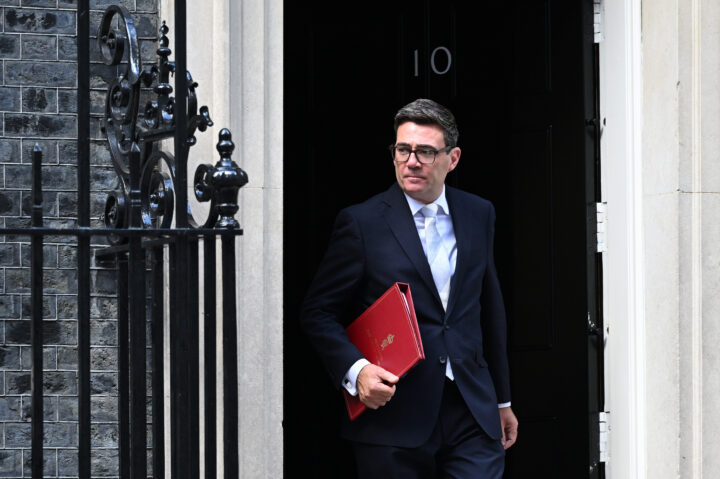
Leon Neal/Getty Images
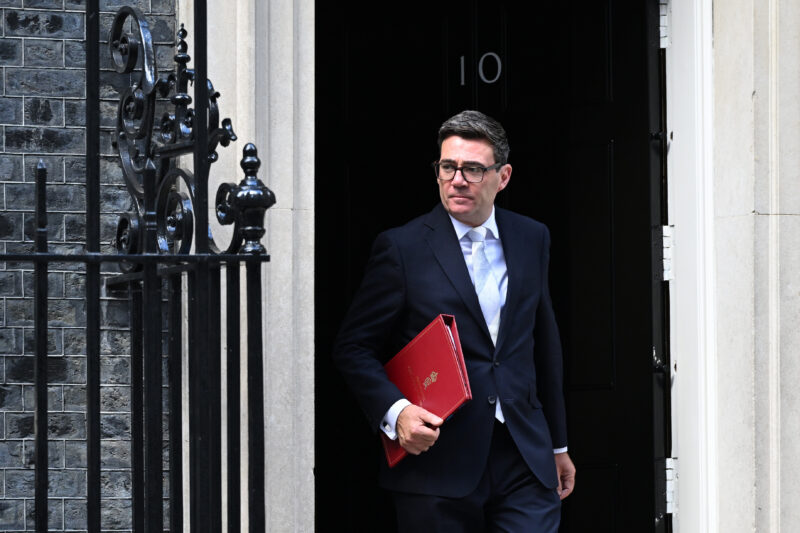
Prime Minister Andy Burnham departs 10 Downing Street to address the House of Commons on Sept. 1, 2026 in London, England.


 Add JewishInsider on Google
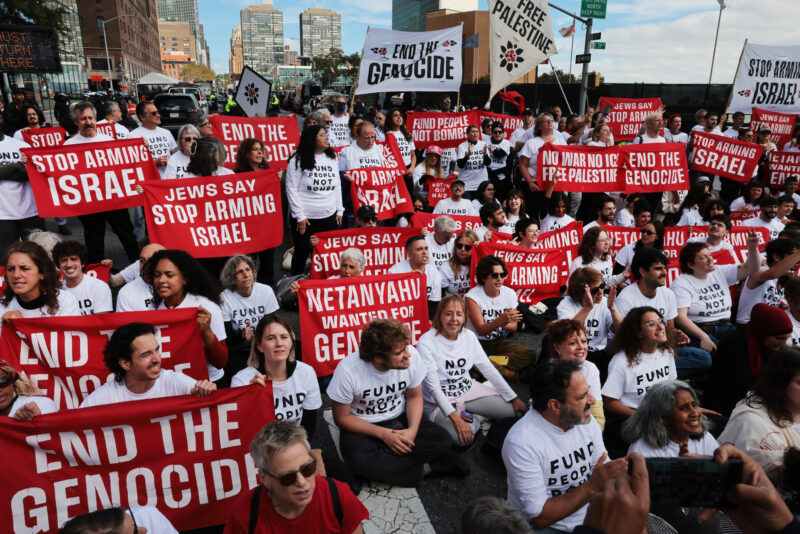
Former White House officials and diplomats say the U.K. government’s decision to slap sweeping new sanctions on Israeli West Bank settlements is primarily a bid to appease far-left political factions in Britain, warning that while the move is unlikely to alter Israeli behavior on the ground, it risks increasing diplomatic friction between London, Jerusalem and Washington.
On Tuesday, U.K. Foreign Secretary Ed Miliband announced the U.K. would institute an import ban on goods produced in settlements, targeted sanctions against individuals and corporate entities involved in constructing, advertising or financing settlement expansion and a ban on events held in the U.K. that promote West Bank real estate.
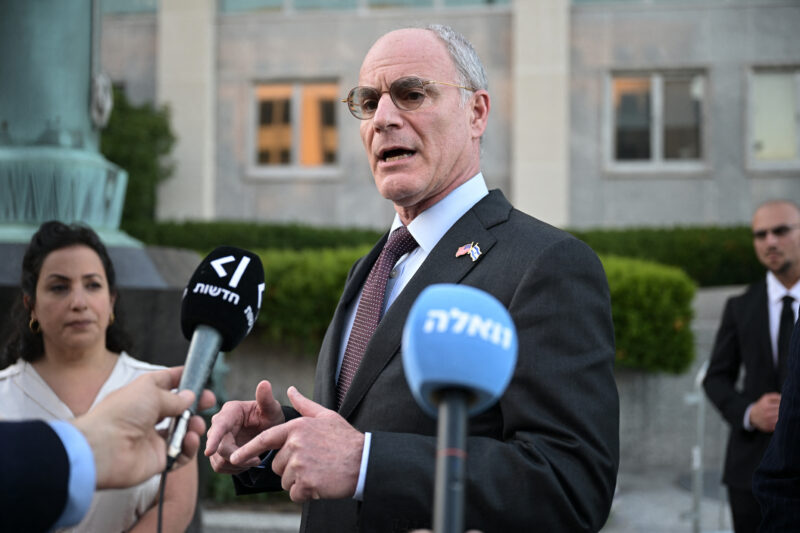
Israeli Foreign Minister Gideon Sa’ar denounced the step as a “hostile sanctions package” and announced that Israel in response would close the British Consulate in Jerusalem, expel British representatives from the U.S.-backed International Gaza Support Center, terminate the British Support Team in Ramallah tasked with training Palestinian Authority Security Forces and bar 12 British officials, including MP Jeremy Corbyn, accused of “antisemitic and anti-Israel activity.”
While the U.S. has not issued an official response, Secretary of State Marco Rubio indicated that Washington will not follow suit, though he refrained from offering explicit condemnation of London’s new policy.
Experts told Jewish Insider that London’s move was predictable given global sentiment toward Israeli settlements, though it’s unlikely to shift Israeli policy. Analysts argued the decision was primarily driven by U.K. domestic politics and warned it could strain relations between Washington and London.
“The poor timing of the U.K. action — days before the Jewish holy days and a few weeks before Israel’s election — shows that this move is largely a matter of British domestic politics,” Elliott Abrams, former U.S. special envoy during the first Trump administration, told JI. “The Labour Party conference is coming, and that was the primary consideration for the British government. This action, and wider European support for it, will not change Israeli conduct, but it will render Europeans even less relevant in Middle Eastern affairs.”
Abrams added that the sanctions fail to deliver tangible support to Palestinians while actively damaging Western diplomatic ties.
The U.K. “seem[s] intent on sacrificing their relationship with Israel without doing anything that actually helps Palestinians,” Abrams said. “This action will hurt U.S.-U.K. relations in one important way: it demonstrates to U.S. policymakers that Britain’s current leadership is not a serious partner.”
Jason Greenblatt, former White House Middle East envoy in the first Trump administration, told JI that the U.K. is prioritizing “domestic politics ahead of its own security” and warned the decision “helps no one.” He predicted the Trump administration is “carefully weighing its response to a badly timed and poorly reasoned decision aimed at an important American ally.”
“Punishing Jews for living and trading in the land where Jewish history began more than 3,000 years ago is a terrible decision, and calling it a legal opinion is a farce,” Greenblatt said. “No Palestinian will be better off for it, and it will not move the Israeli-Palestinian conflict one inch. What it does is weaken an important intelligence partner of the United Kingdom in the middle of the war against the Iranian regime.”
“Tehran, Hamas, Hezbollah, and the Houthis could not have asked for a better gift,” he continued. “Washington raised its concerns before London acted, and London dismissed them.”
Edmund Fitton-Brown, a former British diplomat and senior fellow at the Foundation for Defense of Democracies, similarly characterized the move as “political opportunism” framed by domestic electoral pressures.
“It reflects primarily political opportunism on the eve of an important by-election and in the run-up to the Labour Party conference this fall,” Fitton-Brown said. “Miliband and Burnham are pandering to nervous backbench MPs and to the red-green alliance within the party. They are afraid of losing votes to the Green Party and ‘Gaza-first’ independents.”
Fitton-Brown noted that the decision marks a sharp escalation from previous Labour policy and carries internal risks for the U.K.
“It is an acceleration of poor choices made by the Starmer government, such as recognizing a Palestinian state last year. It indicates that [British Prime Minister Andy] Burnham and Miliband will take a more hostile stance toward Israel than Starmer did,” Fitton-Brown said. “Miliband’s public comments leading up to this were particularly aggressive, and the near-unanimous assessment among British Jews is that this makes them less safe.”
He added that the sanctions will likely damage U.S.-U.K. relations, referencing criticism from Huckabee and warnings from U.S. lawmakers — such as Rep. Randy Fine (R-FL) — regarding potential state-level boycotts against the U.K., which other states may replicate.
“The U.K. is damaging its own security — Israel has helped prevent terrorist attacks on British soil over recent years,” Fitton-Brown said. “The U.K. should be concerned about this, as well as facing renewed Argentinian ambitions in the Falklands, where current U.K. capabilities will struggle to defend the islands without support from key allies, particularly given President Trump’s past equivocation on the issue.”
Simon Henderson, a senior fellow at the Washington Institute for Near East Policy, called the decision “entirely predictable” given international sentiment on the issue.
“Concern about the activities of settler activists whom US Ambassador Huckabee has called terrorists has been widespread in the world,” Henderson said. “We await the responses to the action from London, Europe and Canada by President Trump and Prime Minister Netanyahu.”
In an interview with JI, Hood reflected on a career included stints working on Iran policy, relations with Gulf states during the fraught Arab Spring and antisemitism policy in the tense aftermath of the Oct. 7 Hamas attacks in 2023
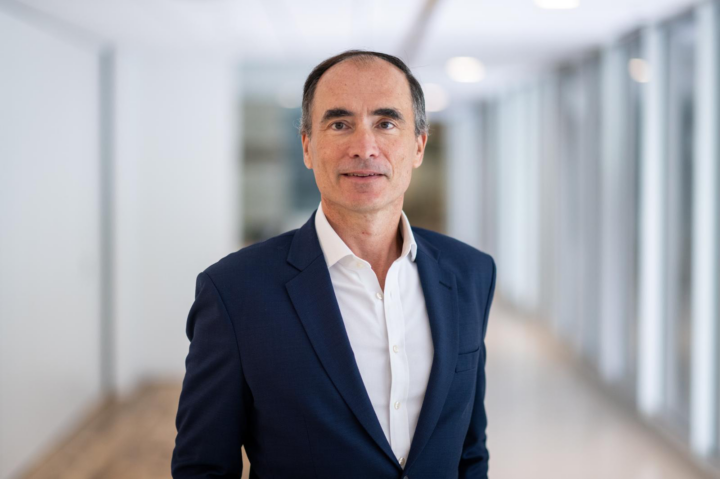
Courtesy
Ludo Hood
After a career in the foreign service, where officers are obliged to keep their political views to themselves and promote the positions of the current U.S. administration, some retiring diplomats have a hard time getting used to speaking their minds, particularly when the press is involved.
Ludo Hood is not one of those people.
The 53-year-old retired from the U.S. Foreign Service last week after two decades of service, a career that took him to Kuwait, Bahrain, France and Qatar. Most recently, he served as a senior advisor to Keith Kellogg, President Donald Trump’s former special envoy for Ukraine, and before that as a close advisor to Deborah Lipstadt, the former U.S. special envoy to monitor and combat antisemitism — two roles that put him in the crossfire of some of the biggest political debates in Washington.
Hood, who is preparing to take on a role at a think tank, sat down with Jewish Insider this week to reflect on a career representing the U.S. that included stints working on Iran policy during negotiations for the 2015 nuclear deal, relations with Gulf states during the fraught Arab Spring and antisemitism policy in the tense aftermath of the Oct. 7 Hamas attacks in 2023.
Through all those foreign postings and geopolitical flashpoints, one of the most “alarming and shocking” moments of Hood’s time as a foreign service officer came within the halls of Foggy Bottom — when, in the months after Oct. 7, the State Department hosted listening sessions for staffers to express anti-Israel views and bash the policies espoused by the federal government.
“It was the only time in my career where active dissent against the elected president’s overall policy and strategic direction was allowed to be aired in the open, and was actually in many ways encouraged,” Hood told JI.
The gatherings were hosted by then-Deputy Secretary of State Kurt Campbell, and they came as some rank-and-file diplomats, plus many political appointees from the Biden administration, voiced dissent against President Joe Biden’s support for Israel.
“In terms of being politically correct, you had to give a lot of deference to a heavy anti-Israel point of view, which maybe is fine in the context of a social studies program at a university,” Hood said. “But it’s the State Department. We are national security professionals who are supposed to be implementing the policy of the duly elected president.”
Hood compared that moment to the sentiment among some foreign service officers who have struggled to represent the U.S. under Trump. Hood acknowledged that some diplomats do not agree with Trump’s approach to foreign policy, but said that they should not express that view publicly as part of their job — and that Trump would not stand for so much public expression of dissent.
“There was and perhaps remains opposition to the way that Trump does and says certain things in the State Department,” said Hood. “The difference here is the Trump people, either under [former Secretary of State Mike] Pompeo or now, would never tolerate unprofessional behavior, and it is unprofessional.”
“Obviously, you’re allowed to have your own personal points of view,” Hood continued. “But if you’re going to sign up to do this work, you ought to be reasonable.”
That doesn’t mean he always agreed with the positions that he was meant to promote as a diplomat. During the Biden administration, Hood took issue with the White House’s policy that nearly anytime antisemitism was mentioned, it had to be coupled with a mention of Islamophobia, a policy that Hood called “illogical and irrational.” (Lipstadt, his former boss, has called for antisemitism and Islamophobia to be discussed as distinct forms of hate.)
“It was official policy at the Biden White House in terms of how they named task forces and so forth,” said Hood. “We had to accept the horrendously problematic addition of ‘counter-Islamophobia efforts’ into what we were doing or what we were commemorating. I say ‘horrendously problematic’ because it undermines the fight against Muslim hatred or other forms of religious hatred to start conflating them for politicized reasons that have nothing to do with the actual strategies needed to curb that kind of discrimination.”
Even before Oct. 7, Hood said, getting certain State Department diplomats to include antisemitism in meetings with foreign leaders could be challenging.
“It could be painfully difficult to say and do certain things because of an institutional reluctance to highlight antisemitism,” Hood said, particularly in Europe.
When Trump was inaugurated early last year, Hood transitioned to the Ukraine file, the first time in his career when his portfolio did not include the Middle East.
He was more sympathetic to the plight of Ukraine than many members of the incoming Trump administration, which he said was more amenable to appeasing Russian President Vladimir Putin and less interested in continuing to spend billions on Ukraine’s defense. Kellogg, the Ukraine envoy, was also more supportive of Kyiv than Trump, leading to some of his portfolio being taken over by White House Special Envoy Steve Witkoff. Kellogg ultimately stepped down in January.
“It was frustrating to see how that played out, partly because the guy is a decent, honorable man who probably could have been treated better by some people operating in the White House and elsewhere,” said Hood. “Perhaps more relevantly, more substantively, I think Kellogg had a view on the Russian invasion of Ukraine, which, from where I stood, reflected reality and reflected how we should be approaching the conflict.”
On the other side of the Ukraine issue was the increasingly influential isolationist right. Hood called the ongoing intra-Republican feud about foreign policy “a profoundly important debate,” even as he came down hard against the isolationist wing.
“I think there’s very easy arguments to be had to push back on isolationism and restrainers,” said Hood. “I think those of us who want an assertive America aren’t asking for forever wars, aren’t asking to invade in the name of democracy. I think there are ways of putting America first on the global stage without deploying what has now become known as neocon objectives, basically democracy promotion.”
It’s fair to say Hood is aligned with the more traditional, interventionist wing of the Republican Party; he recently joined the Hudson Institute, a pro-Israel think tank closely aligned with several former top Bush administration officials. He said that over his two decades in diplomacy, his central views about the world and foreign policy have not changed. But he said he has come to hold a more realpolitik view of the world that is less Pollyannaish about democracy as a strategic objective.
“I think maybe democracy promotion, or even having a heavy focus on human rights, is probably at best naive, if not a lost cause, in some parts of the world,” said Hood. “We shouldn’t necessarily allow those issues to always get in the way of a bilateral strategic partnership that is broadly speaking good for stability and prosperity for that country or for that region.”
Hood is leaving the foreign service at a time when the institution’s future is in question. More than 1,300 State Department staffers — including many foreign service officers — were laid off last summer. The American Foreign Service Association, the union representing foreign service officers, called it “a catastrophic blow to our national interests.”
Hood called Trump’s “top-down approach,” where he leans heavily on personal advisors like Witkoff and Jared Kushner, “understandable in some respects.” He is not instinctually opposed to the cuts and thinks some were necessary.
“We needed a lot of disruption in the national security establishment. There’s still so much bloat to be cut,” said Hood. But, speaking diplomatically, Hood tentatively suggested that Trump might actually does have something to gain from the bureaucrats in Foggy Bottom and America’s embassies around the world.
“What you don’t have now is bottom-up information and recommendations being aired, discussed, debated,” said Hood. “Sometimes there are real questions about implementation and messaging.”
Next stop: the well-trodden Washington path of helping public officials hone their messages. In other words: a think tank.
Combat Antisemitism Movement is co-hosting the July 3 gathering at the U.S. Institute of Peace
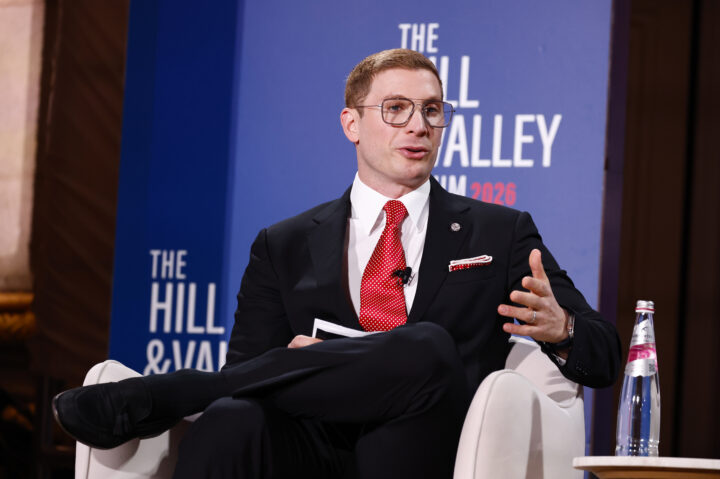
Paul Morigi/Getty Images for The Hill & Valley Forum
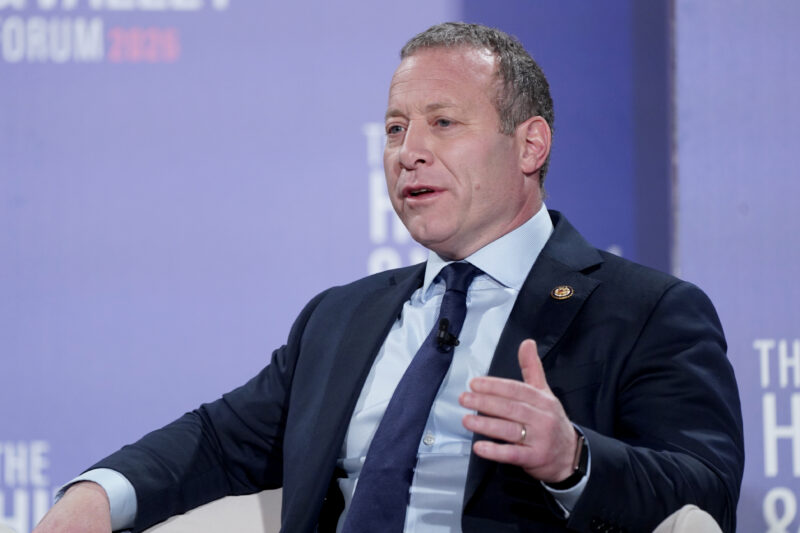
Under Secretary of State Jacob Helberg participates in the The Hill & Valley Forum 2026 at Andrew W. Mellon Auditorium on March 24, 2026 in Washington, DC.
As Washington, D.C., prepares to host a weekend of July Fourth hoopla on the National Mall, senior Trump administration officials, diplomats and Jewish communal leaders will gather on Friday evening across from the Lincoln Memorial for a Shabbat dinner celebrating America’s 250th birthday.
Jacob Helberg, the under secretary of state for economic affairs, and Ambassador Yehuda Kaploun, the Trump administration’s special envoy to monitor and combat antisemitism, are hosting the Shabbat dinner at the U.S. Institute of Peace, according to an invitation obtained by Jewish Insider. The July 3rd gathering is co-hosted by the State Department and Combat Antisemitism Movement.
Attendees can expect to walk away with branded yarmulkes, Jewish prayer books and special challenge coins. Several hundred people are expected to attend, a source familiar with the event told JI.
The State Department-hosted discussions are expected to focus on extending the ceasefire, due to expire Sunday, and a U.S. request that Beirut repeal laws criminalizing contact between Lebanese citizens and Israelis
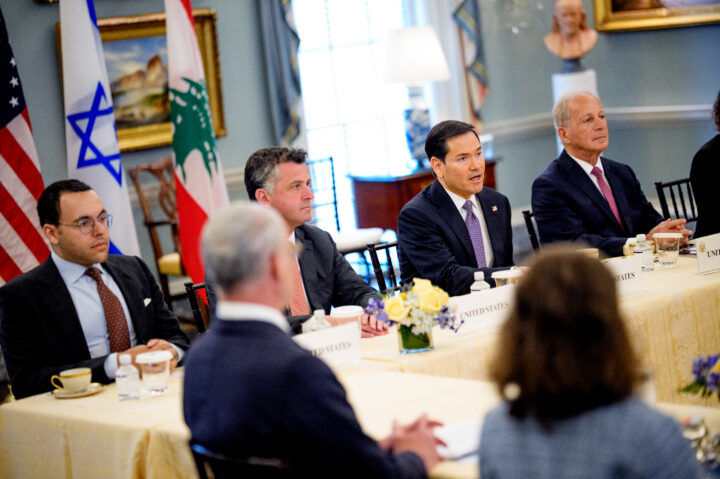
Andrew Harnik/Getty Images
U.S. Secretary of State Marco Rubio (2nd-R), accompanied by U.S. State Department Counselor Michael Needham (C), and U.S. Ambassador to Lebanon Michel Issa (R), speaks as they begin working-level peace talks with Lebanese Ambassador to the U.S. Nada Hamadeh Moawad and Israeli Ambassador to the U.S. Yechiel Leiter at the U.S. State Department on April 14, 2026 in Washington, DC.
The Trump administration’s latest push to ease tensions between Israel and Lebanon faces another key test this week as diplomats prepare for the second round of direct talks between the two countries on Thursday.
The State Department-hosted discussions are expected to focus on extending the current ceasefire, which is due to expire Sunday, and a reported U.S. request that Beirut repeal long-standing laws that criminalize contact between Lebanese citizens and Israelis. Lebanese President Joseph Aoun has said his aim in the talks is to see the IDF withdraw completely from the country.
The discussions follow a historic first meeting last week — the highest-level direct dialogue between the two nations in over 30 years. Since the ceasefire went into effect shortly after the meeting, Hezbollah has repeatedly fired on Israeli troops, provoking retaliation by the IDF. Both sides have accused the other of violating the ceasefire agreement.
Over the weekend, Hezbollah killed two French soldiers who were part of the U.N. peacekeeping force, prompting some leading Republican lawmakers to call for conditioning future U.S. support for the Lebanese Armed Forces on tangible action in disarming Hezbollah.
The talks also come as President Donald Trump extended the fragile ceasefire between the U.S. and Iran indefinitely until negotiations between Tehran and Washington are complete. Should the current halt in hostilities fall apart, experts suggested to JI, Hezbollah may reignite hostilities with Israel on an even broader scale.
Rep. Tim Burchett (R-TN) told Jewish Insider that he wants to see “peace” between Israel and Lebanon, adding that it would be a “great alternative” to the status quo.
“We’ve just got old leaders on all sides and all they want is war because it keeps them in power,” Burchett said. “Old men make decisions and young men die. I think they [Lebanon] are realizing maybe capitalism is probably a better route and not killing all their people.”
Burchett also expressed that he would “absolutely” back the U.S. pushing Lebanon to repeal its anti-contact laws. “I love the First Amendment, and I like it all over the world,” he said.
Rep. Jared Moskowitz (D-FL) shared the sentiment, telling JI he hopes “we can get a deal there,” adding that he would like to see a ceasefire extension to help achieve that.
“If the Lebanese people have made a decision that they don’t want Hezbollah in their country anymore, they don’t want the Iranians having control over their country, I think that’s great news for Lebanon,” Moskowitz said. He also expressed support for the U.S. urging Lebanon to repeal anti-normalization laws, stating, “If repealing the law is a step to get a deal, then I support it. There needs to be a deal.”
Rep. Brad Sherman (D-CA) said he is hoping to see the ceasefire extended, adding that “we all hope for the disarmament and hopefully disbanding of Hezbollah.”
“We’ll see whether the Lebanese government is going to make good on its promises to have a monopoly of force in its own territory,” Sherman said. He added that should the U.S. push Lebanon to repeal its anti-normalization laws, it would be an “excellent step.”
“It would be a good idea and hopefully done in coordination with other good steps by both Israel and Lebanon,” Sherman said.
Rep. Mike Lawler (R-NY) also agreed that such action “would be a positive step forward toward long-term peace and stability.” He added that he would like to see the current ceasefire between Israel and Lebanon be extended.
“Obviously we want long-term peace and stability,” Lawler said. “Talks have been going relatively well. We will see what comes next.”
Robert Satloff, executive director at The Washington Institute for Near East Policy, said he anticipates that the meeting “will be the bridge between last week’s historic opening on Lebanon-Israel direct talks and the start of formal negotiations between the two sides.” He said that it is “quite likely the two sides will agree to extend the ceasefire.”
“One can also expect discussion of other elements that will contribute to the success of the talks, including a possible meeting between U.S., Lebanese and Israeli leaders, the U.S. request that Lebanon repeal repressive laws that ban contact between citizens of the two countries and measures the Lebanese army and security forces should take to signal that this ceasefire will produce a better outcome for all parties than what followed the November 2024 ceasefire,” Satloff added.
Rachel Brandenburg, a senior policy analyst at Israel Policy Forum, said “the mere fact of a second meeting is a positive sign.”
“Top priority for Israel is the disarmament — and more so, dissolution — of Hezbollah, and retaining the freedom of action to continue to strike Hezbollah where and when they determine necessary for their own self defense,” Brandenburg said. “For the Lebanese government, sitting at the table with the Israeli government is both politically risky and an important opportunity for them to be recognized as and assert their place as the only recognized authority of the Lebanese state.”
David Daoud, a senior fellow at the Foundation for Defense of Democracies, meanwhile, said that expectations for talks “should be kept low” and expressed skepticism over whether Beirut would truly work to disarm Hezbollah. He argued that Lebanon is seeking a return to the status quo, noting that despite Trump’s intentions to bridge ties between the two nations, “President Aoun declined to speak with [Israeli Prime Minister Benjamin] Netanyahu and sources close to Aoun have rebuffed the possibility of a meeting between the two leaders as ‘premature.’”
“The question is whether Lebanon is seeking this breathing room as an end in and of itself or to begin gradually acting against Hezbollah,” Daoud said. “As matters stand, I see no indication of the latter.”
Daoud noted that Lebanon has had a “strong reluctance to call out Hezbollah by name since the ceasefire took effect” and also referenced a statement from Salam in which he said the country is “not seeking confrontation with Hezbollah.”
Yoni Tobin, a senior policy analyst at the Jewish Institute for National Security of America, also called for caution in optimism over the talks, stating that a ceasefire “does not constitute progress,” also noting that past ceasefires that halted fighting between Israel and Hezbollah “only kicked the can down the road in terms of disarming Hezbollah.” He also expressed skepticism over Lebanon repealing its anti-normalization law.
“Beirut repealing its law criminalizing communications should be a clear-cut U.S. demand in talks, but I haven’t seen any evidence to suggest that is on the table right now — though it should be,” Tobin said. “As one of the main funders of Lebanon’s military, Washington has the leverage to compel Beirut to reverse this arcane law, which remains an obstacle to what is squarely in the American interest: a normal, productive relationship between Israel and Lebanon.”
Any potential agreements between Jerusalem, Beirut and Washington will ultimately hinge on whether Hezbollah can be fully disarmed
Andrew Harnik/Getty Images
U.S. Secretary of State Marco Rubio (2nd-R), accompanied by U.S. State Department Counselor Michael Needham (C), and U.S. Ambassador to Lebanon Michel Issa (R), speaks as they begin working-level peace talks with Lebanese Ambassador to the U.S. Nada Hamadeh Moawad and Israeli Ambassador to the U.S. Yechiel Leiter at the U.S. State Department on April 14, 2026 in Washington, DC.
The first round of direct talks between Israel and Lebanon has been received positively by diplomats, pro-Israel lawmakers and experts, who see it as a sign of Hezbollah’s waning influence in Lebanon. But despite the optimism surrounding the discussions, experts caution that disarming the terrorist group remains a daunting obstacle that stands in the way of any meaningful change — one that would require a significant shift from the Lebanese government and its armed forces.
On Tuesday, Israeli and Lebanese leadership convened at the State Department in Washington for the highest-level direct discussions in more than 30 years, aiming to outline a framework for “lasting peace” and a “permanent end” to Hezbollah’s influence, according to Secretary of State Marco Rubio.
Rep. Jared Moskowitz (D-FL) told Jewish Insider that “it is great” that talks are taking place, expressing hope that “the Lebanese government, the United States and the Israeli government make a deal, and collectively, they push Hezbollah out.”
“That way the Lebanese people can be freed from the Iranian extremism that they have in their country,” Moskowitz said. “The Lebanese people are being held captive by the Iranian government because of Hezbollah. It’s obviously good for the United States, it’s good for Israel, but more importantly, I think it’s good for the people of Lebanon. I think disarming Hezbollah is obviously key to all this.”
Moskowitz added that while the Lebanese government appears to want to disarm Hezbollah, “they probably need help.”
“It’s not going to happen overnight, but I think it’s historic, and this is what the entire region wants,” he said. “This is what the Gulf states want. Everybody wants to come out of the extremism and the terrorism that Iran is trying to spread in the region.”
Sen. Rick Scott (R-FL) similarly told JI that Hezbollah disarmament is an important factor in talks.
“Why would you have talks if they [Hezbollah] are not going to disarm?” Scott said. “I’m not the prime minister of Israel but my condition would be that Hezbollah has got to disarm.”
Scott dismissed the notion that the Lebanese government and the Lebanese Armed Forces have not done enough to disarm the group, stating that the main problem is “not caused by Lebanon or by the military of Lebanon, it’s caused by Hezbollah.”
Sen. John Cornyn (R-TX) said that disarming Hezbollah should be a “red line” for Israel in talks. He added that Israel “needs a buffer zone so Hezbollah can’t continue to rain down terror on Israelis.”
“Hezbollah has historically been the best trained, best equipped opponents to Israel,” Rep. Don Bacon (R-NE) said. “Israel’s done a great job with them over the last two years, but they’re hardcore fervent believers in destroying Israel.”
Experts similarly described the talks as a meaningful development. John Hannah, a senior fellow at the Jewish Institute for National Security of America, called the discussions an “important breakthrough” and a sign of Hezbollah’s diminishing influence.
“Everyone should welcome the opening of a direct political dialogue between Israel and Lebanon,” Hannah said. “The fact that [the talks are] occurring at all is an important sign of Hezbollah’s declining hegemony over the Lebanese state.”
Robert Satloff, executive director of the Washington Institute for Near East Policy, described the talks as a “win-win-win” in a social media post, adding that Hezbollah emerged as a “big loser.”
“Today is a day to celebrate — we all saw a glimpse of what is possible after so much violence and conflict,” Satloff wrote on Tuesday. “That is a very good thing.”
Still, experts say disarming Hezbollah, which parties agree is necessary for any lasting piece, remains highly difficult and uncertain.
Even before Tuesday’s opening round of discussions, Hezbollah senior member Wafiq Safa said Hezbollah is “not bound” by any deals reached between Israel, Lebanon and the United States.
“It’s hard to be an optimist when it comes to the core question of Hezbollah’s disarmament,” Hannah said. “Even after all that’s been done over the past few years to weaken the group and its Iranian sponsors — including the loss of its legitimacy in the eyes of a majority of Lebanese — it’s not at all apparent that the raw balance of forces inside Lebanon has shifted sufficiently to favor Hezbollah’s near-term demise.”
Hannah described disarming Hezbollah as “worth trying,” but ultimately a “long shot.”
“Since the war against Iran broke out on Feb. 28, Hezbollah has shown through its sustained attacks on Israel that, while much diminished, its forces retain far more significant capabilities than many believed,” he said. “And in the wake of its battle against Israel, Hezbollah is making clear that if push comes to shove, it’s prepared to burn down the state before surrendering its weapons.”
Blaise Misztal, JINSA’s vice president for policy, said the task cannot be accomplished through Israeli military action alone and will ultimately depend on whether Lebanon and the LAF are willing to act.
“[Disarming Hezbollah] can only be fully done by a strong and committed Lebanese government,” Misztal said. “Israel can secure southern Lebanon with ground operations and strike Hezbollah sites in Beirut or the Bekaa Valley, but that will merely distance and degrade the threat, never fully remove it.”
“The question is whether the Lebanese government is, or can be convinced to be, strong and committed enough to take on the task of asserting its control over its own territory,” he added. “Thus far, it has failed to demonstrate either the political will or military capability to do so.”
Hannah similarly noted that “Israel is rightly unwilling to pay the necessary cost in blood, treasure and diplomatic opprobrium” required to fully dismantle Hezbollah, leaving the responsibility to Lebanon and its armed forces.
“The factor that has truly held Lebanon back from disarming Hezbollah has been Hezbollah’s retention of, as far as we can tell, overwhelming support among Lebanese Shiites,” David Daoud, a senior fellow at the Foundation for Defense of Democracies, said. “Having retained that popular support, it can deter the government from pursuing forcible disarmament by dangling the threat of civil war.”
But experts weren’t optimistic that the Lebanese government and LAF are capable — or willing — to take on that role. Hannah said Lebanon’s military “doesn’t appear to have the stomach to truly confront Hezbollah and dismantle the group’s armed wing,” noting that it has already “failed” to disarm the group in southern Lebanon, “much less the rest of the country.”
“It seems even less likely than before the Iran war that the LAF would now be willing to take on the risk of massively confronting Hezbollah,” he said, “in spite of the misery Hezbollah’s unilateral decision to enter the conflict on Iran’s behalf is now inflicting on the rest of Lebanon.”
David Daoud, a senior fellow at the Foundation for Defense of Democracies, also said Beirut “ultimately holds the key” to resolving the issue of Hezbollah’s disarmament. He said that while Lebanon has taken “immense and commendable” steps in “proscribing Hezbollah’s military activities,” the country’s “unwillingness to act against Hezbollah has been missing from the equation” and has “allowed the group to regenerate in the past.”
He added that Hezbollah still “retains enough military strength to make disarmament daunting” for Lebanese forces and the LAF, and that the group continues to wield significant political power.
“The factor that has truly held Lebanon back from disarming Hezbollah has been Hezbollah’s retention of, as far as we can tell, overwhelming support among Lebanese Shiites,” Daoud said. “Having retained that popular support, it can deter the government from pursuing forcible disarmament by dangling the threat of civil war.”
Daoud also raised concerns about Lebanon’s intentions in negotiations, arguing that Beirut may not truly be seeking meaningful change.
“A good test will be the extent to which the LAF fulfills the Lebanese government’s order from early April to put all of Beirut under its full control,” John Hannah, a senior fellow at the Jewish Institute for National Security of America, said. “Will the LAF truly confront and disarm Hezbollah in the capital or simply repeat the phony disarmament it claimed to have completed in the south?”
“Lebanon is seeking to use the negotiations to return to the status quo, and is willing to ‘pay the price’ of a joint photograph with an Israeli ambassador to achieve that objective,” he said. “This is because the situation in Lebanon is indeed dire — economic collapse compounded by war, the direct impact of the war itself and the emergence of sectarian tensions that could boil over into full-on conflict.”
If those dynamics remain unchanged, he warned that Hezbollah could indefinitely delay disarmament and eventually rebuild its strength.
“A good test will be the extent to which the LAF fulfills the Lebanese government’s order from early April to put all of Beirut under its full control,” Hannah said. “Will the LAF truly confront and disarm Hezbollah in the capital or simply repeat the phony disarmament it claimed to have completed in the south?”
Satloff said the challenge will ultimately require translating diplomacy into “practical steps,” including a shift in how the Lebanese military approaches disarmament.
“While some of this can happen in the negotiating room when the parties meet again, nothing can substitute for strong measures by the Lebanese state to isolate, weaken, delegitimize and disarm Hezbollah while promoting the idea of peace,” he said.
He suggested that turning Beirut into a “true weapons-free zone” is necessary “but not sufficient,” pointing to additional steps such as removing Hezbollah officials from government, expelling Iranian operatives from the country and shutting down the group’s financial and institutional networks.
The dinner was hosted by Rabbi Yehuda Kaploun, the U.S. antisemitism special envoy
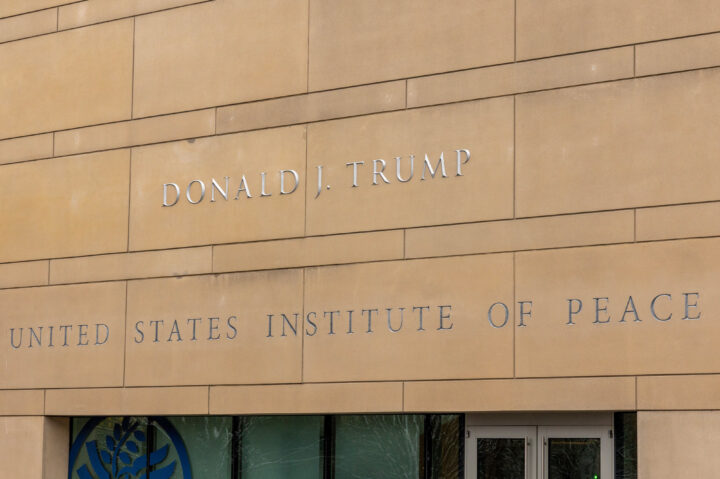
Alex Kent/Bloomberg via Getty Images
The US Institute of Peace (USIP) in Washington, DC, US, on Friday, Dec. 5, 2025.
Several dozen diplomats, senior Trump administration officials and Jewish communal leaders gathered at the Donald J. Trump Institute of Peace on Friday night for a Shabbat dinner hosted by Rabbi Yehuda Kaploun, the U.S. antisemitism special envoy, according to a source who attended the dinner.
A day earlier, that same space had hosted the inaugural Board of Peace meeting.
The gathering brought together a coterie of Washington officials, including Princess Reema, Saudi Arabia’s ambassador to the U.S., and United Arab Emirates Ambassador to the U.S. Yousef Al Otaiba, even though ties between the two Gulf nations have been strained in recent months. Other diplomats in the room came from France, Germany, Poland, Armenia, Azerbaijan, Lebanon and Jordan, according to the source.
Kaploun, who started at the State Department in December after being confirmed by the Senate, spoke at the event. He had recently returned from his first overseas trip, with stops in London, Switzerland and the Munich Security Forum. Reed Rubinstein, the State Department legal advisor, also spoke, as did Princess Reema. The Saudi diplomat talked about how close Israel and Saudi Arabia were to normalization before the Oct. 7, 2023, attacks in Israel and that she hoped to get back to that point, although normalization efforts have stalled.
“Kaploun hosting Arab and European diplomats for a traditional, family-style Shabbat and watching them love every minute of it is one the most clever displays of soft diplomacy I’ve ever seen,” the attendee, who requested anonymity to discuss an off-the-record event, told Jewish Insider. “The Saudis called for normalization. Who saw that coming?”
Most attendees were either diplomats or Trump administration officials, but Republican donor Miriam Adelson was also in the room. Combat Antisemitism Movement founder Adam Beren and board member Arie Lipnick, Conference of Presidents Chair Betsy Berns Korn and Jewish Federations of North America Chair Gary Torgow were also in attendance.
“Diplomats and leaders from across our country and across the world gathered together in a comfortable setting in our nation’s capital and shared a meaningful meal,” Korn told JI. “Ambassador Kaploun explained the importance of Shabbat as well as a heartfelt speech about the dangers of hatred. His powerful message of peace and community resonated throughout the room. We need more of this diplomacy.”
Guests noshed on Shabbat fish, potato kugel, matzah ball soup and more, along with Mediterranean desserts in honor of iftar for the Muslim diplomats in the room, according to the source.
Jeremy Lewin, the acting under secretary of state for foreign assistance, humanitarian affairs and religious freedom, attended the dinner, as did Sarah Rogers, under secretary of state for public diplomacy, and Pierre Gentin, general counsel at the Commerce Department.
Kaploun said at the event that he plans to host more Shabbat dinners in the future.
Adi Farjon is set to be Israel's consul-general in Houston, replacing Livia Link-Raviv; Ron Gerstenfeld will replace Marco Sermoneta as consul-general in San Francisco

Getty Images
Exterior of the Israeli Ministry of Foreign Affairs located in the government complex in Jerusalem. Israel
Israel’s Cabinet approved diplomats to be sent to posts in the U.S. next summer, doing so in a unanimous vote in its weekly meeting on Sunday.
Adi Farjon is set to be Israel’s consul-general to Houston and the Southwest, replacing Livia Link-Raviv.
Farjon is currently the head of the Central Europe Department in the Israeli Foreign Ministry, and was previously a diplomat at the Israeli Embassy to U.N. institutions in Geneva, as well as in Berlin.
Ron Gerstenfeld was appointed consul-general in San Francisco and the Pacific Northwest, replacing Marco Sermoneta.
Gerstenfeld is the director of the Israeli Foreign Ministry’s Department for European Economic Affairs, and previously served in the Israeli embassies in Australia and Uruguay.
Both are expected to take their new posts in August.
The Cabinet also authorized new ambassadors to Ukraine, Argentina, Mexico, Costa Rica and Uruguay, as well as consuls-general in Shanghai and Hong Kong.
Sami Abu Janeb, previously deputy ambassador to Jordan, was appointed consul-general to Dubai.
PM Anthony Albanese blasted the ‘extraordinary and dangerous acts of aggression orchestrated by a foreign nation on Australian soil’
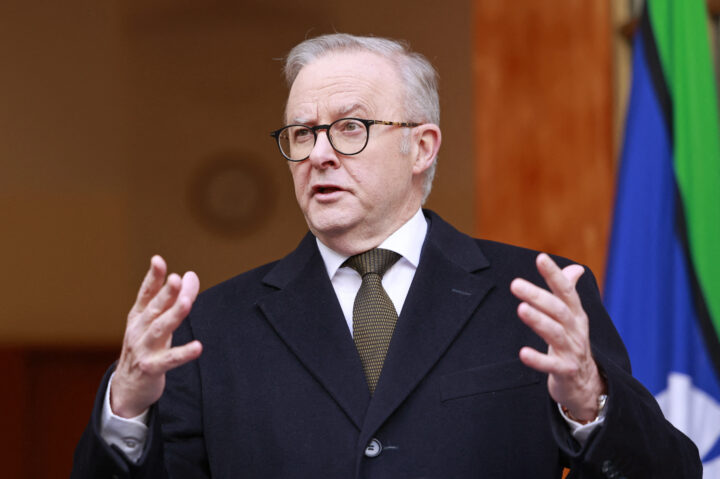
HILARY WARDHAUGH/AFP via Getty Images
Australian Prime Minister Anthony Albanese speaks during a press conference in Canberra on August 11, 2025.
Australia expelled the Iranian ambassador in Canberra as well as three other embassy staffers on Tuesday, with Prime Minister Anthony Albanese accusing the Islamic Revolutionary Guard Corps of orchestrating attacks on a synagogue in Melbourne and a kosher restaurant in Sydney.
Albanese, speaking at a press conference alongside the country’s top intelligence official, foreign minister and home affairs minister, called the plots “extraordinary and dangerous acts of aggression orchestrated by a foreign nation on Australian soil.” The expulsion of Ahmad Sadeghi marks the first time Australia has expelled a foreign ambassador since World War II.
Canberra also withdrew its diplomatic staff from Iran and has encouraged Australian citizens to leave the country if they are able.
Australian intelligence indicates that Tehran was behind additional antisemitic attacks in the country since the Oct. 7, 2023, Hamas terror attacks. The country has seen an explosion of antisemitism, with a 316% year-over-year increase in antisemitic incidents in the year following the attacks.
Mike Burgess, the director-general of the Australian Security Intelligence Organisation, said that the plots were carried out “through a series of overseas cut-out facilitators to coordinators that found their way to tasking Australians,” describing the scheme as a “layer cake” of middlemen originating with the IRGC.
The expulsion of the Iranian diplomats comes shortly after the arrests of two individuals in connection with the December 2024 Melbourne synagogue attack, in which a synagogue was firebombed while nearly two dozen people were inside.
The arson at Sydney’s Lewis’ Continental Kitchen, which took place in October 2024, caused $1 million in damage to the kosher restaurant. Court documents released earlier this month indicate that a middleman, Sayed Moosawi, who was directing the Sydney attack, was to receive $12,000 for his work. Prior to the fire at Lewis’ Continental Kitchen, two men directed by Moosawi mistakenly set fire to a brewery with a similar name to the restaurant.
Facing antisemitism in the workplace, these staffers have turned to each other in group chats and at the Shabbat dinner table for comfort

Kevin Carter/Getty Images
The U.S. Capitol Building is seen at sunset on May 31, 2025 in Washington, DC.
On the night of May 21, several dozen young diplomats and political aides gathered at the Capital Jewish Museum in Washington for a reception focused on humanitarian aid efforts in Gaza.
The event was one of dozens of similar programs that happen around Washington, offering networking opportunities and social connection (alongside tasty hors d’oeuvres) to the overworked, largely underpaid employees that power Congress and the federal bureaucracy. But this event imprinted on the minds of young Jewish politicos because of what happened as it was ending, when Sarah Lynn Milgrim and Yaron Lischinsky, two Israeli Embassy staffers, were shot and killed just after leaving the American Jewish Committee event by an assailant who said that he carried out the attack “for Gaza.”
“I saw the news and I said, ‘Could’ve been any of us,’” a legislative aide for a Democratic member of Congress, who had a ticket to that night’s event, told Jewish Insider last week.
For that staffer, the event brought back to the fore the kind of visceral pain and discomfort that Jewish congressional aides — especially those in Democratic offices and social circles — have gotten used to dealing with since the Oct. 7, 2023, Hamas terror attacks in Israel.
Confronting the aftermath of that day and the ongoing war in Gaza has been a challenge for American Jews in all fields, many of whom have had to face growing antisemitism and antipathy to Israel in their professional lives. But in the Democratic spaces of Capitol Hill — one of the most consequential and most scrutinized workplaces in the country, which is in large part managed by young staffers in their 20s and 30s — the issue is inescapable.
Many of the liberal-minded Jewish staffers on the Hill came to Washington to work on issues such as reproductive rights, access to health care and environmental policy. Now, for nearly two years, they have had to navigate a professional environment that demands an air of detached professionalism while their fellow staffers and Democrats writ large adopt a more critical approach to Israel and antisemitism.
A June poll showed Democratic sympathy toward Israel at an all-time low, with 12% saying they sympathize more with Israelis, and 60% saying they sympathize more with Palestinians. That was a major drop from November 2023, when 34% of Democrats said they were more sympathetic to Israelis and 41% said they were more sympathetic to Palestinians.
Several Democratic Jewish staffers, ranging from junior aides to chiefs of staff — most of whom requested anonymity, wary of being made a target of antisemitism and concerned about putting themselves at risk professionally at a time when Democratic jobs are hard to come by — told JI that, in the face of growing antipathy to Israel and continued antisemitic terror and threats, they have turned to each other to build a tight-knit community among Jews working on Capitol Hill.
“It has led to increased camaraderie and dialogue and kind of just a common understanding and bond … We work for a lot of different members: members who are Jewish, members who are not Jewish, members who one of their main issues is the U.S.-Israel relationship, members who are not mainly concerned with it,” said the legislative staffer. “But nonetheless, I think a lot of us are united and brought together by the aftermath of Oct. 7.”
“If you’re just going to pick up lunch, and you just hear something about ‘apartheid Israel’ in the cafeteria, that hurts. You feel something on that,” said one former senior Jewish staffer who no longer works on Capitol Hill.
Laurie Saroff spent more than 20 years on Capitol Hill, most recently as chief of staff to Rep. Lou Correa (D-CA). When she left Congress in 2022, she started a bipartisan networking organization called the Capitol Jewish Women’s Network.
“So many of us, which is something people don’t understand, are grieving. We’ve been grieving for 650-plus days. Everyone is touched at a different level, but it’s very personal, and sometimes I’m with people who are not Jewish and don’t understand how this impacts us so much,” Saroff told JI. “I think there’s a need for people to come together that I hadn’t seen in the past.”
Part of that desire to connect came from a feeling of alienation from other colleagues on Capitol Hill. Encountering charged anti-Israel rhetoric in the hallways of the Capitol and its fortress of office buildings has become commonplace.
“If you’re just going to pick up lunch, and you just hear something about ‘apartheid Israel’ in the cafeteria, that hurts. You feel something on that,” said one former senior Jewish staffer who no longer works on Capitol Hill. Whenever the war in Gaza intensifies, congressional offices face a barrage of angry, often confrontational phone calls seeking to pressure the members not to support Israel, which the Jewish staffer called “absolutely brutal” for the interns tasked with picking up the phone.
“The things that we hear in our day-to-day about the way that people talk about Jewish communities or Israel groups is so outside the boundaries of what could be considered polite or not antisemitic statements – ‘AIPAC controlling the government,’ AIPAC’s money in races where they don’t even spend it, and yet it’s blamed on AIPAC,” a Jewish foreign policy staffer told JI. “We hear from callers all day long about AIPAC money. Clearly at this point, it’s just a stand-in for saying Jewish money. That’s how I hear it.”
Soon after the Oct. 7 attacks, some Democratic congressional staffers began to pressure their bosses to call for a ceasefire between Israel and Hamas. “Dear White Staffers,” an Instagram account that first went viral several years ago for revealing allegations of lawmaker misconduct, has taken a sharply anti-Israel turn, frustrating many Jewish aides who see their colleagues continuing to follow and engage with the account.
In 2024, some staffers who wanted the U.S. to take a tougher line against Israel created a website that they dubbed the Congressional Dissent Channel. “We are congressional aides dedicated to changing the paradigm of U.S. support for the genocide against Palestinians in Gaza being carried out by the state of Israel,” the organizers wrote on the website, which has since been taken offline.
“I also have had a lot of Dem staff who are not Jewish — who kind of privately don’t agree with this sort of orthodoxy on the topic that is emerging — reach out to me and be like, ‘This is kind of crazy,’” a Jewish Democratic staffer said. “And it’s really nice to hear that. And I’ve definitely gotten closer to some people for that reason,” she told JI, though she added that the anti-Israel contingent in the Democratic Party and on the Hill “feel like there’s a lot of permissiveness for them to say things that are really not acceptable.”
“It’s the small things, like Dear White Staffers. You can’t even explain to your colleagues how repugnant some of these posts are. For any other group, it feels like they would be disciplined. The post would be removed. There would have to be apologies,” the foreign policy staffer told JI. “It’s no secret that — how do I say this? — that diversity is something that seems to be really valued, except for when it comes to Jewish voices.”
Another Jewish Democratic staffer wanted to make clear that many of her non-Jewish colleagues were similarly alarmed by the language that other Hill staffers had adopted after Oct. 7.
“I also have had a lot of Dem staff who are not Jewish — who kind of privately don’t agree with this sort of orthodoxy on the topic that is emerging — reach out to me and be like, ‘This is kind of crazy.’ And it’s really nice to hear that. And I’ve definitely gotten closer to some people for that reason,” she told JI, though she added that the anti-Israel contingent in the Democratic Party and on the Hill “feel like there’s a lot of permissiveness for them to say things that are really not acceptable.”
A senior staffer for a pro-Israel member of Congress said that when their office interviewed potential new hires after Oct. 7, the interviewers began asking job candidates — mostly younger people seeking early career roles — if they were comfortable with the member’s views on Israel and other topics, and what they would do if they disagreed.
“You had to walk on eggshells with your staff, because staff are way more progressive than the offices we were representing. It was a very, very challenging thing, while you’re also dealing with the personal ramifications and trauma of the actual events that happened,” said the former senior staffer who no longer works on the Hill. “I remember there was this one junior staff walkout, and it was the craziest thing to me, because if you’re not from the community, if you’re not a constituent, what are you trying to do? Members are trying to represent the interests of their district, not what their staff or interns want them to do.”
With these experiences casting a shadow over Jewish staffers’ time on the Hill and their understanding of politics and identity, they’ve found comfort in each other and in Jewish tradition.
“There’s a deep desire amongst people to lean on the most beautiful parts of the [Jewish] identity,” a Jewish policy staffer told JI. “I think that gives people a lot of strength because it’s really hard to hear all these things about your community all the time, and then you go to something like a Shabbat dinner … and you’re really reminded that this negative barrage is something that you have to endure for the sake of something that is really meaningful and powerful.”
The legislative aide who had purchased a ticket to the Capital Jewish Museum event said that the aftermath of Oct. 7 and rising antisemitism are “not theoretical and are extraordinarily personal,” which “is a theme that I have found has united and brought together a lot of Jewish staffers on the Hill.” The past two years have also led to “increased camaraderie and dialogue and a common understanding and bond,” bringing these staffers together both inside and outside the workplace.
The staffer who found solidarity with some non-Jewish colleagues said Jewish staff “have formed group chats to support each other and check in and … vent about frustrating experiences that they’re having, stuff like that. So I definitely think professionally and personally the community has deepened a lot and people are really leaning on each other.”
“Shabbat has really been an anchor, I think,” the aide told JI. Congressional staffers endure “lots of busy weeks, lots of long weeknights.” Joining together for a Shabbat meal, as groups of staffers do frequently, becomes “an intentional place to kind of withdraw from that and exist in our Jewish selves.”
The staffer said that, in attending Shabbat dinners, “there’s a deep desire amongst people to lean on the most beautiful parts of the [Jewish] identity. I think that gives people a lot of strength because it’s really hard to hear all these things about your community all the time, and then you go to something like a Shabbat dinner … and you’re really reminded that this negative barrage is something that you have to endure for the sake of something that is really meaningful and powerful.”
Shabbat, she added, is “a good antidote for the constant gaslighting.”
Dennis Ross and David Makovsky’s new book claims that past Israeli leaders have made brave moves, but Netanyahu prioritizes political considerations

Washington Institute
David Makovsky and Dennis Ross.
Former U.S. negotiators and veteran diplomats David Makovsky and Dennis Ross are out with a new book this week. During an in-depth conversation with Jewish Insider, the pair discussed their latest work titled Be Strong and of Good Courage: How Israel’s Most Important Leaders Shaped Its Destiny.
Makovsky and Ross focus on four Israeli prime ministers — David Ben-Gurion, Menachem Begin, Yitzchak Rabin and Ariel Sharon — who, the book says, “met the bar of history” by making courageous decisions that shaped the present and future of Israel.
Ross told JI that they decided to write the book out of a concern that Israel is on a path towards “one state for two peoples,” due to indecision by the Israeli government. “Historically, there have been Israeli leaders who always rose to the occasion and understood that when you face big stakes, you have to make a choice; realize that while there’s always a cost in making a decision, there’s also at times even a higher cost from not making a decision,” Ross said.
Another objective of the book, the authors wrote, was to provide U.S. leaders with ideas that would “make it easier for an Israeli prime minister, whoever it might be, to make a decision” by providing them “political tailwind” to convince the settler community to support an initiative that is of strategic value to Israel’s security.
According to Makovsky, the focus on Ben-Gurion, Begin, Rabin and Sharon was intended to highlight the successes of those leaders. While previous prime ministers — such as Ehud Barak and Ehud Olmert — also made far-reaching offers to move towards peace with the Palestinians, “for whatever reason there wasn’t a breakthrough,” he asserted.
“We thought it’s important for the public to understand that there are people who rose to extraordinary challenges and were successful’’ because they chose to deal with the issue and not kick the can down the road. “They were making a decision that was going to produce either high costs or a terrible political blowback and they were prepared to take that on anyway.”
Makovsky stressed that he and Ross wrote the book as “two centrists. There’s no discourse of polarization, no name-calling of anybody. We’re trying to drive some inspiration from the past in facing the challenges of the future. And, maybe, this book defies political gravity in Washington.”
The former journalist and diplomat said they are “trying to address an issue that is hyper-politicized in a very dispassionate way — because we don’t think that this issue was solved in the end zones of the political spectrum. We think we need to galvanize a consensus in the middle and we think the way to look at it is not to bash people over the head on either side of the parties — in this country or in Israel — but to look at the leaders who actually made a difference.”
Ross warned that Israel is approaching a tipping point at which the option of a two-state solution will no longer be viable. “We make the case that there is no two-state outcome anytime soon. I mean, if you ask me, we are talking 10 to 20 years at a minimum,” he said. “But it’s that tipping point that you have passed where you lose the ability to separate Israelis from the Palestinians, then your only outcome is one state.”
Both Ross and Makovsky agree that Israeli Prime Minister Benjamin Netanyahu’s lack of decision on this issue is driven by political convenience, not ideology or stubbornness. Makovsky is bothered that Netanyahu never made an effort to prepare his base for compromise.
“It is disappointing that someone who’s clearly very bright and is very capable — he’s certainly not shy in shaping the public’s response on Iran — when it comes to political survival, he is always focused on survival rather than changing the public’s attitude on this issue,” he said. “And I think that sets him apart from these other four leaders. These other four leaders found not just that they had to take a right course, but they had to explain it. They did not sugarcoat the problem, because they were problem-solvers. I think that when Netanyahu’s intellectual conclusions clash with his political imperatives, he tends to go with the political imperative.”
Ross echoed the last chapter of the book with regards to Netanyahu: “You don’t become prime minister unless you have political smarts and capability and insight. You certainly don’t become Israel’s longest-serving prime minister, as Netanyahu has, unless you also have an enormous amount of talent,” the former Mideast envoy said. “What we describe him as is someone that — when it comes to dealing with the Arabs, managing what was the Arab awakening, looking at the nature of the Iranian threat — he has been strategic in character and in policy. When it comes to dealing with the Palestinians, we describe him as being political, always trying to find a way to manage his political base even as he’s also trying to manage what he sees as pressures from the outside.”
Turning to the upcoming Israeli repeat election, Ross expressed concern that the Israeli-Palestinian issue is not even discussed as something that has a longterm effect on the Jewish and democratic future of Israel.
“I would love to see a discussion in the Israeli election on separation,” he said. “My guess is, if that actually was the discussion, you’d find most Israelis say, ‘yeah, we think we should separate from the Palestinians.’ The problem is that there isn’t a policy today that reflects that.”
Please log in if you already have a subscription, or subscribe to access the latest updates.
 Continue with Google

 Continue with Apple