














































































Noah Arbit, one of the most vocal and visible Jewish elected officials in Michigan, joined the campaign laying out a series of demands for the state’s Democratic Senate nominee related to Jewish safety and Israel’s right to exist
Katie McTiernan/Anadolu via Getty Images
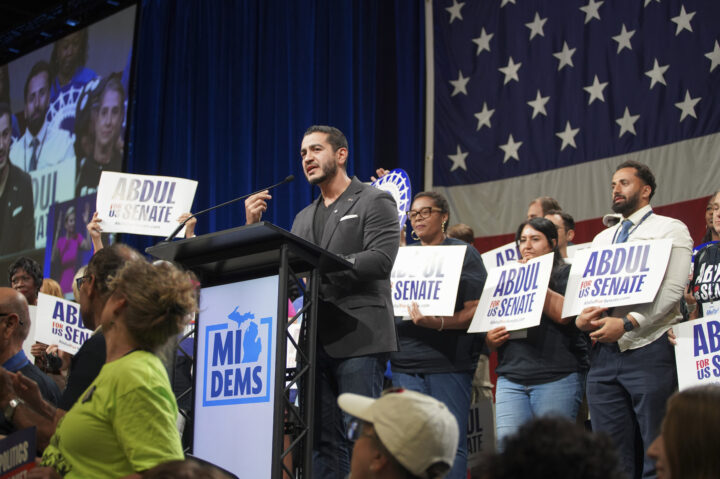
Abdul El-Sayed, Democratic nominee for the U.S. Senate, speaks at the Michgan Democratic Nominating Convention in Lansing, Mich. on Aug. 29, 2026.


 Add JewishInsider on Google
Democratic Michigan state Rep. Noah Arbit and 15 other Democratic leaders on Tuesday joined the Nonnegotiable Michigan campaign that is laying out a series of demands for the state’s Democratic Senate nominee, Abdul El-Sayed, related to Jewish safety and Israel’s right to exist.
Arbit, one of the most vocal and visible Jewish elected officials in the state, has been outspoken in his concerns about El-Sayed, condemning as “tokenism” the Senate candidate’s Rosh Hashanah video with two Jewish women affiliated with the anti-Israel group Jewish Voice for Peace, and condemning El-Sayed ally Hasan Piker as a “fascist” and “dumb and brain-rotted.”
The campaign has called on El-Sayed and other Democratic leaders to affirm commitments to Jewish safety, including that of Zionist Jews; to the right of Jews to define their own identities; to the Jewish right to sovereignty in Israel; to the right of all Jews, including Zionists, to full participation in the American political process; and to “an affirmative vision for a better future for the Middle East.”
In addition to Arbit, who also founded the Michigan Democratic Jewish caucus, several current former public officials joined the effort, including former state Rep. Ellen Cogen Lipton; University of Michigan Regent Mark Bernstein, who also previously chaired the state civil rights commission and led Gov. Gretchen Whitmer’s transition office; West Bloomfield Township Clerk Debbie Binder, township Supervisor Jonathan Warshay and township Treasurer Teri Weingarden; Clawson City Council Member Adam Duberstein; Madison Heights Council Member Sean Fleming; and former Keego Harbor Mayor Rob Kalman.
Several other Jewish and Democratic leaders also joined the effort including Joan Lowenstein, a member of the Michigan Democratic Party Central Committee and president of the Jewish Federation of Greater Ann Arbor; Ron Lippitt, an officer-at-large for the Oakland County Democrats; and David Lauer, Cindy Bank, Michelle Serlin, Michelle Miletic and Yehudis Brea, all board members of the Michigan Jewish Democratic Caucus.
David Kramer, the vice chair of the Michigan Democratic Jewish Caucus and prominent Democratic fundraiser in the state, announced that he was joining the Nonnegotiable campaign last week and that he is not, at this point, prepared to support El-Sayed without his commitment to the demands laid out by the Nonnegotiable campaign.
Senate leaders threatened to withhold funding from the race if Platner remains the nominee, while several of his progressive backers rescinded their endorsements
Laura Brett/Getty Images
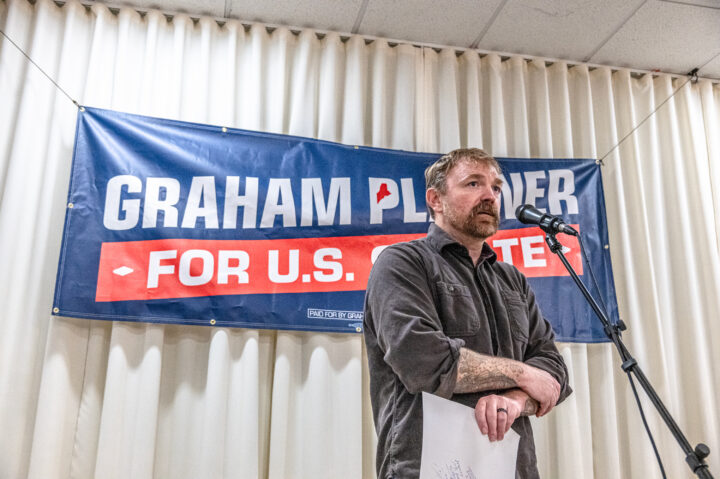
Democratic U.S. Senate candidate Graham Platner speaks to voters at a town hall at the Elks Lodge 188 on June 7, 2026 in Portland, Maine.
Democratic leaders coalesced around calls for Maine Senate candidate Graham Platner to withdraw from the race on Monday following a Politico report in which an ex-girlfriend of Platner’s accused the Democrat of sexual assault, an account the outlet backed up with her correspondence and other interviews.
Platner denied the allegation outright but said in a video statement that he’s “mindful of the political reality it will inflict” and would be “taking the time to reflect on the best path forward.” If Platner voluntarily drops out by July 13, the Maine Democratic Party would have until July 27 to pick a replacement to appear on the ballot.
Senate Minority Leader Chuck Schumer (D-NY) and Sen. Kirsten Gillibrand (D-NY), the chair of the Democratic Senatorial Campaign Committee, said in a joint statement that Platner should withdraw, and that the DSCC would not invest financially in the Maine Senate race if Platner remained the nominee.
“The allegations reported today are incredibly disturbing — violence, abuse and sexual assault are absolutely unacceptable,” Schumer and Gillibrand said. “Graham Platner needs to immediately withdraw as the Democratic nominee for Senate and allow Maine Democrats the opportunity to choose a new candidate who can defeat Susan Collins.”
Schumer and Gillibrand had offered tepid support for Platner in the wake of previous scandals he has weathered on the campaign trail.
Senate Majority PAC, the Senate Democratic super PAC, said in a statement that Platner should withdraw and that the PAC would be “redirecting resources away from the Maine Senate race.” The group said the race would be winnable “if Platner is not on the ballot.”
The Maine Democratic Party’s leadership also called on Platner to end his candidacy.
“Over the past several weeks, multiple women have made serious, credible allegations against Graham Platner. Today’s statements take those allegations even further,” party leaders said in a statement. “Maine Democratic Party leadership is calling on Graham Platner to withdraw as the Democratic nominee for U.S. Senate.”
The party leaders said it’s “essential that we refocus this campaign” on defeating Sen. Susan Collins (R-ME) and the Trump administration.
Maine Statehouse Speaker Ryan Fecteau, a Democrat, also called on Platner to drop out, saying it’s clear that he cannot win the seat.
Several prominent progressives who had previously defended and supported Platner, even through his previous scandals and controversies — including his now-covered Nazi tattoo and domestic abuse allegations — also said that the latest sexual assault allegations were a breaking point.
Sen. Elizbeth Warren (D-MA) said that there can be “no tolerance for sexual assault” and that “the best path forward is for Graham Platner to step aside.”
“I’ve been very clear that sexual assault or violence against women is a red line. These allegations are very serious and credible. Graham Platner should drop out from the race. I am withdrawing my endorsement,” Rep. Ro Khanna (D-CA) said on Monday evening.
Sen. Ruben Gallego (D-AZ) called the allegations “troubling and deeply serious” and likewise rescinded his endorsement.
Sen. Ed Markey (D-MA) said, “The allegations reported against Graham Platner are deeply disturbing and must be taken seriously. I cannot support his candidacy.”
Sen. Martin Heinrich (D-NM) similarly rescinded his endorsement and called for Platner to step aside.
Some of Platner’s prominent media boosters also said that they wanted to see him pull out of the race or otherwise criticized him.
“Platner needs to drop out ASAP — these are awful, credible allegations,” said Jon Favreau, co-host of “Pod Save America.” “It’s now abundantly clear that he just hasn’t been honest about his past and can’t be trusted as a candidate for office.”
Sens. Bernie Sanders (I-VT), one of Platner’s most prominent progressive backers, has not yet addressed the latest allegations.
The End Citizens United PAC also pulled its support for Platner, as did the Sanders-linked Our Revolution, though the group warned “the Democratic establishment: this is not your opening.” TrackAIPAC also pulled its endorsement of Platner.
Rep. Haley Stevens (D-MI), who is running for U.S. Senate in Michigan, also condemned Platner, who campaigned alongside her primary rival, Abdul El-Sayed.
“The allegations against Graham Platner are extremely troubling and completely unacceptable,” Stevens said. “There should be no room for this conduct in the U.S. Senate or any public office. Graham Platner must step aside.”
Numerous other Democratic Senate candidates followed her. El-Sayed, in a statement, did not unequivocally call for Platner to withdraw.
Speculation has already turned to who might replace Platner on the ballot, with many pointing to logger and former state Senate President Troy Jackson, a former gubernatorial candidate who finished third in the 2026 primary, as an alternative choice with a similar background and politics to Platner.
Jackson also campaigned alongside and supported Platner, something that could hinder his electoral prospects.
Jackson was endorsed by the Maine Democratic Socialists of America in his gubernatorial bid.
Former acting Centers for Disease Control Director Nirav Shah, who finished second in the primary, has also been floated as a potential replacement and has reportedly expressed interest.
Maine Gov. Janet Mills, the favored candidate of the Democratic establishment who suspended her campaign for the seat before the primary, could also see a second wind.
A recent poll also tested “Grey’s Anatomy” star and Maine resident Patrick Dempsey’s popularity in the state, as well as Secretary of State Shenna Bellows, who also ran in the gubernatorial primary; state Sen. Joe Baldacci; former House candidate Jordan Wood; Rep. Chellie Pingree (D-ME); former state Rep. Sara Gideon, who lost to Collins in 2020; former Rep. John Baldacci (D-ME); Attorney General Aaron Frey; and former Rep. Mike Michaud (D-ME).
State Sen. Baldacci said that the party “can’t handpick a replacement candidate without some process involving all Democrats” in the state.
Retiring Rep. Jared Golden (D-ME), who had been eyed by Democrats as a potential recruit for the seat, said last month that he was not interested in replacing Platner on the ballot.
Jeffries said Avila Chevalier has ‘walked away from many of the things that have been unearthed’ following a CNN report on her past sympathetic posts about communism and Soviet figures
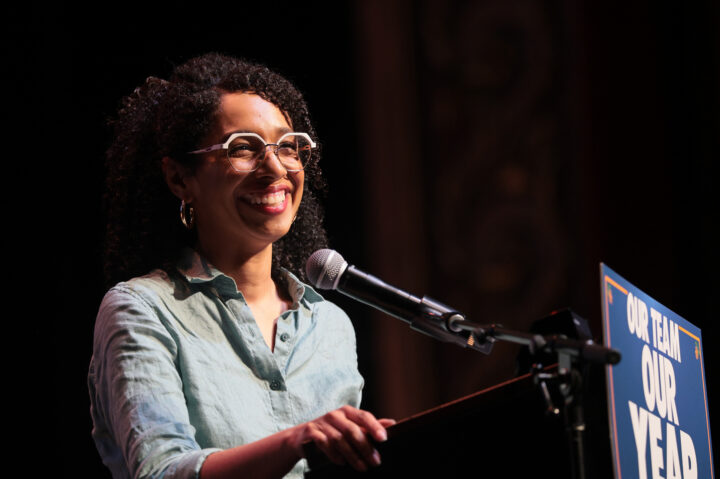
Photo by Michael M. Santiago/Getty Images
Congressional candidate Darializa Avila Chevalier speaks at a rally at King's Theater on June 18, 2026 in New York City.
Asked about New York City congressional candidate Darializa Avila Chevalier’s reported past comments supporting communism, House Democratic leaders suggested this week that she had changed and moderated her views.
CNN reported earlier this week that Avila Chevalier had repeatedly shared on a now-deleted Twitter account sympathetic posts about communism, Marxism and Soviet figures including revolutionary Vladimir Lenin. In an MS NOW interview on Monday, she denied being a communist and said that scrutiny of her past comments is a “distraction.”
Asked about the CNN report and whether communists have a place in the Democratic caucus, House Minority Leader Hakeem Jeffries (D-NY) said, “I don’t think there’s a single member of the House Democratic Caucus right now that identifies as communist.”
He said that Avila Chevalier is “going to have to speak for herself in terms of what she said in the past” but said she has been “pretty clear that she’s walked away from many of the things that have been unearthed, and has pretty clearly indicated that she’s a different person, but that’s for her, ultimately, to communicate, and I’m confident that she will, as best she can.”
Jeffries then pivoted to discussing affordability issues.
Rep. Pete Aguilar (D-CA), the No. 3 House Democrat, offered a similar response, telling Jewish Insider that he is personally a capitalist and that New York City Mayor Zohran Mamdani had indicated that some of the candidates he endorsed, including Avila Chevalier, had changed their views. He said that he would give all of the incoming members a “clean slate” as they enter the House.
Asked more broadly about progressive-versus-moderate divides in the Democratic caucus, Aguilar said at a Tuesday press conference, “This is a big-tent Democratic Party. Going into the fall [general elections], there is room for you, no matter where, no matter where you are.”
He denied any clashes between Democratic factions, saying “every person in that tent” is focused on holding the Trump administration accountable and delivering on Democratic priority issues.
“There may be different places within the broad tent that candidates and members come from, but all of us are aligned on that agenda, and that comes down to the values that we share,” Aguilar said. “This is what a coalition looks like, and people might not be used to it, because the Republican Party is the party of [President Donald] Trump, there’s no room for disagreeing with him.”
He insisted the party could remain united despite ideological differences, and would hash out differences, even if there may be “friction” at times.
Democratic leaders including Hakeem Jeffries continued to withhold their positions on the Massie amendment as right-wing Republicans stalled the House floor for a second straight week

Kevin Dietsch/Getty Images
House Minority Leader Hakeem Jeffries (D-NY) walks to a House Democrat caucus meeting at the U.S. Capitol on May 31, 2023 in Washington, D.C.
House Democrats remain divided over a push by Rep. Thomas Massie (R-KY) to slash $3.3 billion in military aid the U.S. is set to provide Israel in the 2027 State Department funding bill, and top Democratic leaders are continuing to keep their own positions vague.
But when that vote comes to the floor is still uncertain, as a handful of hard-line Republican rebels have pushed normal House business to a halt. Some senior House Democrats indicated that, even if they don’t support this particular effort, they still seek changes to the U.S.-Israel relationship.
House Minority Leader Hakeem Jeffries (D-NY) continued to withhold his position on the amendment, after saying a day prior he might have more to share on the subject after a caucus meeting on Tuesday morning.
“Those conversations are ongoing,” Jeffries said. “We had a very productive meeting today, and as I’ve indicated, there’s a lot that needs to happen differently to get to a place where there’s a just and lasting peace between Israel and the Palestinians, and we all need to focus on actually achieving a two-state solution once and for all.”
Rep. Pete Aguilar (D-CA), the No. 3 House Democrat, said at a press conference on Tuesday that Democrats had continued to air a variety of views on the issue at the caucus meeting. But he again declined to offer Democratic leadership’s view on the subject, pending whether the amendment would actually come up for a vote.
“Whether you are supportive or in opposition to the Massie amendment, that doesn’t mean that we feel everything is going well in that region, and that doesn’t mean that [Israeli Prime Minister Benjamin] Netanyahu has a blank check,” Aguilar — generally viewed as one of the more staunchly pro-Israel members of Democratic leadership — said. “It also doesn’t mean that our aid and support will go on forever, and we will continue to work through that.”
He said that Democratic leaders would have more to share if and when the amendment comes up for a vote. Pressed on how and whether Democrats can explain their decision on the issue, Aguilar called it “tough and emotional for the American people,” before pivoting to criticize GOP policies.
The timing of the vote on the amendment remains in question, as right-wing Republicans have stalled the House floor for the second week in a row, blocking the procedural measure that would advance consideration of the State Department funding bill, as well as the 2027 National Defense Authorization Act.
Rep. Jim Himes (D-CT) — the top Democrat on the House Intelligence Committee — joined his counterparts on the Foreign Affairs and Armed Services committees in opposing the amendment, putting the top Democrats on each national security committee in agreement. But he said he would support conditioning U.S. aid to Israel.
“The Massie amendment is way too overbroad,” Himes told Jewish Insider. “I am all in favor of making sure that the Israelis don’t get weapons that can find their way into settlers’ hands in the West Bank, [and] put some conditions on the way they conduct their wars in Gaza and in Lebanon. But this proposal is way overbroad.”
Rep. Greg Landsman (D-OH) criticized Republicans for allowing the amendment to come to the floor at all. Republicans blocked another Massie-led amendment aiming to strip U.S.-Israel cooperation provisions out of the 2027 National Defense Authorization Act from coming to the House floor.
“I still hope that [House Speaker Mike] Johnson (R-LA) pulls it,” Landsman told JI. “The other side allowing this to come to the floor is truly a mystery to me. My hope is that ultimately Johnson appreciates how terrible this is and the kind of conflict and division it creates. It hurts us, it hurts our partner [and] everything we’re working to do in the Middle East.”
He said he believes Republicans are allowing the amendment to move forward as a deliberate wedge to divide Democrats.
“You don’t play around with issues like this,” Landsman said. “This stuff can become very dangerous very quickly. … Why does he keep using Israel this way? It’s not right, and I think he’s getting a lot of calls from his supporters saying, ‘Stop doing this. Leave this issue alone unless you’re actually voting on something meaningful, but don’t give Thomas Massie airtimes for his grievances as it relates to an entire community of people.’”
Progressive Caucus Chair Rep. Greg Casar (D-TX) told reporters that he expects a “significant number of Democrats” to support the amendment. He said there’s a “growing number of members” that do not support providing additional weapons “for Netanyahu” but “I respect that others may have a different opinion.”
“What I think we’re all trying to get united around is the idea that everybody in the Democratic caucus should be working towards there being peace in the region, stability for Israeli and Palestinian civilians alike, and working to make sure that the Israeli government does not drag us back into war with Iran,” Casar said.
Asked about Democratic leadership’s silence on the issue, Casar said “the leadership should listen to our members, listen to our voters and do their best to provide guidance and information.”
Rep. Alexandria Ocasio-Cortez (D-NY) said that “after witnessing U.S.-funded weapons help perpetuate genocide of Palestinians,” the American people “want to see more accountability into where public taxpayer dollars are going.”
The main difference between the three candidates backed by most Democratic leaders and Mamdani’s favored challengers is the challengers’ hostility to Israel
Michael M. Santiago/Getty Images
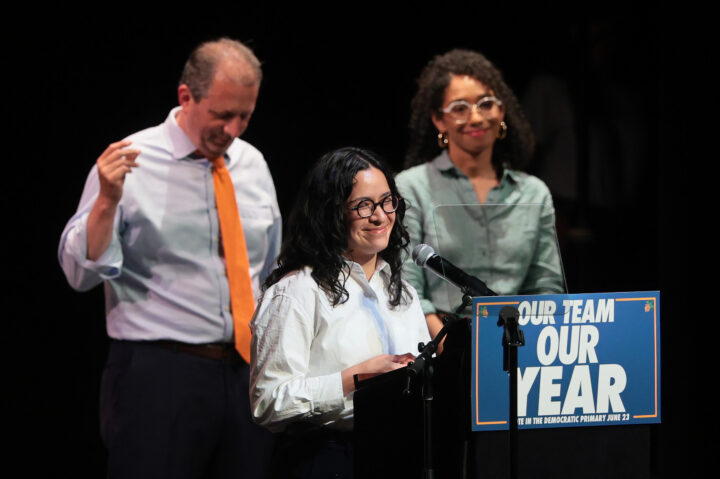
Congressional candidate Claire Valdez speaks during a Get Out the Vote (GOTV) rally at Kings Theater on June 18, 2026 in New York City.
2026 has been the year of the democratic socialist, with numerous far-left, anti-Israel candidates winning mayoralties and congressional primaries in cities up and down the Northeast corridor, from New York to Washington, D.C — and beyond.
Zohran Mamdani, the New York City mayor who proved that radicalism can win hearts and minds among voters in deep-blue jurisdictions, is now trying to utilize valuable political capital by electing three like-minded congressional candidates in primaries in the Big Apple on Tuesday — backing two challengers running against well-funded incumbents, and a third against a well-established progressive borough president.
The outcomes of these three races will go a long way in determining whether Democratic Party voters still draw any red lines around candidates holding views and values that fall outside the party mainstream.
Let’s be clear: The main difference between the three candidates backed by most Democratic leaders and Mamdani’s favored challengers is the challengers’ hostility to Israel.
Mamdani handpicked Darializa Avila Chevalier, a doctoral student with no obvious congressional credentials who protested against Israel the day after it suffered the worst terror attack in its history, to run against Rep. Adriano Espaillat (D-NY), the head of the Congressional Hispanic Caucus and a progressive supporter of the Jewish state.
Avila Chevalier has a laundry list of recent social media posts in which she called for abolishing the police and voiced anti-American and pro-Russian sentiments, while sharing a post saying “Israel doesn’t exist.” That hasn’t disqualified her, in the eyes of a critical mass of the district’s voters.
Mamdani recruited state Assemblywoman Claire Valdez to challenge Brooklyn Borough President Antonio Reynoso, despite the latter’s backing from party leaders. Valdez, a sculptor, has made her opposition to Israel a central part of the race, even falsely accusing AIPAC of being involved in the race when the outside spending against her came from a major teachers’ union. Reynoso, who has been a vocal critic of Israel, hasn’t made the Middle East a central part of his candidacy.
And Mamdani convinced former City Comptroller Brad Lander to run against pro-Israel Rep. Dan Goldman (D-NY), even working to clear the field of other challengers who threatened to split the anti-Israel vote against Goldman. Despite calling himself a progressive Zionist, Lander spent his final debate attacking the congressman for not calling Israel’s war against Hamas in Gaza a genocide and for supporting aid to the Jewish state.
As JI’s Will Bredderman has documented, all three of Mamdani’s picks have made their opposition to Israel a major part of their closing messages. And while polls show Goldman as the underdog in a progressive district, the other two races are highly competitive. Outside groups representing mainstream forces have mobilized on behalf of Espaillat and Reynoso in the final weeks of the race, giving them a fighting chance to prevail.
There’s no doubt that pro-Israel forces within the Democratic Party are facing uphill challenges, especially in deeply progressive districts where voters are increasingly open to far-left candidates. The outcome in New York’s primaries this week will indicate whether the establishment has the ability to slow down the radicals’ momentum.
National Security Action named Maher Bitar, a former Biden official and Students for Justice in Palestine student activist, as its new leader
Screenshot/C-SPAN
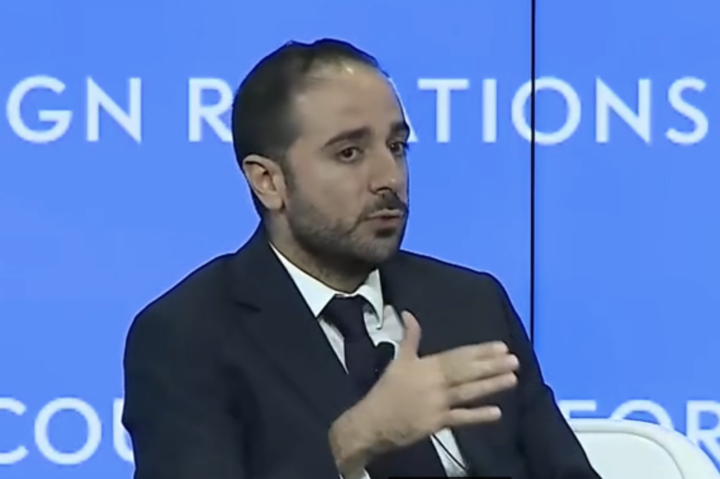
Maher Bitar
Several top Jewish Democrats are expressing concerns about the ideological direction of a newly revived foreign policy group now aiming to shape the party’s approach to Israel in the 2028 presidential election as well as a future Democratic administration.
National Security Action, an influential Democratic foreign policy organization that launched in 2018 and helped staff the Biden administration, is returning to the political arena with a new leader, Maher Bitar, who has served in high-level defense and intelligence roles on Capitol Hill and in the White House, the group confirmed on Sunday.
Bitar, a deputy assistant to President Joe Biden and coordinator for intelligence and defense policy at the National Security Council who most recently served as chief counsel and national security advisor to Sen. Adam Schiff (D-CA), has faced scrutiny over his past record of anti-Israel activism.
During his time in the Biden administration, Bitar, who is Palestinian American, drew criticism from Republican lawmakers who alleged that he had demonstrated bias against Israel, citing, among other things, his past board membership with Students for Justice in Palestine while attending Georgetown University. As a student, he had also helped organize a pro-Boycott, Divestment and Sanctions conference and was shown in a university yearbook performing a dance in front of a banner that called to “divest from Israeli apartheid.”
Ben Rhodes, a former deputy national security advisor in the Obama administration who is now a leading left-wing critic of Israel, co-founded NSA with Jake Sullivan, most recently Biden’s national security advisor. Sullivan drew headlines last year when he came out in support of withholding arms to Israel, an argument he reiterated last month on “Real Time With Bill Maher” while defending the majority of Senate Democrats who had recently voted to block some weapons sales to the Jewish state.
Both sit on NSA’s board and will be involved in the group, Rhodes told Axios, saying he is invested in building a “pipeline” to help “populate a Democratic administration” as well as crafting “ideas that can form a progressive or Democratic foreign policy going forward.”
“The center of gravity has shifted on the relationship with Israel, and there will be a debate about the nature of the relationship going forward,” Sullivan told the outlet.
“We urge National Security Action to continue to be an honest convener about these important issues,” Brian Romick, the president of Democratic Majority for Israel, told Jewish Insider. “There is a strong majority of Americans, including Democratic primary voters, who support the U.S.-Israel relationship because they understand that doing so is in the best interest of the United States.
“DMFI is proud to advocate for those voices and we recognize they have a major role to play in choosing our 2028 nominee,” Romick said.
Bitar told Axios, which first reported his role, that NSA would be a “big-tent” organization seeking to unite the party. “We are not excluding anyone,” he said, noting that the group will serve as a “hub” to discuss Democratic foreign policy “to be ready for 2028 and beyond.”
A former senior foreign policy official in the Biden administration, who was granted anonymity to address a sensitive issue, told JI that Bitar “was part of a small cohort of senior White House advisors who worked to actively undermine President Biden’s policy preferences by inserting their own anti-Israel ideology, especially” following Hamas’ Oct. 7 attacks.
“National Security Action exists to help empower our leaders and broad community of stakeholders to communicate effectively about foreign policy and bring together a wide range of perspectives,” David McGonigal, a spokesperson for the group, said in a statement to JI.
“Maher’s deep relationships across the national security community and the outpouring of support for his appointment — including from members of Congress and organizations such as J Street, the Jewish Democratic Council of America and the Nexus Project — underscore how National Security Action is uniquely positioned to carry out this important mission.”
Ethan Wolf, a Democratic strategist who previously worked as a communications director for Rep. Tom Suozzi (D-NY), told JI he was “concerned National Security Action is rewriting everything they’ve ever stood for and putting their pen in the hand of a ‘Pod Save America’ bro,” referring to Rhodes’ association with the left-wing political podcast hosted by former Obama officials who have grown increasingly hostile to Israel.
DMFI, for its part, also alluded to Rhodes and the podcast in a heated social media post on Monday. “Democrats and Americans do not want Pod Save America hosts dictating our future national security platform,” the group wrote.
Despite other reservations over Bitar’s new role, some Jewish Democrats voiced positive views about his extensive resume.
“Maher has held multiple high-level national security positions in government — in the House, in the Senate and in the Biden and Obama administrations — where he was deeply respected for his pragmatism, depth and expertise,” said Halie Soifer, CEO of the Jewish Democratic Council of America. “I enjoyed working with Maher in the Obama administration and think National Security Action is lucky to have him at the helm.”
Daniel Shapiro, a U.S. ambassador to Israel in the Obama administration who served as a top defense official in the Biden administration, said he had worked with Bitar “in various capacities for over a decade, and know him to be a thoughtful and talented national security professional.”
“When we agree and when we disagree — and we do both — Maher has always been dedicated to pursuing smart, strategic, productive policy in the national interest,” Shapiro told JI. “I am confident we will continue to have a productive dialogue. And I completely reject the prejudiced attacks against him based on his Palestinian-American identity.”
In an unsolicited statement shared by a spokesperson for Schiff, the senator said Bitar “has been devoted to addressing the country’s most complex foreign policy challenges while upholding our values and protecting America’s national security interests.”
“In this new role with National Security Action, I know Maher will continue to provide the great insights and leadership we need to get through these turbulent times,” Schiff told JI.
Joel Rubin, a progressive strategist involved in Jewish and pro-Israel causes, acknowledged what he called a “freak-out” among some Jewish leaders over Bitar, but expressed optimism that the new NSA head would be open to constructive dialogue on a divisive issue.
“As long as multiple voices are included at the table, and I have no reason to believe they won’t be, this is the reality of the Democratic Party,” said Rubin, who is releasing a new book on Democratic foreign policy this week.
Michael Makovsky, the president and CEO of the hawkish Jewish Institute for National Security of America, said, “Given the recent anti-Israel statements and actions of possible Democratic presidential candidates, even historically pro-Israel ones such as Rahm” Emanuel “and centrist former officials like Jake Sullivan, it will be interesting to see if the big tent the organization says it’s seeking will include real pro-Israel voices.”
NSA is also hiring an associate director for polling and outreach to “support its work advancing a smart, principled vision of U.S. foreign policy, while pushing back on the Trump administration’s reckless national security policies,” according to a job listing posted to its website.
The group’s previous executive director, Caroline Tess, a former National Security Council official in the Obama administration, stepped down in 2025.
While Republicans are now rejoicing over their narrow win, it otherwise largely demonstrated how Democratic leaders effectively sacrificed the seat to the GOP rather than elevate an extremist member of their own party
Muhammed Casim's campaign page
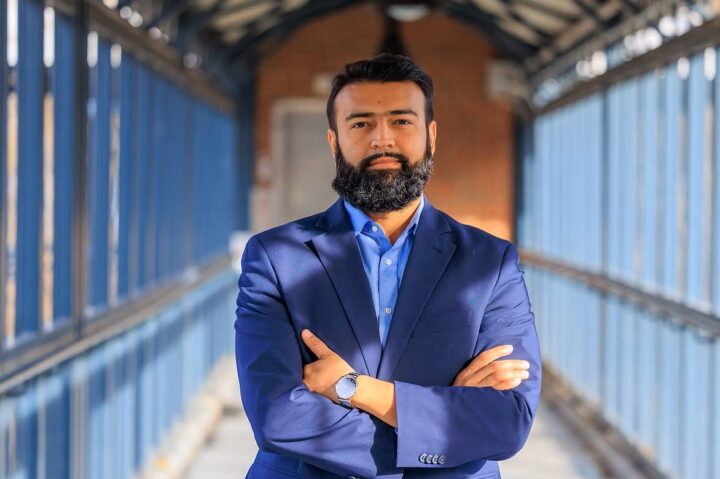
Muhammed Casim
In a low-profile electoral upset that defied the difficult national political environment facing the GOP, a Republican candidate declared victory this week in a down-ballot race for a seat on the Prince William Board of County Supervisors in Virginia — for the first time in nearly 40 years.
But while Republicans are now rejoicing over their narrow win, it otherwise largely demonstrated how Democratic leaders effectively sacrificed the seat to the GOP rather than elevate an extremist member of their own party who had claimed the nomination.
The result underscored the extent to which local Democrats had swiftly mobilized to oppose their own nominee, Muhammed Casim, who faced backlash over a series of recently uncovered past social media comments in which he used racist, misogynistic and antisemitic language. The posts, written more than a decade ago, used the n-word as well as demeaning rhetoric targeting women. He also accused Israel of genocide and promoted a conspiratorial post about U.S. financial assistance to the Jewish state, among other extreme comments.
More broadly, the outcome is an atypical example of how the Democratic Party worked to meaningfully confront extremism within its own ranks, even if its efforts came at the expense of an easily winnable local seat that instead flipped to Republicans for the first time in decades.
Casim apologized for his comments but refused bipartisan calls to drop out of the race, which had motivated a Democratic challenger to launch a write-in campaign that ultimately helped siphon votes away from his embattled bid. He lost to Republican Jeannie LaCroix by a margin of 258 votes. Write-in candidates pulled in 744 votes — a relatively sizable total that appeared to have made a difference in the closely contested race.
“Opposing antisemitism, racism or misogyny isn’t a partisan position,” Marc Broklawski, a Jewish vice chair of the Virginia Democratic Party, told Jewish Insider on Wednesday. “It’s a floor, not a ceiling, and the least we should expect from any party, official candidate or voter. When Democrats hold that floor even when it’s costly, that’s something to be proud of. When we don’t, voters notice that too.”
Casim’s campaign did not respond to a request for comment on Wednesday.
Though some prominent Democrats have sought to reject radicalism in their party, many Jewish party activists have begun to express a growing sense of unease about whether their longtime political home will remain welcoming, amid rising hostility toward Israel that has frequently crossed into antisemitism while producing alliances with controversial figures.
This week, for instance, leading Jewish groups spoke out against New York City Mayor Zohran Mamdani’s decision to host Mahmoud Khalil, the campus anti-Israel activist facing deportation who had justified Hamas’ terror attacks, for dinner at his official residence, while Democratic officials largely stayed silent.
Likewise, a mounting number of Senate Democrats have endorsed Graham Platner in his insurgent bid for Senate in Maine, brushing aside concerns about a recently covered Nazi tattoo whose provenance he has struggled to explain as well as associations with antisemitic conspiracy theorists that have continued to raise alarms among many Jewish party members.
And in Virginia, Jewish Democrats have denounced an anti-Israel state legislator, Sam Rasoul, who has called Zionism “evil” and a “supremacist ideology,” even as high-ranking state party officials have been reluctant to weigh in on his incendiary commentary.
By contrast, several Jewish activists and party strategists said they were encouraged that most Democratic leaders had enforced red lines in the Virginia supervisor election. Even if the party had been forced to endure a short-term hit in losing the seat, they suggested, it was healthy to set standards — particularly in a time of rising extremism on both sides of the aisle.
“Virginia Democratic leaders were clearly repulsed by Muhammed Casim’s racist, misogynistic and antisemitic social media posts,” Sara Forman, a Jewish party strategist who previously worked in the state, told JI. “Their actions, including calling Casim out publicly, should send a strong signal nationally that the entirety of the Democratic Party has not capitulated to the leftist narrative entirely.”
Such opposition was not unanimous, however, as the local party accepted Casim’s apology and said it would stand behind his campaign. “There’s a lesson in there about the integrity of voters and the lack of integrity — and therefore weakened legacy — among some Dem leaders,” Shannon Watts, a gun control activist who has also criticized Platner, wrote in an X post on Wednesday.
“Leadership means speaking out clearly and consistently against antisemitism, racism, misogyny, and not only when it is easy, but especially when it is not — and from whomever,” Eileen Filler-Corn, a Jewish Democrat and former speaker of Virginia’s House of Delegates, told JI. “These values should unite us. We can disagree on policy and politics, but standing against hate and discrimination in all forms should never be up for debate. Our credibility with voters depends on our willingness to apply that standard fairly and without hesitation.”
Still, with most Democratic elected officials in the county refusing to support Casim after his posts had surfaced near the end of the race, nonpartisan Jewish leaders and members of both parties voiced satisfaction regarding the strong show of resistance.
“We think it is imperative that both parties call out the fringe and hateful elements in their own parties, so we’re certainly glad to see the Democratic Party do it in this instance — especially when it was hard and cost them a seat,” Vicki Fishman, the director of Virginia government and community relations at the Jewish Community Relations Council of Greater Washington, told JI. “It’s an important lesson for everybody that hate is hate, and when you see the ugly rhetoric in your own house for what it is, it’s important to call it out.”
Gary Katz, a Jewish Republican activist in nearby Loudoun County, said he was “encouraged by the outcome” of Tuesday’s race, “where principled voices within the Democratic Party chose to reject a nominee whose past comments reflected racism, misogyny and antisemitism — even at the risk of losing the seat to a Republican.”
He said the dynamic “mirrors efforts we’ve seen in the GOP, such as in Fairfax County, to keep hateful elements from gaining leadership roles,” referring to a recent election where Republicans beat back an extreme candidate for county chair who had spread antisemitic conspiracy theories.
“It’s a reminder that combating the rising scourge of antisemitism requires people of good conscience in both parties to prioritize our shared values over partisan wins,” Katz told JI on Wednesday. “We need more of this vigilance to ensure that extreme fringes on either side never hold power, and that we support responsible leadership, even when we disagree politically, rather than those who align with us but betray our core principles.”
Many New York Democrats, from Gov. Kathy Hochul to Attorney General Letitia James, quickly spoke up. It took Mamdani over a day to do the same.
Michael M. Santiago/Getty Images
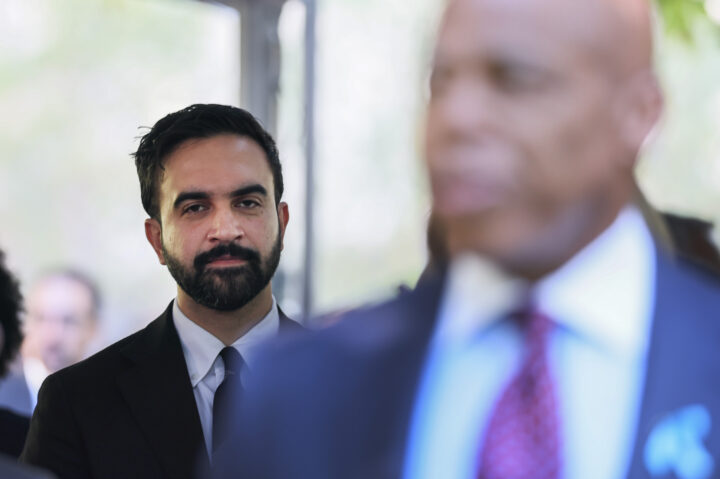
New York City Mayoral Zohran Mamdani (L) and former Mayor Eric Adams attend the annual 9/11 Commemoration Ceremony on September 11, 2025 in New York City.
New York City Mayor Zohran Mamdani is facing criticism from Democratic leaders over his delayed and muted response to last week’s pro-Hamas protest in Queens that caused nearby schools and a synagogue to close early in anticipation of the demonstration, where dozens of masked protesters chanted “We support Hamas” near the synagogue.
Democratic elected officials across New York — including left-wing politicians hostile to Israel, like Mamdani ally and former City Comptroller Brad Lander — were quick to release statements condemning the support for Hamas that was on display at the demonstration, which was organized by the group Palestinian Assembly for Liberation, [PAL]-Awda, to protest an event held by CapitIL, a Jerusalem-based real estate agency.
The event was held at the Modern Orthodox synagogue Young Israel of Kew Gardens Hills.
A flyer promoting the protest, which took place on a residential street about half a block from the synagogue, called the meeting an “illegal event” promoting “blatant land theft and dispossession.” Keffiyeh-clad demonstrators also chanted “There is only one solution, intifada revolution,” “Globalize the intifada,” and “Death to the IDF” for more than two hours while banging on drums.
“Let’s be crystal clear: this is vile antisemitism,” Lander, who is running to unseat Rep. Dan Goldman (D-NY) as a Mamdani-endorsed challenger in New York’s 10th Congressional District, said on Friday morning. “This should not have to be said: you can oppose land sales in the West Bank, without supporting terrorism & the mass murder of Jews.”
Gov. Kathy Hochul, who endorsed Mamdani in the mayoral election, also weighed in on Friday morning, saying, “Hamas is a terrorist organization that calls for the genocide of Jews. No matter your political beliefs, this type of rhetoric is disgusting, it’s dangerous, and it has no place in New York,”
New York Attorney General Letitia James said Friday midday, “Hamas is a terrorist organization. We do not support terrorists. Period.”
Other New York Democratic leaders who condemned the protest quickly and directly on Thursday and Friday included New York City Comptroller Mark Levine, Senate Minority Leader Chuck Schumer and Sen. Kirsten Gillibrand and Reps. Grace Meng and Ritchie Torres.
But the newly inaugurated mayor remained silent Thursday night and much of the following day regarding the demonstration, which marked his first major test in protecting the city’s Jewish community.
His spokesperson did not respond to multiple inquiries from Jewish Insider on Thursday, including one asking whether the mayor’s team had discouraged demonstrators from protesting and another, immediately after the event, asking if he condemned any of the slogans chanted.
Mamdani broke his silence late in the afternoon on Friday when he was asked about the protesters’ pro-Hamas chant by Politico reporter Jason Beeferman while leaving a campaign event in Brooklyn for Democratic Socialists of America-endorsed candidate Claire Valdez, who is running for a Brooklyn-Queens congressional seat held by Rep. Nydia Velazquez (D-NY)
“That language is wrong,” Mamdani replied while walking to a car after the event. “I think that language has no place in New York City.”
Mamdani later followed up with an additional statement just after Shabbat started in New York: “As I made clear, the rhetoric and displays that we saw and heard in Kew Gardens Hills last night are wrong and have no place in our city,” he said. “My team is in close touch with the NYPD regarding last night’s protest and counterprotest. We will continue to ensure New Yorkers’ safety entering and exiting houses of worship as well as the constitutional right to protest.”
On Saturday, when asked at a press conference why he didn’t “condemn both sides,” Mamdani answered, “I absolutely have an opposition to the sale of land in the West Bank. It’s a violation of international law and that comes from my belief in the importance of following international law.”
“It’s been a distressing few months for Jews everywhere. I appreciated the mayor’s statement,” Democratic strategist Chris Coffey told JI. “Could it have come earlier? Sure. But being mayor in the first week is pure pandemonium and chaos. The important part is that he got it right.”
But Mamdani’s eventual response was met with continued concern from Jewish leaders over its delay and neglect to specifically condemn Hamas. In a sign of the far-left character of his political base, he also received criticism from DSA-aligned allies in his own camp for criticizing the protest.
“It’s a step up from his statement [after the Oct. 7, 2023 terrorist attacks in Israel], which failed to even mention Hamas. Still, it’s concerning that it takes the mayor of the city with the largest population of Jews outside of Israel nearly 24 hours to condemn blatant antisemitism when every other major elected in New York found the time,” Democratic state Assemblymember Sam Berger, who represents the district where the protest took place, told JI on Sunday.
Another Democratic Queens assemblymember, Nily Rozic, told JI, “It shouldn’t take the mayor [nearly] 24 hours to condemn an antisemitic protest layered in antisemitism, let alone one that openly supports terror organizations.”
Rozic expressed dismay over the timing of the statement after Shabbat.
“If the mayor were genuine in his concern over Jewish safety he would have acted with urgency and not waited so long, when most of those impacted wouldn’t see his statement until long after,” she told JI.
“I am a vocal & passionate support[er] of Mamdani’s,” Adam Carlson, founding partner of the polling group Zenith Polls, wrote on X. “But I’ve waited patiently all day for him to forcefully condemn Hamas — watching dozens of other city & state electeds do so — and am still waiting. This is not only hurtful to me, but it’s bad politics & distracts from his agenda.”
New York magazine writer David Freedlander posted screenshots on X of texts sent to him on Friday afternoon from two city political operatives, both “broadly supportive of Mamdani.”
The messages were identical: “Zohran is completely blowing this pro-Hamas protest thing.”
Please log in if you already have a subscription, or subscribe to access the latest updates.
 Continue with Google

 Continue with Apple