













































































If approved, the move would make the Weitzman National Museum of American Jewish History a part of the Smithsonian Institution

Courtesy
The National Museum of American Jewish History


 Add JewishInsider on Google
A congressionally created commission studying the potential transfer of the Weitzman National Museum of American Jewish History in Philadelphia to the Smithsonian Institution held its first meeting on Tuesday, the start of a two-year process to produce recommendations for Congress and the Trump administration on whether to move forward with the merger.
The commission, appointed by congressional leaders, includes Weitzman Chairman Emeritus Philip M. Darivoff, author and historian Dara Horn, Washington Free Beacon publisher Michael Goldfarb, former University of Pennsylvania President Amy Gutmann, former Rep. Kathy Manning (D-NC), The New York Historical President Louise Mirrer, former chairman of the U.S. Commission for the Preservation of America’s Heritage Abroad Paul Packer and presidential historian Tevi Troy.
Darivoff, appointed by House Minority Leader Hakeem Jeffries (D-NY), and Horn, appointed by Senate Majority Leader John Thune (R-SD), serve as chair and vice chair of the commission, respectively.
Commissioners were sworn in on Tuesday by Sens. David McCormick (R-PA) and John Fetterman (D-PA).
“Jewish American history is American history. It should absolutely be shared now and for generations to come,” Fetterman said. “I’m proud to support this commission in its efforts to bring the Weitzman into the Smithsonian and as the first Pennsylvania-based museum in this iconic American institution.”
Darivoff told Jewish Insider in a joint interview with Horn last week that the Weitzman is the only museum that “seeks to tell the full story of American Jews, the history of American Jews, and their broad contribution to America and to inform the visitors on Jewish history and culture.”
Horn agreed that “this is a time when there’s a new urgency to this topic,” given the “ignorance” about American Jewish history and American Jews today. “I am excited to be part of this process and also delighted that this is a possibility that Congress is taking seriously.”
While the United States Holocaust Memorial Museum in Washington is a federal entity, it is not a part of the Smithsonian Institution and, Horn emphasized, there’s more to Jewish life and culture than the Holocaust. The Weitzman, she said, can help change the conversation around the American Jewish story.
“This is about America … and this is an important part of American history that has been very neglected, and also this is about a living Jewish culture and civilization,” Horn continued. “It’s a story that not a lot of Americans have access to.”
Both Horn and Darivoff emphasized that Jewish culture and civilization are deeply entwined through American history over the course of hundreds of years.
The commission is charged with examining whether the Weitzman’s collection would enhance the Smithsonian’s collection — something Darivoff said will require hiring experts to conduct research — whether the Weitzman would be a financial burden or benefit for the Smithsonian and how governance of the museum would be handled if a transfer were completed. Darivoff and Horn emphasized that the commission is not prejudging the process.
Becoming part of the Smithsonian would make the Weitzman’s mission to educate people about Jewish culture, history and contributions to the country and the world part of the federal government’s mission, Darivoff explained, “and that’s a huge injection of momentum and an elevation on the project that the mission is dedicated to.”
He said that becoming part of the Smithsonian can also make the Weitzman a more attractive institution for potential donors of precious artifacts, given the prestige that the Smithsonian carries.
“We’re living in an era where you have a crisis of credibility in institutions, and the Smithsonian is an institution that is associated with serious scholarship, serious history, finding ways to translate that history to be accessible to the public, to be accessible to students,” Horn added. “People who are looking for resources about American Jewish history, people who are looking for ways to make this accessible to a broader audience — it would be a way of putting that history in that place.”
The study comes at a time of turmoil for the Smithsonian as a whole. The Smithsonian’s secretary, Lonnie G. Bunch III, is set to resign at the end of the year as President Donald Trump attempts to assert authority over the historically independent institution.
The administration is reportedly attempting to condition funding to the institution on its compliance with the Trump administration’s priorities and preferred narratives.
Asked whether those developments might factor into the commission’s considerations, Darivoff and Horn emphasized that the commission was appointed in a bipartisan fashion and that the questions it is examining are bigger than any political moment.
Darivoff described the Smithsonian as “one of the great and important cultural and educational institutions in our country” and said it will remain so into the future.
“These are things that come and go in our political life,” Horn said. “Regardless of whether it becomes a Smithsonian institution, the Weitzman is going to continue to be here, and this opportunity to examine this as part of the Smithsonian is really something that’s above the fray because it is a generational opportunity.”
Five years after 'People Love Dead Jews,' the novelist's new book reframes Jewish hatred as a lie about destruction — and tells Jews they don't have to accept it
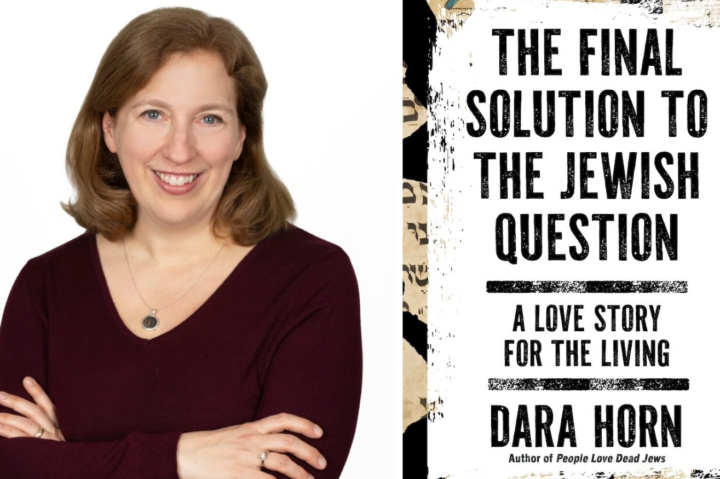
If you thought People Love Dead Jews — Dara Horn’s 2021 essay collection examining society’s reverence for remembering deceased Jews while failing to support the living ones — was an awkward book to read in public, just wait until you get your hands on Horn’s newest title: The Final Solution to the Jewish Question.
Horn, a celebrated novelist who has become the bard of contemporary antisemitism since Dead Jews was published five years ago, is in on the joke; she likes to say that both titles make great beach reads because no one will dare sit within several feet of you. (Her dad even made a custom People Love Dead Jews beach towel for her to test out the theory.)
But despite borrowing its title from the name of the Nazis’ infamous plan to rid Europe of its 11 million Jews during World War II, Horn’s latest book, which will be published on Sept. 1, is not a Nazi manifesto.
Instead, the title of Horn’s new book serves as an eye-catching, subversive dog whistle that is meant to pique the interest of antisemites — while also serving as a cheeky summary of Horn’s goal of actually trying to come up with a solution to the wave of antisemitism that has swept the world in recent years.
She just can’t believe that she is the one coming up with those solutions.
“I saw People Love Dead Jews as just a detour from my real work, which I see as writing novels,” Horn told Jewish Insider in an interview last week.
The genesis for Horn’s latest book came in the aftermath of Dead Jews. She spoke at public events often in 2021 and 2022, and she recalls becoming “the receptacle for everyone’s horror stories.” People would go up to Horn after she discussed the book and tell her about their own experiences of antisemitism. They often chalked up these incidents to jokes or misunderstandings or annoyances, such as a couple being ghosted by a longtime friend after the friend attended their son’s bar mitzvah or an actor turned down for roles in Hollywood because they looked “too Jewish.” But when taken together, they present a picture of a society that has learned to accept ambient anti-Jewish hate.
“This is going to sound really ridiculous,” Horn reflected on her previous book, “but I didn’t even really think it was a book about antisemitism. I saw it as a book about this weird historical phenomenon about the way we commemorate the past and how that affects the present.”
Many Horn acolytes felt that her thesis was borne out during the aftermath of the Oct. 7, 2023, Hamas terror attacks in Israel, the deadliest day for the Jewish people since the Holocaust, as they watched sympathy for Jewish victims turn to anger at Israel’s military response and even praise for Hamas’ actions.
“I’m not happy to have been right about this,” she said.
Horn became a sought-after expert on the willingness of many people to excuse contemporary hatred of Jews while insisting that they are not, actually, antisemitic. She was asked to serve on an antisemitism advisory group at Harvard, her alma mater, though the effort quickly fell apart. She testified to a congressional committee investigating antisemitism at Harvard. In early 2024, she wrote an essay in The Atlantic describing antisemitism as “the big lie,” and examined why so many smart people, including at Harvard, are willing to fall for it. Through all of it, American Jews — particularly young people on college campuses — wrote to her constantly, describing all the ways they had been excluded, shunned, cast out or harassed simply for being Jewish and declining to disavow Israel.
Horn is not, reflexively, a cynic. She does not think most people are out there looking to attack Jews. She summed up her understanding of non-Jews and how they relate to antisemitism by invoking the story of Purim, the holiday that celebrates the Jewish people’s courage in the face of a genocidal leader.
“Most people are not Haman,” Horn said, referring to the king’s advisor, who sought to exterminate the Jews of ancient Persia. “Most people are Ahashverosh.” That’s a reference to the bumbling king who pleaded ignorance at the malicious plans of his closest advisor but ultimately supported his ouster when the king’s wife, the Jewish Queen Esther, revealed her identity and asked for his help.
With her new book, Horn wanted something to offer the people who are ignorant rather than hate-filled, something to share with “your friend who doesn’t get it,” or “the principal of the school who is dealing with this,” she told JI.
“I am providing a solution. Not a solution in terms of, like, ‘Here’s 10 policy points we should implement,’” Horn explained. “It’s, ‘Here’s the story we need to be telling about who we are, to ourselves and to everyone else,’ and this is the story that is going to inspire people to imagine a better future.”
So what is that story? Horn wants the world to see Judaism as “a 3,000-year-old anti-tyrannical movement” that “is always going to piss off dominant societies.”
So the way to understand modern-day antisemitism, Horn argues, is not about “bias or bigotry or prejudice [or] conspiracy theory.” It’s about framing antisemitism as a lie.
“The lie,” Horn continued, “is always the same: Jews are destroying what you value the most.”
Since Dead Jews came out five years ago, and particularly after Oct. 7, Horn has watched many people freeze in the face of that assertion. She has observed a fatalism creep into the Jewish community, a sense that nothing can help, that this is our lot.
To those people, her answer is simple: “You don’t have to put up with this crap.”
Please log in if you already have a subscription, or subscribe to access the latest updates.
 Continue with Google

 Continue with Apple