














































































Plus, Temple Israel seeks to 'tell its story'

Andrew Harnik/Getty Images
Tulsi Gabbard is sworn in as Director of National Intelligence in the Oval Office at the White House on February 12, 2025 in Washington, DC.


 Add JewishInsider on Google
This P.M. edition is reserved for our premium subscribers — offering a forward-focused read on what we’re tracking now and what’s coming next. Please don’t hesitate to share your thoughts and feedback by replying to this email.
📡On Our Radar
Notable developments and interesting tidbits we’re tracking
Director of National Intelligence Tulsi Gabbard distanced herself — to a degree — from two of her isolationist-minded aides, Joe Kent and Dan Caldwell, who have taken a hostile stance to the U.S.’ Middle East policy, Jewish Insider’s Marc Rod reports.
Gabbard affirmed, after being pressed at a House Intelligence Committee hearing today, that the conspiratorial views about Israel espoused by Kent in his resignation letter earlier this week did concern her, and said about Caldwell that he would have no influence over intelligence reports at her agency.
Gabbard, who has previously been a vocal critic of military engagement with Iran, further acknowledged that her current position requires her to “check” her personal views “at the door”…
Reports of a potential $200 billion emergency funding request from the Pentagon for the war in Iran are drawing firm Democratic opposition and hedged responses from Republicans on the Hill: House Speaker Mike Johnson (R-LA) said he’ll “look at” the request “but obviously it’s a dangerous time in the world and we have to adequately fund defense,” while Sen. Lindsey Graham (R-SC) said he’d “hate to be the senator that denied the request if it made sense.” Rep. Pat Ryan (D-NY) responded with a simple “No,” while Sen. Richard Blumenthal (D-CT) called it a “nonstarter”…
The Senate is set to hold another round of votes on blocking U.S. arms transfers to Israel, after Sen. Bernie Sanders (I-VT) filed three new joint resolutions of disapproval against $658.8 million in sales of over 20,000 bombs to Israel, JI’s Marc Rod reports.
A majority of the Democratic caucus — 27 lawmakers — voted to block at least one arms sale in July of last year, a significant jump in support from previous similar efforts; Israel’s standing in the party has largely declined since then amid Democratic criticism of the war with Iran…
During a meeting with Japanese Prime Minister Sanae Takaichi at the White House today, President Donald Trump reiterated that he had told Israeli Prime Minister Benjamin Netanyahu not to attack Iranian oil facilities, after an Israeli strike on the South Pars gas field yesterday: “I told them, don’t do that. We didn’t discuss. … It’s coordinated, but on occasion, he’ll do something.”
Trump also put pressure on Takaichi to help secure the Strait of Hormuz, while European leaders released a joint statement “express[ing] our readiness to contribute to appropriate efforts to ensure safe passage through the Strait,” after repeatedly declining to get involved. A team of British military planners is now consulting with CENTCOM on options to assist short of military action, The New York Times reports…
Asked if he will deploy more U.S. troops in the region, Trump told reporters he’s “not putting troops anywhere. If I were, I certainly wouldn’t tell you — but I’m not putting troops”…
Secretary of Defense Pete Hegseth compared Iran to Hamas in a briefing today, saying that, “just like Hamas and their tunnels,” Iran has “poured any aid, any economic development … into tunnels and rockets”…
A group of congressional Democrats is urging the State Department to restart chartered evacuation flights out of Israel and take additional steps to help U.S. citizens who wish to leave the country amid the ongoing war with Iran, JI’s Marc Rod reports.
The lawmakers described the State Department’s current partnership with El Al, which launched on March 13 with a limited number of special evacuation flights for U.S. citizens, as insufficient. The Israeli airline has currently suspended registration for the flights, and government-imposed security restrictions are limiting passenger capacity on each flight and reducing airport operations…
Treasury Secretary Scott Bessent said that the U.S. may lift sanctions on Iranian oil already at sea in order to blunt rising gas prices. “In essence, we will be using the Iranian barrels against the Iranians to keep the price down for the next 10 or 14 days as we continue this campaign,” he explained on Fox News…
Saudi Foreign Minister Prince Faisal bin Farhan warned the kingdom is reaching a breaking point after continued Iranian attacks, saying “what little trust” Riyadh had with Tehran has “completely been shattered.”
On a potential Saudi military response, Prince Faisal said, “Do they have a day, two, a week? I’m not going to telegraph that.” It’s a notable shift for Riyadh, which had been pivoting away from its traditional allies and towards Iran and other Islamist countries prior to the war…
Illinois Gov. JB Pritzker condemned AIPAC after a primary cycle in which the pro-Israel group spent millions backing — and opposing — candidates across the state, calling it “an organization that was supporting Donald Trump and people who follow Donald Trump.”
Pritzker, a Jewish Democrat who was once an AIPAC donor himself, said it “really is not an organization that I think today I would want any part of.” He further echoed far-left sentiments that Israel dragged the U.S. into conflict with Iran, claiming Trump “simply follow[ed] Netanyahu into that war”…
Rep. Jared Moskowitz (D-FL) details his experience with a would-be assailant, a man described by authorities as a “ticking time bomb,” who was arrested near his home last year after police discovered an arsenal of weapons and a handwritten list of targets that included Jewish sites and Moskowitz.
“Besides the police presence outside his house, Moskowitz himself will not appear in parades and says he won’t speak at outdoor staged events. ‘It’s not worth it. I’d rather lose my election,’” the lawmaker told Roll Call…
Temple Israel in suburban Detroit released photos of the devastation to the building caused by an attacker last week, noting that it had “chosen thus far not to make [the photos] public” but are doing so now “to take back control of our narrative” after several were leaked to the media.
“We share these images because our community deserves to see our building through eyes of love, not through the lens of spectacle. This is our sacred space, and we will be the ones to tell its story,” the synagogue wrote…
The University of California, Berkeley reached a settlement in its lawsuit with the federal government, agreeing to pay $1 million and make changes to its discrimination policy following accusations that the university had failed to properly address campus antisemitism.
Among the policy changes, the school will clarify that the word “Zionist” cannot be used as a proxy for Jew or Israeli. The claims in the lawsuit predate the recent campus unrest over Israel’s war in Gaza, stemming from an incident in 2022 when student groups adopted policies saying they would not host Zionist speakers…
⏩ Tomorrow’s Agenda, Today
An early look at tomorrow’s storylines and schedule to keep you a step ahead
Keep an eye out in Jewish Insider for a look at the struggles facing international broadcasters Voice of America and Radio Free Europe in reaching Iranian citizens during the ongoing war due to budget cuts and roadblocks from the U.S. Agency for Global Media.
The House Appropriations Committee will hold a field hearing at the U.S. Mission to the U.N. in New York City on “accountability and reform” at the U.N.
We’ll be back in your inbox with the Daily Overtime on Monday. Shabbat Shalom!
DEADLINE LOOMING
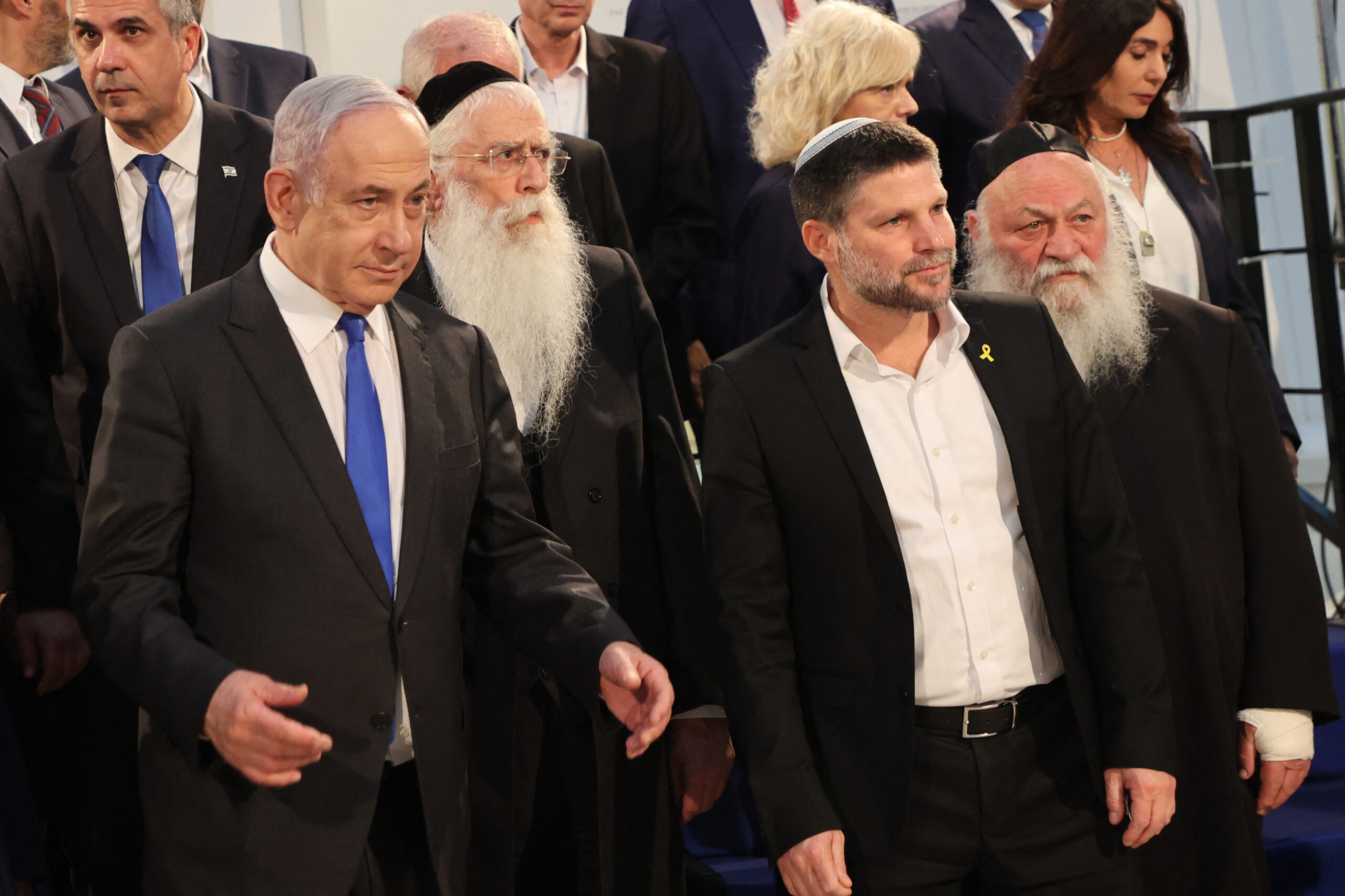
The prime minister’s governing coalition is struggling to stay intact to pass 2026 budget amid shifting political priorities
QUARREL ON THE QUAD

Anti-Israel activists are singling out regent Jordan Acker, hoping to unseat him with attorney Amir Makled, who represented a member of the school’s encampment
Gabbard, who has previously opposed war with Iran, said she has been required in her current role to ‘check’ her personal views ‘at the door’

Yuri Gripas for The Washington Post via Getty Images
Director of National Intelligence Tulsi Gabbard speaks during a Cabinet meeting with President Donald Trump on Wednesday April 30, 2025 at the White House in Washington, DC.
Director of National Intelligence Tulsi Gabbard distanced herself — to a degree — on Thursday from two aides who have taken hostile stances toward the U.S.’ Middle East policy: the recently departed director of the National Counterterrorism Center, Joe Kent, and the recently hired Dan Caldwell.
Kent resigned from the administration this week with a conspiratorial letter condemned by many as antisemitic, claiming that there was no imminent threat from Iran and that Israel and pro-Israel advocates in the U.S. had tricked the administration into joining it.
“He said a lot of things in that letter,” Gabbard said, when first asked at a House Intelligence Committee hearing if she agreed with Kent’s letter. “Ultimately, we have provided the president with the intelligence assessments, and the president is elected by the American people and makes his own decisions based on the information that’s available to him.”
Pressed again on whether Kent’s comments blaming Israel concern her, Gabbard affirmed that they do.
Regarding Caldwell — a prominent GOP isolationist who was reportedly hired to serve in the ODNI, Gabbard’s agency, after being fired amid a leak investigation from the Pentagon last year — Gabbard denied personal knowledge of him and claimed he would have no influence over intelligence products.
“My understanding is one of my elements sought to hire Dan Caldwell months ago for a purely administrative role that would not have any position over the intelligence analysis or assessments on any topic,” Gabbard said.
Pressed on her own personal views on the war in and threat from Iran, Gabbard declined to specify. The intelligence chief was previously outspoken as a member of Congress and then as a political commentator against a conflict with the Islamic Republic, which she had said would be unconstitutional and devastating on a scale not seen this century.
Gabbard said Thursday that her job requires her to set aside her own personal beliefs to prevent politicization of the U.S. intelligence products.
“The cost of war weighs very heavily upon me and my colleagues here, especially for those of us who have experienced and seen the cost firsthand,” Gabbard said. “My own personal and political views, as I mentioned earlier, I was asked and required by Congress and by the president in this role as the director of national intelligence to check those views at the door, to ensure that the intelligence assessments are not colored by my personal views.”
Pressed on the reasoning for the war in Iran, CIA Director John Ratcliffe affirmed that Israel did not force the U.S.’ hand in starting the war, an assessment with which Gabbard agreed.
Ratcliffe emphasized throughout the hearing that, regardless of whether the Iranian government theoretically maintained an edict prohibiting the development of nuclear weapons, it was stockpiling uranium enriched to 60% purity, for which there is no civilian purpose and which no other country has done without subsequently trying to obtain nuclear weapons.
“Much has been made by some about a fatwa against the development of nuclear weapons. Notwithstanding the fatwa, what we know — the intelligence community is in agreement on this — is that Iran possesses at least 440 kilograms of uranium enriched to weapons grade 60%,” Ratcliffe said. “The only use for that would be the development of nuclear weapons.”
“Our intelligence is also clear that they have not lost their ambition and that the activities to rebuild or reconstitute their nuclear facilities and centrifuges [continued],” he added.
Gabbard said that the intelligence community has “high confidence” that it knows where Iran’s enriched uranium stockpile is located.
Prior to last summer’s U.S. strikes on Iran’s nuclear program, Gabbard had said that Iran was not actively building a nuclear weapon, an assessment that President Donald Trump later dismissed as incorrect. She also said that lawmakers had mischaracterized her past remarks and assessment.
During the hearing, Gabbard said that, given the elimination of many in Iran’s top echelons, current U.S. intelligence and understanding of the Iranian leadership and its intentions is less clear than before the war, but described the new supreme leader, Mojataba Khamenei, as more extreme than his father.
“To be clear on Mojtaba, the son who has been named to replace [former Supreme Leader Ayatollah Ali Khamenei], it is unclear of his status or his involvement,” Gabbard said. “He was injured very severely through Israeli strikes, and so the decision-making is unclear about what’s happening in the Iranian leadership.”
Gabbard emphasized that the Israeli government’s own goals for its operations are not necessarily the same as those of the Trump administration — noting that the Israeli military has focused on eliminating Iranian leaders, while the U.S. is focused on Iranian military capabilities.
She said she does not know Israel’s own position on a potential deal with Iran, or have any information on Israel’s decisions to strike Iranian energy infrastructure. “I’m not privy to any of their deliberations or into their calculus and launching this or other attacks. I’m not, we are not involved with the operational element of this,” Gabbard said.
Rep. Josh Gottheimer (D-NJ) said that he supported the action by the U.S. and Israel to eliminate Iranian leaders and missile capabilities, but said that the administration needs to explain its actions and goals more fully to the American public.
Under questioning from Gottheimer, the intelligence officials affirmed that Trump had been briefed on the possibility of disruptions to global energy markets and a potential hard-line shift in Iranian leadership as a result of the war.
Gabbard said that, while the FBI has been having success in disrupting attempted terrorist attacks at home, those efforts have been stymied by the fact that some homegrown extremists may not have direct contact with foreign terrorist organizations.
FBI Director Kash Patel pushed back on accusations from Democrats that he had undermined and crippled U.S. counterterrorism efforts against Iran. Democrats repeatedly highlighted the firing of agents assigned to counter-Iran efforts, reportedly due to their past involvement in investigations of Trump.
Patel initially declined to comment on the firings pending litigation, but later said that any firings would be the result of internal misconduct investigations by career officials, regardless of other circumstances. Despite ongoing efforts to push officials connected with investigations of Trump out of the government, Patel largely downplayed his personal knowledge of the agents in question.
He also insisted that the FBI’s Iran team is strong, noting that it has tracked a 43% increase in Iranian espionage and attempted attacks, and that it has more than 300 ongoing terrorism-related investigations on Iran.
And Rep. Dan Crenshaw (R-TX) took a swipe at conservative commentator Tucker Carlson, who has claimed he’s under investigation by the federal government. Crenshaw, questioning witnesses about federal foreign surveillance authorities, surmised that Carlson’s communications with Iranian officials had likely been captured through existing targeting of those Iranians — not by efforts targeted at Carlson himself.
“When somebody, and let’s say their name rhymes with, I don’t know, ‘Tucker Carlson’ is claiming that the CIA is spying on him — I’m going to guess here, because I don’t know — I’m going to guess that the most likely scenario is that, in the process of him speaking with Iranian intelligence officials, it is incidentally collected,” Crenshaw said. “Nobody is spying on Tucker Carlson, or his inbox — to my knowledge, at least.”
Caldwell was adamantly opposed to the U.S. strikes on Iran last summer and argued that preventing Iran from obtaining a nuclear weapon should not be a top-tier U.S. priority
Yuri Gripas for The Washington Post via Getty Images
Director of National Intelligence Tulsi Gabbard speaks during a Cabinet meeting with President Donald Trump on Wednesday April 30, 2025 at the White House in Washington, DC.
Dan Caldwell, a vocal GOP critic of the administration’s Middle East strategy who hails from the isolationist wing of the party, has been hired for a job at the Office of the Director of National Intelligence under DNI Tulsi Gabbard.
Caldwell, once a top advisor and ally to Secretary of Defense Pete Hegseth, was dismissed last spring, accused of leaking to the press, and publicly criticized by Hegseth. Caldwell blamed his firing on opposition from the “foreign policy establishment.”
“In his new position, Mr. Caldwell will serve as an adviser to senior intelligence officials who are responsible for coordinating the work of 18 federal intelligence agencies and drafting the president’s daily intelligence briefing,” The New York Times reported.
A spokesperson for the ODNI said in a statement, “Any individual who is hired by ODNI goes through an extensive background review, including record checks and personal interviews, with a trained official to ensure the individual is trustworthy and does not pose a threat to national security.”
An administration official said that there “was no evidence released to suggest Mr. Caldwell had, in fact, leaked information from the Pentagon. The matter was investigated, and he was cleared” and that he has not yet started in his role but that it “would be an administrative role.”
Caldwell joins the administration amid ongoing operations in the Middle East — after having adamantly opposed the more limited U.S. strikes on Iran last June, maintaining his view that preventing Iran from obtaining a nuclear weapon should not be a top U.S. priority.
The isolationist wing of the party has established an apparent power base inside ODNI under officials including Gabbard, National Counterterrorism Center Director Joe Kent and Deputy Director of National Intelligence for Mission Integration Will Ruger, who like Caldwell worked for the isolationist Koch-backed Defense Priorities think tank before joining the Trump administration.
Prior to Ruger, Gabbard sought to hire Daniel Davis — also a Defense Priorities affiliate and a strident critic of Israel and opponent of U.S. action against Iran — for the role but reversed course amid public scrutiny.
Donald Trump Jr. praised Caldwell on Monday as a “true loyalist to my father and the entire MAGA movement” and an “America First Patriot.”
One former administration official told JI they see the hire as part of an ongoing effort by Ruger to “undermine the president on Iran,” “bring down” the U.S. operations against the Islamic Republic and attack CIA Director John Ratcliffe. “The sooner the president gets rid of Gabbard the better. He needs someone loyal at DNI, not leakers with political agendas,” the former official said.
Right-wing commentator Laura Loomer also lamented Calwell’s rehiring, alleging that Caldwell threatened to kill Hegseth when he was fired and that “to be hired to work at ODNI, you have to be an anti-Semite, a Trump hater, a Never Trump, funded by Koch, or a Democrat,” adding, “Their whole purpose is to undermine Trump and amplify the Tucker Carlson shadow government network.”
Caldwell’s first stop after his firing last April was an interview with Tucker Carlson, on whose show he has made subsequent appearances. He said in his initial appearance on the program that his dismissal was instigated by individuals who objected to his restrained approach to foreign policy matters.
“I have some views about the role of America in the world [that], as we’ve discussed, are a little controversial. All of us in our own ways threatened really established interests,” Caldwell told Carlson in April of himself and the other accused Pentagon leakers. “We threatened a lot of established interests inside the building and outside the building, and we had people who had personal vendettas against us.”
In between his two roles in the second Trump administration, Caldwell served as a senior fellow for foreign policy at American Moment, an organization aimed at staffing Republican political offices with young conservatives that advocates for a restrained foreign policy. He was also a frequent online commentator on Middle East policy issues.
Ahead of the U.S. strikes on Iran’s nuclear facilities last year, Caldwell argued adamantly against them, warning that they would turn into an extended nation-building effort and accusing Israel of trying to drag the U.S. into a war and undermine U.S. diplomatic efforts. He also dismissed a report suggesting that Iran had resumed its nuclear weapons program.
“The costs of a conventional strike against Iran’s nuclear program are potentially catastrophic in lives, dollars, and instability,” he said. “Yet, the long-term impact on the effectiveness of Iran’s nuclear program is likely to be limited.”
Throughout the war, he repeatedly warned that the U.S. and Israel lacked the air defense stockpiles to defend against sustained and ongoing Iranian attacks.
When the U.S. attacked Iran, Caldwell co-wrote an op-ed lamenting the U.S. decision and stating that the “move carries immense risks, potentially plunging the United States into yet another costly, dangerous quagmire in a region that is less important to Washington than foreign-policy elites would have you believe.”
The op-ed continued, “If Trump’s military operation isn’t tightly defined or properly managed, or if actors in the US government or outside of it are allowed to willfully expand the scope of the operation, the second outcome is the most likely — and the most disastrous,” referring to an extended war aimed at regime change.
After the strikes he said, in a co-written report, that no military approach other than a full occupation of Iran would permanently stop its progress toward a nuclear weapon and that U.S. strikes “may set the program back without destroying it, allowing Iran to reconstitute and even speed up its program over time.”
In the wake of the operation, Caldwell argued in a co-written analysis piece that the U.S. force posture in the region is “more of a burden than a benefit” and that around two-thirds of U.S. forces deployed to the Middle East as of July 2025 be withdrawn.
He said that there is no “existential military threat to the U.S. homeland” in the Middle East, therefore additional assets deployed after the Oct. 7, 2023, attacks should be removed, U.S, air defenses should be pulled back, carrier strike groups should be removed from the region and all U.S. forces should be removed from Iraq, Syria, Kuwait and Qatar, as well as some of the U.S. forces in Jordan.
“While a nuclear-armed Iran is not ideal, it does not pose an existential threat to the United States, as Tehran has no delivery vehicles capable of reaching the U.S. homeland,” Caldwell wrote. “Israel might view the threat posed by a nuclear Iran differently, but the interests of a U.S. partner — one that itself has nuclear weapons and receives significant U.S. military aid — should not solely drive the U.S. posture in the region.”
He additionally claimed that the U.S. military presence in the Middle East has no impact on the Iranian regime’s calculations “when it comes to the country’s nuclear program or its wider regional military strategy.”
And he said that the U.S.’s military presence “encourages risk taking by Israel” and that Israel might not have launched strikes on Iran last year if not for the U.S. presence.
Caldwell argued last November that conservatives shouldn’t rule out opposing U.S. aid to Israel.
He also dismissed the “freak out” among conservatives about a reported plan to establish a Qatari air force training facility in the United States.
And he warned that ongoing U.S. strikes against the Houthis could have dragged the U.S. into “another forever war in the Middle East.”
The conservative Caldwell additionally defended progressive Maine Senate candidate Graham Platner when Platner first disclosed that he had a tattoo resembling a Nazi symbol, claiming that Nazi tattoos were “fairly common” in the Marines during the war on terror.
Please log in if you already have a subscription, or subscribe to access the latest updates.
 Continue with Google

 Continue with Apple