













































































If approved, the move would make the Weitzman National Museum of American Jewish History a part of the Smithsonian Institution

Courtesy
The National Museum of American Jewish History


 Add JewishInsider on Google
A congressionally created commission studying the potential transfer of the Weitzman National Museum of American Jewish History in Philadelphia to the Smithsonian Institution held its first meeting on Tuesday, the start of a two-year process to produce recommendations for Congress and the Trump administration on whether to move forward with the merger.
The commission, appointed by congressional leaders, includes Weitzman Chairman Emeritus Philip M. Darivoff, author and historian Dara Horn, Washington Free Beacon publisher Michael Goldfarb, former University of Pennsylvania President Amy Gutmann, former Rep. Kathy Manning (D-NC), The New York Historical President Louise Mirrer, former chairman of the U.S. Commission for the Preservation of America’s Heritage Abroad Paul Packer and presidential historian Tevi Troy.
Darivoff, appointed by House Minority Leader Hakeem Jeffries (D-NY), and Horn, appointed by Senate Majority Leader John Thune (R-SD), serve as chair and vice chair of the commission, respectively.
Commissioners were sworn in on Tuesday by Sens. David McCormick (R-PA) and John Fetterman (D-PA).
“Jewish American history is American history. It should absolutely be shared now and for generations to come,” Fetterman said. “I’m proud to support this commission in its efforts to bring the Weitzman into the Smithsonian and as the first Pennsylvania-based museum in this iconic American institution.”
Darivoff told Jewish Insider in a joint interview with Horn last week that the Weitzman is the only museum that “seeks to tell the full story of American Jews, the history of American Jews, and their broad contribution to America and to inform the visitors on Jewish history and culture.”
Horn agreed that “this is a time when there’s a new urgency to this topic,” given the “ignorance” about American Jewish history and American Jews today. “I am excited to be part of this process and also delighted that this is a possibility that Congress is taking seriously.”
While the United States Holocaust Memorial Museum in Washington is a federal entity, it is not a part of the Smithsonian Institution and, Horn emphasized, there’s more to Jewish life and culture than the Holocaust. The Weitzman, she said, can help change the conversation around the American Jewish story.
“This is about America … and this is an important part of American history that has been very neglected, and also this is about a living Jewish culture and civilization,” Horn continued. “It’s a story that not a lot of Americans have access to.”
Both Horn and Darivoff emphasized that Jewish culture and civilization are deeply entwined through American history over the course of hundreds of years.
The commission is charged with examining whether the Weitzman’s collection would enhance the Smithsonian’s collection — something Darivoff said will require hiring experts to conduct research — whether the Weitzman would be a financial burden or benefit for the Smithsonian and how governance of the museum would be handled if a transfer were completed. Darivoff and Horn emphasized that the commission is not prejudging the process.
Becoming part of the Smithsonian would make the Weitzman’s mission to educate people about Jewish culture, history and contributions to the country and the world part of the federal government’s mission, Darivoff explained, “and that’s a huge injection of momentum and an elevation on the project that the mission is dedicated to.”
He said that becoming part of the Smithsonian can also make the Weitzman a more attractive institution for potential donors of precious artifacts, given the prestige that the Smithsonian carries.
“We’re living in an era where you have a crisis of credibility in institutions, and the Smithsonian is an institution that is associated with serious scholarship, serious history, finding ways to translate that history to be accessible to the public, to be accessible to students,” Horn added. “People who are looking for resources about American Jewish history, people who are looking for ways to make this accessible to a broader audience — it would be a way of putting that history in that place.”
The study comes at a time of turmoil for the Smithsonian as a whole. The Smithsonian’s secretary, Lonnie G. Bunch III, is set to resign at the end of the year as President Donald Trump attempts to assert authority over the historically independent institution.
The administration is reportedly attempting to condition funding to the institution on its compliance with the Trump administration’s priorities and preferred narratives.
Asked whether those developments might factor into the commission’s considerations, Darivoff and Horn emphasized that the commission was appointed in a bipartisan fashion and that the questions it is examining are bigger than any political moment.
Darivoff described the Smithsonian as “one of the great and important cultural and educational institutions in our country” and said it will remain so into the future.
“These are things that come and go in our political life,” Horn said. “Regardless of whether it becomes a Smithsonian institution, the Weitzman is going to continue to be here, and this opportunity to examine this as part of the Smithsonian is really something that’s above the fray because it is a generational opportunity.”
Howard Lutnick: ‘We are here because the victims of the Holocaust can continue to remind us that apathy must be overcome by meaning, neglect supplanted by remembrance and indifference surmounted by love’
Courtesy Lois Frankel
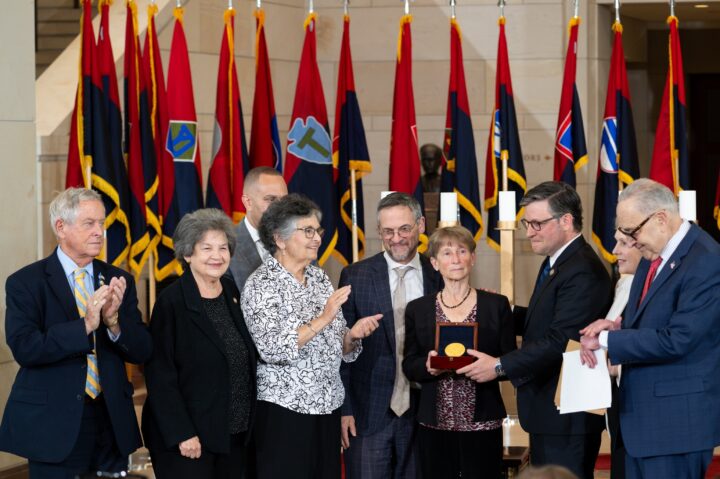
Commerce Secretary Howard Lutnick, congressional leaders, newly appointed U.S. Holocaust Memorial Museum Board Chair Jeff Miller and others spoke alongside Holocaust survivors on Capitol Hill on Tuesday at the U.S.’ annual commemoration of Yom HaShoah.
At the event, House Speaker Mike Johnson (R-LA) and other lawmakers presented a congressional gold medal — Congress’ highest honor — to the family of Benjamin Ferencz, the youngest of the U.S. prosecutors at the Nuremberg trials. Ferencz’s daughter, accepting the award, echoed her father’s motto — ”law, not war” — also imprinted on the medal itself.
In his remarks, Lutnick said that “President [Donald] Trump has shown through action, not just words but bold action, that he is the greatest friend of the Jewish people,” pointing the president’s work to free the hostages who were still in captivity in Gaza on Yom HaShoah last year.
Lutnick also recounted his visit last year to Poland, where he commemorated the liberation of Auschwitz and Birkenau, an experience that “left an indelible impression on my wife and me.” He drew a line from those atrocities to the 9/11 attacks, in which Lutnick, the former CEO of Cantor Fitzgerald, lost friends, family and many of his colleagues.
“Both groups of the fallen are made up of common heroes whose memory on earth will be lost if not for the determined effort by organizations like the Holocaust Memorial Museum to keep their legacy alive and ensure that the refrain ‘Never Again’ echoes for generations to come,” Lutnick continued. “We are here because the victims of the Holocaust can continue to remind us that apathy must be overcome by meaning, neglect supplanted by remembrance and indifference surmounted by love.”
Miller, a lobbyist who was recently appointed to replace former Ambassador Stuart Eizenstat as the Museum’s board chair, described Holocaust remembrance and the mission of the museum as a critical duty.
“The fight against antisemitism and Holocaust denial is one of the defining moral challenges of our time,” Miller said. “For as long as the museum stands, as long as the truth of the Holocaust is taught, and as long as the people of conscience refuse to surrender to hatred, the [forces] of antisemitism, will find that they have not awakened our fear, but our unbreakable will and our determination to never, ever surrender in the fight against evil.”
Miller also acknowledged the rampant and growing modern problem of antisemitism. He warned that Holocaust denialism has been spreading, particularly online, that antisemitism has returned “not quietly, but openly,” with Hamas’s Oct. 7, 2023, attacks serving as a “brutal reminder of what happens when hatred of Jews is allowed to go unchecked,” and Jews facing attacks and feeling afraid globally.
He said that he’s seen his own daughters face antisemitism on their college campuses, a challenge that “demands leadership, moral clarity and action.”
Then-Gen. Dwight D. Eisenhower’s warning at the end of World War II that some would eventually try to deny the Holocaust, “has become reality,” Miller said.
“The Holocaust demonstrates that hate began with the Jews but did not end with the Jews. That lesson cannot be more urgent today, and that is why the work of the United States Holocaust Memorial Museum matters so deeply,” Miller said. “Antisemitism has once again shown its face in our time with shocking boldness. Let the world hear this clearly: We will confront it. We will expose it, and we will defeat it, because the promise of Never Again is not negotiable.”
Miller offered particular thanks to Trump, calling him the greatest friend of the Jewish people and Israel, saying that the Jewish people “owe President Trump a lifetime of gratitude” for his efforts to free the hostages in Gaza and push back against antisemitism on college campuses and elsewhere.
But he also said that the challenge of antisemitism goes beyond any institution, individual or administration, and is instead a question of “the responsibilities of free people in every generation,” emphasizing that the Holocaust began with “lies, with propaganda, with conspiracy theories.”
Johnson highlighted modern manifestations of antisemitism particularly on college campuses and in support for the Oct. 7, 2023, Hamas terrorist attacks on Israel.
“Today, the work is even more important than ever, not only because those who personally witnessed this tragedy grow fewer in number each year, but because denying and distorting the truth of the Holocaust has become something, once again, that is tolerated and in some cases, even defended,” Johnson said. “On college campuses, leaders of once respectable institutions have excused hateful ideas as ‘context.’ The flags of radical Islamic terrorist groups have become commonplace on campus quadrangles, and safe spaces are reserved not for the Jewish students threatened by physical violence on those campuses, but for those who chant ‘From the river to the sea’ and ‘Long live Hamas.’”
He said that these “dangerous ideologies” have “dangerous consequences.”
House Minority Leader Hakeem Jeffries (D-NY) emphasized that neutrality and silence are not options in the face of antisemitism.
“It’s important that we continue to take a side,” Jeffries said. “We have no other moral choice, because we know the violent and deadly history and reality of antisemitism. Jewish life has included, for thousands of years, pain, pogroms, persecution, prejudice, expulsions, the terrorist attack on Oct. 7 and the Holocaust. Never again must always mean never again.”
Senate Minority Leader Chuck Schumer (D-NY) highlighted the need to call out antisemitism wherever it arises.
“We must continue to keep our eyes open today, at a time when antisemitism sadly runs rampant around the world once again,” Schumer said. “The responsibility falls on all of us. We must remember how the Holocaust happened, how too many stood silent in the face of evil, and how the death of democracy in Europe enabled the death of 6 million Jews. The poisons of fascism and antisemitism come from the same vial.”
Other lawmakers who spoke included Reps. Lois Frankel (D-FL) and Joe Wilson (R-SC) and Sen. Kirsten Gillibrand (D-NY), who led the legislation awarding Ferencz with the gold medal. Sarah Bloomfield, the director of the USHMM, delivered remarks on behalf of Ferencz’s son, and several Holocaust survivors shared their stories as well.
Please log in if you already have a subscription, or subscribe to access the latest updates.
 Continue with Google

 Continue with Apple