














































































The Senate majority leader also said the deal triggers requirements for the administration to provide Congress with the opportunity to review the agreement under INARA

Kayla Bartkowski/Getty Images
Sen. Majority Leader John Thune (R-SD) calls on reporters following the weekly Senate Republican caucus policy luncheon at the U.S. Capitol on January 14, 2025 in Washington, DC. Senators spoke about the Laken Riley Act which was named after a nursing student who was murdered in February 2024 by Jose Ibarra, a migrant from Venezuela who crossed the border in September 2022, that could give state attorney generals far-reaching veto power over federal immigration policy.


 Add JewishInsider on Google
With scant details provided by the Trump administration about the contours of the peace deal with Iran, Senate Majority Leader John Thune (R-SD) said on Monday afternoon that he doesn’t yet know enough about the administration’s deal with Iran to determine whether it is a good deal that will prevent Iran from acquiring a nuclear weapon.
“I don’t know enough about it to say,” Thune told reporters. “I think the issues are going to be compliance, and how you can enforce that, and what are the financial incentives that the Iranians have from our country, and what are they conditioned upon.”
The South Dakota Republican said that a positive deal would include financial incentives that are conditioned upon Iran winding down its nuclear program, the disposal of Iran’s enriched uranium and Tehran giving up its capacity to have a nuclear program in the future.
Thune also indicated that he believes the deal should be submitted to Congress for review under the Iran Nuclear Agreement Review Act.
“There are some requirements that are triggered because of the nuclear components of the deal, in terms of notification or informing Congress,” Thune said. “I know there is probably some expectation that there may be a vote at some point, whether that’s on a resolution of disapproval or something. We’ll see. I just don’t know enough about it yet. And I don’t think even the people who follow this stuff closely up here know that much.”
The administration hasn’t publicly commented on the issue of INARA yet, and has offered varying timelines for when it might release the text of the agreement. In media appearances, Vice President JD Vance has been framing specific nuclear issues as part of the next round of talks, rather than the current MOU, which could give the administration an avenue to attempt to dodge INARA review.
Thune said that “somebody” from the administration, whether that be Vance or other officials, “will need to” come to the Hill to brief members.
“For sure, our members are going to have a lot of questions about it,” Thune said.
Sen. John Barrasso (R-WY), the No. 2 Senate Republican, indicated he was similarly in the dark about the agreement.
“I haven’t seen anything from the president in terms of what’s in it. I’ve seen some press reports,” Barrasso told reporters. “I want to see what’s actually in it and I congratulate the president for his continued efforts.”
But asked whether he was concerned that the deal would be an effective surrender to Iran in providing sanctions relief, Barrasso rejected the idea out of hand.
“President Trump is never, ever going to do what you just suggested,” Barrasso said. “He’s not going to accept a deal that doesn’t eliminate nuclear weapons, isn’t enforceable, isn’t verifiable and doesn’t take Iran completely out of what they’ve been doing to try to undermine and attack us for the last 47 years.”
The president also said on ‘Meet the Press’ that U.S. forces could be deployed into Iran to retrieve and destroy the regime's stockpile of enriched uranium
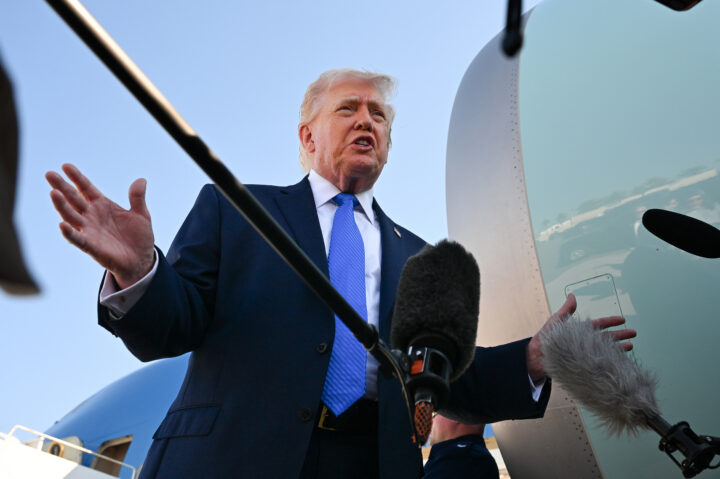
Roberto Schmidt/Getty Images
President Donald Trump speaks to reporters before boarding Air Force One at Palm Beach International Airport on March 23, 2026 in West Palm Beach, Florida.
Appearing on NBC’s “Meet the Press” on Sunday, President Donald Trump said his red line for resuming military action in Iran would be if he didn’t believe the parties could reach a deal in a timely manner, and said U.S. forces could be deployed into Iran to retrieve and destroy the regime’s stockpile of enriched uranium.
Trump continued to assert that Iran is desperate for a deal, even as negotiations appear largely deadlocked and as Esmaeil Baghaei, Iran’s Foreign Ministry spokesperson, told CNN in Tehran on Sunday that the primary obstacle to an agreement is Washington’s changing and “contradictory” positions. Meanwhile, U.S. and Iranian forces continue to exchange strikes nearly daily around the Strait of Hormuz.
Trump ruled out the prospect of unfreezing any Iranian assets or offering upfront sanctions relief to secure a breakthrough, maintaining that compliance must precede concessions.
“If they behave, if they do a good job, we start talking,” Trump said. But should Iran walk away from the table or drag out the timeline, the president emphasized he would not rule out a return to hostilities.
“My red line would be if I think I wasn’t going to make a deal, or if I wasn’t going to make a deal fast enough,” Trump said of resuming military action, noting that if Iran were to kill additional Americans — more than a dozen U.S. troops have already been killed in the current conflict — that would be “something that I would think about very seriously.”
“We’re having very good negotiations with the people that are leading the country now. It’s the third group that we’ve been dealing with. And they are different. And you could say it’s regime change actually because these are very different people. I find them to be more rational, very smart,” he added.
Trump specifically noted that he considers Supreme Leader Mojtaba Khamenei — the son of the late Supreme Leader Ayatollah Ali Khamenei — a more “rational” negotiating partner.
“I think [he is] more rational. He’s pretty badly injured. So there’s a certain bravery there,” Trump said. “A lot of people, if they were injured that badly, they wouldn’t be talking about, you know, ‘How are we doing with the United States?’ They’d have other things on their mind. So there’s a certain bravery there. But he is very seriously injured.”
The president further said U.S. forces could be sent into Iranian territory to secure the regime’s nuclear stockpiles, claiming that Washington knows exactly where the material is stored.
“The way you do it is if we make a deal now, we’re friendly, we’ll all go together. It’ll be our equipment. We’ll take it out and destroy it, whether it’s onsite or whether we take it offsite,” Trump explained. “We will be at peace. And we will go with them, or without them. But we won’t have people shooting at us, okay?”
He added: “Now, if we don’t make a deal, then we’re going to take them out militarily very harshly. And we’ll wait until we do that before we go, in which case we’ll have safety either way.”
Trump further claimed that the U.S. possesses highly specific data on Iran’s remaining military capabilities, including the locations of its drones, manufacturing plants, remaining missiles and launch sites. While the president stated that the majority of Iran’s production facilities “have been knocked out,” he acknowledged that Tehran still maintains some of its arsenal.
“I know almost the number, and we know where they are too, and we know where their drones are, and we know where their drone factories are,” Trump said. “Most of the drone factories have been knocked out, most of the launching pads have been knocked out and most of the missile manufacturing areas have been knocked out. But they still have capacity. They have some missiles, they have some drones. I would say percentage wise, maybe 21-22% of their missiles. It’s a lot of missiles, but it’s not what it was when we first attacked.”
Turning to the broader regional landscape, Trump clarified that he is “not demanding” that Lebanon be included in a peace deal with Iran, as Tehran has requested, though he expressed a desire to see “a more surgical” approach to combating Hezbollah
“I’d like to see Lebanon have a better life,” Trump said. “I’d like to see a more surgical attack on Hezbollah. I think it should be more surgical,” he added, but did not reference Israel or its recent military actions against the terror group.
Please log in if you already have a subscription, or subscribe to access the latest updates.
 Continue with Google

 Continue with Apple