











































































The closure of Oro Nami after less than a year has reignited a long-running debate about why the nation's capital is stuck with just one full-service kosher option
Gabby Deutch
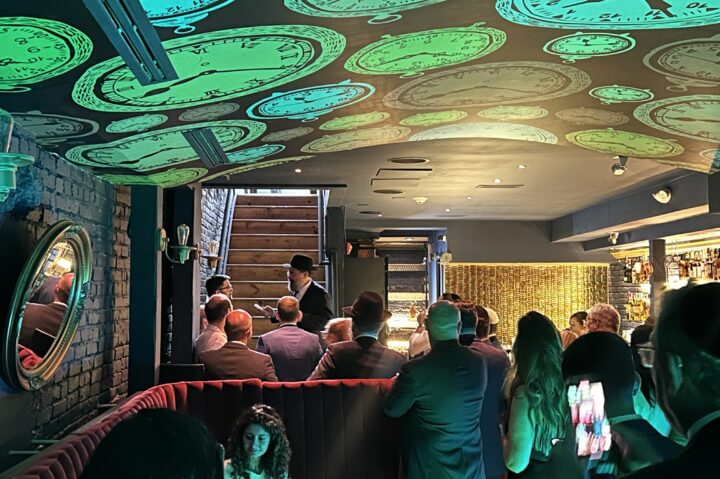
Rabbi Levi Shemtov, executive vice president of American Friends of Lubavitch (Chabad), prepares to hang a mezuzah on the doorpost at the grand opening of Oro Nami, a new kosher sushi restaurant in the West End neighborhood of Washington on June 25, 2025.


 Add JewishInsider on Google
At last year’s grand opening for Oro Nami, a kosher sushi spot in Washington, the restaurant’s splashy aesthetic — red velvet booths, multicolor clocks projected on the ceiling, dark walls, a light-up floor — did not exactly align with the clientele: Capitol Hill staffers, new Trump administration appointees, K Street lobbyists and a handful of Orthodox rabbis.
But even if Oro Nami’s atmosphere felt slightly out of place in Washington’s quiet West End neighborhood, where the city’s small Orthodox community is centered, that incongruity was no match for the excitement among observant Jews living in the nation’s capital. For years, people had been clamoring for more kosher dining options in the city, and in particular one that would be open past 8 p.m. Oro Nami seemed like the answer.
That is, until it shut down in May, after less than a year in business.
Now Char Bar, the meat restaurant in the West End that has been serving observant Democratic and Republican officials — and their friends and colleagues — for years, is once again the only sit-down kosher restaurant with a liquor menu. Nearly all of the area’s kosher restaurants are located in Maryland suburbs like Silver Spring and Rockville, where the bulk of the region’s Orthodox community lives. In a city that thrives on power lunches, kosher-keeping Jews have only one option.
The closure of yet another kosher restaurant in the District has reignited one of Jewish Washingtonians’ favorite conversation topics: Why aren’t there more kosher restaurants in a city as important as the nation’s capital?
People with knowledge of the restaurant business say that the answer is straightforward, if unsatisfying: economics. The Washington metro area has more than 300,000 Jews, according to a community-wide study completed in 2017. Just 5% of them are Orthodox, and most of the Orthodox Jews live in Maryland.
“Kashrut in general in D.C. I think is tricky, because from a real estate perspective, everything is priced like a normal restaurant,” said Rabbi Charlie Schwartz, the director of Lehrhaus, a kosher restaurant in Boston that plans to expand to Washington. “It’s assuming that you’ll do a high volume of business on Fridays and Saturdays, and for larger restaurant spaces that you’ll have pretty high alcohol sales, and kosher restaurants just don’t operate that way.”
“There isn’t a concentrated district [in D.C.] where all the Orthodox Jews work. There isn’t a district where everybody is going to particular museums. Even the museums and the things that tourists do are spread out,” said Dani Klein, who runs the popular blog “YeahThatsKosher.”
In 2024, Lehrhaus announced to great fanfare that it planned to open in Washington, its second city, in 2025. But the restaurant, which bills itself as a “Jewish tavern and house of learning,” has not even broken ground on a location in D.C. yet. (“We’re 100% in on D.C,” Schwartz promised. “We’re not dismayed in any way.”)
Dani Klein, who runs the popular blog “YeahThatsKosher,” said that the layout of the city doesn’t help.
“There isn’t a concentrated district [in D.C.] where all the Orthodox Jews work. There isn’t a district where everybody is going to particular museums. Even the museums and the things that tourists do are spread out,” said Klein. He compared it to Midtown Manhattan, where he works in corporate marketing. Due to its proximity to major tourist attractions such as Times Square, Broadway and Central Park, along with scores of office towers, the neighborhood has a wealth of kosher options, though he noted several restaurants have closed recently.
He described Chicago as a more apt parallel to D.C., although Washington actually has more kosher options downtown.
“As you go further north [in Chicago], outside of downtown, and you start going to where the Jewish community lives, then you get massive pockets of kosher,” said Klein. Washington’s kosher restaurants are mostly in the suburbs, too.
Char Bar’s owner, Michael Chelst, does not primarily earn a living from running a kosher restaurant. He also works in the mortgage business, and he recently took over operating Moti’s Market, the kosher grocery store in Rockville.
“I call us a ‘likely for profit’ business. We’re not a nonprofit,” Chelst told Jewish Insider recently. “I get frustrated when people go, ‘Oh, why don’t you do more of this and that.’ I’m like, ‘Listen, we’re just trying to keep it open and keep it going for our community and for the people there.’” Still, the vast majority of Char Bar’s customers are tourists, according to Chelst.
Despite the addition of Oro Nami last year, 2025 was Char Bar’s highest-revenue year since it opened in 2014. (Chelst previously ran a different kosher spot, Eli’s, in the same location.) Chelst said he thinks Washington would benefit from a dairy restaurant, even if it competes with Char Bar.
“I’m sure that would hurt our business, but I wouldn’t be upset if one opened, because that would be good for the community,” said Chelst.
People know there’s an appetite for more options, even if the money isn’t quite there to support them.
“I get a call, I’d say, every other month or so from someone who’s very interested in starting up any of a range of Kosher cuisine enterprises here,” said Rabbi Levi Shemtov, executive vice president of American Friends of Lubavitch (Chabad). “I know of a few currently still considering doing so. They’re watching downtown business lunch traffic, and when that picks up, I think you’ll see another one or two actually get established.”
Other options have opened and closed over the years. Jack Abramoff, the Republican lobbyist who went to prison on corruption charges, ran a kosher deli for a period in the early 2000s. An upscale kosher French restaurant called L’Etoile closed in 2002 after three years. The local Israeli chain Shouk closed last year, in part due to boycotts by anti-Israel activists. In earlier eras, when the local Jewish community was actually centered in the District and not the suburbs, kosher options were not so hard to come by; following the Civil War, six kosher restaurants were operating in D.C.
“I urge the relatively new kosher-keeping residents of Washington, D.C., to understand the privilege that they have to live in this time,” said Aaron Keyak, a Democratic consultant who moved to Washington nearly 20 years ago. “And with the advent of all these food delivery apps, you can reach into the suburbs and get everything from kosher Chinese to pizza.”
But despite the kvetching from locals, Washington’s kosher restaurant scene has not actually been stagnant in recent years. Oh Mama Grill, a casual Israeli-style falafel and shawarma restaurant, opened in Adams Morgan in 2022 and is still operating. During the academic year, anyone — whether affiliated with George Washington University or not — can visit Zingers, a kosher restaurant in the GW Hillel that opened in 2023 and is operated by the university’s dining operation, as part of the school’s pledge to provide kosher options for Jewish students. Zingers serves sandwiches and bowls alongside what it deems “the best chicken sandwich in Foggy Bottom.” At $12, the sandwich can compete with non-kosher options.
“People eat there because the food is good,” said GW Hillel’s executive director, Daniel Novick. “A lot of non-Jewish students are eating there.”
There are even now kosher deli sandwiches available for purchase in the cafeteria at Longworth, one of the congressional office buildings.
Other kosher options in the city include Pow Pow, a vegan Asian restaurant with two locations in the city, and Baked By Yael, a bakery across from the zoo in Woodley Park that sells pastries, challah, bagels and cake pops. They are certified by a kashrut agency operated by local Modern Orthodox rabbis — so while some strictly religious Jews may not eat there, the creation of DC Kosher to give the seal of approval to local plant-based restaurants was a boon to most of the city’s observant Jews.
“I urge the relatively new kosher-keeping residents of Washington, D.C., to understand the privilege that they have to live in this time,” said Aaron Keyak, a Democratic consultant who moved to Washington nearly 20 years ago. “And with the advent of all these food delivery apps, you can reach into the suburbs and get everything from kosher Chinese to pizza.”
“People are always kvetching about why there aren’t more establishments,” said Rabbi Levi Shemtov, executive vice president of American Friends of Lubavitch (Chabad). “But once they open, the proprietors feel that the community doesn’t show enough support.”
D.C. is a foodie city, at least for the non-kosher keepers. Two Washington restaurants appeared on The New York Times’ vaunted “50 Best Restaurants” list last year. Don’t expect to find kosher restaurants on the list — but that doesn’t mean the city’s kosher food scene is a lost cause.
Shemtov, one of the best-known Orthodox rabbis in Washington, had a blunt message to Jewish Washingtonians about the local food scene.
“People are always kvetching about why there aren’t more establishments,” said Shemtov. “But once they open, the proprietors feel that the community doesn’t show enough support.”
It was like the now-famous Barack Obama line from the 2016 Democratic National Convention, when he urged Democrats to vote in that year’s elections. Don’t boo. Vote.
Shemtov’s message is similar. Don’t kvetch. Eat.
Chabad Rabbi Zvi Hershcovich thought he was the ‘only weirdo’ following Jewish hockey players, until he started an X account for fellow aficionados
courtesy
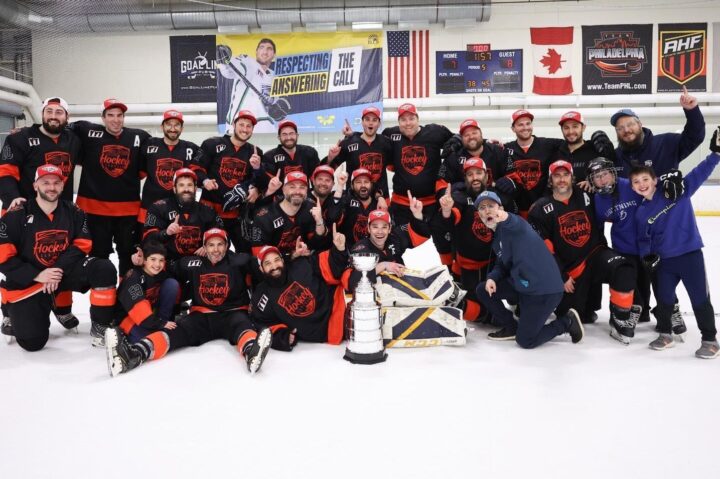
@JewishHockey account creator Zvi Hershcovich (center, right) after his team won their division in last year's Rofeh Cholim Cancer Society Classic, a Jewish benefit tournament in Pennsylvania/
Zvi Hershcovich is from Canada, which means he loves hockey. He is also a Chabad rabbi, so helping Jews connect to their faith is his sacred mission.
Helping a Jewish hockey player wrap tefillin? Life goal achieved.
Yet that wasn’t what Hershcovich expected to happen when he created the X account @JewishHockey, where he posts clips of Jewish hockey players at all levels — National Hockey League superstars, minor league up-and-comers, college athletes — scoring goals and generally looking cool on the ice, usually accompanied by a deeply Jewish caption.
“On the last night of Chanukah, Zach Hyman spins the Dreidel on a backhand and wins the chocolate coins,” one post from @JewishHockey stated on Monday, with a clip showing Edmonton Oilers left winger and Jewish day school graduate Zach Hyman scoring a goal against the Vegas Golden Knights. (The Oilers won 4-3.)
A day earlier, @JewishHockey spotlighted a goal by Vancouver Canucks center Max Sasson against the Boston Bruins in a game Vancouver won in a shootout. “With seconds left to the period, Max Sasson shakes off his defenseman like powder sugar on a Sufganiya, and buries it like a defiled altar found by the Maccabees,” the post read.
With 3,900 followers, the nearly two-year-old account doesn’t have a huge audience. But it does have a cult following. That’s where the story with the tefillin comes in.
“People reach out all the time with different things, and I’ve made some connections with many hockey players,” Hershcovich told Jewish Insider in an interview on Tuesday. “Some of them have been very Chabad-centric, where I’ll connect with someone online or in person. Just last week, I helped a Jewish hockey player get a pair of tefillin.”
After the antisemitic attack at a Hanukkah celebration in Australia earlier this month, a hockey player in British Columbia was motivated to wrap tefillin but did not know where or how to do so, so he reached out to @JewishHockey. The closest Chabad rabbi was still a significant drive away, but Hershcovich, who declined to name the athlete, made the shidduch anyway. The two men connected, and FaceTimed Hershcovich to prove it.
“Then I decided, I shot my shot. I said, ‘Hey, listen, would you be interested in wearing tefillin every day if you had your own pair?’” Hershcovich recalled. “He said sure. He gave his word. So I threw it out there on Twitter, and someone who asked to remain anonymous wrote back and said, ‘I’ll sponsor the pair.’”
The hockey account is a bright spot on X, where antisemitism and harassment have grown worse in recent years.
“Twitter [X] has become a bit of a cesspool thanks to the propaganda of the enemies of the Jews,” Hershcovich said. “Even on posts that I post, you’ll get a lot of hate, but there definitely has been a community rising, and there’s a close knit Jewish hockey community. It’s very neat to be part of it.”
Serving as the unofficial Jewish ambassador to the world of hockey is not Hershcovich’s day job (though it did lead to some freelance work for a Jewish Hockey Hall of Fame being developed in Toronto). His career looks like many other Chabad rabbis. He spent a short stint as a Chabad emissary in Russia more than a decade ago. Now he teaches at a Chabad day school in Philadelphia, creates animated programming for religious children and works on programming for Jewish college students.
The son of two ba’al teshuva Jews — people who were raised secular but chose in adulthood to become observant — Hershcovich, 43, first connected to hockey through his grandfather, with whom he often watched Montreal Canadiens games.
“There was Mathieu Schneider on the Canadiens, and he was my grandfather’s pride and joy, that the Canadiens had a Jewish hockey player on the team. So that might be where it started,” Hershcovich said, referring to the hockey Hall of Famer who won a Stanley Cup in 1993.
Basketball was Hershcovich’s main sport as a child, until he took up hockey at a Chabad camp. Later, his parents subscribed to the Jewish Press and he remembered an article about a Jewish hockey prospect. So he started keeping an eye on the hockey news for Jewish players after seeing how excited that story made his grandfather.
“I thought I was the only weirdo doing this for many years, following specifically Jewish hockey players,” Hershcovich said. He still plays hockey every Saturday night after Shabbat, and participates in an annual Jewish hockey tournament in Pennsylvania that draws hundreds of athletes and benefits Rofeh Cholim Cancer Society, which supports cancer patients and their families.
In 2022, as a passion project, Hershcovich drafted a pseudo “Team Israel” for hockey — a fantasy roster of Jewish players from around the world who might join an Israeli team, inspired by the fact that 20 of the 24 players on the Israeli baseball team at the 2020 summer Olympics were American Jews.
“I had some fun with that, and that led to more fans, more Jewish hockey fans, discovering there was a larger group. So I opened up a Twitter account and started posting highlights of Jewish hockey players, and things kind of blew up from there,” said Hershcovich. “It’s become part of my daily routine. I wake up in the morning, I just breeze through a couple of Google Alerts, and I go through elite prospects, my bookmarked players. It gives you an update over who scored and some basic statistics from the previous night. I’ll look through it. If I see some highlights, I’ll share them. This has been going on as there’s been a huge explosion in the Jewish hockey world.”
Jewish hockey fans have been delighted to see more and more Jewish players on the ice in the NHL in recent years. Hershcovich thinks a “golden age” of Jewish hockey is on the horizon. He has watched with excitement the rise of Zeev Buium, the American son of Israeli immigrants, who was the 12th overall pick in the 2024 NHL draft, now playing for the Canucks. Among younger prospects, there are even more Jewish players.
“The rise of Jewish hockey is incredible. And following along with the youth, there’s incredible talent coming to the NHL. This might be just the start of the golden age of hockey,” said Hershcovich.
There is perhaps no better time to witness the dawn of that golden age than the holidays, when team Jewish heritage nights take place across the month of December.
“This Chanukah, Jewish players are no longer anomalies in the NHL … they’re central to the game,” Dan Brosgol, the executive director of Temple Shir Tikva in Wayland, Mass., wrote in a blog post this month after seeing Bruins goaltender Jeremy Swayman at TD Garden.
Throughout Hanukkah, hockey teams throughout the league host Jewish heritage nights to bring more Jewish fans and families to the games. These programs often feature public menorah lightings and special giveaways. @JewishHockey, of course, posts about all of them.
The Florida Panthers had Hebrew-language jerseys. The Pittsburgh Penguins gave out special jerseys showing the team’s mascot underneath Hanukkah candles, with Stars of David scattered across the design. People who purchased a special ticket for the Philadelphia Flyers’ Jewish heritage night received a Flyers-themed menorah, complete with a puck and a hockey stick.
“Hanukkah seems to have that Christmas feel of the snow and all that, that winter vibe, and therefore to have it with ice hockey really makes sense,” said Hershcovich. “Recently, the teams have been trying to somewhat outdo each other with different shtick.”
One of the most creative celebrations of Jewish heritage will come in March, when the minor league Tulsa Oilers will host the team’s first ever “Jewish Heritage Game” — and the athletes will take to the ice in specially designed blue-and-white jerseys that say “Jewish Heritage Game” and feature the Oilers’ logo on top of a star of David.
“That’s something that hopefully will get imitated as well. That would bring a tremendous surge of pride,” said Hershcovich.
He’ll be tweeting about it.
Jonathon Kahn, Columbia's associate dean of community and culture, signed a petition in 2021 accusing Israel of ‘settler colonialism, apartheid and ethnic cleansing’

InSapphoWeTrust / Flickr
Columbia University
Columbia University’s new hire for senior associate dean of community and culture was a signatory of a 2021 letter supporting the Palestinian “indigenous resistance movement” and rejecting the “the fiction of a ‘two-sided conflict.’” He is tasked with leading “meaningful dialogue” in his new position.
Jonathon Kahn signed on to the “Vassar Community Members’ Statement of Solidarity with the Palestinian People” while a professor of religion at Vassar College.
“We affirm that the Palestinian struggle is an indigenous resistance movement confronting settler colonialism, apartheid, and ethnic cleansing, and stand in solidarity with the Palestinian people,” the letter read. It came amid the May 2021 Israel-Hamas conflict, in which at least 13 Israelis were killed by Hamas rocket fire. The open letter also “includes a commitment to academic BDS, which, if put into effect, would restrict the educational opportunities and academic freedom of students and faculty who want to study about or in Israel.”
In his new role at Columbia, Kahn will “build and lead initiatives that cultivate curiosity, civic purpose and meaningful dialogue — facilitating student engagement with faculty outside the classroom, and helping reimagine what a liberal arts and sciences education can be in the next century,” Josef Sorett, dean of Columbia College and vice president for undergraduate education, said in a statement announcing the appointment on Tuesday.
Columbia University did not respond to an inquiry from Jewish Insider asking whether the school was aware of the petition before hiring Kahn.
The senior associate dean of community and culture role is a new position, created in the wake of increased antisemitism that has plagued Columbia’s campus since the Oct. 7, 2023, Hamas terror attacks in Israel.
Kahn, who has no known social media presence, said in a statement sent to the Washington Free Beacon on Wednesday regarding the petition that he is “a Zionist” who “believe[s] deeply in Israel’s right to exist and thrive as a Jewish state” and also “deeply value[s] Palestinian life and Palestinians’ aspirations for statehood.”
“My beliefs are not fully captured in this letter that was authored more than four years ago,” he said. “I didn’t agree with every sentence then, and I still don’t. But I put my name to that letter at a time when I felt in deep disagreement with actions taken by the Israeli government and I wanted to signal my support for the Palestinian civilians who were suffering.”
Kahn’s appointment comes just over a month after Columbia reached a deal with the Trump administration, in which it has to pay a $200 million dollar settlement, to restore some $400 million in federal funding that was cut by the government in March due to the university’s record dealing with antisemitism.
Please log in if you already have a subscription, or subscribe to access the latest updates.
 Continue with Google

 Continue with Apple