













































































A longtime Albany operative has joined forces with local lawmakers for a statewide push against ‘anti-Jewish hate’
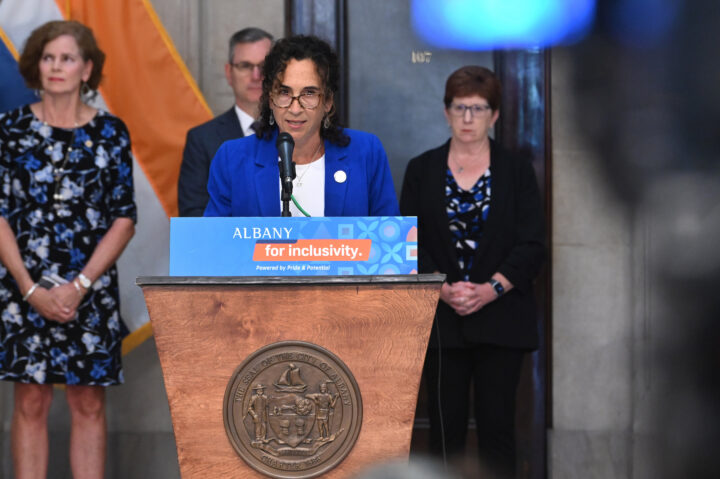
Lori Van Buren/Albany Times Union via Getty Images
Deborah Zamer, Albany Common Council member, speaks during a press conference at Albany City Hall on Tuesday, Sept. 2, 2025, in Albany, N.Y.


 Add JewishInsider on Google
Three Jewish politicos from New York’s Capital Region — all women, and all Democrats — have launched a new state-level committee dedicated to supporting candidates with liberal social views who also push back on anti-Jewish and anti-Israel forces.
Aleinu-NY PAC, named for the Jewish prayer that translates to “on us,” registered with the New York Board of Elections in late September and officially launched its website last week. It describes itself as “a new nonpartisan political action committee in NYS established to support candidates who stand up against Antisemitism and the scourge in violence against the Jewish community throughout New York.”
Behind the PAC’s inception is veteran Albany lobbyist and consultant Libby Post, along with Albany Common Councilmember Deborah Zamer and Schenectady County Legislator Michelle Ostrelich. A longtime advocate for gay rights and animal welfare, Post told Jewish Insider that the left-wing reaction to the Oct. 7, 2023, Hamas attacks, and the subsequent rise of antisemitic incidents, have placed Judaism at the center of her identity and political concerns for the first time.
“People celebrating Oct. 7 — it’s absolutely disgusting — and not recognizing the fear that has gone through the Jewish community because of the antisemitic, anti-Zionist rhetoric, that’s just turning into violence,” she said in an interview. “I used to say that I was a lesbian who happened to be Jewish. Now I say I’m a Jew who happens to be a lesbian.”
Post said the PAC would consider endorsing candidates “regardless of where they’re running or what party.” But she added that the group would not depart from the values that had defined so much of her political career, and highlighted a section of the website that invokes the halakhic principle of Kavod HaBriyot, often interpreted as universal human dignity.
“We want to help elect candidates who demonstrate their opposition to antisemitism and violence against the community, but we also will be looking at their stands on choice [on abortion] and LGBT rights because that has to do with hate,” she said. “We’re not going to support a candidate who might be great on half what we want them to be great on, but they’re Islamophobic, or they’re anti-choice, or they’re homophobic.”
Post said the PAC had not yet determined how it would define these standards in a candidate questionnaire, and acknowledged that it might rule out support for many Republican candidates or even for conservative Democrats representing the state’s large Orthodox communities.
However, on the question of Israel’s right to exist, the PAC’s standard is already in place and unequivocal.
“Anti-Zionism is a form of anti-Jewish hatred, just like antisemitism. Full stop,” the FAQ section of the webpage states. “Anti-Zionism is a hate movement that uses the lies of ‘genocide,’ ‘apartheid,’ and ‘colonizer’ to incite hostility and violence against the Jewish community.”
Nonetheless, the committee will focus not on foreign policy, but exclusively on domestic rhetoric and the problem of bias attacks.
Post said the PAC had collected $5,000 from around a dozen donors in just one week. But it will not begin interviewing candidates or making endorsements until local elections next year, and will likely hold its first in-person fundraiser in her office near the state Capitol building after the legislature reconvenes in January.
Post said that the “antisemitic spewing from all corners” and the “silence from the left” on Hamas’ sexual assaults during the Oct. 7 attacks had made the PAC’s creation feel necessary.
“I’ve had it. It’s the only way I can explain this,” Post said. “I’m glad my parents aren’t alive to see any of this, because my father fought in [WWII], and we, like so many others, lost family in the Holocaust.”
Kings County Victory Project seeks to elevate three Dems, including in contest between Syrian Jewish and Russian Jewish candidates
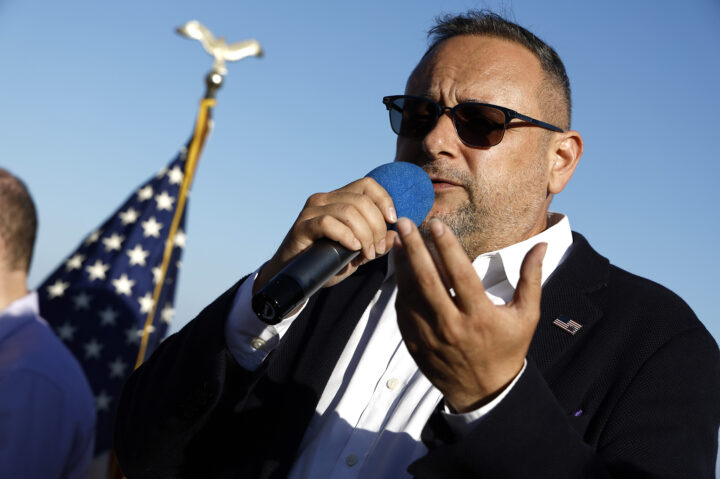
John Lamparski/Getty Images
Candidate for NYS Assembly District 45 Michael Novakhov speaks during a "Save New York" rally for Republican gubernatorial candidate Lee Zeldin in Brighton Beach on August 03, 2022 in the Brooklyn Borough of New York City.
The Mamdani-world operative serving as treasurer for a national anti-AIPAC campaign is now running a New York State committee seeking to oust three Republican lawmakers in Brooklyn — two of whom are Jewish.
State Board of Elections records show that attorney and activist Mark Hanna submitted paperwork to establish the Kings County Victory Project committee in late September. The PAC’s stated purpose is to boost the candidacies of three Democrats running against incumbent Republicans in centrist and right-leaning parts of southern Brooklyn: Joey Cohen-Saban, running against Assemblymember Michael Novakhov; Chris McCreight, seeking to unseat Assemblymember Alec Brook-Krasny; and Joyce Xie, vying against Assemblymember Lester Chang.
“I intended for it to be a bit more of a useful thing for the November elections, for any of the Democrats that are running in, like, contested Republican districts, to flip seats,” Hanna told Jewish Insider.
Novakhov and Brook-Krasny are two of the most prominent elected officials from Brooklyn’s Russian-speaking Jewish community, which has grown increasingly Republican since the early 2010s. Cohen-Saban hails from the borough’s sizeable Syrian Jewish community, which is politically conservative but mostly votes Democratic in local elections.
Hanna worked with now-New York City Mayor Zohran Mamdani on the 2017 City Council campaign of Rev. Khader El-Yateem, an unsuccessful bid backed by the Democratic Socialists of America, a campaign that Mamdani has credited with having “transformed” his political outlook and engaged him in local affairs. More recently, Hanna has served as treasurer of the American Priorities PAC, a self-styled anti-AIPAC effort which has taken in huge sums from Mamdani supporters in the tech sector and spent the funds boosting left-wing critics of Israel. Among the PAC’s most prominent recipients are Michigan Senate candidate Abdul El-Sayed, and congressional candidates Adam Hamawy and Rev. Frederick Haynes III in New Jersey and Texas, respectively.
Hanna also ran alongside and served as election attorney for Carmella Charrington, who won a race for Democratic district leader — an unpaid but influential internal party position — as part of a left-wing wave in June. Jewish Insider discovered that Charrington had shared an Instagram post promoting industrialist Henry Ford’s infamous antisemitic tract ‘The International Jew,’ which she described as “the truth.” Hanna condemned Charrington’s comments at the time but declined to call for her resignation.
Hanna’s involvement with the new committee prompted an attack from the embattled Novakhov, who edged out Cohen-Saban in a tight race in 2024.
“I’ve said it before: my opponent keeps very bad company,” the incumbent said in a statement to JI. “Now we know that the same political operative helping oversee the effort to elect Joey Saban is also running the finances of a multimillion-dollar Super PAC working against pro-Israel candidates.”
But Cohen-Saban said he had no knowledge of the Kings County Victory Project’s existence, and did not want its support unless Hanna recanted his stance on Israel and denounced Charrington.
“I’m a proud supporter of AIPAC, and if there is any organization, PAC, whatever you want to call it, that is trying to get involved in my race, but doesn’t share my values, I don’t welcome their help,” the Democratic challenger told JI, highlighting his family’s ties to Israel, where they lived after fleeing Syria but before coming to Brooklyn. “You need to share my values, and you need to have my interests in order to be able to play any role in my campaign, whether it’s direct or indirect.”
The race between Cohen-Saban and Novakhov has been one of the most closely watched in New York Jewish politics — not only because it pits two of the city’s Jewish immigrant populations against each other, but because a Cohen-Saban victory would add a pro-Israel Democratic to the dominant Assembly majority in a year that has seen a raft of anti-Israel candidates elected to the state legislature.
Cohen-Saban, McCreight and Xie are, like Hanna and Charrington, Democratic district leaders. But recent weeks have found them on opposite sides of an internecine battle for control of the Brooklyn party organization. Hanna, McCreight and Charrington are part of a left-liberal bloc seeking to remove the current centrist leadership, while Cohen-Saban and Xie have backed the present establishment. Cohen-Saban further highlighted that he was among the first district leaders to demand Charrington’s resignation after JI reported her remarks.
Hanna, for his part, argued that he meant for the Kings County Victory Project to overcome these internal divides and focus on dislodging Republican electeds. However, he said that the ongoing legal battle for control of the Brooklyn organization had prevented him from raising meaningful funds for the PAC to date, and he was uncertain how much of a role it could play in next month’s elections.
Brook-Krasny declined to comment for this article.
The vote was the latest defeat by anti-Israel activists within the Democratic National Committee
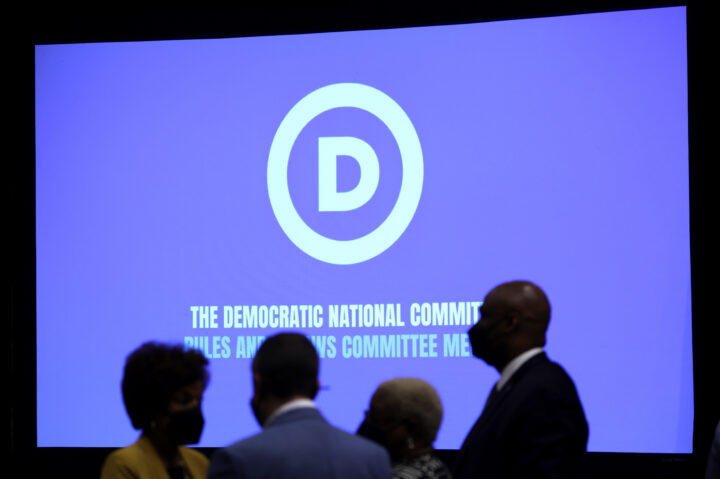
Alex Wong/Getty Images
Committee members wait for the beginning of a meeting of the Democratic National Committee’s Rules and Bylaw Committee in Washington, DC
Democratic Party activists on Thursday voted to reject a measure that criticized the involvement of AIPAC in Democratic primaries and the American political system.
The resolution was debated during a meeting of the Democratic National Committee’s Rules Committee at the DNC’s New Orleans meeting. Committee members were considering new policy resolutions, including one introduced by a Florida activist that took aim at AIPAC and the group’s “undue influence over democratic debate and policymaking.” It was voted down in a voice vote.
“The DNC made clear today that all Democrats, including millions who are AIPAC members, have the right to participate fully in the democratic process,” AIPAC spokesperson Deryn Sousa told Jewish Insider.
Jewish Democratic advocates who were in the meeting room praised the decision.
“We’re pleased that the resolution that wrongly singled out AIPAC was defeated, and that the other anti-Israel resolutions failed to move forward. These measures would be a gift to Republicans, would further fracture our party and do nothing to bring Israelis and Palestinians closer to peace,” Democratic Majority for Israel CEO Brian Romick, who attended the meeting, told JI after the vote.
Halie Soifer, the CEO of the Jewish Democratic Council of America, said the group agrees with the goal of getting dark money out of politics but that AIPAC should not be targeted explicitly.
“We agree with the rejection of dark money in politics — a topic covered in another more expansive resolution adopted by the committee — but also believe that singling out any individual organization is both unproductive and unnecessarily divisive,” Soifer, who also attended the meeting, told JI.
Earlier in the meeting, the committee voted to support a measure “condemning the influence of dark money in the 2026 Democratic primary elections” that called out the artificial intelligence and cryptocurrency industries.
The vote by the DNC’s resolutions committee comes as the Democratic Party faces growing internal strife about its long-standing support for the U.S.-Israel relationship, as some party activists seek to push the group to the left. A new Pew Research Center poll released this week revealed that 80% of Democrats and Democratic-leaning independents have an unfavorable view of Israel — an increase from 69% who said the same last year.
Two other resolutions that touched on Israel-related issues were referred to a working group on the Middle East that DNC Chair Ken Martin created last summer to help smooth over some of the party’s fissures on the Israeli-Palestinian conflict.
One of these referred to Israel’s actions in Gaza as a genocide and called for conditioning U.S. military aid to Israel, and the other called for de-escalation in Iran and Gaza. A third resolution on the Middle East, condemning the U.S. missile strike that hit a girls’ school in Iran and killed at least 165 people, passed.
Sen. Bill Cassidy told the largest teachers’ union in the country it has ‘lost sight’ of its congressionally chartered purpose

Kayla Bartkowski/Getty Images
Sen. Bill Cassidy (R-LA) speaks to reporters following the weekly Republican Senate policy luncheon at the U.S. Capitol on March 11, 2025, in Washington, D.C.
Sen. Bill Cassidy (R-LA), the chairman of the Senate Health, Education, Labor and Pensions Committee, sent a letter on Thursday to the National Education Association accusing the largest teachers’ union in the country of a “deeply troubling” pattern of antisemitism within its ranks.
“The Jewish people have suffered assaults on their identity, religion, culture, and lives for millennia. Disturbingly, we are witnessing a rise in antisemitic sentiment across the Western world, including in the United States,” Cassidy wrote. “Let me put it plainly: antisemitism in all its forms is abhorrent and has no place within our society, especially at our K-12 schools, higher institutions of learning, workplaces, and within unions.”
Cassidy said that the NEA has “lost sight” of its congressionally chartered purpose, adopting a “misplaced” focus on “political activism, foreign policy, and environmental and social justice causes” and becoming “hostile” to Jewish NEA members.
The letter lists out a litany of incidents including a map sent in a mass email to three million NEA members describing the entire land of Israel as “indigenous” Palestinian territory and linking to resources from Hamas-supporting organizations, an attempted boycott of the Anti-Defamation League and reported harassment of Jewish delegates at the NEA’s national conference.
It also raises concerns about a series of provisions included in the 2025 NEA handbook, including language about Holocaust Remembrance Day that “significantly glossed over and failed to mention the attempted annihilation of the Jewish people under the Nazi regime”; one-sided language on the “Palestinian Nakba” that fails to acknowledge Arab attacks on Jews or the United Nations’ role in Israel’s founding; and language that aims to separate anti-Zionism from antisemitism.
Cassidy said that Jewish NEA members have informed the committee that they “are feeling increasingly threatened and ostracized” by the NEA’s “seeming indifference” to them, have been blocked from leaving the national NEA and have had no recourse to address these issues.
NEA representatives at schools have been “increasingly hostile” to Jewish teachers as well, Cassidy said, targeting them for supporting Israel, denying the Oct. 7 attacks and downplaying and denying antisemitism.
Cassidy said the NEA has repeatedly failed to properly and fulsomely apologize for these incidents. In one case, he said, “the NEA’s retroactive statement appears to be a sloppy, insincere, and reactionary attempt [to] move on from its unacceptable behavior.”
Cassidy put forward dozens of questions to the organization, including the process that allowed for the anti-Israel map to be sent out and whether those involved had been held accountable, the NEA’s response to Jewish members who were harassed and the approval process for the handbook language, and how and why it has responded — or not responded — to antisemitism, among various others.
Sen. Chris Murphy argued that there are no provisions in federal law that give the government any authority to condition funding on the ‘viewpoint diversity’ of the faculty

Jemal Countess/Getty Images for Fair Share America
Sen. Chris Murphy (D-CT) speaks at the U.S. Capitol on April 10, 2025 in Washington, DC.
Senate Appropriations committee members sparred on Thursday over the Trump administration’s sweeping moves to combat campus antisemitism, including withholding hundreds of millions of dollars from some elite institutions.
The debate was sparked by an amendment proposed by Sen. Chris Murphy (D-CT) that would prevent the administration from spending any funding on the Office for Civil Rights until the Department of Education inspector general certifies that enforcement actions targeting colleges and universities are being carried out in accordance with law and regulation.
The amendment was voted down along party lines. It’s unclear at this point how much funding the bill — which has not yet been released in full — actually provides for the Office for Civil Rights. The Trump administration had requested substantial cuts to the office’s budget.
Murphy said that the actions taken by the Office for Civil Rights have been undertaken “without going through any of the prescribed processes that we have put in law and previous administrations have put in regulation,” to allow schools and the public to contest and litigate against the decisions before losing federal funding.
“I think the extraordinary ways this administration is ignoring the law or going around the law requires us to do due diligence in making sure that when we appropriate money it gets used for the proper purposes,” Murphy said.
He called the administration’s suspension of funding to Harvard University particularly egregious, specifically highlighting the administration’s demand for greater viewpoint diversity in Harvard’s faculty.
Murphy argued — as he has previously — that there are no provisions in federal law that give the government any authority to condition funding on the “viewpoint diversity” of the faculty.
Sen. Shelley Moore Capito (R-WV), the ranking member of the subcommittee responsible for Department of Education funding, pushed back, describing the administration’s actions as necessary and proper to counter “rampant” antisemitism on campuses and address a lack of action by the prior administration.
“Some of those higher education institutions have come to the table with the administration and said, ‘Yes, we’re gonna make changes, and that’s because of the violations of the office of what is under the Office of Civil Rights Under Title VI,’” Capito said. “Your amendment would halt the work of the Office of Civil Rights.”
Capito warned that any pause in Office for Civil Rights activities would likely drag on significantly.
She compared the situation on college campuses to the Nazi regime in World War II.
Sen. Jon Ossoff (D-GA), who is Jewish, condemned the administration’s actions.
“I utterly reject this administration’s cynical exploitation of this issue, which it uses as a fig leaf to take control of and impose its will on institutions of higher education and other critics,” Ossoff said.
During the committee meeting, Democrats emphasized that the Department of Education funding bill as a whole defied Trump’s wishes to defund and dismantle key parts of the department.
Please log in if you already have a subscription, or subscribe to access the latest updates.
 Continue with Google

 Continue with Apple