












































































The planned meeting on Thursday was canceled after the Senate left town early; the chamber is not expected to return until after the midterm elections

GETTY IMAGES
A general view of the U.S. Capitol Building from the National Mall, in Washington, D.C., on Thursday, May 29, 2025.


 Add JewishInsider on Google
The Senate Judiciary Committee canceled a planned Thursday meeting where the committee was set to discuss and vote on the Right to Worship Act, a bipartisan and bicameral bill that would create buffer zones outside of religious institutions during worship services.
The committee announced earlier this week that the bill was on the committee’s agenda for a meeting this week — a significant sign of progress for the still relatively new legislation, which supporters hope to pass before the end of the year. But the meeting was canceled after the Senate finished its work for the week on Wednesday and left Washington until after the midterm elections.
House Speaker Mike Johnson (R-LA) has previously expressed support for the bill.
Muslim, Sikh, Hindu and evangelical groups also turned out in support of the federal buffer zone legislation that would protect against harassment outside of places of worship
Marc Rod
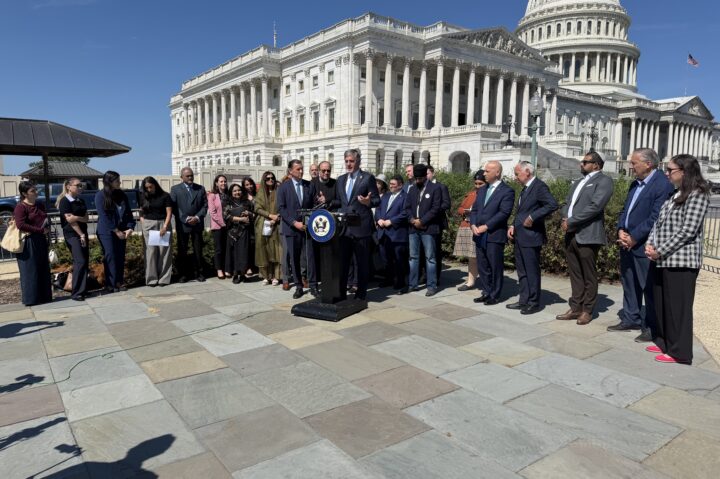
Reps. Tom Suozzi (D-NY) and Brad Knott (R-NC) rally with religious groups in favor of the Right to Worship Act on Sept. 16, 2026.
Reps. Brad Knott (R-NC) and Tom Suozzi (D-NY) rallied outside the Capitol on Wednesday alongside more than two dozen representatives of religious community organizations in support of the Right to Worship Act, their federal bill establishing buffer zones outside of religious institutions to protect them from disruptions.
House Speaker Mike Johnson (R-LA), who has been involved in supporting the bill behind the scenes, also expressed his support for it in a statement to Jewish Insider.
“Religious liberty is regarded as our ‘First Freedom.’ Our Founders listed it first in the Bill of Rights because they understood how essential it was to the foundation of our Republic. But that right rings hollow if worshippers must brave harassment or worry for their safety as they exercise their religion,” Johnson said.
“Americans of all religious affiliations deserve the right to do so without fear and the Right to Worship Act ensures they can, while also maintaining the First Amendment right to peaceful protest,” he continued. “I commend Rep. Knott for his leadership on this legislation and his steadfast defense of our fundamental freedoms.”
Knott and Suozzi’s press conference included representatives from various nondenominational Jewish groups and the Orthodox movement, as well as leaders from the evangelical, Sikh, Hindu, Muslim and even Scientology communities. The Reform and Conservative movements are also supporting the bill.
Knott and Suozzi praised each others’ work on the bill and ability to compromise to put out this consensus bill.
“I commend Rep. Suozzi again for his monumental effort in assembling this team behind us, this team around the country, that was so valuable in crafting this legislation,” Knott said.
“It’s a very rare hallmark in this town when you have a senior legislator like Rep. Suozzi come to a freshman legislator on the House floor and say, ‘Look, we’re trying to do the same thing. I will lay down my bill and join forces with you so long as we can get this thing across the finish line.’ And had he not done that, I don’t know if we’d be here today,” he continued.
Suozzi previously had introduced separate buffer zone legislation that contained a somewhat different formula than the Right to Worship Act.
Knott said he’d been in contact with various colleagues including Rep. Jamie Raskin (D-MD), the ranking member of the Judiciary Committee, which has jurisdiction on the bill, and has seen significant support.
Suozzi likewise praised Knott as “a former prosecutor, new member of Congress from North Carolina, very well respected by his colleagues, and somebody that I personally admire, especially getting to know him over the past couple months, and listening to him speak, and seeing his intellect and his compassion work together to try and get a bill done across party lines.”
At one point in the press conference, a shofar sounded in the distance from somewhere on the Capitol grounds.
Also speaking in support of the bill were Anti-Defamation League CEO Jonathan Greenblatt; Jewish Federations of North America CEO Eric Fingerhut; Jessica Bernton, the American Jewish Committee’s director of congressional affairs; Nathan Diament, executive director of the Orthodox Union Advocacy Center; Rabbi Yossie Charner, Agudath Israel of America’s director of congressional affairs; Elizabeth Cullen, Hadassah’s director of government relations; Hadas Alterman, Stand With Us’ director of legislative strategy; and Combat Antisemitism Movement President of U.S. Affairs Alyza Lewin.
Diament urged that the bill be the first order of business when the House returns in November, after its extended recess that began Wednesday.
They were joined by representatives from the National Association of Evangelicals, American Muslim and Multi-faith Women’s Empowerment Council, Hindu American Foundation, United Sikhs, BAPS Swaminarayan Sanstha (a Hindu group) and the Coalition of Hindus of North America.
Suozzi and Knott acknowledged that the legislation’s applicability to the repeated incidents during which anti-Israel protesters have demonstrated outside of or broken into events at synagogues promoting aliyah to Israel or land sales in Israel and the West Bank would likely have to be litigated in court if the bill passes.
“There’s going to be litigation that will come. That’s why we spent so much time speaking to constitutional experts about this process,” he said. “There’s going to be litigation about that question and about others as well. The bill really focuses heavily on religious services, so that’ll be a real question and a real challenge as to whether or not that will withstand the constitutional challenge.”
He added that he hopes the bill “sends a message that we all have to do better in the process.”
Knott added that the bill requires “a substantial, focused, intentional effort to prevent someone from entering or otherwise worshipping. Within the buffer zone, if you hold a sign that says, ‘Israel, do better,’ that’s perfectly consistent with this law. If I grab a worshipper by the lapel pin and said, ‘You’re committing whatever crime you allege,’ that’s a disruption that’s not sanctioned with this bill.”
He said, “The definition targets the focused, intentional disruption, not the benign peaceful [one],” adding that the bill is intentionally focused on incidents in which “where people use an organized, established house of worship to target specific people.”
During the press conference, Suozzi specifically credited a constituent, Abraham Hamra, with first bringing the buffer zone issue to his attention and prompting him to craft his original bill, the SACRED Act.
Hamra told JI that his family is from Syria and came to the United States to seek religious freedom. He said he felt “we couldn’t stand idly by and just complain” after protesters disrupted an event in Park East Synagogue in nearby Manhattan. He started a petition calling for buffer zone legislation, which gathered 10,000 signatures.
A member of the board of Long Island’s Holocaust Memorial and Tolerance Center brought the petition to Suozzi’s attention and connected him with Hamra.
“This bill is now a reality, and honestly, it is a bill that’s going to protect what’s great about America, because the First Amendment gives us the right to speech and the right to worship,” Hamra said. “If we protect both of those rights, we continue having the America that many refugees flee to, the America that enables so much success, and that’s why I started this petition, hoping that this bill would be introduced.”
Both Suozzi and Knott also credited various leaders from the Jewish and other communities for their work on the bill, including Greenblatt and the ADL and Diament and the OU, as well as Hudson Bay Capital CEO Sander Gerber and Moshe Davis, the former director of the New York City Mayor’s Office to Combat Antisemitism, who have been heavily involved in the effort.
The new bill narrows the language around educational institutions to build a veto-proof majority in the council
John Lamparski/Bloomberg via Getty Images
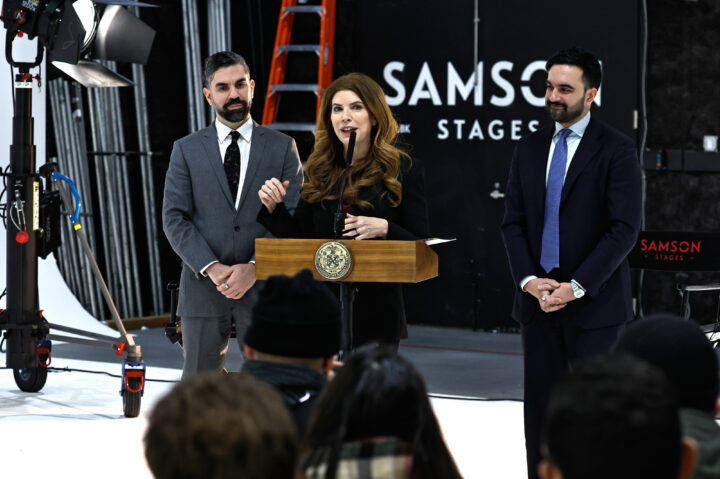
Julie Menin, speaker of the New York City Council, and Mayor Zohran Mamdani on Jan. 12, 2026.
New York City Council Speaker Julie Menin will back fresh legislation to compel the NYPD to establish formal protocols for deploying buffer zones around schools during protests — a push Menin said will sail through the council with more than enough votes to beat any effort from Mayor Zohran Mamdani to block it.
The move comes a month after Mamdani exercised his veto power — for the first and only time to date — in order to stop a similar bill from becoming law, even as he allowed another measure to establish police policy for buffer zones around houses of worship to go into effect.
In his explanation of his decision to veto, Mamdani cited concerns from unions that the blocked measure could interfere with their demonstrations around college facilities, even though the proposal contained an explicit labor carveout.
In a press conference on Wednesday, Menin characterized this as a misunderstanding — one the new legislation will rectify by applying exclusively to early childhood education facilities and “most K-12 schools,” and “explicitly excluding libraries, teaching hospitals, colleges and universities.”
“That will more clearly focus the legislation on the most vulnerable students,” Menin told reporters. “These students were always at the core of the legislation.”
Bronx Councilman Eric Dinowitz, chairman of the Jewish Caucus, introduced the first school security perimeter bill as part of a Menin-backed package of legislation to combat antisemitism. But sources told Jewish Insider that Manhattan Councilwoman Elsie Encarnacion will carry the new version.
Encarnacion’s office did not immediately reply to a JI request to confirm this.
Menin maintained that she had whipped enough votes to pass the original Dinowitz bill over Mamdani’s veto, but chose not to “jam through an override” while her colleagues had lingering qualms regarding higher education institutions. She also denied the new iteration represented a “watering-down” of the original proposal.
“What our weeks of conversation revealed was that there was a considerable number of members who wholly support the intent of the legislation, but who have concerns about which educational facilities are included,” she said. “We heard them, and now we’re choosing to address them rather than dismiss them.”
The mayor’s team said it would wait to review the text of the bill before weighing in.
“The Mamdani administration has not seen the specific legislative language, and we look forward to reviewing it,” Deputy Press Secretary Sam Raskin said. “The mayor believes New York City must remain a place where students can access their schools safely as well as exercise their constitutional right to protest.”
Menin, Mark Levine and Brad Hoylman-Sigal — the most senior Jewish elected officials in NYC — beseeched the Jewish community not to flee the city despite tensions with the mayor
Vladimir Kolesnikov/Michael Priest Photography
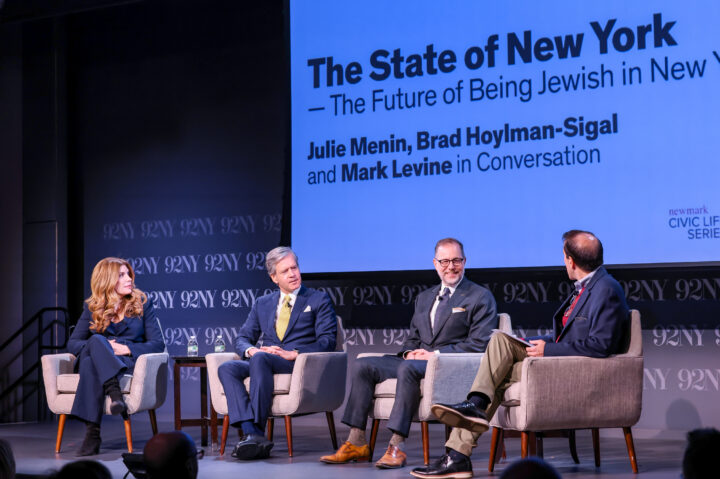
New York City Council Speaker Julie Menin, Comptroller Mark Levine and Manhattan Borough President Brad Hoylman-Sigal speak at 92NY on April 22, 2026.
New York City Council Speaker Julie Menin warned Wednesday morning that if Mayor Zohran Mamdani vetoes the council’s legislation intended to regulate protests at religious and educational sites, the city will face “more divisiveness,” calling the decision a critical test for the mayor.
The bills, which include measures to create standard NYPD policy for deploying buffer zones during protests at educational and religious facilities, face a potential veto as Mamdani has repeatedly declined to take a stand on the issue. He has acknowledged concerns against the legislation from left-wing activists and civil rights groups who have targeted synagogues and yeshivas with anti-Israel demonstrations, and has until the end of this week to veto the bills or they become law automatically.
“We need less divisiveness. I really hope — and I’ve said this to the mayor — that there is not a veto of the package of bills. That’s necessary. It will create much more division,” Menin said during a panel discussion at 92NY on “the future of being Jewish in New York,” featuring the city’s most senior Jewish elected officials: Menin, who is the first Jewish council speaker, Comptroller Mark Levine and Manhattan Borough President Brad Hoylman-Sigal.
The panel, moderated by 92NY CEO Seth Pinsky, comes as the city has experienced historic levels of antisemitism in the wake of the Oct. 7, 2023, terrorist attacks — and as Jews navigate a tense relationship with a mayor who has held hostile views towards several key communal issues. New York City has the largest population of Jews outside of Israel.
Asked by Pinsky what advice each would give to Mamdani to try to reassure the roughly 70% of the Jewish New York City electorate that did not vote for him, Hoylman-Sigal called on Mamdani to “follow the tradition of every mayor preceding him [since 1951] and visit Israel.”
He added that Mamdani already has some “really good Jewish advisors,” including Phylisa Wisdom, a progressive Jewish leader Mamdani tapped in February to run the Mayor’s Office to Combat Antisemitism. A range of Jewish Democratic politicians and advocates had lauded Wisdom’s selection, though she has alienated some Orthodox and Hasidic Jewish leaders over her work criticizing the secular education taught at yeshivas in the past.
Hoylman-Sigal’s assertion that the mayor’s heart “is in the right place” when it comes to the Jewish community was met with a chorus of “boos” from the audience.
Addressing the city’s long-standing Israel bonds investments, which Mamdani has called to end in a key source of tension for him and Levine, Levine said the investments “are not political [and] shouldn’t be political.”
“Israel bonds have never missed a payment in 70 years,” said Levine. “And by the way, we’ve had no protests about our investments in Saudi Arabia, our investments in Pakistan or China.”
All three Jewish leaders echoed the sentiment that despite a turbulent past few years, the New York City Jewish community remains resilient, and urged New Yorkers not give into the rising calls to decamp to Florida.
“Absolutely stay in New York,” said Menin. “This is not a time to lose hope. Hopefully the three of us here can embody the future of the commitment to fighting antisemitism, the commitment to supporting the Jewish community. This is a time to lean into it as opposed to shy away from it. New York is a city that has been a beacon of inclusion and tolerance; we need to make sure that it stays that way.”
“I believe the Jewish community in New York City is stronger than it’s ever been,” said Levine, who praised Mamdani’s decision to retain former Mayor Eric Adams’ NYPD commissioner, Jessica Tisch, who is Jewish and openly identifies as Zionist.
“In many synagogues, attendance is way up. Jewish New Yorkers are active in ways they haven’t been. We’ve seen new coalitions come together … This engagement gives me real hope for the future,” continued Levine.
“My wish looking forward to the next 25 years is that we see a community that fought — that didn’t move to Miami with its bad bagels — and that we kept this story going of what is really one of the most glorious Jewish communities.”
The department’s deputy commissioner acknowledged the City Council bill will formalize, not change, police policy
Alexi J. Rosenfeld/Getty Images
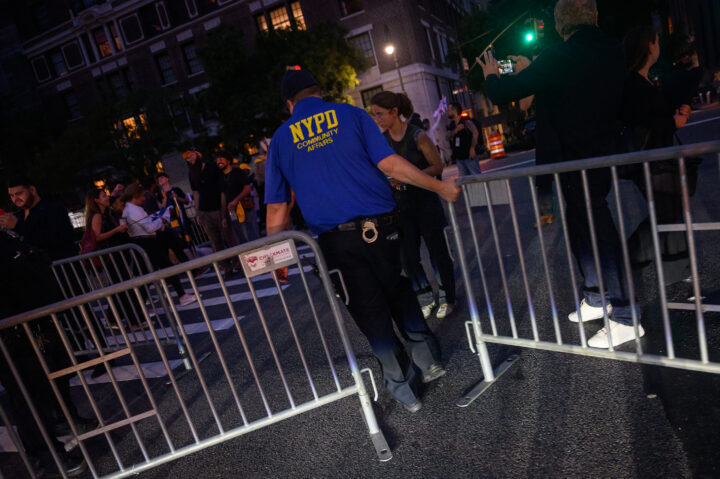
NYPD officers set up barricades separating pro-Israel and anti-Israel protesters on Sept. 25, 2025 in New York City.
The NYPD — part of New York City Mayor Zohran Mamdani’s administration — declared before the City Council on Wednesday that it has “no objections” to Council Speaker Julie Menin’s proposal compelling the department to develop a policy for establishing “buffer zones” outside houses of worship during protests.
The legislation formed the core of a suite of antisemitism-battling legislation that Menin, the body’s first Jewish speaker, rolled out in January. The bill, which obligates the NYPD to codify protocol for ensuring worshippers can enter and exit religious facilities without obstruction or harassment, initially contained language that would set the range of police barricades or tape at “up to 100 feet.”
However, an updated iteration of the legislation released Monday night eliminated any specific reference to distance, in response to objections that such language could actually constrict the NYPD’s range of protective activity. As a result, the department announced before a hearing of the Council’s Committee to Combat Hate that it has no issues with the bill, following the mayor’s previous allusions to unspecified concerns he and his NYPD Commissioner Jessica Tisch had with the proposal.
“We greatly appreciate that dialogue and collaboration,” said NYPD Deputy Commissioner for Legal Affairs Michael Gerber, who explicitly stated he was providing the opinion of Tisch. “The result is a bill that is consistent with the NYPD’s ability to protect people entering and leaving places of worship, as well as our commitment to facilitating First Amendment activity.”
The Menin bill is distinct from Gov. Kathy Hochul’s push for 25-foot buffer zones around houses of worship, which would subject violators to criminal penalties. Despite the controversy over the Council proposal, which inspired dueling rallies in opposition and support prior to the hearing, Gerber noted that the law would not impose new policies upon the NYPD but simply require Tisch to formalize and publish their procedures.
“To be clear, the policy will not alter our practices but rather will articulate and describe what we are already doing,” Gerber said. “I think the bill fosters transparency.”
A corollary piece of City Council legislation, introduced by Councilmember Eric Dinowitz — chair of the body’s Jewish Caucus — would apply the same standards to educational facilities. Gerber said his department could not offer the same carte blanche support for this proposal, because it would set uniform standards for police conduct on both public and private property.
Menin pressed Gerber regarding the NYPD’s failure to set up a clear path of access and egress to Park East Synagogue in Manhattan amid an anti-Israel protest in November spearheaded by openly pro-Hamas activists. Gerber reiterated a statement of regret that Tisch, a scion of one of the city’s most prominent Jewish families, also made at the time.
“We got that one wrong,” said Gerber. “We didn’t have the appropriate frozen zone at the entrance, and that led to a situation that should not have happened.”
But the deputy commissioner stressed that the NYPD must guarantee the right of protesters to demonstrate in sight and earshot of their targets, even if their message is hateful and even if the targets are entering or exiting a house of worship.
“The NYPD must protect the First Amendment rights of protesters,” said Gerber. “If individuals choose to protest against those entering a place of worship, the NYPD will ensure that they have sight and sound to the entrance of that location, consistent with the First Amendment. At the same time, the protesters will not be permitted to obstruct, impede or interfere.”
Several left-wing members of the Council pressed Gerber for statistics and responses to hypothetical scenarios, and to make a straightforward declaration of support or opposition to the measure.
Other council members shared their view that the bill does not go far enough. “My concern is that we’re putting forward a symbolic bill that doesn’t really address the real concerns and fears that are being expressed today,” said Councilmember Sandy Nurse.
Menin’s proposal now has 27 co-sponsors, two more than the needed majority of the Council’s 51 members — though seven short of the number required to override a mayoral veto. Mamdani has so far declined to say whether he would sign the bill if it reaches his desk.
Her legislative proposals could be opposed by New York City mayor Zohran Mamdani
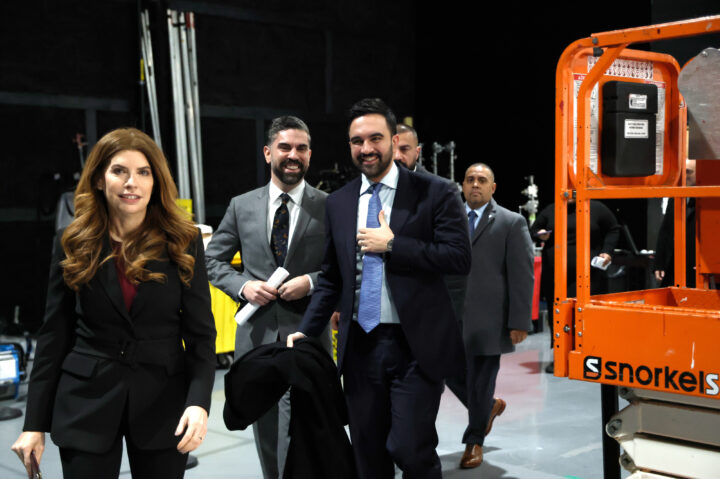
Julie Menin, speaker of the New York City Council and Zohran Mamdani, mayor of New York, arrive for an announcement in the Brooklyn borough of New York, US, on Monday, Jan. 12, 2026 (Photographer: John Lamparski/Bloomberg via Getty Images)
Julie Menin, the recently elected speaker of the New York City Council, announced a comprehensive plan to confront rising antisemitism on Friday, unveiling several initiatives that notably include an emerging legislative proposal to establish buffer zones around houses of worship to keep protesters from harassing congregants.
The measure, which echoes legislation introduced last month by state legislators, comes in response to a recent series of anti-Israel demonstrations outside synagogues in New York City, including a protest in Queens last week where participants voiced support for Hamas — raising fears in the Jewish community amid a broader rise in antisemitic activity across the five boroughs.
But it could place Menin, the Council’s first Jewish speaker and a vocal defender of Israel, at odds with Mayor Zohran Mamdani, underscoring a tension in their new relationship on areas in which anti-Israel activism crosses a line into antisemitic behavior. In his statement addressing the Queens protesters, for example, Mamdani, a fierce critic of Israel who has long identified as an outspoken anti-Zionist, chose not to accuse them of antisemitism as several of his top allies on the far left had done, even as he made sure to call Hamas a terrorist group and denounce the slogans chanted by demonstrators as “wrong.”
While Menin has yet to confirm the exact distance of the barrier she hopes to impose around houses of worship, she has floated a possible perimeter of 100 feet, far surpassing a 25-foot zone proposed by Gov. Kathy Hochul in her State of the State address this week. Mamdani, who was in attendance during the governor’s speech in Albany, did not applaud when she mentioned buffer, stirring speculation over his support for implementing such restrictions.
Some critics have raised concerns that the efforts could run afoul of free speech protections, though one state legislator who introduced a bill to create buffer zones last month told Jewish Insider that the legislation had balanced those considerations with a need to safeguard congregants from intimidation in seeking to freely practice their religion.
“We’re not trying to stifle peaceful protests,” Menin said on Friday during a press conference held at the Museum of Jewish Heritage in Manhattan. “What we are trying to do is protect congregants for any house of worship, of freely being able to enter and exit without fear of intimidation or harassment.”
Jack Lobel, a spokesperson for Menin, told JI that the legislation “establishing a safe perimeter around schools and houses of worship is being drafted, and we will have more to share in the future.”
Mamdani, meanwhile, has voiced interest in exploring the establishment of buffer zones that some Jewish leaders have urged him to consider. The mayor signed an executive order on his first day in office to instruct the police commissioner and the Law Department to assess “proposals for regulation of protest activity” outside houses of worship, citing a possible buffer “of at least 15 feet and up to 60 feet from the entrance.”
In a statement shared with JI, Dora Pekec, a spokesperson for Mamdani, said the mayor “is committed to fighting antisemitism, and ensuring that New Yorkers continue to be able to worship freely as well as exercise their First Amendment rights.”
“On the first day of his administration, the mayor directed the NYPD and Law Department to review the legality of a range of proposals, including those like Speaker Menin’s buffer zones proposal, and he will wait for the outcome of that review,” she added.
Jewish leaders who spoke with JI provided mixed predictions about how Mamdani would respond to the legislation, which came in addition to a range of proposals Menin announced on Friday — including $1.25 million in funding for the Museum of Jewish Heritage and a new hotline to help report incidents of antisemitism that would be overseen by the New York City Commission on Human Rights.
With the exception of Menin’s safety zones bill, one Jewish leader argued that there was “not much for” the mayor “to push back on,” calling the other new proposals “mostly monetary.”
The establishment of legally proscribed perimeters around houses of worship is “the only” issue where there is ongoing uncertainty, the Jewish leader told JI on condition of anonymity to address a sensitive topic. “But we don’t have her proposal yet,” he said of Menin’s effort, which marked the first legislative push of her new tenure.
Still, Josh Mehlman, the chairman of the Flatbush Jewish Community Coalition, an Orthodox group in Brooklyn, said he was optimistic that the legislation would pass, noting his conversations with Menin as well as other supportive Council members indicated Mamdani would ultimately be amenable to the final version of the bill.
“It’s not something they feel that the mayor would not be happy with,” he told JI.
Please log in if you already have a subscription, or subscribe to access the latest updates.
 Continue with Google

 Continue with Apple