












































































The 30-second ad hits Democratic Bob Harvie over his record as Bucks County Commissioner
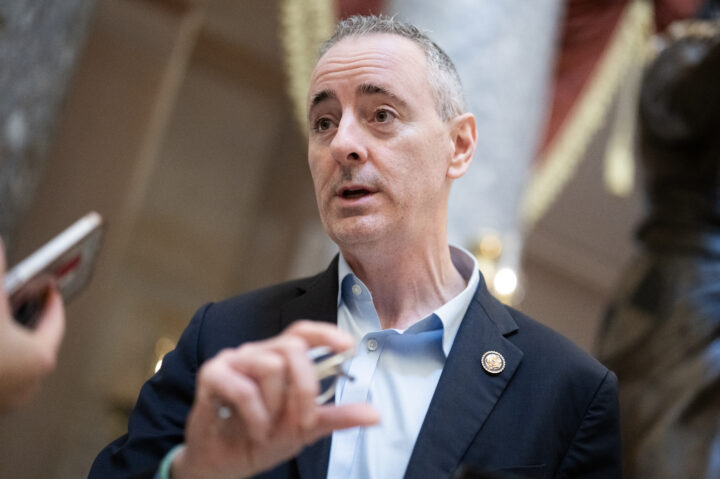
Tom Williams/CQ-Roll Call, Inc via Getty Images
Rep. Brian Fitzpatrick (R-PA) talks with a reporter in the U.S. Capitol's Statuary Hall on Friday, March 27, 2026.


 Add JewishInsider on Google
The Republican Jewish Coalition Victory Fund is launching a $400,000 advertising campaign on Sunday to boost Rep. Brian Fitzpatrick (R-PA), attacking Bucks County Commissioner Bob Harvie across digital and streaming platforms in the suburban Philadelphia swing district.
The 30-second ad highlights Harvie’s votes for tax increases, accusing him of supporting higher taxes for voters while voting to raise his own salary. The Christmas-themed ad labels Harvey as “Bob ‘Holiday’ Harvey,” ending with “Pay raise for him. Holiday gloom for us. That’s the Harvie spirit.”
Pennsylvania’s First Congressional District is one of only two seats won by Vice President Kamala Harris in 2024 that also elected a Republican to the House. The Cook Political Report rates the seat “lean Republican.”
The RJC investment comes as other signals suggest that Republicans view Fitzpatrick as increasingly vulnerable. The Congressional Leadership Fund, the House GOP leadership’s super PAC, put $4.5 million into the race this week, the first time that CLF has spent in the district since 2020.
“We stand with Congressman Brian Fitzpatrick because he continues to deliver results for the hardworking people of Pennsylvania’s 1st Congressional District,” RJC CEO Matt Brooks said in a statement.
Brooks emphasized Fitzpatrick’s previous career as an FBI agent.
“For the Jewish community in particular, Fitzpatrick takes the rise of antisemitism seriously as a threat to American Jews, and he has been among the most reliable allies in the House of Representatives in support of the US-Israel relationship,” Brooks said. “Brian Fitzpatrick has earned the trust and support of Pennsylvania voters.”
Rep. Dan Goldman said that ‘words of condemnation are no longer enough’ and that there has been a ‘systematic failure’ by Congress to address rising antisemitism since Oct. 7
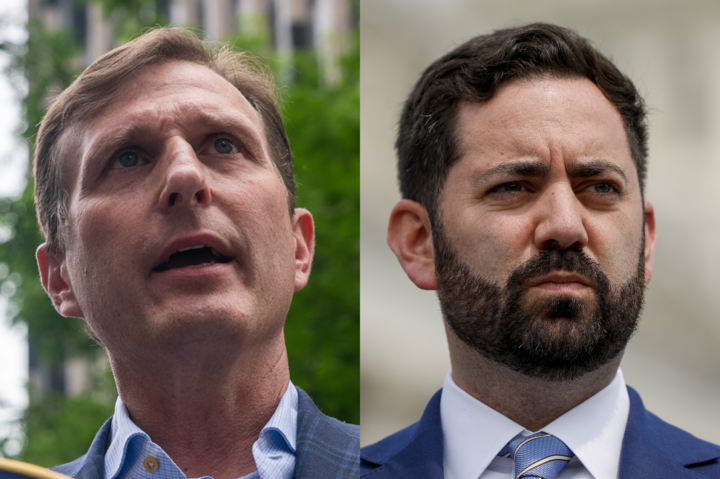
Reps. Dan Goldman (D-NY) and Mike Lawler (R-NY) are leading 28 colleagues in introducing a House version of the Jewish American Security Act, the package of antisemitism-related legislation introduced by Sens. Jacky Rosen (D-NV) and James Lankford (R-OK) last month in the Senate.
The bill includes a proposal for significant increases in security funding, new oversight and administrative measures to address antisemitism on college campuses and new transparency requirements for social media companies relating to antisemitism online.
The legislation is being co-sponsored by Reps. Grace Meng (D-NY), Brian Fitzpatrick (R-PA), Debbie Wasserman Schultz (D-FL), Maria Salazar (R-FL), Jared Moskowitz (D-FL), Rudy Yakym (R-IN), Josh Gottheimer (D-NJ), Marc Veasey (D-TX), Don Bacon (R-NE), Haley Stevens (D-MI), Michael McCaul (R-TX), Nicole Malliotakis (R-NY), Laura Gillen (D-NY), Jeff Van Drew (R-NJ), Jake Auchincloss (D-MA), Ted Lieu (D-CA), Dan Meuser (R-PA), Brad Schneider (D-IL), Tom Barrett (R-MI), Jen Kiggans (R-VA), Greg Landsman (D-OH), David Kustoff (R-TN), Juan Ciscomani (R-AZ), Lois Frankel (D-FL), Tom Suozzi (D-NY), Randy Weber (R-TX), Kristen McDonald Rivet (D-MI) and John Moolenaar (R-MI).
“Words of condemnation are no longer enough,” Goldman said in a statement. “Since the October 7th attacks, there has been a systematic failure in Congress and in our communities to counter the threat posed by surging antisemitism across this country.”
Goldman, a co-chair of the House antisemitism task force, said the bill would change that pattern: “Whether on campus, at synagogues, or online — the Jewish American Security Act will provide the tools necessary to help secure our at-risk communities to practice their faith without fear. American Jews cannot be asked to bear this burden alone. As Americans, we must stand shoulder to shoulder with those under siege by hate.”
Lawler, who is also the lead sponsor of the long-stalled Antisemitism Awareness Act, said in a statement that by providing additional resources for the Nonprofit Security Grant Program, the bill would help safeguard constitutionally protected religious freedom and bolster Jewish institutions against attacks.
“This bill also delivers critical protections for Jewish students on college campuses through stronger Title VI enforcement, requires greater transparency from online platforms on antisemitic content, and establishes key threat assessments,” Lawler said. “We must act decisively so Jewish Americans can feel safe in their schools, synagogues, and online.”
The legislation is supported by a wide range of Jewish groups across the religious and political spectrum.
“[A]ntisemitism remains a serious threat to the safety and security of the American Jewish community. A piecemeal approach to combat this scourge of [antisemitism] is no longer sufficient. The Jewish American Security Act is a serious and comprehensive federal response to this epidemic of hate,” Jonathan Greenblatt, CEO of the Anti-Defamation League, said in a statement. “We are grateful to Congressmen Goldman and Lawler for championing this bill in the House and showing that keeping Jewish Americans safe is a genuine bipartisan priority.”
Eric Fingerhut, the CEO of the Jewish Federations of North America, told Jewish Insider in a brief interview that, given the support in both the House and Senate and the Jewish community, “there’s never really been something like this at this level of comprehensiveness on Jewish security, with all the Jewish organizations working together.”
“People care, but they just don’t realize how bad it’s been. They don’t realize what’s happened in the last year. They don’t understand how Temple Israel was almost a disaster that would have changed the country,” Fingerhut continued. “This is really an important moment and we are all over this. There’s nothing that’s a higher priority.”
He said that if the bill passes, “we really have something that will make a difference for the Jewish community, which has been the target of a serious domestic terror crisis over this last year. So we’re grateful and we’re ready to work.”
American Jewish Committee CEO Ted Deutch said in a statement that Americans should not need security to pray or be afraid to leave their homes and interact in their communities, “yet, that is exactly what Jews in this country are experiencing every day.”
“We are at an inflection point. Surging antisemitism is not just a threat to the Jewish community; it is a crisis for our democracy and the values we cherish as Americans — pluralism, religious freedom, and the promise of equal protection,” Deutch said. “We thank Representatives Goldman and Lawler for their leadership and demonstrating that confronting this hatred is not a political issue, but a moral obligation.”
Amy Spitalnick, the CEO of the Jewish Council for Public Affairs, said that antisemitic violence “demands investments in a sustained, whole-of-government and whole-of-society response.”
“The Jewish American Security Act helps us to meet that need by focusing on tools that we know work,” Spitalnick said. “A truly inclusive American democracy requires Jewish safety — and so too does our safety as Jews depend on protecting our democratic institutions and values and ensuring the safety and rights of each and every community.”
Nathan Diament, the executive director of the Orthodox Union Advocacy Center, said that the organization “strongly supports” the bill and that the “unprecedented wave of antisemitism demands an unprecedented response by our government,” including increasing NSGP funding to $1 billion.
Rabbi Jonah Pesner, the director of the Religious Action Center of Reform Judaism, said that “the need for meaningful steps to bolster security and the fight against hate is vital.”
“The Jewish American Security Act strengthens the government tools and funding that will be available to help us meet this moment and uphold the American commitment to religious freedom,” Pesner said.
William Daroff, the CEO of the Conference of Presidents of Major American Jewish Organizations, praised the bipartisan support for the legislation as well as the broad consensus around it in the Jewish community, urging the bill’s quick passage.
“It is deeply encouraging to see this bill come together with bipartisan, bicameral support at a time when that kind of consensus is all too rare. There is real meaning in Republicans and Democrats joining around the shared responsibility to protect Jewish Americans,” Daroff said.
“It is encouraging to see real consensus across Jewish organizations. Since October 7, engagement is up and coordination is stronger. That unity is both needed and significant.”
The swing-district Republican is the first GOP lawmaker other than isolationist Thomas Massie to support constraining the administration’s military operations in Iran
Tom Williams/CQ-Roll Call, Inc via Getty Images
Rep. Brian Fitzpatrick (R-PA) talks with a reporter in the U.S. Capitol's Statuary Hall on Friday, March 27, 2026.
Rep. Brian Fitzpatrick (R-PA), a moderate Republican and co-chair of the House Problem Solvers Caucus, introduced a war powers resolution on Thursday that aims to enforce the deadlines for the war in Iran laid out in the 1973 War Powers Act.
Fitzpatrick is the first Republican — other than isolationist Rep. Thomas Massie (R-KY) — to introduce legislation that would constrain the administration’s ability to act in Iran. The move is a signal that GOP support for the effort could begin to erode if the administration disregards legal limitations on the length of its operation in Iran.
The War Powers Act limits any military operation initiated unilaterally by the executive branch to 60 days, with an additional 30-day drawdown period, unless the operations are subsequently authorized by Congress. The 60-day period will expire at the end of April.
“The War Powers Act of 1973 is the law of the land,” Fitzpatrick said. “This consistent standard must be applied to all past, current, and future administrations when it comes to military hostilities abroad. … This is the law that has applied to past administrations, and it is the law that will apply to current and future administrations. This is the law and, until it is changed, it will be consistently applied and consistently enforced across all administrations and all conflicts.”
Other Republicans, including moderates, have also indicated that they would be uncomfortable with or unable to support any military operations in Iran past the 60-day deadline without additional congressional authorization — though some have said they would support such an authorization.
Yet, others have argued that the limitations in the War Powers Act are not legally binding and say Republicans on the Hill will disregard them.
Running in a highly competitive district, Fitzpatrick’s move could also be a sign of discomfort with the continued war effort among swing-district Republicans ahead of the midterm elections.
Bipartisan letter argued that not removing the presidents from their positions would constitute an ‘endorsement’ and ‘act of complicity’ in the presidents’ ‘antisemitic posture’

Kevin Dietsch/Getty Images
Claudine Gay, president of Harvard University and Liz Magill, president of University of Pennsylvania, testify before the House Education and Workforce Committee at the Rayburn House Office Building on December 05, 2023, in Washington, D.C.
Seventy-four House lawmakers wrote to the boards of Harvard, the Massachusetts Institute of Technology and the University of Pennsylvania on Friday demanding that they immediately fire their presidents in response to widely criticized congressional testimony they delivered on antisemitism on their campuses earlier this week.
The presidents of the three schools have come under increasing scrutiny this week amid growing speculation that their jobs could be on the line following their refusal to say earlier this week that calls for Jewish genocide would violate their schools’ codes of conduct.
“Testimony provided by presidents of your institutions showed a complete absence of moral clarity and illuminated the problematic double standards and dehumanization of the Jewish communities that your university presidents enabled,” the letter reads. “Given this moment of crisis, we demand that your boards immediately remove each of these presidents from their positions and that you provide an actionable plan” to ensure the safety of the Jewish community on campus.
“Anything less,” than the steps they requested, the lawmakers continued, “will be seen as your endorsement… and an act of complicity in their antisemitic posture.”
The letter was led by Rep. Elise Stefanik (R-NY), who questioned the presidents on the genocide issue, and Rep. Jared Moskowitz (D-FL). Rep. Josh Gottheimer (D-NJ) is the only other Democrat who signed the letter; the rest are Republicans.
The lawmakers said that the testimony makes it “hard to imagine” any Jewish or Israeli person feeling safe on their campuses when the presidents “could not say that calls for the genocide of Jews would have clear consequences on your campus.”
It adds that subsequent social media statements seeking to clarify or walk back those comments “offered little clarification on your campus’ true commitment to protecting vulnerable students in this moment of crisis,” describing them instead as “desperate attempts to try and save their jobs” and “too little too late.”
Shortly before the Stefanik-Moskowitz letter was released, a group of thirteen House Democrats wrote to the boards of the three schools urging them to re-examine their codes of conduct to make clear that calls for the genocide of Jews are not acceptable.
This second letter, led by Reps. Kathy Manning (D-NC), Jake Auchincloss (D-MA) and Susan Wild (D-PA), includes similar language to the bipartisan letter regarding the presidents’ testimony and how it would make Jewish campus members feel unsafe, but stops short of directly calling for the presidents to be fired.
The lawmakers wrote that they felt “compelled to ask” if the presidents’ responses “align with the values and policies of your respective institutions.”
“The presidents’ unwillingness to answer questions clearly or fully acknowledge appalling and unacceptable behavior — behavior that would not have been tolerated against other groups — illuminated the problematic double standards and dehumanization of the Jewish communities at your universities,” the letter continues. “The lack of moral clarity these presidents displayed is simply unacceptable.”
The lawmakers requested that the schools update their policies to “ensure that they protect students from hate” and describe their plans for protecting Jewish and Israeli community members.
“There is no context in which calls for the genocide of Jews is acceptable rhetoric,” the letter reads. “While Harvard and Penn subsequently issued clarifying statements which were appreciated, their failure to unequivocally condemn calls for the systematic murder of Jews during the public hearing is deeply alarming and stands in stark contrast to the principles we expect leaders of top academic institutions to uphold.”
The letter notes that federal civil rights law prohibits discrimination against Jews on campus, and that criminal law bans hate crimes, violence and incitement to violence.
“Students and faculty who threaten, harass, or incite violence towards Jews must be held accountable for their actions,” the lawmakers wrote. “If calls for genocide of the Jewish people are not in violation of your universities’ policies, then it is time for you to reexamine your policies and codes of conduct.”
Signatories to the Democratic letter include Manning, Wild, Auchincloss, Debbie Wasserman Schultz (D-FL), Lois Frankel (D-FL), Haley Stevens (D-MI), Greg Landsman (D-OH), Grace Meng (D-NY), Brad Schneider (D-IL), Dan Goldman (D-NY), Donald Norcross (D-NJ), Jerry Nadler (D-NY) and Elissa Slotkin (D-MI).
All of the signatories to the Democratic letter are either Jewish or deeply involved with Jewish community issues on the Hill.
Earlier this week, a third letter by six House Republicans from Pennsylvania — Reps. Guy Reschenthaler (R-PA), alongside Congressmen John Joyce, M.D. (R-PA), Mike Kelly (R-PA), Lloyd Smucker (R-PA), Brian Fitzpatrick (R-PA), and Dan Meuser (R-PA) — called for University of Pennsylvania President Liz Magill specifically to be fired.
Please log in if you already have a subscription, or subscribe to access the latest updates.
 Continue with Google

 Continue with Apple