













































































Assistant Attorney General Harmeet Dhillon warned last week that countries participating in boycotts of Israel could face U.S. retaliation
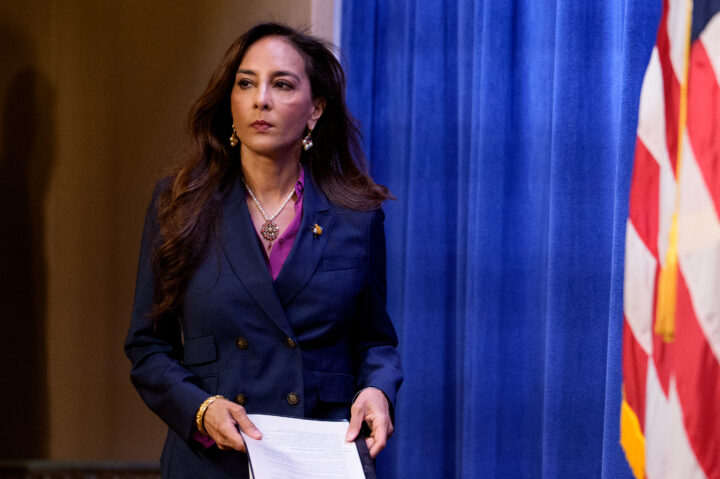
Andrew Harnik/Getty Images
Assistant Attorney General for Civil Rights Harmeet Dhillon arrives for a news conference at the Justice Department on September 29, 2025 in Washington, DC.


 Add JewishInsider on Google
The assistant attorney general for civil rights, Harmeet Dhillon, warned last week that countries participating in boycotts of Israel could face U.S. retaliation, raising the prospect of sanctions against Britain and other European governments.
But Washington still has yet to clarify its policy, and it remains unclear whether the Trump administration plans to move forward with retaliatory measures.
Speaking in Washington last week, Dhillon sharply criticized the measures taken by European countries, describing the actions as involvement in BDS and a form of antisemitism. European officials, however, have argued that the sanctions are different from the BDS movement.
“What we call this in the United States is the BDS movement. It is antisemitism,” Dhillon said while speaking in D.C. on Oct. 6. “And I think every country that is doing that is going to risk, while President Trump is in power, retaliatory or corresponding sanctions potentially.”
One Republican congressional source told Jewish Insider that Treasury Department and Commerce Department officials had told their office that the departments were prepared to add those countries that announced sanctions targeting Israeli settlements last month to the Treasury’s international boycott list, but the State Department was refusing to grant the clearance necessary to do so.
Reached for comment, a State Department spokesperson told JI: “We are not going to comment on internal deliberations speculated on by an anonymous source.”
The U.K. announced an import ban on settlement goods and sanctions on related entities on Sept. 9.
The Netherlands introduced stricter measures on Sept. 22, including penalties of up to six years in prison for violations. Israel responded by revoking the diplomatic credentials of Dutch envoys in Ramallah.
France, Canada and other countries have also enacted or pledged similar restrictions involving the West Bank, east Jerusalem and the Golan Heights. The measures have drawn condemnation in Israel. U.S. Ambassador to Israel Mike Huckabee has warned that Britain could face economic repercussions.
Secretary of State Marco Rubio had previously indicated that the U.S. would not join the sanctions. Republicans in Congress have also told JI they oppose them. Before Dhillon’s remarks, the administration had not publicly condemned the measures.
A former U.S. administration official, speaking on background, confirmed the sanctions are not yet “settled administration policy” and noted that Dhillon’s comments could be strategic.
“Dhillon’s comment does not necessarily reflect settled administration policy. A decision to impose such sanctions would need consideration by Treasury, State, USTR, and above all the President; it’s not a DOJ decision,” the former official said. “It may reflect a decision to sanction the UK, or a warning shot meant to deter others from following the UK, or her view but not a final policy decision.”
The distinction between the European measures and the broader BDS movement could also become significant as the administration determines how to respond. European governments have presented their restrictions as measures targeting Israeli settlements rather than participation in the broader BDS campaign against Israel.
Jonathan Ruhe, a fellow at the Jewish Institute for National Security of America, said the uncertainty comes against a complicated history of U.S. policy toward Israeli settlements and BDS.
“Israeli settlements have always existed in a gray area when it comes to U.S. opposition to BDS. President Obama excepted West Bank settlements from his enforcement of anti-BDS laws, and Biden sanctioned certain settler activities while officially opposing BDS.”
He said that ambiguity appears to have carried into the Trump administration as tensions between Israel and European governments over settlement policy have increased.
“This gray area now seems to be carrying over to the Trump administration, where coherent and consistent policymaking has never been a strong suit, precisely as the West Bank and U.S.-European ties become particularly tense more generally,” Ruhe said.
Ruhe also pointed to the administration’s previous responses to European actions targeting Israel as a possible indication of how Washington could respond to the latest measures.
“Though Amb. Huckabee repeatedly called settler violence ‘acts of terror’ and ‘criminal activity’ over the summer, Europe’s latest threats follow a pattern where the administration jumps at the opportunity to retaliate for sanctions, embargoes, and arrest warrants aimed at Israel from Europe,” Ruhe said.
Jason Greenblatt, who served as White House Middle East envoy in the first Trump administration, did not clarify whether he expects the policy to be officially implemented, however he noted that he would “strongly support such a policy.”
“Countries that do that should understand there can be consequences, even if they are long standing friends of the United States,” Greenblatt said. “When governments turn the BDS movement’s anti-Israel agenda and antisemitic ideology into policy, the United States has every reason to respond.”
Greenblatt further argued that just because certain countries are U.S. allies, it should not shield them from consequences when acting against Washington’s interests.
“Ambassador Huckabee publicly warned of consequences before Britain announced these measures last month, and Britain proceeded anyway,” he continued. “Friendship and history should not provide immunity when a government acts against U.S. interests and principles, and against one of our closest and most important allies.”
The bipartisan bill, backed by most Republicans and 33 Democrats, would strip federal funding from colleges engaged in boycotts against Israel

Leigh Vogel/Getty Images
Rep. Josh Gottheimer (D-NJ)
House Democrats overwhelmingly voted against a bill that would strip federal funding from colleges and universities engaged in boycotts of Israel, with just 33 Democrats supporting the measure.
The bill ultimately passed 237-169, with two Republicans voting against the measure along with the majority of House Democrats.
The Protect Economic and Academic Freedom Act, led by Reps. Virginia Foxx (R-NC) and Josh Gottheimer (D-NJ), would make colleges that participate in a “nonexpressive commercial boycott” of Israel ineligible to receive federal student aid funding, requiring them to certify annually that they are not engaged in such boycotts and instructing the Department of Education to annually publish a list of schools that fail to submit such certifications.
The law would apply to boycotts of Israel as a country or to companies and other entities operating under Israeli law, which would include settlements in the West Bank.
The Democrats who supported the bill were Reps. Jake Auchincloss (D-MA), Kathy Castor (D-FL), Gil Cisneros (D-CA), Jim Costa (D-CA), Joe Courtney (D-CT), Henry Cuellar (D-TX), Don Davis (D-NC), Lois Frankel (D-FL), Laura Gillen (D-NY), Jared Golden (D-ME), Vicente Gonzalez (D-TX), Greg Landsman (D-OH), George Latimer (D-NY), Susie Lee (D-NV), John Mannion (D-NY), Jared Moskowitz (D-FL), Donald Norcross (D-NJ), Jimmy Panetta (D-CA), Marie Gluesenkamp Perez (D-WA), Josh Riley (D-NY), Brad Schneider (D-IL), Hillary Scholten (D-MI), Kim Schrier (D-WA), Brad Sherman (D-CA), Darren Soto (D-FL), Haley Stevens (D-MI), Tom Suozzi (D-NY), Shri Thanedar (D-MI), Dina Titus (D-NV), Ritchie Torres (D-NY), Juan Vargas (D-CA), Eugene Vindman (D-VA) and Debbie Wasserman Schultz (D-FL).
Republican Reps. Warren Davidson (R-OH) and Thomas Massie (R-KY) opposed it.
“No student, no professor should be shut out of research, study abroad opportunities, or academic partnerships, or feel unwelcome in the classroom because of where they’re from or what religion they practice,” Gottheimer said in a statement ahead of the vote. “Yet that’s exactly what the boycott-divest-sanction movement seeks to do — targeting one country and one religion: Israel and Judaism.”
He insisted the bill would not impact speech, protest or academic debate, but “simply says that if your university takes federal taxpayer dollars, it can’t discriminate against academic partnerships or investments with one country. That’s it. I urge my colleagues on both sides of the aisle to support this bipartisan bill.”
House Minority Leader Hakeem Jeffries (D-NY) called the bill a “poorly-written Republican bill” that would not oppose the BDS movement but instead “provide Donald Trump with the power to punitively launch political attacks on our colleges and universities.”
He pledged that a Democratic majority would “advance unifying legislation” to combat antisemitism.
Rep. Jerry Nadler (D-NY), a co-chair of the House Jewish Caucus, said that he strongly opposes the Boycott, Divestment and Sanctions movement and believes that it “can veer into antisemitism.”
“But no matter how strongly I oppose the BDS movement, I also believe that those who engage in BDS have a First Amendment right to do so,” Nadler continued, calling the bill a “direct and gross violation of the First Amendment.”
He said it also “treats the entire West Bank as part of Israel, erasing the Green Line and undermining efforts to promote a two-state solution.”
A memo from Rep. Bobby Scott (D-VA), the ranking member of the House Education and Workforce Committee, also urged Democrats to oppose the bill, warning that it could “potentially” restrict schools’ First Amendment rights and that it does not address a currently existing problem. It also notes opposition from J Street and the American Federation of Teachers.
The Jewish Democratic Council of America also opposed the bill, which it said is “an infringement on free speech and undermines efforts toward peace.”
AIPAC and Jewish groups, including the Republican Jewish Coalition and the Louis D. Brandeis Center for Human Rights Under Law, supported the bill.
AIPAC said in a statement, “This legislation helps protect pro-Israel students from discriminatory boycotts and efforts to deny them the ability to study in Israel or learn from Israeli professors, while fully protecting First Amendment rights.”
The RJC noted, “insisting that universities join the BDS lynch mob was the key demand campus protesters confronted university administrators with during the period of antisemitic violence and unrest that swept American campuses after October 7, 2023.”
The bill’s prospects of passing the Senate in the remaining months of the current congressional term are unclear. It has no companion legislation in the Senate and there had not been much public attention on the legislation prior to its passage today in the House.
The Jewish Book Council launched a new subscription service, Nu Reads, which provides six Jewish books per year, modeled on the success of PJ Library
For Jewish and Israeli authors and the people who enjoy their books, the publishing industry has been a decidedly depressing place over the last two years.
A spreadsheet titled “Is Your Fav Author a Zionist?” went viral on social media and called for readers to boycott so-called “Zionist” authors, a label extended even to some who merely spoke to Jewish audiences. The literary magazine Guernica retracted an essay by an Israeli author in response to protests from staff. LitHub, the preeminent news site dedicated to the publishing industry, has adopted a stridently anti-Israel stance since Hamas’ Oct. 7 attacks two years ago. “A litmus test has emerged across wide swaths of the literary world effectively excluding Jews from full participation unless they denounce Israel,” the author Jamie Kirchick wrote in The New York Times last year.
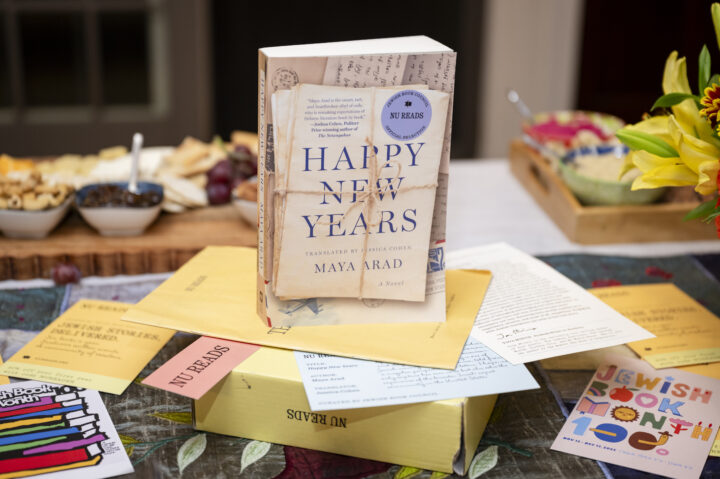
A new initiative from the Jewish Book Council, a 100-year-old nonprofit dedicated to promoting Jewish literature, aims to fight back against the torrent of bad news for Jewish writers. This month, JBC unveiled Nu Reads, a subscription service that will deliver selected Jewish books to subscribers bimonthly. The first book, Happy New Years by the Israeli author Maya Arad, has already shipped to Nu Reads’ inaugural subscribers.
“There’s a chill for our community across the industry,” JBC CEO Naomi Firestone-Teeter told Jewish Insider in an interview this month. “If we care about Jewish literature and we care about these authors and ideas, we need to buy these books. We need to invest in them and support them.”
Curated book subscription services have soared in popularity in recent years. A reinvigorated Book of the Month Club launched in 2016, an homage to the ubiquitous brand of the 1950s and 1960s that helped curious readers find new titles; the new iteration has a reported 400,000 members. More than 230,000 Jewish families in the U.S. and Canada receive children’s books each month through PJ Library, a program modeled on Dolly Parton’s Imagination Library. It was PJ Library — which has transformed young Jews’ experience with Jewish books in the two decades it has existed — that served as an inspiration to JBC.
“I very jokingly suggested that I wish that there was a PJ Library for grown-ups,” said Tova Mirvis, the author of five books and Nu Reads’ writer-in-residence, who helps curate the book selections. “It was just an idea, and I began to think about it. I spent a lot of time thinking about my own experience of reading Jewish books, and how who I am as a person and as a writer is so shaped by my love of Jewish fiction.”
Unlike PJ Library, Nu Reads is not a charity project. It asks consumers to choose to spend their money on hardcover copies of new Jewish books. The founding subscriber rate of $154 includes six books delivered over the course of a year, along with invitations to community gatherings and author talks. Several hundred people have become subscribers in the two weeks since Nu Reads was announced.
At a time when Jewish writers face growing challenges in the publishing industry, JBC hopes Nu Reads will herald Jewish readers’ purchasing power to remind publishers that Jewish books are a good investment, because publishing is, ultimately, a business.
“It’s much harder to get published because there are fewer venues. There are fewer places that review books. We have so many other distractions we use aside from reading books. There are fewer bookstores — all the ways that, I think, the literary world has shrunk, and so of course that affects Jewish writers as well,” Mirvis told JI.
Nu Reads, Mirvis hopes, will serve as “a reminder to the literary world, to publishers and editors, that there are so many people within the Jewish community who love these books. I think it’s a way to galvanize readers to say, ‘I want to read the next generation of these writers.’”
In early 2024, JBC created an online resource for Jewish writers and publishing industry professionals to report instances of antisemitism they had experienced. The organization, which is best known for presenting the annual National Jewish Book Awards, also launched a virtual support group for Jews in the literary world that still meets regularly.
“This is such a competitive industry,” said JBC CEO Naomi Firestone-Teeter. “We’re holding all of that together to try to not be sensationalist about anything, but at the same time, these are real concerns that are valid.”
So far, JBC has received more than 400 reports of antisemitism, with examples including digital harassment and abuse, students kicked out of literary journals because of their views on Israel and writers asked by publishers or marketers to discuss their Judaism only in a particular way.
Still, it’s nearly always impossible to attribute a decision in the literary world purely to antisemitic motives. A book may be dropped by a publisher because of the author’s attitude toward Israel or the Jewish themes it portrays. But it could also be dropped for a near-infinite number of other reasons: limited demand, fewer books being published overall or the book simply not being very good.
“This is such a competitive industry,” said Firestone-Teeter. “We’re holding all of that together to try to not be sensationalist about anything, but at the same time, these are real concerns that are valid.”
Nu Reads’ second selection is Sam Sussman’s Boy From the North Country, a novel about a boy in upstate New York who grows up with a nagging sense that he is Bob Dylan’s illegitimate child. (The book is based on Sussman’s own life, and a glance at a photo of the author reveals more than a passable resemblance to the folk icon.)
As a child in the Hudson Valley, far from other Jews, Sussman had formative encounters with stories by Jewish writers such as Chaim Potok, Philip Roth and Tony Kushner. When he moved to New York City, Jewish book events were how he tapped into the Jewish community.
“We only have so much control over how the wider world receives Jewish literature,” author Sam Sussman told JI. “But I think it’s very important that within the Jewish world, we’re open to stories from Jews of all backgrounds and with all political and cultural perspectives.”
“I really grew up in a part of the world where there weren’t a significant number of other Jews, and literature was a really important way for me to connect to a broader sense of Jewish community,” Sussman told JI.
Sussman has not experienced the kind of pushback or stigmatizing that some other Jewish writers have reported since Oct. 7. Instead, he urged Jewish readers to think about how to ensure that the full diversity of Jewish voices and stories are told and respected.
“We only have so much control over how the wider world receives Jewish literature,” Sussman told JI. “But I think it’s very important that within the Jewish world, we’re open to stories from Jews of all backgrounds and with all political and cultural perspectives.”
Sussman’s story, and the growing positive acclaim for his debut novel, is a reminder that despite the steady drip of negative headlines for Jewish authors, the literary world — an industry Jewish authors and intellectuals helped shape over decades — is not a monolith, and the story of American Jewish literature has not yet reached its conclusion.
“How do we respond to the urgent needs of our community and raise awareness about them and create written documentation around them, but also, how do we find ways that we can just really celebrate our Jewishness and have that propel us forward?” asked Firestone-Teeter. “The ability to hold all these things at once is incredibly inspiring.”
Please log in if you already have a subscription, or subscribe to access the latest updates.
 Continue with Google

 Continue with Apple