







The group behind the pro-Hamas chants in Queens has a nationwide network and links to pro-terror organizations and individuals
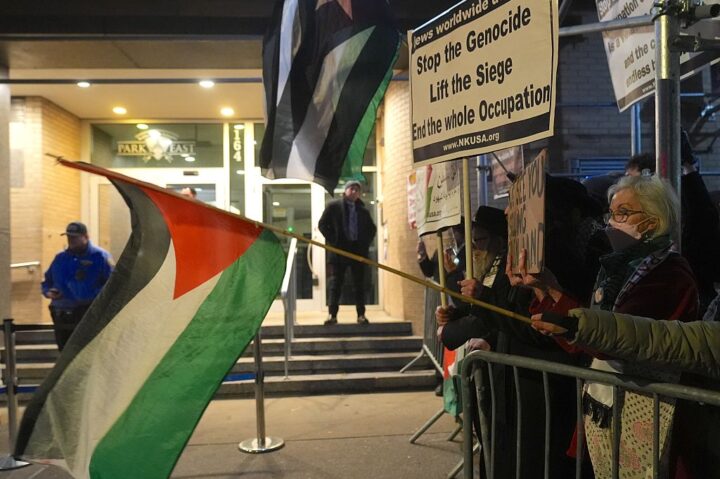
Selçuk Acar/Anadolu via Getty Images
Anti-Israel demonstrators gather at 'No Settlers on Stolen Land' protest against a Nefesh b'Nefesh event at the Park East Synagogue in Manhattan in November 2025.


 Add JewishInsider on Google
The group behind a pro-Hamas demonstration near a Queens synagogue earlier this month and a series of other events targeting Jewish religious institutions has deep pockets — and deep roots, which criss-cross the country and link it to various extremist cells — according to publicly available tax filings.
The demonstrators who broke into chants of “Say it loud, say it clear, we support Hamas here” outside Young Israel of Kew Garden Hills — and triggered outrage over New York City Mayor Zohran Mamdani’s belated condemnation — were affiliated with an outfit known by multiple names: Palestinian Assembly for Liberation (PAL), Al-Awda (Arabic for “the return”) and Palestine Right to Return Coalition (PRRC). But official filings with state and federal authorities reveal that the groups are different monikers of a single nonprofit operation, one whose revenue has exploded in recent years: from just $44,789 in 2022 to $451,903 in 2024, the most recent period for which filings are available.
The group also orchestrated the action targeting Park East Synagogue in Manhattan in November, and the “Flood Boro Park” rally that devolved into violence last February. On the day of Hamas’ Oct. 7, 2023, attacks on Israel, the organization issued a full-throated endorsement of the assault.
“The Palestinian Assembly for Liberation and Al-Awda NY send their highest salutations to the Palestinian Resistance, the Freedom Fighters and Defenders of the indigenous Palestinian people,” a post on its Facebook page reads. “PAL and Al-Awda NY call on Palestinians globally to take their place in history, and to mobilize in all fora in support of the Liberation Operation.”
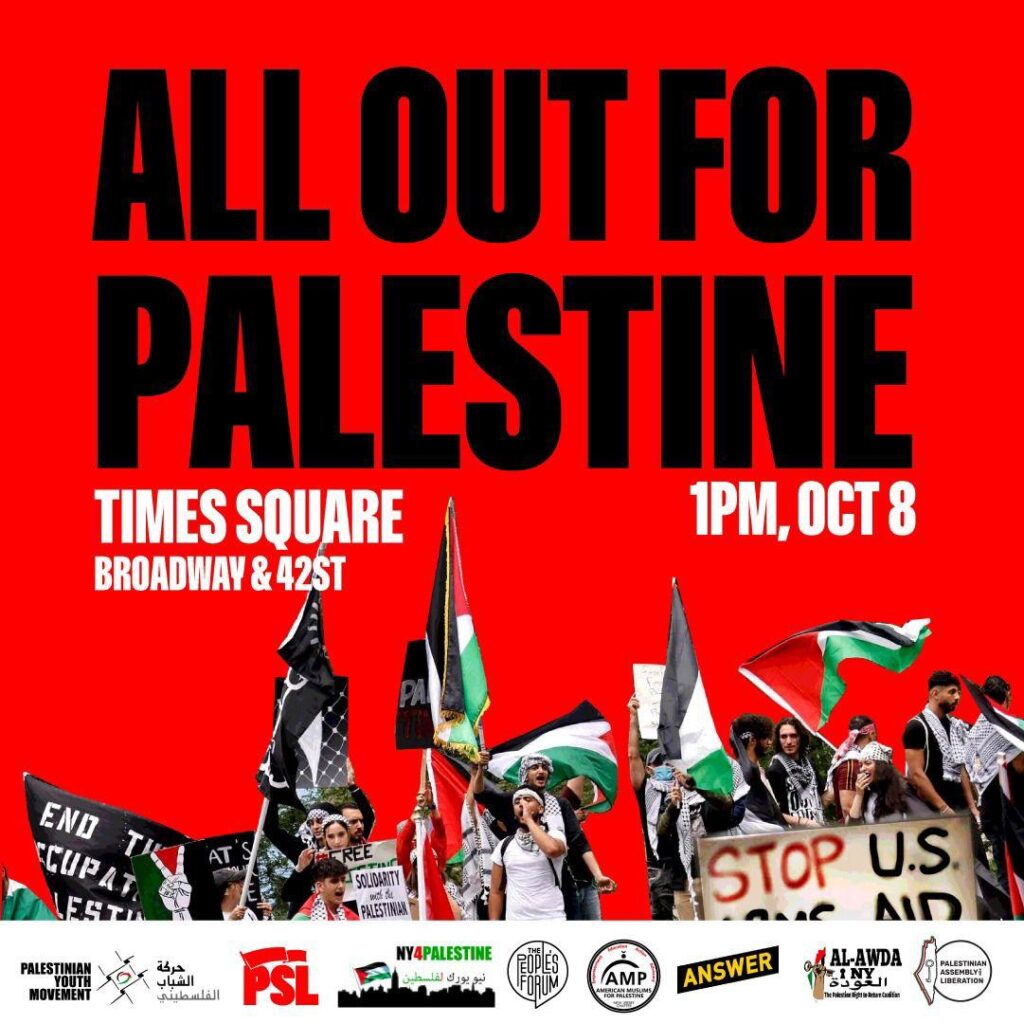
The group helped organize a Times Square protest the following day, alongside multiple far-left organizations. Much of the blowback the event received from New York officials centered on the participation of the NYC chapter of the Democratic Socialists of America, of which Mamdani is and was a member.
However, materials promoting the demonstration show that its staging received support not just from PAL/Al-Awda/PRRC but also from the People’s Forum, a Manhattan-based arm of a global network financed by Beijing-based tech mogul Neville “Roy” Singham. Singham and his wife, Jodie Evans, have poured their massive fortune into advancing disinformation supportive of the Chinese government and its allies, Russia and Iran. The People’s Forum also hosted Al-Awda’s national conference in 2022, which featured speakers from the DSA BDS Working Group.
Social media and blog posts reveal that PAL/Al-Awda/PRRC has also worked closely with Evans’ organization CODEPINK, known for its tactics of disrupting Capitol Hill hearings and political events, and for its pro-China and pro-Iran activism. PAL/Al-Awda/PRRC has also long partnered with the Party for Socialism and Liberation and its affiliate, Act Now to Stop War and End Racism Coalition, which provides staff to the Singham network. All of these groups have been involved in the Shut It Down 4 Palestine protest campaign, as well as in the 2024 encampments at Columbia University.
PAL/Al-Awda/PRRC also has ties to Samidoun, a group identified by Israel, Germany, Canada and the United States as a fundraiser and affiliate of the Popular Front for the Liberation of Palestine, which has been designated as a terror group by the U.S. for decades. PAL/Al-Awda/PRRC and Samidoun have cross-promoted and participated in each other’s events for years.
Further, a booklet for a 2023 “People’s Tribunal” on the Al-Awda website identifies Samidoun co-founder Charlotte Kates as “a member of Al-Awda, The Palestine Right to Return Coalition,” and archived versions of a now-deleted page listing PAL/Al-Awda/PRRC’s national board identified Kates as the group’s “Communications/Secretary” from 2021-2023. These pages also reveal that Nerdeen Kiswani, the founder of Within Our Lifetime and an outspoken defender of militant group violence, served as PAL/Al-Awda/PRRC’s “Youth Representative” in these same years. During that same period, Kiswani was a student at CUNY Law School, and delivered a speech at the school’s 2022 commencement in which she alleged that she had “been facing a campaign of Zionist harassment by well-funded organizations with ties to the Israeli government and military.”
The national board also includes attorney Lamis Deek, who has publicly praised Hamas, the PFLP, and Iran’s Al-Quds intelligence force — and who officially launched the “Palestinian Assembly for Liberation” with other Al-Awda organizers in 2021.
The PFLP and Hamas are not the only terror organizations with which PAL/Al-Awda/PRRC and its leaders have shown affinity. The Anti-Defamation League discovered one of the group’s self-identified founders, Abbas Hamideh, lauded Hezbollah on his Twitter account.
Tax documents show PAL/Al-Awda/PRRC at present has just two officers on its board. The organization’s chair is Amani Barakat, part of a prominent business, real estate and philanthropic dynasty based in Southern California. The late family patriarch, Adil Barakat, was a leader in the Arab American Press Guild and the United States Organization for Medical and Educational Needs, a relief organization centered on Middle Eastern affairs.
PAL/Al-Awda/PRRC’s treasurer and only other listed executive is Anas Amireh, a Miami-area realtor who has lectured at Florida International University.
Barakat, Amireh and Deek did not respond to requests for comment, and messages left in an inbox and at a phone number listed on the Al-Awda website similarly received no answer.
The source of the group’s swelling resources isn’t clear from public information. It has received sizable contributions from “dark money” funds that mask the original contributor’s identity, as well as from the WESPAC Foundation, a New York-based charity that has come under fire for underwriting organizations that call for Israel’s destruction.
Labor for Palestine and U.S. Campaign for the Academic and Cultural Boycott of Israel are also both affiliated with PAL/Al-Awda/PRRC, and operate out of its address in Coral Gables, Fla.
Jonathon Kahn, Columbia's associate dean of community and culture, signed a petition in 2021 accusing Israel of ‘settler colonialism, apartheid and ethnic cleansing’

InSapphoWeTrust / Flickr
Columbia University
Columbia University’s new hire for senior associate dean of community and culture was a signatory of a 2021 letter supporting the Palestinian “indigenous resistance movement” and rejecting the “the fiction of a ‘two-sided conflict.’” He is tasked with leading “meaningful dialogue” in his new position.
Jonathon Kahn signed on to the “Vassar Community Members’ Statement of Solidarity with the Palestinian People” while a professor of religion at Vassar College.
“We affirm that the Palestinian struggle is an indigenous resistance movement confronting settler colonialism, apartheid, and ethnic cleansing, and stand in solidarity with the Palestinian people,” the letter read. It came amid the May 2021 Israel-Hamas conflict, in which at least 13 Israelis were killed by Hamas rocket fire. The open letter also “includes a commitment to academic BDS, which, if put into effect, would restrict the educational opportunities and academic freedom of students and faculty who want to study about or in Israel.”
In his new role at Columbia, Kahn will “build and lead initiatives that cultivate curiosity, civic purpose and meaningful dialogue — facilitating student engagement with faculty outside the classroom, and helping reimagine what a liberal arts and sciences education can be in the next century,” Josef Sorett, dean of Columbia College and vice president for undergraduate education, said in a statement announcing the appointment on Tuesday.
Columbia University did not respond to an inquiry from Jewish Insider asking whether the school was aware of the petition before hiring Kahn.
The senior associate dean of community and culture role is a new position, created in the wake of increased antisemitism that has plagued Columbia’s campus since the Oct. 7, 2023, Hamas terror attacks in Israel.
Kahn, who has no known social media presence, said in a statement sent to the Washington Free Beacon on Wednesday regarding the petition that he is “a Zionist” who “believe[s] deeply in Israel’s right to exist and thrive as a Jewish state” and also “deeply value[s] Palestinian life and Palestinians’ aspirations for statehood.”
“My beliefs are not fully captured in this letter that was authored more than four years ago,” he said. “I didn’t agree with every sentence then, and I still don’t. But I put my name to that letter at a time when I felt in deep disagreement with actions taken by the Israeli government and I wanted to signal my support for the Palestinian civilians who were suffering.”
Kahn’s appointment comes just over a month after Columbia reached a deal with the Trump administration, in which it has to pay a $200 million dollar settlement, to restore some $400 million in federal funding that was cut by the government in March due to the university’s record dealing with antisemitism.
Marvel Joseph is 'bridging the gap between the black community and Israel'

Courtesy
Marvel Joseph speaks at the AIPAC 12th annual real estate division luncheon in New York.
As a new employee of the Maccabee Task Force, an organization that fights BDS on college campuses, Marvel Joseph is responsible for connecting with students at historically black colleges and universities. Joseph’s goal, he told Jewish Insider, is “bridging the gap between the black community and Israel.” The recent college graduate is up for the task — he was an outspoken AIPAC activist at Florida Atlantic University (FAU), and a prominent black voice in the college’s pro-Israel scene.
But following George Floyd’s death at the hands of Minneapolis police officers last month, Joseph, the son of Haitian immigrants, has found himself in an unfamiliar role: teaching Jewish communities about racism. He has participated in recent Zoom webinars with different Jewish communities — including an Orthodox synagogue and his alma mater’s Hillel — about the ongoing protests. In recent weeks he has discussed fighting police brutality with rabbis, Jewish nonprofit professionals and other Israel advocates he has gotten to know since he first got involved in the pro-Israel space in 2018.
“This is the first time that I’ve really been able to say, ‘This is what it’s like being black,’” Joseph explained. “Never before in my entire time as a pro-Israel advocate or pro-Israel leader… have I ever had the opportunity, necessarily, to really stand up and say, ‘This is what my community is going through.’”
Since he attended a 2018 retreat hosted by AIPAC for African-American students, Joseph has placed Israel advocacy at the forefront of his personal and professional endeavors. He has interned at AIPAC, traveled to Israel four times and developed relationships in the Jewish community. Now, for the first time, he is asking the friends he made there to show up for him — and he has found a largely receptive audience.
“What I’m hoping comes out of all of this, when it’s all said and done, is that in the same way that we have black activists in the pro-Israel movement, I hope we also get strong Jewish activists in the pro-black community and the black lives matter movement,” Joseph said.
Joseph, who is Christian, is used to being in Jewish spaces, having grown up and attended school in Boca Raton, Florida. In 2010, when a major earthquake rocked his parents’ native Haiti, many of his Jewish friends joined together to raise relief funds for Haitians. That memory of “Jewish kids helping me” has stayed with Joseph.
As a child, he identified more with the Haitian community than with the broader African-American community in south Florida. “Growing up from immigrant parents as opposed to growing up from a family of descendants of African-American slaves… there’s a different starting point,” Joseph said. Unlike some of his friends whose families were affected by violent, racially tinged events, his parents started fresh in America in the 1980s.
Even in the mostly white spaces he was accustomed to, Joseph didn’t think much about racism. “The schools that [my parents] put me in, even though I was the only black person there, I didn’t feel any different than anyone else, because my background, my culture, always revolved around being Haitian, not around being black in America,” Joseph said.
That changed when he started college. At a fraternity party freshman year with a white friend from home, the friend turned to him, saying, “‘Dude, I’m so glad that you’re not like these other n*****s,’” Joseph recalled. “I was like, ‘What?’ And he’s like, ‘Yeah, you’re one of the good ones,’” Joseph said. “It didn’t matter anything else that happened years before… to him I was just a good n****r,” Joseph added.
The encounter at the party set him on a quest to “find out what my real identity was,” he said. Joseph began reading black authors like James Baldwin, whose quote “to be black and conscious in America is to be in a constant state of rage,” inspired his journey toward better understanding systemic racism in the United States.

Marvel Joseph leads a Maccabee Task Force trip to Israel for black student leaders in December. (Courtesy)
Still, Joseph’s Haitian background is a key part of his identity, and it’s what inspired his connection to Israel. He has only been to Haiti once, on a three-day visit in 2019, which he described as the most meaningful trip of his life. “It was the first time when I walked into a place I didn’t feel out of place. I got to actually be part of my people,” Joseph explained. “Probably how a lot of Jewish people feel when they get to go to Israel.” That shared feeling of being part of a diaspora, and having a homeland, drew him toward Israel.
Joseph has built a niche for himself in the pro-Israel world, as a Christian and a Haitian who speaks about his deep connection to the Jewish state. But he told Jewish Insider that he never felt like “the token black person in the pro-Israel movement.” The reason, Joseph said, is that “when you’re tokenized, you say what they tell you to say and not what you believe. Everything I say is stuff that I believe.”
As he sees it, many Jewish organizations — including some right-leaning ones who might not otherwise host discussions about racism — are reaching out to him now “because they realized that this is someone who stands up for [the Jewish community] in ways that no one prior has.”
Joseph understands that it’s unusual for a black person who is not Jewish to pursue a career in what is largely a Jewish cause. “We love talking about MLK being the ultimate black Zionist, but MLK had other things that he was worried about,” Joseph said, adding, “I’ve essentially dedicated my first year out of school, at least my first year out of school, to really doing this work.”
So what does Joseph hope to see from his Jewish friends? “My response to people when they say, ‘Hey, we’re thinking about you during this time,’ is, ‘Well hey, call your congressman, tell them you’re thinking about me and all the black people that have been killed.’”
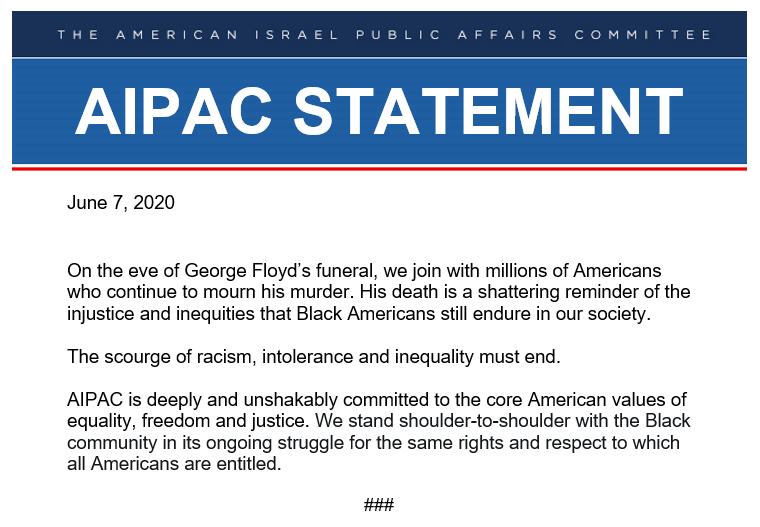
AIPAC, which sent a letter to its African-American members six days after Floyd’s death expressing solidarity, received criticism for being slow to issue a public statement in response to the events, but Joseph wasn’t concerned by that. What mattered more was the messages of support he received from friends at AIPAC and in the pro-Israel community, people who asked him how they could support him and the cause. “It’s a bipartisan organization… the fact that people decided that whether this is a partisan issue or not, I support you and your community, not because of everything you’ve done for me but because it’s the right thing to do, to me means more than any statement,” Joseph explained.
He views his position in the Jewish community as a bridge-builder, someone who supports Israel and fights antisemitism but also helps “my friends in the Jewish community understand that there’s a world outside of just the Jewish issues.” He understands that the anti-Israel policies in the official Black Lives Matter platform give some Jews pause. “But the idea of ‘black lives matter’ is black lives matter. There’s other ways to support a community,” Joseph said.
“At the end of this,” Joseph explained, he hopes to see “more education and a more genuine partnership, not an ‘I scratch your back, you scratch mine,’ but a ‘please tell me how I can help.’”
Please log in if you already have a subscription, or subscribe to access the latest updates.
 Continue with Google

 Continue with Apple