


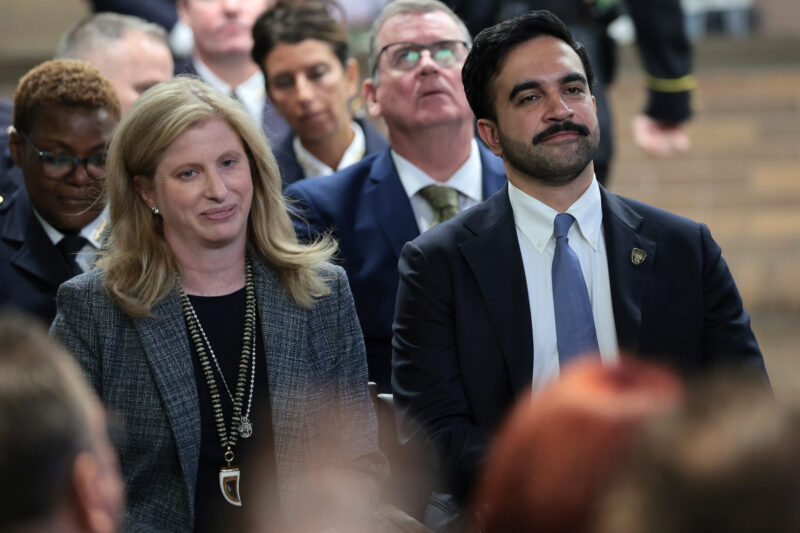





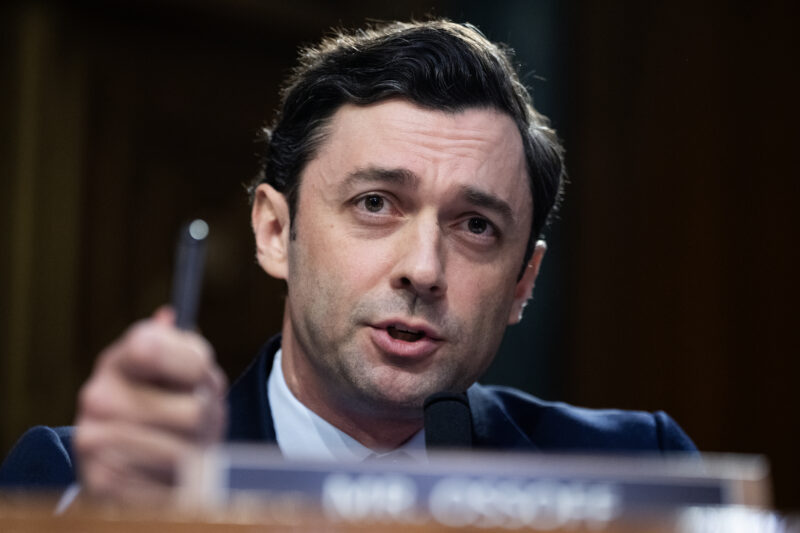




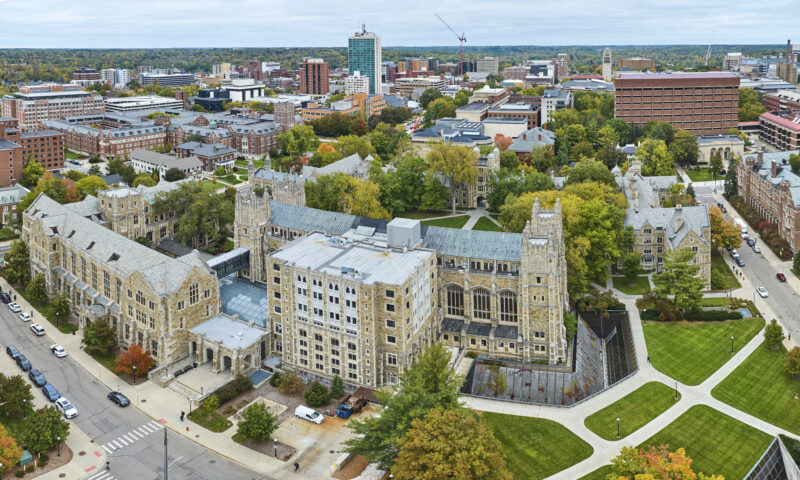

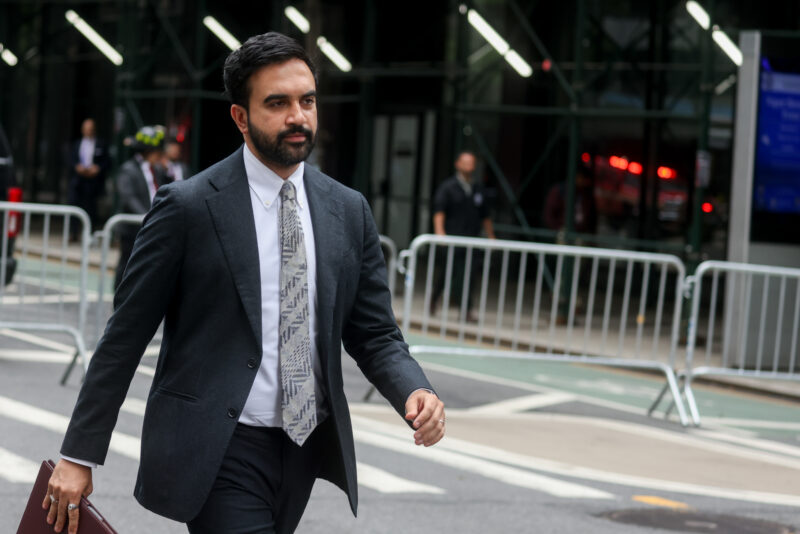





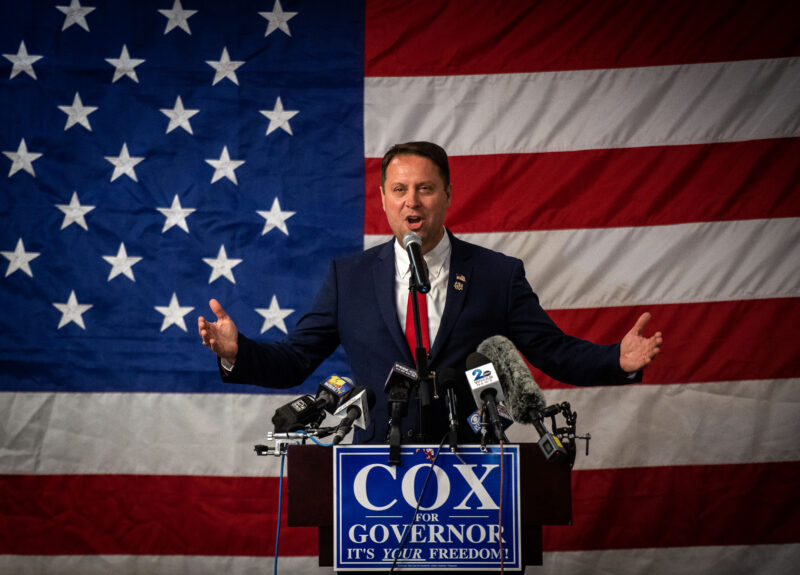



























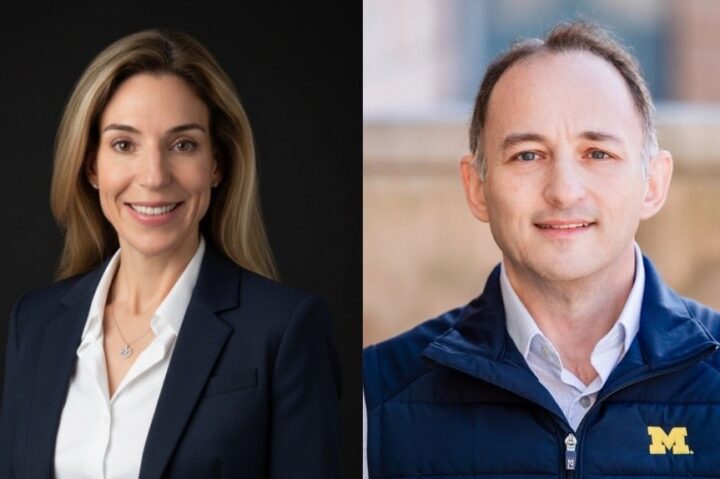
Republican nominees Lena Epstein and Michael Schostak, who both identify as Jewish, told JI they’re campaigning on fighting antisemitism at the school
Campaign website
Lena Epstein and Michael Schostak


 Add JewishInsider on Google
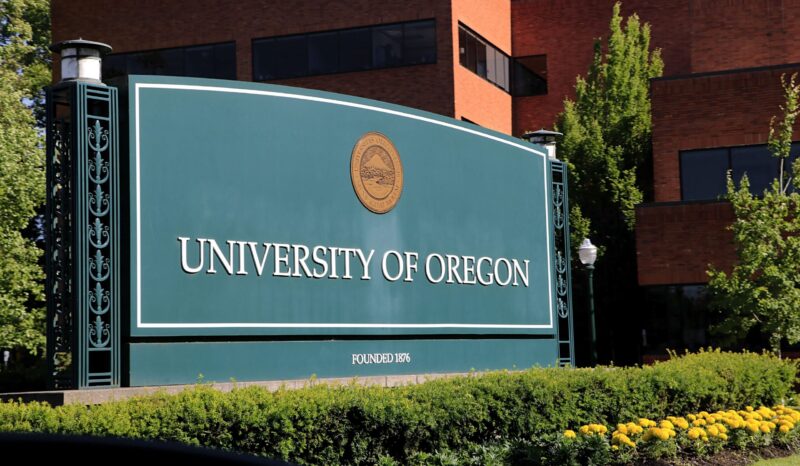
Michigan’s statewide election for two seats on the University of Michigan Board of Regents — the body that governs the state’s flagship university — has become a surprisingly contentious race in a swing state full of high-profile match-ups.
After Amir Makled, a trial attorney with a history of antisemitic and pro-Hezbollah social media posts, unseated incumbent Regent Jordan Acker at the Democratic Party nominating convention last month, the two Republican candidates running for the board see an opening to pitch themselves to Democrats and Independents.
Acker, who is Jewish, had spoken out against efforts to divest Michigan’s endowment from Israeli companies, and faced antisemitic harassment from pro-Palestinian campus activists, while Makled has promoted efforts to boycott Israel. (Acker and Brown campaigned together during the primary, but Acker did not respond to a request for comment about who he’s backing in the general election.)
Lena Epstein, an oil executive who chaired President Donald Trump’s campaign in Michigan in 2016 before running for regent, told Jewish Insider in a recent interview that reaching disaffected Democrats who are upset about Makled’s place on the ticket is a priority for her.
“There are the individuals that believe that I’ll be a fabulous regent and really great at the job and able to effect positive change over these next eight years, and for the long term,” said Epstein, who also ran for the board in 2022 and narrowly lost. “Then there’s the other folks that simply don’t want the other gentleman who is nominated to win, and we accept support from Democrats, independents and Republicans.”
Epstein has an MBA from Michigan, as does the other Republican on the ticket, Michael Schostak, the treasurer of Bloomfield Township, a Detroit suburb. Schostak told JI in an interview that since Makled’s nomination, Michigan alumni around the country who are now closely following the race have been calling him.
“They care about their alma mater and they want to make sure that it stays in good hands, and they’re very concerned about what they’ve seen from Amir Makled,” Schostak said. “I’m not running to be the Jewish candidate. I am Jewish, but that’s not why I’m running. I got into this race eight months ago because I cared about affordability of tuition and college costs.”
The two regents who are elected this November to serve on the eight-person board will join an ongoing search for a new university president following a tumultuous few years for Michigan, one of the top public universities in the country — and the school with the fifth-largest Jewish student population, according to Hillel International.
Both Schostak and Epstein identify as Jewish, though Epstein has at times described herself as a messianic Jew, meaning she believes in the divinity of Jesus. For that reason, the mainstream Jewish community considers messianic Jews to be Christian. She recently told the Forward that she is “100% Jewish,” and that her family belongs to a Reform synagogue in Bloomfield Hills.
Both Republicans say fighting antisemitism is a priority for them if elected to the board of regents.
“Antisemitism should never be minimized, normalized or explained away. Jewish students deserve the same protection and dignity as every other student on campus,” Epstein said. “One of the most troubling failures that we’ve seen at the University of Michigan is the hesitation to call antisemitism what it is.”
Schostak recalled conversations with Jewish students who were afraid to wear Star of David necklaces on campus or scared to walk to class during the anti-Israel encampments two years ago.
“I felt terrible, just sick to my stomach for the Jewish students on campus who had to live through that, and the pro-Israel students. There are a lot of pro-Israel students who are not Jewish,” said Schostak. “We’ve got to acknowledge them, who felt like they couldn’t express themselves because they were going to be harassed or followed or shouted at, or whatever, and the fact that all this was going on, the encampments, and people felt like it wasn’t safe.”
Both candidates said the university did a poor job of handling the firestorm of campus events in the 2023-2024 school year after Hamas’ Oct. 7 attacks and called for more clarity about rules surrounding campus protests.
“When it comes to protests on campus at U of M, peaceful protest has been a very long-standing tradition at this fine university,” said Epstein. “Students have every right to speak out. Students do not have the right to make other students feel unsafe walking to class. A university simply can’t function if rules are enforced selectively, depending on politics.”
Schostak and Epstein said they will emphasize support for free speech across all viewpoints at a school where they think intellectual diversity is lacking. But the response to anti-Israel protests, even hateful ones, cannot be shutting all protests down, according to Shostak.
“Free speech to me is very important, and they have the right to protest and make noise, as long as they don’t disrupt the university’s business,” said Schostak. “What I would tell the Jewish and pro-Israel students is, ‘Look, you need to be just as vocal in your beliefs and standing up for Israel and standing up for the Jewish people as they are standing up for the Palestinian people.’”
After a Michigan professor delivered an anti-Israel speech at commencement this month, Epstein and Schostak released a joint statement questioning the choice of the professor, Derek Peterson, as a speaker and criticizing his rhetoric. “There is a time and a place for emotionally charged debate. A commencement ceremony is not it,” they wrote.
Makled and Paul Brown, the other Democratic nominee who was first elected to the board of regents in 2018, have both criticized President Donald Trump’s approach to higher education, and pledged to push back on funding cuts where possible. Schostak expressed concern about the cuts as well, while noting that the regents should encourage the university to work to not get additional funding cut off.
“I am concerned,” Schostak said. “The university is going to have to tap dance around that to make sure that they abide by all the rules to make sure that our research funding isn’t cut off or any of our other funding isn’t cut off.”
Epstein has declined to say much on the issue. When asked about Trump’s adversarial approach to universities, she pointed out that Michigan is a public institution.
“We do accept public funds, and we do work in concert with the government based on those financial dynamics,” she said. “With that said, I believe that the University of Michigan should be an autonomous organization.”
Both candidates understand that to the extent to which Michigan voters are even paying attention to the race, most will not make a decision based on issues related to Israel or campus protests. So their focus remains on issues like college affordability and job opportunities.
“[Voters] care about sending their kids to college, being able to afford to pay for it, having their kids stay here when they graduate, so that we can provide an environment where they can thrive,” said Schostak. “That’s what they care about, and those are the issues that I’m going to be speaking to.”
Rep. Kristen McDonald Rivet said some of her party’s nominees are ‘out of step with my values and those of Democrats across our state’
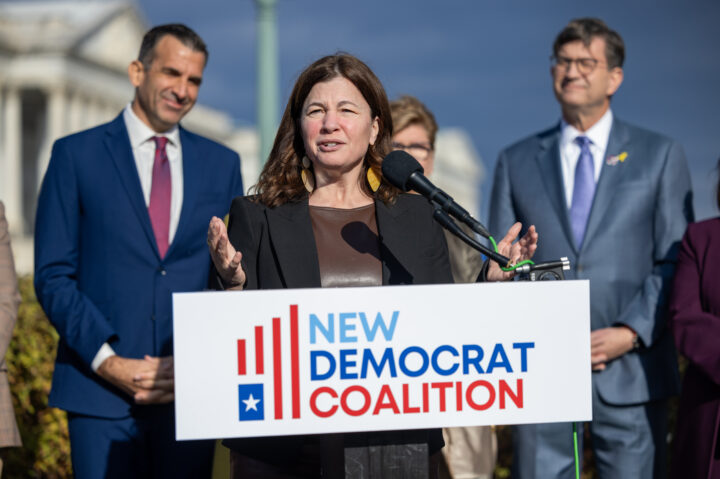
Rep. Kristen McDonald Rivet (D-MI) speaks to the press during a press conference for the New Democrat Coalition outside of the U.S. Capitol in Washington, DC on November 21, 2024. (Photo by Nathan Posner/Anadolu via Getty Images)
Rep. Kristen McDonald Rivet (D-MI), a Democrat representing a swing district in Michigan, condemned the state party for nominating an attorney who expressed support for Hezbollah for the University of Michigan Board of Regents, as well as other harassment and divisive tactics delegates targeted at pro-Israel candidates at the party convention last weekend.
She argued that such activity and decisions will ultimately help Republicans in the November midterm elections.
“What I saw on the MDP Convention floor is deeply troubling — for what it says about who we are, how we win, and whether we will be able to meet this urgent moment,” McDonald Rivet said on X on Tuesday, emphasizing that, coming from the only Trump-won district held by a Democrat in the state, she “know[s] how hard it is to win.”
She said that while she is “excited” to run alongside “many” of those nominated, “the Convention nominated others with extreme positions and records — like calling Tucker Carlson ‘a real one,’ Hezbollah leaders ‘martyrs,’ or amplifying Qasem Soleimani — that are out of step with my values and those of Democrats across our state.”
Her comments are a reference to Makled, who has run on an anti-Israel platform and had an endorsement from the SEIU labor union pulled over past social media posts expressing support for Hezbollah. Makled’s nomination ousted Jewish regent Jordan Acker, who was repeatedly harassed and had his home vandalized by anti-Israel demonstrators.
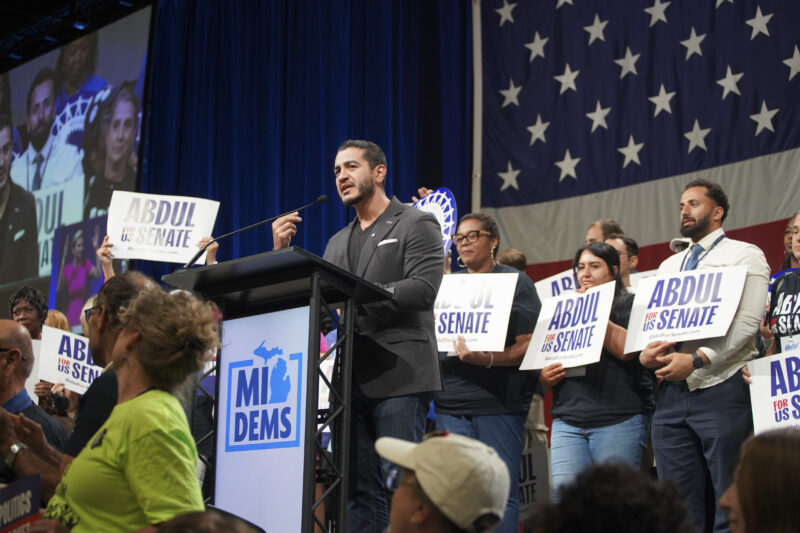
McDonald Rivet said she was also concerned that “too much of the behavior we saw on the floor is not acceptable.” Pro-Israel candidates and those supporting them, including a supporter of Acker and Rep. Haley Stevens (D-MI), faced aggressive boos at the party convention, to the extent that Abdul El-Sayed, the far-left Senate candidate who many of those vocal demonstrators are supporting, called out their behavior.
“We don’t name-call. We don’t belittle and bully. We don’t shout people down. We don’t make them feel unwelcome or unsafe based on who they are,” McDonald Rivet said. “We reject all forms of hate, including both antisemitism and Islamophobia.”
She said that the Democrats “will never beat MAGA by practicing their division.” She pointed to comments by Michigan Republicans celebrating the chaos and welcoming Jewish Democrats into the fold as proof that the events at the convention will “[make] it much, much harder for us to win back power this November” and make Republicans’ “jobs easier.”
“On Sunday, we saw a troubling step in the wrong direction. But it isn’t too late to course correct. Michigan Democrats, we can’t afford any less,” she concluded.
McDonald Rivet called for the Democratic Party to come together around a “unifying agenda” and to create spaces where everyone feels “respected, liked, and welcome.”
Dearborn attorney Amir Makled will proceed to the November general election, replacing Jordan Acker

Jose Juarez/AP
Amir Makled, right center, a candidate for the University of Michigan Board of Regents, walks with his wife, Nassrine Gomah Makled, after winning the party's nomination during the Michigan Democratic Party State Endorsement Convention, Sunday, April 19, 2026, in Detroit.
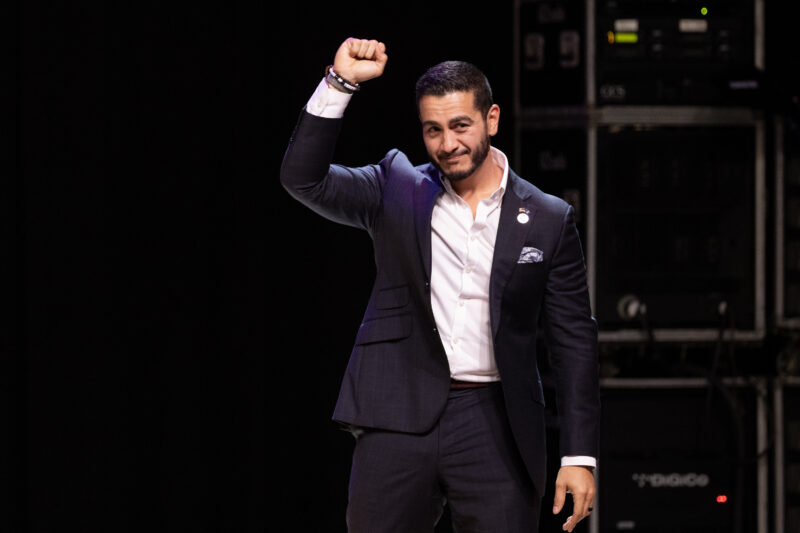
Michigan Democrats on Sunday nominated insurgent candidate Amir Makled, an anti-Israel attorney, for the University of Michigan Board of Regents over incumbent Jordan Acker, a Jewish regent who had been targeted by far-left activists over his support for Israel.
Acker was actively campaigning for reelection alongside Paul Brown, both of whom were first elected in 2018. But only Acker was targeted by Makled’s backers, even though both Acker and Brown had supported disciplining anti-Israel student activists and opposing efforts to divest from Israel. Brown was also nominated by the Democratic Party on Sunday, and he and Makled will now advance to the November general election.
The positions are statewide elected offices, and regents are tasked with governing Michigan’s flagship public university. Two of the board’s eight seats are up for election this November.
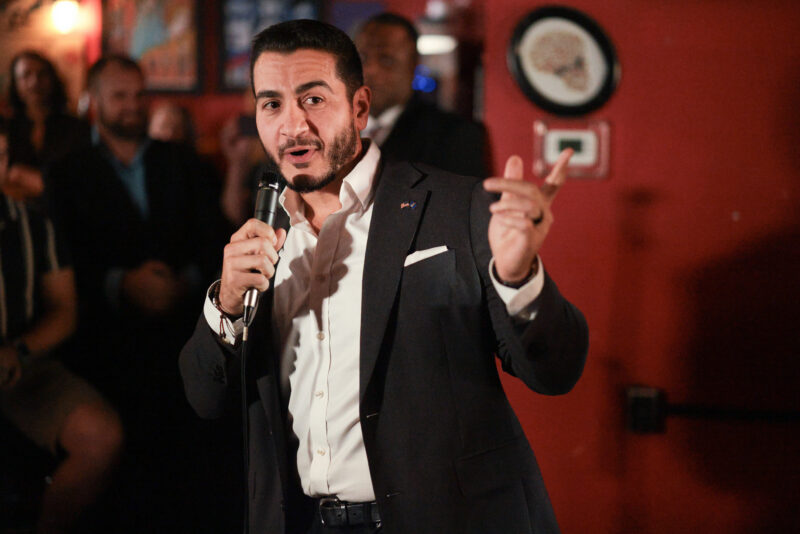
Makled has argued in his campaign that the university should divest from Israel. A trial attorney based in Dearborn, Makled previously represented a University of Michigan student who was arrested during the 2024 anti-Israel encampment.
He faced criticism earlier this month after the Detroit News documented Makled’s history of sharing pro-Hezbollah and antisemitic tweets, which he has since deleted but not addressed. Those revelations prompted SEIU, the labor union, to pull their endorsement of Makled.
In 2024, Acker’s home was targeted by anti-Israel activists on multiple occasions in incidents that university leadership and Michigan politicians described as antisemitic.
Anti-Israel activists are singling out regent Jordan Acker, hoping to unseat him with attorney Amir Makled who represented a member of the school’s encampment

JEFF KOWALSKY/AFP via Getty Images
Anti-Israel demonstrators set up a mock trial against the University of Michigan's Board of Regents on the university's campus in Ann Arbor, Michigan, on April 21, 2025.
When Jordan Acker ran for the University of Michigan Board of Regents in 2018 — a statewide elected office — he presented himself as a young alumnus eager to bring a fresh energy to the governing board of Michigan’s flagship public university.
But since the Oct. 7 Hamas attacks in Israel in 2023, Acker has become the target of the university’s anti-Israel activists, facing harassment and vandalism that Michigan leaders have called plainly antisemitic.
Acker, who is Jewish, has been a staunch opponent of efforts to divest university funds from Israel, along with other members of the Board of Regents, which has reiterated that it will not divest from Israeli companies. In November, the president of Michigan’s student government vetoed a divestment resolution.
In May 2024, a stranger wearing a keffiyeh came to Acker’s house in the middle of the night and placed papers on the door, described as a list of demands from the “UMich Gaza Solidarity Encampment.” In December of that year, his front windows were smashed and his wife’s car was vandalized with pro-Hamas graffiti. The university called it “a clear act of antisemitic intimidation.”
Now Acker is up for reelection, along with regent Paul Brown. Both of them are Democrats who were elected to the board in 2018, and they each oppose divestment.
But the university’s anti-Israel activists are targeting only Acker. This time, they are advocating for voters to unseat him and to vote instead for Amir Makled, a candidate who has aligned himself with anti-Israel activists and advocated for the university to divest from Israel. Only two of the three candidates will proceed to the general election, where they’ll go up against two Republicans.
A flyer that was distributed at a recent Washtenaw County Democrats meeting in support of Makled called out only Acker for his support of Israel. (Brown told Jewish Insider that he and Acker are running on a ticket, and they are doing events together as well as joint fundraising.)
“UM Regent Jordan Acker is up for re-election this year, and as one of the most vocally zionist regents who has personally advocated for the repression of pro Palestine voices at the university, we are mobilizing to unseat him from his position on the Board of Regents,” read the flyer, which featured a photo of Acker’s face crossed out with a red X. “Together we can replace him with pro-Palestine regental candidate Amir Makled who helped successfully defend the UM Encampment 11 against charges from MI attorney general Dana Nessel.”
The flyer encouraged Michigan students to sign up to attend the Michigan Democratic Party convention in Detroit on April 19, where delegates will nominate the two candidates for Board of Regents.
Nearly two decades ago, Makled helped pass a measure calling on the University of Michigan’s Dearborn campus to divest from Israel when he was a student there in the late 2000s. It was one of the first universities in the nation to vote in support of the Boycott, Divestment and Sanctions movement.
Makled, a Dearborn trial lawyer who represented an anti-Israel protester who was arrested during the 2024 University of Michigan encampments, is basing his pitch to voters in part on the idea that the state’s flagship public university should divest from Israel. Makled has been endorsed by Rep. Rashida Tlaib (D-MI), one of the most vocal critics of Israel in Congress.
“Investment in entities that are not ethical and don’t represent the values of this institution aren’t in the best interest of the university,” Makled recently told The Michigan Daily, the campus newspaper. “[Investment] should be based off ethical dollars and ethical approaches to investment. And so we shouldn’t be profiting from entities that are supporting a genocide.”
And while Acker and Brown might prefer that the race not be used to relitigate the messy 2023-2024 academic year that followed the Oct. 7 Hamas attacks — other issues like tuition affordability and the university’s response to President Donald Trump are expected to be a focus for all three candidates — the election is already shaping up to be a referendum on the university’s handling of anti-Israel protests that year.
“We made mistakes. I think there’s no question about it. And I think a lot of these decisions were made from a place of real stress and real personal fear and real trying to do what was right based on the information we knew at the time,” Acker told JI on Wednesday. “You have to be realistic and protect the rights, yes, of pro-Palestine protesters. I think that’s one of our most sacred rights. But we can’t do so at the expense of other people’s rights.”
Brown is also opposed to divestment, and he, like Acker, had to deal with a protester showing up at his home in the middle of the night. But it did not change his stance on divestment.
“I had a masked person come to my home at 3 a.m. and nail a demand letter onto my door that said, Do these I think, four things by Thursday or else, and every one of them was, in essence, a form of punishment to the people in the nation of Israel,” Brown said. “My feeling is that I’m just fundamentally opposed to using the university as a mechanism, as a weapon, to punish any group or nation.”
Makled, who is the child of Lebanese immigrants, received a burst of national media attention early last year when he was detained at the Detroit airport on his way home from a family vacation. He claimed he was being questioned because he was representing a University of Michigan student who was facing felony charges of resisting arrest during a police raid on the anti-Israel encampment in 2024. He told the Michigan College Democrats that the Board of Regents’ handling of the protests was part of his reason for deciding to run.
“We have to support students, and we have to have the right to speak out, because that’s at the core of what we do when we’re going through the process of higher education,” Makled said at the meeting.
The charges against the protesters, including his client, were dropped last year. Afterward, in the courtroom, he made an impromptu speech.
“This was not about trespass. This was not about felony conduct. This was the criminalization of free speech and today the state of Michigan agrees,” said Makled. “There is still a genocide that is happening in Palestine. And we should never forget that today, we still get to stand firm and say, free Palestine.”
Makled did not respond to a request for comment.
Yael Nativ’s application to return as a dance professor was rejected after the department chair told her ‘things are very hot’ at the university since the Oct. 7, 2023, attacks and Gaza war

GETTY IMAGES
This photo was taken from the top of Sather Tower on UC Berkeley campus.
As part of a settlement reached on Wednesday, the University of California, Berkeley acknowledged it discriminated against an Israeli former professor, and offered remedies for the situation, two years after the school disinvited her from teaching a course on Israeli dance, Jewish Insider has learned.
Dance professor Yael Nativ filed a lawsuit against the UC Board of Regents in August, claiming that she was the victim of discrimination under California law. Nativ, a visiting professor who taught a course on contemporary Israeli dance in 2022 and reapplied for the 2024-25 school year, alleged that her application to return was denied due to her Israeli nationality and the climate on campus following the Oct. 7, 2023, terrorist attacks in Israel and ensuing war between Israel and Hamas. Nativ was represented in the suit by the Louis D. Brandeis Center for Human Rights Under Law.
Under the agreement, UC Berkeley Chancellor Rich Lyons issued a personal apology to Nativ. She was also granted $60,000 in monetary damages and was invited by the university to teach the course she “successfully” taught during a previous semester at UC Berkeley — during a semester of her choosing. According to a joint statement from UC Berkeley and the Brandeis Center, “UC Berkeley publicly acknowledges the violation of [its] policy against discrimination with regard to Dr. Nativ and commits to rigorously enforce this policy to prevent recurrence.”
The UC Berkeley Office for the Prevention of Harassment and Discrimination opened an investigation into Nativ’s case last year following her complaint. After a probe that lasted several months, OPHD concluded that she had faced discrimination based on national origin. The recent settlement, however, is the first time the university offered steps to address the mistreatment.
The lawsuit alleges that months after Nativ sent in her application, she received a WhatsApp message from the chair of the department of theater, dance and performance studies, SanSan Kwan, saying she was under pressure from faculty not to bring anybody from Israel or hold courses related to Israel.
“[M]y dept cannot host you for a class next fall. … Things are very hot here right now and many of our grad students are angry. I would be putting the dept and you in a terrible position if you taught here,” Kwan wrote, according to the lawsuit.
“It’s a shame that this [incident] required us to file a lawsuit, because it was a pretty straightforward case of discrimination,” Paul Eckles, senior litigation counsel at the Brandeis Center, told JI. Even though OPHD already ruled in Nativ’s favor, Eckles said there was still a need to “get [the university] to take some action.”
A separate lawsuit against UC Berkeley, also filed by the Brandeis Center on behalf of Jewish groups in November 2023, remains under litigation. That lawsuit alleges that the university violated its own policies and federal civil rights laws by allowing discrimination, harassment and physical violence against Jewish students and faculty. Incidents cited include an attack against a Jewish student draped in an Israeli flag by protesters who struck him with a metal water bottle and the distribution of e-mails to Jewish students calling for their gassing and murder. The complaint, filed in San Francisco federal court, was among the first against a major university after the Oct. 7 attacks and ensuing Israel-Hamas war, with similar discrimination lawsuits following at universities nationwide.
Please log in if you already have a subscription, or subscribe to access the latest updates.
 Continue with Google

 Continue with Apple