










































































Senate Democrats voted in lockstep to block a procedural motion to open debate on the 2027 National Defense Authorization Act
Getty Images
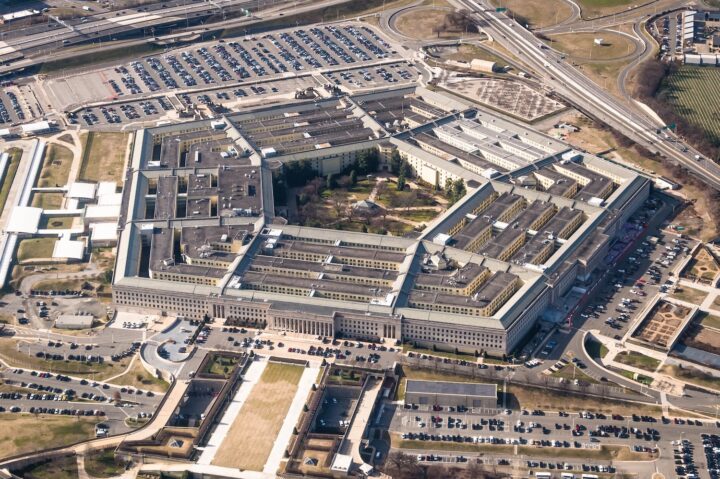
The Pentagon


 Add JewishInsider on Google
Citing concerns about the Iran war and the administration’s elevated defense funding request, Senate Democrats voted in lockstep on Tuesday evening to block a procedural motion to open debate on the 2027 National Defense Authorization Act, despite the bill passing out of the Armed Services Committee with bipartisan support.
The decision to block the start of debate on the NDAA — an annual must-pass bill that typically garners strong bipartisan support — is a rare step by Democrats signaling significant frustrations with the Trump administration’s ongoing war against Iran.
Sen. Jack Reed (D-RI), the top Democrat on the Armed Services Committee, said in a statement that he continues to support provisions in the bill, “but I cannot vote to proceed to a bill that enables an ongoing war against Iran that Congress never authorized and the American people overwhelmingly oppose.”
He said that Democrats are seeking amendments to “require accountability” for the war that have been rejected by Republicans. Reed added that Democrats also cannot support a significant increase in defense spending without more reliable accounting of the costs of the Iran war or “basic information” about it, and without a corresponding increase in non-defense spending.
Sen. Patty Murray (D-WA), the ranking member of the Senate Appropriations Committee, similarly cited the Iran war as a primary reason for her opposition to the bill.
“I will always do everything in my power to take care of our servicemembers and keep our country safe, but this bill authorizes President Trump’s absurd $1.5 trillion defense budget request while doing nothing to put an end to his disastrous war or prevent him from starting more costly conflicts abroad,” Murray said in a statement. “I refuse to endorse President [Donald] Trump’s obscene war budget, and I refuse to move this bill forward as Trump pushes our country deeper into a war the American people oppose”
Sen. Jeanne Shaheen (D-NH), the ranking Democrat on the Senate Foreign Relations Committee, said in a statement that it is “vital that we both pass the NDAA and that we constrain the President’s lawless and costly war against Iran.”
“With the President re-launching his self-defeating war, I voted against the motion to end debate on the NDAA, so we can continue to advocate for greater transparency and an end to this conflict,” Shaheen continued.
She said that amendments to reduce overall spending and withhold any congressional authorization for the Iran war failed along party lines during the closed-door committee markup of the NDAA.
Six progressive Democrats — Sens. Chirs Van Hollen (D-MD), Bernie Sanders (I-VT), Jeff Merkley (D-OR), Peter Welch (D-VT), Ed Markey (D-MA) and Elizabeth Warren (D-MA) — said they would vote against the motion to demand a vote on removing a provision on U.S.-Israel cooperation from the bill, and urged colleagues to do the same.
Though some anti-Israel voices have tried to paint that provision as the reason the Democratic caucus voted en masse against the bill, most Democrats did not cite that in their own statements on the bill.
Sen. John Fetterman (D-PA), the only Senate Democrat who has unreservedly supported the Iran war, was not present for the vote.
Republicans called the Democratic blockade dangerous to national security.
Sen. Chuck Grassley (R-IA) called the vote “SHAMEFUL” and said that the vote demonstrates that Democrats don’t take national security issues, which he described as the most important responsibility of the federal government, seriously.
‘An overriding goal that has been one of my most profound concerns since coming to the United States Senate is to preserve bipartisan support for Israel,’ Blumenthal told JI
Heather Diehl/Getty Images
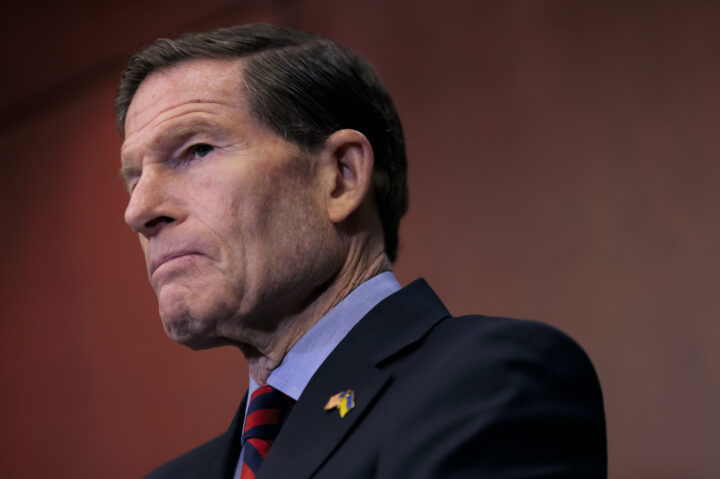
Sen. Richard Blumenthal (D-CT) holds a press conference at the U.S. Capitol on March 03, 2026 in Washington, DC.
Sen. Richard Blumenthal (D-CT), one of just seven Senate Democrats to vote last week against resolutions to block U.S. arms sales to Israel, said that he wants to maintain and restore bipartisan support for Israel.
“An overriding goal that has been one of my most profound concerns since coming to the United States Senate is to preserve bipartisan support for Israel,” Blumenthal told Jewish Insider in a brief interview on Wednesday. “I partnered with [former Sen.] John McCain (R-AZ) on traveling to the Middle East and to Israel a number of times. He believed powerfully, as I do, that the cause of Israel’s security has to be bipartisan, and I will adhere to that goal as long as I’m in this body.”
Asked how that support on the Democratic side can be restored, he said that he doesn’t have a silver bullet, but he’s “going to work at it every day,” reaching out to colleagues on both sides of the aisle, even those who disagree with him, to work on the issue and travel to the region.
“I will take advantage of every opportunity to make sure that we are as bipartisan as possible, and I resent and oppose anyone who tries to use Israel as a wedge issue politically,” he said. “We need to make decisions on the merits of our own national interests and security.”
He said that he has family in Israel and in the IDF, but his support for Israel comes from it being one of the U.S.’ closest allies and the U.S.-Israel relationship being “vital to our own national security” through military cooperation, intelligence sharing and technological, academic and educational cooperation.
“My argument to my colleagues is that Israel is an ally in a dangerous world,” he continued.
He said he’s also working “fervently” toward normalizing relations between Israel and Saudi Arabia and other Gulf states, a goal he said was “very close” prior to the Oct. 7, 2023, Hamas attacks.
“But it’s a very powerful, long-range dynamic that serves everyone’s interests, including our own,” Blumenthal said, describing normalization as an issue that “could bring us together again, to more robust bipartisan support.”
Asked during a Tuesday press conference about the anti-Israel shift in the Democratic Party, Senate Minority Leader Chuck Schumer (D-NY), another one of the seven Democrats who opposed the effort to block weapons sales, pivoted to discussing the war in Iran.
“Our caucus is united and focused on ending the war in Iran,” Schumer responded.
Meeks said he will likely bring up a war powers resolution for a vote this week, and is waiting to see if several of his colleagues will flip their votes in favor

Tom Williams/CQ-Roll Call, Inc via Getty Images
Rep. Gregory Meeks (D-NY)
Rep. Greg Meeks (D-NY) said he’s aiming to call up a war powers resolution this week to force an end to the war in Iran, but that he’s still working to lock down the support of a few wavering Democratic and Republican lawmakers whose support will be necessary to pass the legislation.
Meeks had considered calling up the legislation before Congress’ two-week recess, but ultimately declined to do so, saying he was waiting until the legislation could pass and he didn’t yet have the votes.
“I’m probably going to do war powers this week. I’m still working [on] it. I’m very close,” Meeks told Jewish Insider. “I’ve got just about all of the Democrats — just about — and [some] Republicans. And I have some that are contemplating, but I don’t know what they’re going to do.”
He said that there are a few lawmakers who voted against a previous war powers effort in the House who are talking to him and considering now voting in favor, but haven’t disclosed their final plans to him yet.
Meeks said that he thinks he will get “just about every Democrat … maybe the exception of one.”
Of the four Democrats who voted against a previous war powers effort, two — Reps. Greg Landsman (D-OH) and Henry Cuellar (D-TX) — said that they would vote for the next war powers resolution, and Cuellar affirmed those plans to JI on Tuesday. Reps. Juan Vargas (D-CA) and Jared Golden (D-ME) haven’t announced their plans yet.
Vargas told JI on Tuesday that he has made up his mind, but declined to preview how he plans to vote. Golden, who is not running for reelection, could be the hardest of the four to flip.
On the Republican side, Rep. Lauren Boebert (R-CO), who said she would oppose a supplemental funding request for the war, declined to comment on how she would vote, saying she isn’t currently focused on a potential war powers resolution.
Meeks said that the current ceasefire makes it an important time for Congress to weigh in, and that he may ultimately bring the resolution forward for a vote even if he’s not sure if there are sufficient votes to pass it.
“We don’t know what the president may do or may not do afterwards,” Meeks explained. “I’ve been waiting to get commitments … it may be time for them to get on one side of the fence or the other, as opposed to staying on the fence. I may just do it. I haven’t decided yet, but I may just do it.”
Even if the resolution passes the House, it currently would not pass the Senate and would almost certainly be vetoed by the president. But Meeks argued that passing the resolution in the House would send an important message to the administration anyway.
“I think this is giving a message to the president — and it becomes really important, because the 60 days will be up soon, and they have to come to Congress for the money,” Meeks said, referring to a 60-day deadline for the operation cease or to come to Congress for authorization under the War Powers Act. “And it lets the president know that unless he comes to Congress and lets us know what the plan is, he’s not going to get the money.”
Rep. Don Bacon (R-NE), who has said the administration hasn’t properly articulated its plans and goals for the war to Congress, told reporters he will “support continued operations until we get this job done, or it’s clear to me it’s fruitless.”
“I support the military campaign. I think some of the commentary has not been helpful from the White House, but yes, I think the military has done a great job,” Bacon said, pointing to the destruction of Iran’s leadership and military capabilities.
He said that an Authorization for Use of Military Force would be legally required to continue the war beyond the 60-day deadline — a point that other Republicans have disputed — but said that he would be “inclined to support” such an authorization.
“Maybe not a blanket one, but yes, I think we should finish the job,” Bacon said. “These guys have been our enemy. These guys have been our enemy, they’ve killed young [U.S. troops].”
Jewish Insider’s Washington reporter Matthew Shea contributed reporting.
The lawmakers called it another example of Trump’s ‘troubling lack of strategic foresight’ in executing the war against Iran

Tasos Katopodis/Getty Images for VoteVets
Sens. Cory Booker (D-NJ), Tim Kaine (D-VA), Chris Murphy (D-CT) and Tammy Baldwin (D-WI) speak with veterans about the Iran war at Capitol Hill on March 18, 2026 in Washington, DC.
A group of 25 Senate Democrats criticized President Donald Trump on Friday for lifting sanctions on Russian and Iranian oil exports, sanctions which have seen broad bipartisan support.
“We write with deep concern and confusion over your administration’s recent decision to ease sanctions on Russian and Iranian oil exports,” the Democrats wrote in a letter to the president. “These actions speak once again to the troubling lack of strategic foresight that has marked your administration’s decision-making prior to and during its war of choice with Iran, jeopardizing the lives of our servicemembers across the region and raising costs for Americans here at home.”
The lawmakers accused Trump of “scrambling — and failing” to address the impacts of the effective closure of the Strait of Hormuz amid the conflict, despite reported warnings that an attack on Iran would likely cause oil prices to spike.
And, they alleged, the sanctions waiver will provide a new revenue source of as much as $14 billion for “the very regime that U.S. servicemembers are risking their lives to strike” while having little impact on bringing down global oil prices.
They highlighted that Russia is already reportedly set to make $4.9 billion from rising oil prices, an amount further supplemented by the sanctions waivers, in spite of Russia’s support for Iran’s strikes on U.S. military forces.
“Relieving sanctions on U.S. adversaries during an active conflict is just the most recent indicator of an incoherent and disordered policy approach,” the letter continues. “Economic relief for Americans starts with the cessation of wars of choice, not the continuation of them.”
The lawmakers demanded public hearings by administration officials on the decision to provide sanctions relief.
The letter was signed by Sens. Tim Kaine (D-VA), Ruben Gallego (D-AZ), Jack Reed (D-RI), Cory Booker (D-NJ), Chris Murphy (D-CT), Tammy Baldwin (D-WI), Tammy Duckworth (D-IL), Adam Schiff (D-CA), Chris Coons (D-DE), Jeff Merkley (D-OR), Chris Van Hollen (D-MD), Angus King (I-ME), Richard Blumenthal (D-CT), Angela Alsobrooks (D-MD), Michael Bennet (D-CO), Ron Wyden (D-OR), John Hickenlooper (D-CO), Andy Kim (D-NJ), Sheldon Whitehouse (D-RI), Elissa Slotkin (D-MI), Alex Padilla (D-CA), Gary Peters (D-MI), Mark Kelly (D-AZ), Dick Durbin (D-IL) and Mazie Hirono (D-HI).
Republicans, despite widespread support for the U.S. sanctions on Iran, have generally been downplaying the impacts of the sanctions relief, describing it as a careful measure to relieve oil price shocks that is designed to be temporary. Some have also echoed claims by the administration that they plan to intercept and freeze the revenues for Iran before they reach the regime’s coffers.
Please log in if you already have a subscription, or subscribe to access the latest updates.
 Continue with Google

 Continue with Apple