













































































The members say the compressed timeline give states and institutions too little time to complete applications for the 2026 Nonprofit Security Grant Program
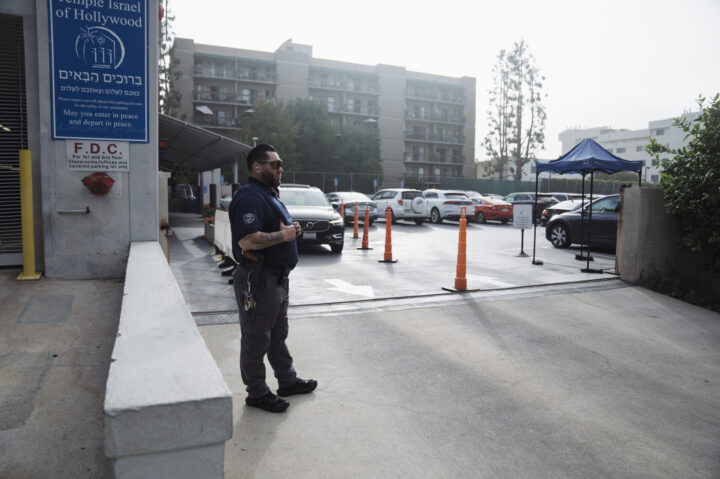
Photo by Eric Thayer/Getty Images)
A security guard stands watch in front of a synagogue on October 9, 2023 in Los Angeles, California.


 Add JewishInsider on Google
A bipartisan group of 58 House members urged the Federal Emergency Management Agency on Thursday to extend the deadline for 2026 Nonprofit Security Grant Program applications, arguing that the current timeline gives states and institutions “insufficient time to complete the application process” and fulfill the program’s goals.
Applications for the program were announced on June 24 and are due to the federal government from state emergency management agencies by July 24. Those state agencies must set their own earlier deadlines for individual institutions to submit applications.
“It is essential that eligible applicants have a fair shot to apply for these funds and fully realize the program’s intended purpose,” the lawmakers, led by Reps. Grace Meng (D-NY) and David Joyce (R-OH), wrote in a letter to acting FEMA Administrator Robert Fenton. “The current timeline imposes significant administrative constraints on both applicants and [state administrative agencies], potentially limiting full and fair participation in this year’s grant cycle.”
The lawmakers argued that organizations would have a short amount of time — potentially just days — to review the program, obtain necessary assessments, develop proposals, gather documents and submit applications. The signatories noted that FEMA has historically provided as many as 80 days from the application announcement to the deadline.
The letter notes that the application period also overlaps state hate crimes grant program application periods in some states, “overburdening” institutions, particularly smaller ones that don’t have large teams to handle grant-writing.
FEMA’s continued delays in releasing 2025 NSGP awards create further issues, the lawmakers explained: “organizations will be applying without knowing their eligibility, creating additional complications since eligibility for this year’s grant is affected by the recipient’s status for last year’s grant.”
The letter urges FEMA to extend the 2026 application deadline, to give state agencies more time to review applications, nonprofits more time to prepare their applications and to guarantee “FEMA receives the strongest possible pool of eligible projects for consideration.”
The Jewish Federations of North America said it organized the letter and was the first to publicize it.
“At a time of rising threats against faith-based communal institutions, Congress has made clear that protecting vulnerable communities is a bipartisan priority,” JFNA CEO Eric Fingerhut said. “Giving state administrative agencies and nonprofit organizations adequate time to complete FEMA’s application process will help ensure these critical security resources reach those NSGP is designed to protect.”
Lauren Wolman, the senior director of government relations and strategy at the Anti-Defamation League, said that “a one-month application window presents significant challenges for the nonprofits that need this funding the most, particularly smaller organizations without dedicated grant writing staff.”
Wolman added, “Extending the deadline would help ensure every eligible organization has a meaningful opportunity to secure the resources they need to protect their communities.”
Rabbi AD Motzen, the national director of government affairs at Agudath Israel of America, said, “Agudath Israel strongly supports the bipartisan Meng Joyce letter and the request for a longer application period. We have heard from nonprofits that are not sure if they were awarded the grant from the previous year and have to make a rushed decision whether or not to apply for this year.”
Nathan Diament, the executive director of the Orthodox Union Advocacy Center, said that the OU also agrees that an extension of the deadline would be “very helpful.”
Separately, 15 Democrats on the House Homeland Security Committee wrote to Homeland Security Secretary Markwayne Mullin and Fenton, raising concerns about the administration’s handling of various FEMA grant programs including NSGP, accusing them of including language in the application materials “that is confusing, impractical, incomplete, and potentially unlawful.”
The Democrats specifically accuse the administration of “deliberately slow processing” of 2025 NSGP applications, noting the continued delay in announcements of 2025 funding and calling for the outstanding grants to be issued “immediately.”
“At-risk nonprofits are forced to navigate overlapping application cycles without knowing if they even need to apply for the FY 2026 NSGP,” the letter reads. “With the FY 2026 application window already open and set to close in less than a month, FEMA’s internal delays and contradictory directives are creating unnecessary burdens for subrecipients.”
It also criticizes the administration for “conflicting instructions on required documentation” and requirements related to immigration and elections imposed on grant recipients. “Imposing these complex mandates on small, volunteer-run, nonprofit organizations, threatens to penalize the very institutions the program is designed to protect,” the Democrats wrote.
The lawmakers said NSGP funds should not be used ‘to reinforce other policy priorities’ as new conditions may require organizations to cooperate with immigration enforcement and curb DEI programs

Kevin Carter/Getty Images
U.S. Capitol Building on January 18, 2025 in Washington, DC.
A bipartisan group of 82 House lawmakers wrote to Homeland Security Secretary Kristi Noem on Thursday urging her to roll back new conditions placed on applications for the Nonprofit Security Grant Program amid rising antisemitic attacks.
The bipartisan support for the letter is particularly notable given that, while Democrats have been raising concerns about the conditions for months, Republicans have, publicly, been comparatively quiet.
“We are writing to you today to express our desire to ensure that the NSGP is adequately funded and unimpeded by new requirements that are unrelated to the security of grant recipients and their communities,” the letter, led by Reps. Max Miller (R-OH), Brad Schneider (D-IL), Josh Gottheimer (D-NJ) and Michael McCaul (R-TX), reads. “Insufficient funding or unnecessary obstacles to obtaining grants could undermine the right of every religious community to freely and peacefully worship and congregate without fear.”
The letter states that new conditions issued by DHS in April 2025 “create new compliance requirements for recipients that will divert limited funds and restrict the religious conscience of synagogues, schools, and other institutions pivotal to our communities.”
The new conditions may compel religious institutions to cooperate with immigration enforcement activities and eliminate diversity, equity and inclusion programs.
“We encourage DHS to work to make compliance with NSGP requirements as simple and streamlined as possible. We also request that DHS ensures NSGP remains a program designed to protect the security of houses of worship, not to reinforce other policy priorities,” the lawmakers wrote. “In this time of rising antisemitic terror attacks and violence against diverse faith-based institutions, we believe it is crucial that NSGP remains a critical resource for all who seek to worship in safety and free from partisan politicization.”
They called on Noem to issue new guidance that “waives any terms and conditions that do not directly relate to the grant’s purpose, which is to help qualified institutions improve their security against increasing threats.”
The lawmakers emphasized the clear need for and lifesaving impact of NSGP funds in a time of increased hate-motivated violence. They also thanked Noem for her “ongoing support” for the program.
DHS has not yet awarded grants from the 2025 grant cycle, and lawmakers have accused the administration of withholding critical information about which institutions have received funding under separate grant rounds. Democrats have alleged the department is mismanaging the program.
Funding for the grants in 2026 — thought to be finalized just weeks ago — was again thrown into question last week when lawmakers agreed to reopen negotiations over the Department of Homeland Security funding package for the year following the deadly shootings by immigration agents of two U.S. citizens in Minneapolis.
“The Nonprofit Security Grant Program is one of the most vital programs protecting the Jewish community. We continue to encourage every Jewish institution with heightened security needs to apply for these funds,” Jewish Federations of North America CEO Eric Fingerhut said. “We have also heard from our community that the current terms and conditions have had the unintended effect of deterring some organizations from applying, which is why we believe they should be updated appropriately.”
“At a time of rising violence and hatred targeting houses of worship, NSGP is an essential lifeline for synagogues and other faith-based institutions seeking to protect their congregants,” said Lauren Wolman, ADL’s senior director of government relations and strategy. “We are grateful for the bipartisan effort to ensure DHS requirements remain clear, consistent, and focused on what matters most — helping at-risk nonprofits protect themselves from threats. Organizations must be able to access these resources quickly, with confidence, and without unnecessary delays.”
“Jewish and other communities facing violent threats deserve to know that the government is prioritizing their safety, not politicizing it,” Amy Spitalnick, the CEO of the Jewish Council for Public Affairs, said. “Yet the chaos created by these new terms and conditions has only created more vulnerability for communities, who are worried that they’ll be forced to choose between their core religious beliefs and their basic security — a concern we’ve been raising for months.”
“We appreciate Reps. Miller and Gottheimer for helping lead this important bipartisan call to clarify that NSGP should not be used for anything other than the security of our communities,” Spitalnick continued.
Please log in if you already have a subscription, or subscribe to access the latest updates.
 Continue with Google

 Continue with Apple