














































































Cassidy said Trump raised his voice after the senator defended his vote backing a resolution directing the administration to withdraw U.S. forces from Iran
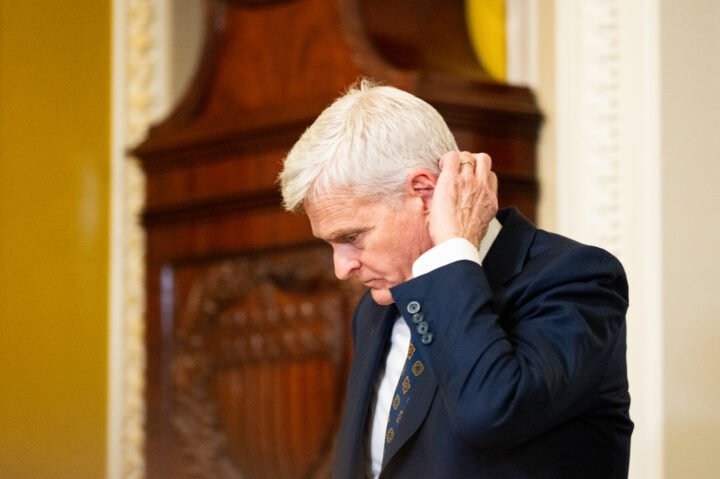
Bill Clark/CQ-Roll Call, Inc via Getty Images
Sen. Bill Cassidy, (R-LA), walks through the Ohio Clock Corridor before President Donald Trump arrives for the Senate Republicans' lunch meeting in the U.S. Capitol on Wednesday, June 24, 2026.


 Add JewishInsider on Google
President Donald Trump engaged in a shouting match with Sen. Bill Cassidy (R-LA) during a closed-door lunch with Senate Republicans on Wednesday over the outgoing Louisiana senator’s support for a war powers resolution directing the administration to withdraw U.S. forces from Iran that passed the chamber the previous day.
Cassidy acknowledged the incident after the luncheon concluded, telling reporters that the dispute began when the president questioned aloud why any Republican would vote for the resolution. The Louisiana senator stood up from his chair and asked Trump if his question was rhetorical or if he wanted an explanation. Cassidy said Trump responded by asking for an explanation, which the senator obliged.
The Louisiana senator said that he told the president, “You have not told the American people what’s going on. It was supposed to last four weeks, it has lasted for four months. Our original objectives have not been achieved. And I want to know what’s going on.”
He went on to say that Trump “did not particularly care for my comments” and “raised his voice,” prompting Cassidy to grow angry. At some point during the confrontation, other GOP senators encouraged Cassidy to sit down and tried to “deescalate” the situation. Cassidy obliged his colleagues and stopped engaging the president.
“I lost my temper,” Cassidy said. “That’s not appropriate, it’s the Irish in me. But I, again, matched his tone, and his volume. It went back and forth.”
Cassidy accused Trump of making several negative comments about him, including a remark about Cassidy losing his reelection bid to a Trump-backed challenger. Another GOP senator said that Cassidy referred to Trump as “my brother” at one point instead of his formal title, which Trump responded to angrily.
Still, the senator said that Cassidy remained respectful of the president during the exchange, and attributed the blowup in part to Trump’s longstanding frustration with Cassidy on a range of issues, including his impeachment in 2021.
Cassidy noted that he would continue to vote for the war powers resolutions until he is briefed on the war effort. Sens. Lisa Murkowski (R-AK), Susan Collins (R-ME) and Rand Paul (R-KY) joined Cassidy in helping Democrats pass a war powers resolution in the Senate for the first time on Tuesday, delivering the upper chamber’s first rebuke of the president’s war.
He added that he will be satisfied once the administration briefs Congress on the details of the U.S. memorandum of understanding with Iran. “You say everything’s fine, but on the outside, it doesn’t look like everything’s fine,” he said of the Trump administration’s handling of diplomatic efforts to end the war in Iran.
“I make no apologies for standing up to the president, if you will, trying to demand that more information be shared with the American people,” Cassidy said. “If someone tries to bully you into not asking that question, I’m not going to accept that either. I am sticking up for the American people, even if I’m speaking to the president.”
The meeting was organized by Sen. Rick Scott (R-FL) and comes at a time of heightened tension between Trump and the Senate Republican conference over the war powers vote; Trump’s demands that the Senate pass his signature voter ID bill, for which Senate Republicans say they lack the votes; and, most recently, Trump’s last-minute decision on Wednesday morning to cancel a signing ceremony at the Capitol for a much-anticipated bipartisan housing package.
A large group of Senate Republicans — including Senate Majority Leader John Thune (R-SD), Majority Whip John Barrasso (R-WY), Sens. John Hoeven (R-ND), Jerry Moran (R-KS), Thom Tillis (R-NC), Mike Rounds (R-SD), Katie Britt (R-AL), Kevin Cramer (R-ND), Tim Scott (R-SC), Mike Crapo (R-ID), John Kennedy (R-LA), Collins, Murkowski and others — huddled on the Senate floor for an extended period after the contentious meeting, in what appeared to be an at-times animated conversation.
Following the luncheon, Scott told reporters that Trump was “very forceful about what he cares about,” also noting that the president talked about Iran “a lot.”
“[Trump] is very comfortable he’s going to get a deal,” Scott said. “[Iran is] doing exactly what he wants. He was very disappointed that somebody would vote on the war powers resolution to stop him in the middle of negotiations, so that frustrates him.”
Scott suggested he understands Trump’s heated demeanor: “If I was the president, I was in the middle of a negotiation to protect American lives, I would be frustrated too.”
Scott said that Trump told senators that Iran is not telling the truth about the talks, and that if Iran doesn’t agree to a good deal, the U.S. will return to military action.
“He said Iran’s agreeing to whatever his requests are. Don’t believe in anything [that] the Iranian press is putting out, because it’s a complete lie,” Scott said. “He’s very comfortable that they’re not gonna have nuclear weapons, they’re not going to have the money to be able to continue to support Hamas, Hezbollah and the Houthis, so he’s very comfortable that we’re going to have a good deal.”
Kennedy, who has been skeptical that the Iranian regime will hold to the terms of any deal but supportive of the administration’s negotiation efforts, offered a similar view.
“I’m in the middle of serious negotiations, trying to settle a conflict, and one of my mates undermines me,” Kennedy said of the president’s perspective. “I’m going to be mad too, and he was mad as a murder hornet about that. He’s right to be mad, in my opinion. Not criticizing anybody for their vote, but these next 60 days are critical,” he added, referring to the 60-day window for further negotiations established in the agreement with Iran.
“We ought to support him, whether you like him or not,” Kennedy continued. “I don’t know how it’s going to end up, you’ll have plenty of time to assess it after 60 days, but we’re going to give peace a chance for 60 days.”
Cramer said that Trump was “very detailed” in his discussion of the situation in the Middle East, but he and other Republicans said there was little opportunity for them to ask questions.
Like Scott, Cramer said Trump disputed Iran’s characterizations of the talks. “He emphasized again that everything they’re saying they’re not giving up, they’re giving up,” Cramer said. “My trust is in our administration until such time as they sign something that’s foolish.”
Another GOP senator, speaking on condition of anonymity, said that Trump emphasized to the group that he could “blow everything up” but that that would have harmed many Iranians, which he wanted to avoid.
The senator told JI that the president explained the MOU to senators — including the financial benefits Iran stands to gain and his decision to strike Iranian nuclear sites in 2025 — and defended his diplomatic overtures to the Iranian regime. They said that Trump told the group, “Without any question in his mind, the number one thing is that Iran is just not going to be able to have a nuclear weapon, ever.” The senator said Trump expressed “so much compassion for Israel” in his remarks.
Trump also warned the lawmakers, according to the senator, that, “If we don’t watch out, what we do here can screw up a whole lot of stuff when you’ve got people that are negotiating” a possible deal with Iran.
Rounds said the president provided senators “more of a briefing in terms of what [the administration is] doing over [in Iran] than we’ve heard to date.” However, Rounds noted that “most of it to me was consistent with what we’ve learned” in previous classified briefings.
When asked whether Republican senators explained to Trump that there is a lack of votes to pass his voter ID bill, the SAVE America Act, Rounds said, “We really didn’t get into that.”
Sen. Tommy Tuberville (R-AL), a strong supporter of the president, praised Trump’s performance in the meeting, telling reporters after the luncheon, “You can’t take it personal. You’ve got to go in knowing that the head coach is coming into the … room.”
“The president did a hell of a job of getting his message over, and sometimes in a loud voice, sometimes not so loud,” Tuberville said. “That’s how you do it. That’s how I did it. Not to say it’s perfect. He came in and got his point across, and I think when we all left, we understood where he [stands].”
Sen. Roger Marshall (R-KS) similarly dismissed the shouting match between Trump and Cassidy as indicative of the president having an issue with the Senate GOP conference.
“I think it’s great for a family to have these types of discussions,” Marshall said. “You all act like no one ever yelled at each other. I didn’t go into a doctor’s hospital board meeting where there wasn’t yelling at each other. I think it’s perfectly fine if you’re trying to air your grievances.”
Sen. John Cornyn (R-TX), meanwhile, sarcastically told reporters that there “was quite a unity message” during the meeting.
Cornyn also remarked that Trump spoke for an hour and 15 minutes and that there “wasn’t really an opportunity” for him to get a question in.
The president’s continued push for the Senate to pass the SAVE America Act, despite lacking the votes without abolishing the 60-vote filibuster threshold, was also a major point of contention.
“He wants the SAVE Act, that much is clear,” Kennedy told reporters. “I want to say that I’m on the record for any way to get the SAVE Act passed. I still think there’s potential through reconciliation, but some of my Senate colleagues don’t agree with it. … It’s clear he wants it.”
“I know there’s frustration over the SAVE Act passage, but we simply don’t have the votes because we’re not going to nuke the filibuster,” Tillis said. “We’ve made it clear multiple times, if the SAVE Act requires nuking the filibuster it’s simply not going to happen and that’s been obvious long before today.”
Cassidy said the deal leaves Iran stronger and sanctions-free, while senators including Tillis, Cruz and Scott pushed back on Trump's acceptance of Iranian ballistic missiles
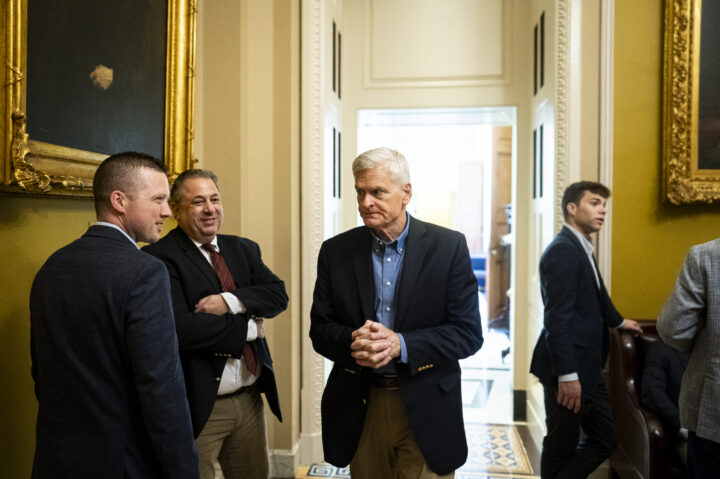
Photo by Al Drago/Getty Images)
Sen. Bill Cassidy (R-LA) departs a meeting with Senate Republicans in the U.S. Capitol on June 28, 2025 in Washington, DC.
Some Senate Republicans are breaking with President Donald Trump over his handling of Iran, pushing back on the memorandum of understanding’s significant financial relief to the regime and Trump’s comments on Wednesday that he is willing to accept an Iranian ballistic missile program and some level of nuclear enrichment.
“Reagan is rolling over in his grave,” retiring Sen. Bill Cassidy (R-LA) said on X. “Iran’s nuclear ambitions were not curbed, and they have learned that threatening the Strait of Hormuz works and will undoubtedly leverage it in the future. Now, Iran gets to build brand-new infrastructure under this deal.”
Cassidy recently voted in favor of war powers resolutions that aimed to prevent further combat operations in Iran. He’s retiring after being defeated by a Trump-backed primary challenger.
“Before the war, the Strait [of Hormuz] was open, Iran was being crushed by sanctions and 13 service members were still alive,” Cassidy said. “Now, 13 Americans are dead, families have paid billions at the pump, sanctions will be lifted, and the bombing has stopped. This is the worst foreign policy blunder in decades.”
He subsequently explained to reporters: “Iran went from having sanctions and now is having no sanctions. Hundreds of billions of dollars [are] being paid to it. Our allies are weaker. Our opponent is stronger. You say the strait’s open — the strait was open four months ago.”
Asked whether he thought the deal was worse than the Obama-era Joint Comprehensive Plan of Action, Cassidy responded, “I didn’t like the JCPOA the first time. I don’t like it the second time.”
While Cassidy was perhaps the most strident critic, numerous Republican senators also expressed their disagreement with Trump’s comments, the deal, or both.
Given that eliminating Iran’s nuclear enrichment and ballistic missile capacity were stated objectives of the war, “$100 billion and 13 lives later, I’ll need to understand that rationalization,” Sen. Thom Tillis (R-NC) told Jewish Insider of Trump’s comments.
He added later that the $300 billion reconstruction fund laid out in the MOU is “concerning,” though he called the deal preliminary and said he needed to see more details.
“I need to see it taken as a whole. I can’t be against it because I need to see the net. I need to see, have we accomplished what the president set out to accomplish?” Tillis continued. “If you remember, we were going to obliterate their military, we were going to take all of the uranium or any weapons grade uranium out of the country — we’re equivocating on that now. I just need to see what the new deal is now.”
He said that, given the costs of the war, “there needs to be some accountability for Iran. We can’t just walk out because we’re getting a bit skittish over the economic consequences of going to war to begin with.”
While Trump argued that Iran should be able to have ballistic missiles because others in the region do as well, Sen. Rick Scott (R-FL) said that the difference is that other countries in the region aren’t American adversaries.
“I would be fine [with them having missiles] if they didn’t want to kill Americans. I don’t care if Saudi Arabia has them, or if Israel has them because they don’t want to kill us,” Scott told JI. “But if somebody wants to kill me, I don’t want them to have a ballistic missile.”
Asked about the financial benefits Iran is set to receive under the deal, Scott said that he does not want any U.S. funding to support Iran, and that Iran should be paying the U.S. reparations instead.
“I’m not spending a dime for Iran. I want them to pay us for what we had to do,” Scott continued.
Sen. Ted Cruz (R-TX) warned against giving Iran a financial windfall, though he placed blame for the situation on those around the president, rather than Trump himself.
“History teaches that giving billions of dollars to theocratic lunatics who want to murder us is not a good idea,” Cruz said. “I think the President is receiving some very poor advice on this deal.”
Cruz said on his podcast that “if this deal is giving them $300 billion, that’s a mistake. I hope that is not the case.” But he also said that it is “absurd” to compare it to the JCPOA in light of the U.S. military action against Iran’s nuclear program.
“What I’m urging the president, what I’m saying to him, is don’t give away the victory. I don’t believe he’s doing so, I hope he’s not doing so, I hope his administration is not doing so,” Cruz said. “We have defeated their military, don’t suddenly come in with massive buckets of cash to let them rebuild and become a threat to America again.”
He added on X that the fact that Biden Iran Envoy Rob Malley supported the deal “may be the most serious criticism that can possibly be leveled against it.”
Sen. Pete Ricketts (R-NE) said that “it’s a bad idea to allow Iran to have a ballistic missile program,” though he said he was waiting to see what the text of the deal says on the issue of enrichment. Sen. Mike Rounds (R-SD) told JI, “I don’t feel the same way” as Trump on the missile and enrichment issues.
Sen. Lindsey Graham (R-SC), one of the most vocal supporters of the Iran war on Capitol Hill, offered his support for the MOU in a lengthy X post following a conversation with special envoy Steve Witkoff.
“It is my opinion that signing the MOU will be beneficial to the United States, in as much as the Strait of Hormuz will begin to open, and the hostilities with Iran will stop,” Graham said. “Whether or not the United States can reach an acceptable, verifiable deal with Iran regarding its nuclear program and other issues is yet to be determined, but I see little downside to trying.”
He added that the MOU would also be worthwhile as an “essential step” toward enabling the normalization of relations between Saudi Arabia and Israel, restoring economic stability and ending the war.
Despite that, Graham still broke with Trump on his comments on Iranian nuclear enrichment.
“I’m not OK with nuclear enrichment at all,” Graham said.
Sen. Josh Hawley (R-MO), who has been one of the most vocal GOP advocates for bringing the war to a close, said that he’s “glad the strait is reopening” and “glad that their nuclear program is under rubble and presumably will stay that way.”
“I don’t really want to give them any money,” Hawley continued. “I discourage that. I would not want to do that. But, let’s see what happens and I wish the VP all the best of luck.”
Sen. Roger Wicker (R-MS), the chairman of the Senate Armed Services Committee, told JI he would continue to withhold comment on Iran, the same response he’s been offering to reporters on the deal throughout the week.
On the Democratic side, Sen. Richard Blumenthal (D-CT) said that the deal constituted “unconditional surrender … by us, not by Iran,” referencing Trump’s demands earlier in the war.
“There seems to be no objective of this war that has been accomplished and in fact has emboldened Iran internally and strengthened their standing in the world community,” Blumenthal continued. “They’ve taken the best punch we could give them and they seem bolder than ever.”
He said that the financial benefits Iran is set to receive under the MOU “will enable them to support their malign proxies in the region, causing more instability and bloodshed.”
Blumenthal said that Iran’s objectives of “death to America and death to Israel … will only be advanced by this huge amount of money and additional freedom they have to sell their oil with lifting sanctions.”
The motion passed with four Republicans voting in favor, teeing up a vote on the war powers resolution itself
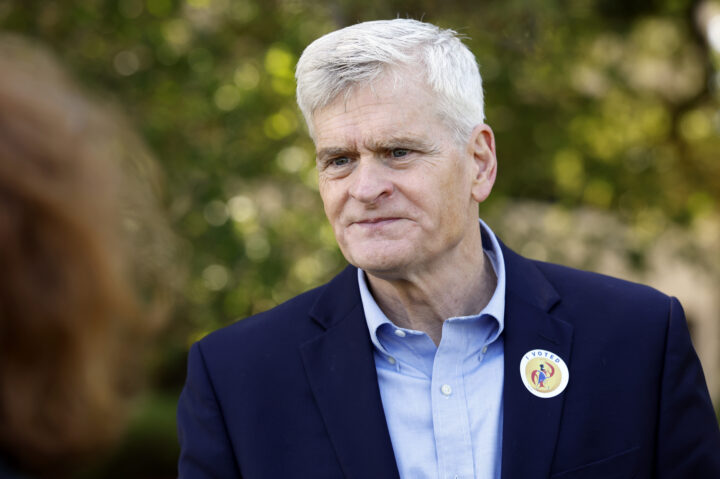
Tyler Kaufman/Getty Images
Sen. Bill Cassidy (R-LA) speaks to media on the first day of early voting outside of the Louisiana State Archives on May 02, 2026 in Baton Rouge, Louisiana.
Sen. Bill Cassidy (R-LA) joined with Democrats to vote for a procedural motion advancing legislation that would end U.S. military operations against Iran, allowing the war powers resolution to move forward on Democrats’ eighth such attempt since the war began.
Cassidy joined three other Republicans — Sens. Susan Collins (R-ME), Lisa Murkowski (R-AK) and Rand Paul (R-KY) — in voting for the procedural motion, which was approved by a 50-47 vote. Sen. John Fetterman (D-PA) voted against the motion.
The passage of the motion will now tee up further debate and an additional vote on the resolution itself, at a time to be determined. The Senate is set to depart for a Memorial Day recess this weekend, and floor time this week is expected to be focused on a reconciliation bill funding immigration enforcement, among other issues.
Cassidy’s vote came days after he lost his primary race to a challenger backed by President Donald Trump. He’s been supportive of the Iran war to this point, but has also been critical of the administration and has voiced the need to assert congressional power, particularly in the wake of his election loss.
He emphasized to reporters on Monday evening the need to rally support from traditional U.S. allies to address the situation in the Strait of Hormuz.
“While I support the administration’s efforts to dismantle Iran’s nuclear program, the White House and Pentagon have left Congress in the dark on Operation Epic Fury,” Cassidy said on X. “In Louisiana, I’ve heard from people, including President Trump’s supporters, who are concerned about this war. Until the administration provides clarity, no congressional authorization or extension can be justified.”
The result came about in part due to absences by Sens. John Cornyn (R-TX), Thom Tillis (R-NC) and Tommy Tuberville (R-AL). Had they been present and voted as they have in the past, the vote would have been tied, allowing Vice President JD Vance to cast a tie-breaking vote and reject the motion.
Yet, some of those votes may not be guaranteed when the resolution itself comes to the floor.
Tillis, who is retiring, has repeatedly bucked Trump and his party on a range of issues. Cornyn has been strongly supportive of the war, but Trump on Tuesday endorsed his primary opponent, Texas Attorney General Ken Paxton, likely setting Cornyn on the road to defeat in his primary race.
Cornyn announced on X shortly after the vote that he would be canceling campaign events in Texas on Wednesday and heading back to Washington to vote on Republicans’ reconciliation bill.
However, earlier this year, several Republicans voted with Democrats to advance a similar motion on a war powers resolution relating to Venezuela, but most of them flipped their votes under pressure from the administration and Republican leadership, ultimately blocking final passage of the resolution.
The House could pass a war powers resolution as well this week, depending on attendance. A previous vote last week was tied, 212-212, but Rep. Jared Golden (D-ME), the sole Democrat to vote against the resolution, said he would vote for a future resolution.
Even if the resolutions pass, they can still be vetoed by Trump.
Rep. Julia Letlow is now the favorite to win the Louisiana race; she faces state Treasurer John Fleming in a June runoff
Tyler Kaufman/Getty Images
Sen. Bill Cassidy (R-LA) speaks to media on the first day of early voting outside of the Louisiana State Archives on May 02, 2026 in Baton Rouge, Louisiana.
Dogged by his vote to impeach President Donald Trump in 2021, Sen. Bill Cassidy (R-LA) lost his bid for reelection on Saturday night, finishing in third place in the Louisiana Republican primary behind Trump-endorsed Rep. Julia Letlow (R-LA) and state Treasurer John Fleming.
Letlow and Fleming, the top two finishers, will now compete in a runoff, which will be held on June 27. Cassidy only received 25% of the primary vote, lagging well behind Letlow, who received 45% of the vote, and Fleming, who won 28%.
The race offered another strong signal that Trump’s backing is the most important factor in Republican nomination fights. Of the seven Republican senators who voted to convict Trump at his 2021 impeachment trial, only two remain in the Senate. One of them, Sen. Susan Collins (R-ME), faces her own difficult reelection.
The results also come two weeks after Trump and his political allies successfully ousted five Republican state senators in Indiana primaries, after they opposed the Trump administration’s push to redraw the state’s congressional lines to further favor Republicans.
Cassidy, first elected to the Senate in 2014, had long been one of the more bipartisan members of his caucus, using his experience as a doctor to take the lead on health care issues. He drew close scrutiny for his decision supporting Robert F. Kennedy, Jr. to be confirmed as health and human services secretary in his role as HELP Committee chairman, despite holding serious misgivings over Kennedy’s record opposing vaccine requirements.
In his concession speech, Cassidy told supporters: “When you participate in democracy, sometimes it doesn’t turn out the way you want it to. But you don’t pout. You don’t whine. You don’t claim that an election was stolen from you.”
The next big test of Trump’s influence in party politics will come on Tuesday, when Rep. Thomas Massie (R-KY), a virulent opponent of Israel, will face off against Trump-endorsed challenger Ed Gallrein, a Navy veteran. Trump allies and outside pro-Israel groups have poured millions into the race to defeat Massie. Polls show the race is competitive, with Gallrein holding late momentum.
The Senate education committee chairman said New York City public schools’ federal funding could be at risk

Kayla Bartkowski/Getty Images
Sen. Bill Cassidy (R-LA) speaks to reporters following the weekly Republican Senate policy luncheon at the U.S. Capitol on March 11, 2025, in Washington, D.C.
Sen. Bill Cassidy (R-LA), the chair of the Senate Health, Education, Labor and Pensions Committee, announced on Thursday that he’s launching an investigation into New York City Mayor Zohran Mamdani, prompted by the mayor’s rescission last month of executive orders from the prior administration related to Israel and antisemitism.
“Has antisemitism decreased in New York City? I haven’t seen any evidence of that. Academic institutions have, of recent, been places where Jewish students have felt quite threatened,” Cassidy told Jewish Insider, referring to Mamdani’s repeal of an executive order implementing the International Holocaust Remembrance Alliance’s working definition of antisemitism that came as part of a broader revocation of executive orders issued by former Mayor Eric Adams following his indictment in September 2024 on federal bribery and wire fraud charges.
“I think Mayor Adams did a good job in signaling that the city had an interest in making sure that students, no matter how they identified themselves, were safe from harassment,” Cassidy continued. “The rescinding of the antisemitism and Israel orders doesn’t seem to be conducive with a lowering instance of antisemitism, so why did Mamdani rescind them? That’s the point.”
Among his first actions in office, Mamdani also repealed an anti-Boycott, Divestment and Sanctions order.
Cassidy said in a letter to Mamdani that “strong leadership against antisemitism and discrimination is essential to the safety and security of Jewish New Yorkers.”
“It is my job to ensure every student feels safe, and at a time when Jewish students feel scared, I am concerned your actions will only exacerbate their fears,” Cassidy continued. “Decisions by your administration that weaken established safeguards for Jewish students in New York and are out of alignment with federal executive orders warrant careful scrutiny. Jewish students deserve clear assurance that their safety and civil rights will not be compromised by your administration’s actions.
He warned that repealing the IHRA order puts New York City out of alignment with federal antisemitism executive orders “and may hinder the U.S. Department of Education’s Office for Civil Rights’ enforcement of Title VI.” He warned that the $2.2 billion in federal funding allocated to New York City public schools could be at risk depending on “compliance with federal civil rights laws and applicable executive orders designed to protect students.”
Cassidy asked Mamdani to explain his administration’s plans to adopt an alternative antisemitism definition, its plans to combat antisemitism on campuses, whether it has consulted with the federal government about the “potential funding implications” of withdrawing the IHRA order, whether it has issued guidance to New York City schools about antisemitism and whether he believes BDS is antisemitic.
“Whatever somebody’s ideological background, if they’re in a position of responsibility, they must protect their citizens,” Cassidy said in a post on X. “Clearly, antisemitism has been on the rise. We must respond to real dangers directed at Jewish students.”
The Louisiana congresswoman was joined by Reps. Jasmine Crockett and Lance Gooden on the trip, which included meetings with Qatari leaders, some of whom have been accused of backing Palestinian terrorism
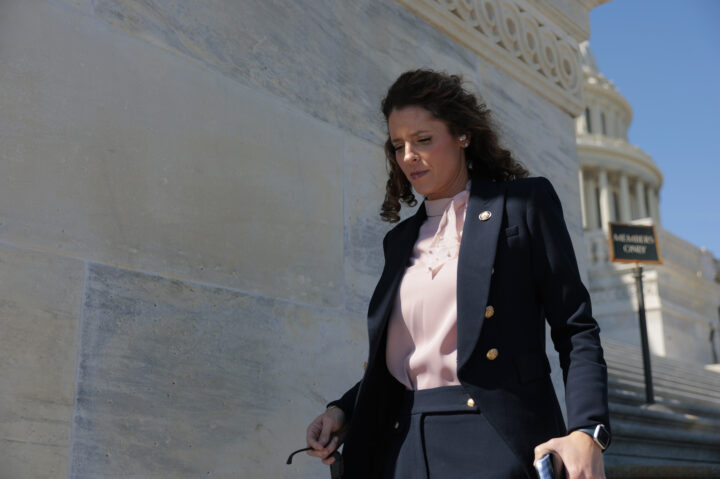
Anna Moneymaker/Getty Images
U.S. Rep. Julia Letlow (R-LA) departs during a series of votes at the Capitol on March 11, 2025 in Washington, DC.
Rep. Julia Letlow (R-LA), who announced a primary challenge to Sen. Bill Cassidy (R-LA) this week, was part of a 2023 junket trip to Qatar funded by a pro-Doha business group.
She was joined by Rep. Jasmine Crockett (D-TX), who is mounting a Senate bid in Texas, on the Qatar trip.
The February 2023 trip, funded by the U.S.-Qatar Business Council, included meetings with Qatari leaders, some of whom have been accused of backing terrorism. According to ethics paperwork submitted by the members, the group spent nearly $15,000 on Letlow’s travel and close to $18,000 on Crockett’s travel.
Rep. Lance Gooden (R-TX), who has spoken out in defense of Qatar amid criticism from some of his House colleagues since the Oct. 7, 2023, Hamas terror attacks, also participated in the trip, as did former Rep. Scott Taylor (R-VA), now the president of the U.S.-Qatar Business Council.
Qatar’s relationship with and funding of Hamas has come under significant scrutiny in the U.S. since the Oct. 7 attacks. Qatari Emir Tamim bin Hamad bin Khalifa Al Thani, with whom the group met, privately coordinated with Hamas leaders in the years leading up to Oct. 7 to provide covert financial support for Hamas’ terrorist activities against Israel, according to documents seized by Israel in Gaza.
The group also met with the CEO of Qatari bank Masraf Al Rayan, who was sued by American victims of Palestinian terrorism. The 2020 lawsuit accused the bank and others of funneling money to Palestinian terrorist groups. The suit was dismissed in early 2025, citing lack of personal jurisdiction.
The agenda submitted to the House Ethics Committee by the group also features a variety of other events focusing on promoting the U.S.-Qatar relationship, including meetings with various Qatari business and government leaders, as well as American universities operating campuses in Qatar.
An invitation to the members who participated in the trip describes it as an “opportunity to explore the potential expansion of business ties between American companies and those of Qatar. During this trip, you will be introduced to Qatar’s existing investment, economic, trade, and commercial ties to the United States and opportunities for further development.”
In spite of concerns about Qatari influence in Washington, both Letlow and Crockett have maintained pro-Israel records in Congress. Crockett, in particular, is seen by leaders in the Texas Jewish community as the candidate more supportive of Israel in the primary between herself and state Sen. James Talarico.
Other pro-Israel lawmakers have also visited Doha in recent years.
Neither Letlow nor Crockett responded to requests for comment.
Sen. Bill Cassidy told the largest teachers’ union in the country it has ‘lost sight’ of its congressionally chartered purpose
Kayla Bartkowski/Getty Images
Sen. Bill Cassidy (R-LA) speaks to reporters following the weekly Republican Senate policy luncheon at the U.S. Capitol on March 11, 2025, in Washington, D.C.
Sen. Bill Cassidy (R-LA), the chairman of the Senate Health, Education, Labor and Pensions Committee, sent a letter on Thursday to the National Education Association accusing the largest teachers’ union in the country of a “deeply troubling” pattern of antisemitism within its ranks.
“The Jewish people have suffered assaults on their identity, religion, culture, and lives for millennia. Disturbingly, we are witnessing a rise in antisemitic sentiment across the Western world, including in the United States,” Cassidy wrote. “Let me put it plainly: antisemitism in all its forms is abhorrent and has no place within our society, especially at our K-12 schools, higher institutions of learning, workplaces, and within unions.”
Cassidy said that the NEA has “lost sight” of its congressionally chartered purpose, adopting a “misplaced” focus on “political activism, foreign policy, and environmental and social justice causes” and becoming “hostile” to Jewish NEA members.
The letter lists out a litany of incidents including a map sent in a mass email to three million NEA members describing the entire land of Israel as “indigenous” Palestinian territory and linking to resources from Hamas-supporting organizations, an attempted boycott of the Anti-Defamation League and reported harassment of Jewish delegates at the NEA’s national conference.
It also raises concerns about a series of provisions included in the 2025 NEA handbook, including language about Holocaust Remembrance Day that “significantly glossed over and failed to mention the attempted annihilation of the Jewish people under the Nazi regime”; one-sided language on the “Palestinian Nakba” that fails to acknowledge Arab attacks on Jews or the United Nations’ role in Israel’s founding; and language that aims to separate anti-Zionism from antisemitism.
Cassidy said that Jewish NEA members have informed the committee that they “are feeling increasingly threatened and ostracized” by the NEA’s “seeming indifference” to them, have been blocked from leaving the national NEA and have had no recourse to address these issues.
NEA representatives at schools have been “increasingly hostile” to Jewish teachers as well, Cassidy said, targeting them for supporting Israel, denying the Oct. 7 attacks and downplaying and denying antisemitism.
Cassidy said the NEA has repeatedly failed to properly and fulsomely apologize for these incidents. In one case, he said, “the NEA’s retroactive statement appears to be a sloppy, insincere, and reactionary attempt [to] move on from its unacceptable behavior.”
Cassidy put forward dozens of questions to the organization, including the process that allowed for the anti-Israel map to be sent out and whether those involved had been held accountable, the NEA’s response to Jewish members who were harassed and the approval process for the handbook language, and how and why it has responded — or not responded — to antisemitism, among various others.

Noam Moskovitz/Knesset Spokesperson
Amir Benayoun performs at the Knesset's “Songs in their Memory” event to mark Yom HaZikaron, April 29th, 2025
Good Wednesday morning.
In today’s Daily Kickoff, we report on a new musical project that aims to mark Yom HaZikaron, Israel’s national memorial day, and spotlight Sen. Bill Cassidy’s efforts to target antisemitism from his perch at the top of the Senate Health, Education, Labor and Pensions Committee. We also report on President Donald Trump’s dismissal of at least seven members of the U.S. Holocaust Memorial Council who were appointed by former President Joe Biden, and preview today’s Senate markup of the Antisemitism Awareness Act. Also in today’s Daily Kickoff: Abigail Mor Edan, Tom Barrack and Gov. Phil Murphy.
What We’re Watching
- Today is Yom HaZikaron, Israel’s day to honor and remember those killed in the country’s wars and in terror attacks. Official and unofficial events are being held around the country today. Yom Haatzmaut, the country’s independence day, begins at sundown tonight.
- The Israeli government’s official Yom Ha’atzmaut celebration was canceled due to high winds and adverse weather conditions.
- This morning in Washington, the Senate HELP Committee is voting on the Antisemitism Awareness Act and the Protecting Students on Campus Act. More below.
- The House Foreign Affairs Committee is holding a hearing on State Dept authorization.
- This afternoon, the House Armed Services Committee is holding a hearing on missile defense.
- Later today, the Senate Committee on Aging is holding a hearing on antisemitism targeting older Americans. Read more here.
- The Supreme Court is hearing oral arguments today in St. Isidore of Seville Catholic Virtual School v. Drummond, which focuses on funding for faith-based charter schools.
- Tonight, The Washington Institute for Near East Policy is holding its 40th anniversary gala dinner in Washington.
What You Should Know
A QUICK WORD WITH JI’S MELISSA WEISS
As a siren sounded last night at 8 p.m. and then again at 11 a.m. this morning local time, Israel came to a standstill as it honored some 25,000 Israelis killed in the nation’s wars and in terror attacks, Jewish Insider Executive Editor Melissa Weiss reports.
Cars stop on highways and their drivers step out. Neighbors step out onto their balconies, heads bowed. At public gatherings across the country, Israelis are briefly frozen in place — quiet, pensive — before coming to life again as the siren concludes.
As the siren ends and an altered version of normalcy resumes, Israelis are left to grapple with the dual realities of a nation at war that must simultaneously live and mourn, that must fight both an enemy committed to its destruction and tend to the millions traumatized by the Oct. 7 attacks and a year and a half of war, that is forced to fight both internal divisions and external threats.
In comments made at the Jewish News Syndicate‘s International Policy Summit in Jerusalem earlier this week, Israeli Strategic Affairs Minister Ron Dermer told attendees that Israel’s war with Hamas — the longest sustained war since the country’s fight for independence nearly eight decades ago — would be over within a year.
But it’s not the first time an Israeli official has given a timeline. In May 2024, Israeli National Security Advisor Tzachi Hanegbi predicted that the war would last through the end of the year — which at that point was a nearly unimaginable amount of time.
But today, the idea that the war could last another 12 months is draining to a populace that is fatigued from a year and a half of war, grieving those they have lost both in the war and the attacks that preceded it, and waiting for the return of the remaining 59 hostages.
Reservists, already struggling to maintain both their home lives and carry out their military duties, are buckling under the strain, amid a growing national anger over the failure of the government to make significant moves to draft soldiers from within the Haredi community, a segment of Israeli society that is among those that have suffered the fewest losses — both on Oct. 7 and in the ensuing war. (Read more on the topic from eJewishPhilanthropy’s Judah Ari Gross here.)
And the country’s military — the leadership of which has almost entirely turned over since last Yom HaZikaron — finds itself at odds both internally and with the government, amid debates over war strategy and priorities, as well as accountability for the Oct. 7 attacks.
In March, when the Israeli Democracy Institute last conducted a survey about how Israelis would prioritize the government’s stated war goals, 68% said that the release of the remaining hostages should be the top priority, with 25% saying that toppling Hamas should be the first priority. It’s a gulf that has widened since the question was first posed in January 2024, when 51% said that the hostages should be the first priority, and 36% wanted to prioritize the destruction of Hamas.
Concerns about the government’s attitude toward the hostages are even less likely to be allayed following a comment by Sara Netanyahu, made in a meeting on Tuesday with individuals selected to light torches in the state’s Independence Day ceremony, that fewer than 24 hostages remain alive — correcting her husband, who said that 24 were alive, in keeping with previous government information. The exchange was widely panned, with Channel 12’s Amit Segal saying it was “truly bizarre and inappropriate” for the families to learn of the devastating news “through an interjection by Sara Netanyahu.”
For the families of the remaining hostages, the prospect of another year of war is unthinkable.
Emily Damari, the British-Israeli hostage who was freed earlier this year, reflected on Yom HaZikaron in a social media post to her Instagram page. Damari said that last year, she and fellow hostage Romi Gonen realized the significance of the day as their captors watched Al Jazeera. “At 11 a.m.,” Damari said, “we decided to stand for a moment of silence in memory of the fallen, who in their death commanded us to live, in memory of our friends who were killed.”
Today in Gaza, miles from where Israelis commemorate the dead, the living hostages languish after 572 days in captivity, prisoners awaiting the kind of freedom that the rest of the world takes for granted while enduring the kind of inhumanity the rest of the world could not imagine. And across the country, parents, siblings and children mourn those who have died — some who were killed protecting the country, others who died simply for living in it.
More than 300 soldiers and 79 civilians were killed between last Yom HaZikaron and today. It is impossible to know how many of them attended Yom HaZikaron events last year in their communities and on their bases, listening to the stories of those fallen in battle and those killed in acts of terror. Did they think the war would have ended by the next Yom HaZikaron? Did they imagine that their names would be among those mourned this year?
It is in the days leading up to Yom Kippur that Jews ask to be inscribed in the Book of Life. But it is on Yom HaZikaron that many ponder their own mortality, and the country’s — and what it means to be Israeli.
ON THE HILL

The Senate Health, Education, Labor and Pensions Committee is set to meet on Wednesday to vote on the Antisemitism Awareness Act, in what could be a contentious meeting with a slew of potential amendments, some of which seek significant changes to the bill, Jewish Insider’s Marc Rod and Emily Jacobs report.
State of play: Sen. John Hickenlooper (D-CO), a HELP Committee member and co-sponsor of the AAA, told JI that “about 50 different amendments” have been introduced, and it remains to be seen what the bill will look like at the end of the committee’s markup. As a co-sponsor, he indicated that he is inclined to support the bill. Sens. Angela Alsobrooks (D-MD) and Lisa Blunt Rochester (D-DE), had been seen as potential or likely votes in favor, but are now expected to vote against the legislation. Some Democrats are framing the legislation as a giveaway of additional power to the Trump administration. Sen. Rand Paul (R-KY), who is seeking drastic changes to the legislation, is also likely to oppose it. A largely cosmetic amendment from GOP leadership appears aimed at mollifying freedom of speech and religion concerns from other Republicans.
Words of Warning: Matt Brooks, the CEO of the Republican Jewish Coalition, warned this week that anti-Israel sentiments that he said have taken over the Democratic Party are beginning to infiltrate the Republican Party and require a strong response, JI’s Marc Rod reports.
targeting hate

Sen. Bill Cassidy (R-LA), the chairman of the Senate Health, Education, Labor and Pensions (HELP) Committee, will bring up the Antisemitism Awareness Act and another piece of antisemitism legislation for consideration today — the latest in a series of steps Cassidy has taken to respond to campus antisemitism since the Oct. 7, 2023, Hamas attacks in Israel. AAA has been a priority for the Jewish community for years and for Cassidy, who told Jewish Insider’s Emily Jacobs in an interview this week that he expects both pieces of legislation to advance out of committee.
Legislative affairs: The Louisiana senator has made antisemitism a major focus for the HELP Committee this Congress. Cassidy has leaned in since taking over the chairmanship role from Sanders in January, signing on as a cosponsor of the AAA, reintroducing his Protecting Students on Campus Act with Sen. John Fetterman (D-PA) — which will also be marked up today — holding the panel’s first hearing on domestic antisemitism since Oct. 7 and launching an investigation into Americans Muslims for Palestine’s activities on college campuses. Cassidy says he wants to see the response from universities once the two bills become law, but is open to considering further legislative efforts if needed down the line. “I think we have to see how this plays, because, obviously, there’s executive orders, obviously there’s a greater sense of awareness among college and university presidents that they are being scrutinized because of this,” Cassidy said of next steps for Congress in finding policy avenues to address domestic antisemitism.
EXCLUSIVE DETAILS

The Trump administration has dismissed multiple members of the U.S. Holocaust Memorial Council appointed by former President Joe Biden, Jewish Insider’s Marc Rod and Matthew Kassel report.
Who’s out: Sources familiar with the situation told JI that those fired from the board overseeing the U.S. Holocaust Memorial Museum and other Holocaust commemoration activities include former Second Gentleman Doug Emhoff, former White House Chief of Staff Ron Klain, former Ambassador Susan Rice, former Deputy National Security Advisor Jon Finer, former presidential senior advisor Tom Perez, former Ambassador Alan Solomont and Mary Zients (an activist and wife of former White House Chief of Staff Jeff Zients). “He’s talking all about fighting antisemitism, but he chooses to make a divisive call on the official arm of the federal government that was created to remember the Holocaust,” Solomont told JI. The New York Times also reported that Anthony Bernal, a senior advisor to former First Lady Jill Biden, had been dismissed.
REPORT RELEASE

Harvard University’s long-awaited dual reports on antisemitism and Islamophobia, released on Tuesday, reveal a campus beset by tension and simmering distrust — as well as a university struggling to handle competing claims of discrimination, animosity and exclusion made by Jewish and Muslim students, Jewish Insider’s Gabby Deutch and Haley Cohen report.
Commitments: In the 300-page antisemitism report, which was made public amid alumni frustration and pressure from the Trump administration, Harvard committed to partnering with an Israeli university; providing additional resources for the study of Hebrew and Judaic studies; hosting an annual academic symposium on antisemitism; asking the leadership of Sidechat, a social media app that allows college students to post anonymously, to enforce its content moderation policies; and launching a pilot program in the business school addressing contemporary antisemitism.
exclusive

A group of more than 20 Senate Republicans led by Sen. Jim Risch (R-ID) is set to introduce legislation on Wednesday that would strip U.S. funding from any United Nations agency that takes action to expel, downgrade, suspend or restrict Israel’s participation, Jewish Insider’s Marc Rod reports. “Israel is one of America’s greatest allies, and under President Trump’s Administration, we will no longer tolerate — much less fund — the blatant antisemitism at the United Nations. This bill will send a clear message to the UN and any other antisemitic international organizations: if you want America’s money, you’ll need to respect our Israeli friends,” Risch, who chairs the Senate Foreign Relations Committee, said in a statement. “America will always stand with Israel.”
On board: The Stand with Israel Act is co-sponsored by Sens. Tom Cotton (R-AR), Ted Budd (R-NC), Mike Lee (R-UT), James Lankford (R-OK), Lindsey Graham (R-SC), Mike Crapo (R-ID), Dave McCormick (R-PA), Joni Ernst (R-IA), Katie Britt (R-AL), Bill Hagerty (R-TN), Thom Tillis (R-NC), Shelly Moore Capito (R-WV), John Boozman (R-AR), Marsha Blackburn (R-TN), Josh Hawley (R-MO), John Barrasso (R-WY), Pete Ricketts (R-NE), Jim Justice (R-WV), John Hoeven (R-ND), John Cornyn (R-TX) and Rick Scott (R-FL).
MEANINGFUL MUSIC

Israelis start Yom HaZikaron, their day to honor those killed in wars or in terror attacks, by standing silently as a siren blares throughout the country. When the siren goes off, first at 8 p.m. and then at 11 the next morning, the nation comes to a standstill. Traffic stops in bustling intersections, and drivers get out to stand next to their cars. Bus drivers pull over on the side of the highway. But what do Israelis do after the evening siren? For many, the answer is easy: They sing. This year, Galgalatz and Army Radio, a news and talk station run by the IDF, worked on a joint project of reported audio features and songs relating to fallen soldiers and victims of terror. Army Radio shared details of the project with Jewish Insider’s Lahav Harkov before its release to the public planned for this afternoon.
Living lyrics: One new song, “You’re Out There Traveling,” is based on a poem written by Aharon Danino, brother of Ori Danino, who was kidnapped at the Nova festival on Oct. 7 and murdered soon after. Danino, 25, escaped the music festival in a car, but went back to help save the lives of Maya and Itay Regev and Omer Shemtov, who were taken hostage and later released. The song is performed by “M Hamistaarev,” an IDF reservist who goes undercover as a Palestinian and therefore performs with a mask covering his face. Tiktok videos of M singing in Gaza went viral soon after the war began in 2023, and he has since released original music. M went to the shiva for Ori Danino and became friendly with the family, and Danino’s brother brought him the poem, which they worked together to set to music.
Worthy Reads
A Country Divided: In his “Clarity” Substack, former Israeli Ambassador to the U.S. Michael Oren looks at the schisms dividing the country’s military that underscore deeper divisions across Israel. “Pilots fire from tens of thousands of feet in the air, far from almost any danger, while the ground troops are fighting in the ruins and mud of Gaza with indescribable dangers everywhere. But while seemingly about operational issues, the debate reflects the underlying divisions within Israeli society. The majority of the pilots come from a different socio-economic background than most of the Golani soldiers and paratroopers under the Southern Command. There are ethnic and religious schisms that separate the two groups as well. At stake is not only the differences between the blue uniforms of the air force and the ground forces’ green uniforms, but between people of Israel generally. … We must strive to achieve a compromise which, while not loved by all, will at least prove acceptable. Achieving that compromise is not just the job of the army but above all, the government’s, which must not retreat from its sovereign responsibility. We owe this all to the memory of the approximately 25,000 who fell in our wars and in terrorist attacks. We must honor them all with unity.” [Clarity]
A Pence for Your Thoughts: In The Wall Street Journal, former Vice President Mike Pence reflects on President Donald Trump’s first 100 days in office. “Similarly, reports of negotiations with the mullahs in Tehran sound increasingly like President Obama’s failed nuclear deal. In the interest of peace, and our cherished ally Israel, the Iranian nuclear program must be verifiably dismantled or destroyed. … President Trump deserves credit for an energetic and effective start. His instincts on security, strength and sovereignty are as sharp as ever. But if we want to see this nation become truly great again, we can’t exchange time-tested conservative principles for populist platitudes. We need to stand with our allies and stand up to our enemies. We need to cut taxes and tariffs, keep our military strong and well-funded, and lead on the world stage. A strong first 100 days is a foundation. But only a return to the conservative principles that guided our administration and achieved peace and prosperity during the president’s first term will ensure that this administration builds something lasting—for the president’s legacy, and for America’s future.” [WSJ]
Piker Problem: The Free Press’ Josh Code spotlights the mainstreaming of far-left anti-Israel streamer Hasan Piker, whose rise on Twitch has drawn scrutiny both of his rhetoric and of the platform’s decision to continue hosting him. “In an era when Democrats seem at a loss to counter the bro-y populism of the MAGA right, Piker uses the MAGA-coded activities of weightlifting and trips to the gun range to make socialist politics hip, courting an audience of young and very online men who have been drifting right. Mainstream news outlets have called him ‘The AOC of Twitch’ — Rep. Alexandria Ocasio-Cortez being one of the only other Democrats to successfully wield social media—and ‘a model for the future of progressive media.’ In the past year alone, he’s appeared at the Democratic National Convention, as well the left’s favorite podcast, ‘Pod Save America’ and the tour of Senator Bernie Sanders and AOC herself. He’s also done an interview with Jon Stewart for ‘The Daily Show,’ set to release in mid-May. … But Piker’s rise isn’t just the story of a young man realizing he can get rich by telling young Americans to hate their country and love their enemies — it’s the story of a platform that lets him promote it. Twitch’s 61-year-old CEO, Dan Clancy, is an apparent fan of Piker. In an interview with Bloomberg in April 2023, Clancy said he appreciates the streamer’s ‘frankness and bluntness.’” [FreePress]
Word on the Street
The Senate confirmed Tom Barrack as U.S. ambassador to Turkey by a 60-36 vote, with Democratic Sens. Michael Bennet (D-CO), Chris Coons (D-DE), Maggie Hassan (D-NH), Amy Klobuchar (D-MN), Jacky Rosen (D-NV), Jeanne Shaheen (D-NH) and Mark Warner (D-VA) supporting him…
The Qatari Diar and Dar Global are slated to announce a deal to construct a Trump International beachside project north of Doha, the company’s first real estate development in the Gulf nation…
The Trump administration is pushing Egypt to allow commercial and military American vessels free passage through the Suez Canal in exchange for the administration’s strikes on Houthi targets in Yemen that have targeted ships transiting through the Red Sea…
Defense Secretary Pete Hegseth is backing Vice Adm. Brad Cooper, the deputy commander of U.S. Central Command, to replace outgoing CENTCOM Gen. Michael “Erik” Kurilla, who is retiring this summer; Hegseth is boosting Cooper over Gen. James Mingus, an Army general who was widely expected to be tapped for the role…
The Treasury Department announced sanctions on six companies in China and Iran for their ties to Tehran’s ballistic missile program…
Secretary of State Marco Rubio is weighing the possibility of cutting the U.S. security coordinator role for the West Bank and Gaza Strip; the position, held by a three-star general, liaises between Israeli and Palestinian security officials…
New Jersey Gov. Phil Murphy, who is traveling in the Middle East with his family, met in Manama this week with members of the Jewish community, including former Bahraini Ambassador to the U.S. Houda Noonoo…
A Native American Democratic Party activist is challenging the results of the Democratic National Committee’s recent leadership vote, arguing that the election process, by which activist David Hogg was selected as one of the party’s vice chairs, had “discriminated against three women of color candidates”…
New York City Mayor Eric Adams, who is making his bid for reelection as an independent, is gathering signatures on a newly created “EndAntiSemitism” ballot line…
Washington, D.C., Mayor Muriel Bowser is facing questions over an unreported 2023 trip she and four staffers took to Qatar, for which Doha paid more than $60,000; Bowser’s office, which initially claimed the trip was paid for by the U.S. Conference of Mayors, has asked Doha to sign a donation agreement two years after the trip took place…
The Texas state legislature overwhelmingly passed legislation that would codify the International Holocaust Remembrance Alliance’s working definition of antisemitism; the bill, which has already been passed by the state Senate, will be sent to Gov. Greg Abbott’s desk…
A federal judge ruled that Mahmoud Khalil, the Columbia University graduate who has been detained by immigration authorities for the last month, can proceed with a lawsuit alleging that his detention violates his First Amendment rights…
Germany’s center-left Social Democrats party agreed to join a coalition government with the country’s center-right Christian Democratic Union and Christian Social Union, positioning CDU leader Friedrich Merz to be the country’s next chancellor…
A new survey by the Jewish Federations of North America found that a third of Jews are more engaged with the Jewish community than they were before Oct. 7, 2023, eJewishPhilanthropy’s Judah Ari Gross reports…
Israel’s Central Bureau of Statistics said in its annual report that the country’s population had exceeded 10 million for the first time in its history…
An Israeli man was sentenced to 10 years in prison for conspiring with Iranian agents to assassinate senior Israeli officials and for illegally entering an enemy country…
Iranian officials cited “false” documentation of the items stored at the Shahid Rajaee port prior to an explosion at the facility earlier this week…
Characterizing Turkey as a “potentially threatening regional power” led by a “pro-Hamas” president, a new report from the Jewish Institute for National Security of America released Wednesday argues that Turkey should not be considered for readmission into the F-35 fighter jet program, Jewish Insider’s Marc Rod reports…
Conservative commentator David Horowitz, the founder of the David Horowitz Freedom Center, died at 86…
Walter Frankenstein, who survived the Holocaust by hiding in locations throughout Germany before going on to fight in Israel’s War of Independence, died at 100…
World War II veteran and avid Mets fan Seymour Weiner, who became a viral sensation after he was honored as the team’s Veteran of the Game during Opening Day 2024, died at 98…
Pic of the Day

More than a dozen House lawmakers met on Tuesday with Abigail Mor Edan, an Israeli-American kidnapped by Hamas on Oct. 7, 2023, at age 3, and her family.
Lawmakers in attendance included Reps. Mike Lawler (R-NY), Ritchie Torres (D-NY), Nancy Pelosi (D-CA), Susie Lee (D-NV), Zoe Lofgren (D-CA), Nicole Malliotakis (R-NY), Laura Gillen (D-NY), Eugene Vindman (D-VA), Brad Schneider (D-IL), Grace Meng (D-NY), Sarah McBride (D-DE), Lois Frankel (D-FL), Debbie Wasserman Schultz (D-FL), Andrew Clyde (R-GA), Mike Levin (D-CA), Randy Fine (R-FL) and Pete Aguilar (D-CA).
Birthdays

“Wonder Woman” actress, Gal Gadot turns 40…
Rabbi, scholar and professor of Jewish studies at Yeshiva University, Saul J. Berman turns 86… Founder and CEO of Kansas City-based American Public Square, he was the U.S. ambassador to Portugal during the Obama administration, Allan J. Katz turns 78… Brooklyn-based clinical social worker, Marsha S. Rimler… Psychologist, author of several children’s books and president of the Saban Family Foundation, Cheryl Saban turns 74… Israeli Supreme Court justice until 2021, he was previously attorney general of Israel, Menachem “Meni” Mazuz turns 70… Partner in the communications and ad agency GMMB, he served as an advisor to President Obama in both his 2008 and 2012 presidential campaigns, James David (Jim) Margolis turns 70… London-based international real estate investor and developer, Zachariasz “Zak” Gertler turns 69… Cartoonist and illustrator, best known for his over 100 magazine covers appearing on The New Yorker and other publications, Barry Blitt turns 67… Former commissioner at the Equal Employment Opportunity Commission, she was a U.S. Supreme Court law clerk, Chai R. Feldblum turns 66… Professor of sociology at the Hebrew University in Jerusalem, she served as president of Jerusalem’s Bezalel Academy of Art and Design, Eva Illouz turns 64… Senior fellow at Misgav: the Institute for Zionist Strategy and National Security, David M. Weinberg… Borough president of Manhattan, Mark D. Levine turns 56… CEO of Newton, Mass.-based Gateways: Access to Jewish Education, focused on children with special educational needs, Tamar Davis… Senior director for U.S. Jewish grantmaking at the Charles and Lynn Schusterman Family Philanthropies, David Rittberg… Executive director of federal affairs at General Motors, Eric Feldman… Legislative director for U.S. Sen. Ted Cruz (R-TX), Omri Ceren… Senior policy advisor at Alston & Bird in Washington DC, Jonathan Jagoda… Chief communications officer at Business Insider, Ari Isaacman D’Angelo turns 40… Screen, stage and television actress and singer, Dianna Agron turns 39… Founder of Lubin Strategies, he is also an affiliate at Harvard’s Berkman Klein Center, Nathaniel (Nate) Lubin… Communications director for Sen. Mark R. Warner (D-VA), Rachel S. Cohen… Associate in the D.C office of Simpson Thacher & Bartlett, Daniel E. Wolman… Elementary schoolteacher at Broward County Public Schools, Jenna Luks… Reporter at The Wall Street Journal covering consumer behavior and economics, Rachel B. Wolfe… Director for NextGen at the World Jewish Congress, Yonatan (Yoni) Hammerman… Fund manager for a private foundation, Idan Megidish… Global account sales manager for Isotopia Molecular Imaging, Noam Aricha…
In the House, Republicans are moving ahead on a series of investigations into the matter

Kevin Dietsch/Getty Images
Sen. Lindsey Graham (R-SC) talks to members of the media as he makes his way to the Senate chamber at the U.S. Capitol on April 23, 2024 in Washington, DC.
Senate Judiciary Committee Republicans penned a letter to Sen. Dick Durbin (D-IL) on Thursday to request that he hold a hearing on how the uptick in antisemitism on college campuses is violating the civil rights of Jewish students.
The letter was led by Sen. Lindsey Graham (R-SC), the top Republican on the committee, and signed by every Republican who serves on the panel, including Sens. Chuck Grassley (R-IA), John Cornyn (R-TX), Thom Tillis (R-NC), Ted Cruz (R-TX), Tom Cotton (R-AR), Josh Hawley (R-MO), John Kennedy (R-LA), and Marsha Blackburn (R-TN). They urged Durbin, who chairs the committee, to convene a hearing “on the civil rights violations of Jewish students” and “the proliferation of terrorist ideology — two issues that fall squarely within this Committee’s purview.”
“With this current state of inaction, it is incumbent upon this Committee to shed light on these civil rights violations,” the group wrote. “This Committee owes it to Jewish students, and all students who attend universities with modest hope of having a safe learning environment, to examine these civil rights violations.”
“Our committee should examine why more is not being done to protect the civil rights of innocent students across America,” they added. “We must also examine the threat to national security posed by the proliferation of radical Islamist ideology in the academy. These pressing issues demand our immediate attention.”
A spokesperson for Durbin did not immediately respond to JI’s request for comment on the letter, which came the same day as a missive from Sen. Bill Cassidy (R-LA) to Sen. Bernie Sanders (I-VT) requesting a similar hearing before the Senate Health, Education, Labor, and Pensions Committee.
Cassidy, the top Republican on the Senate HELP Committee, sent a letter to Sanders on Thursday urging him to convene a hearing in his capacity as committee chairman on the uptick in antisemitism on college campuses.
Cassidy’s letter, first obtained by Jewish Insider, marks the second time in six months that the Louisiana senator has written to Sanders requesting that he allow for a full committee hearing “on ensuring safe learning environments for Jewish students, as required by the Civil Rights Act of 1964.” Cassidy released a statement last week re-upping his call for a hearing, though he told JI that effort got no response.
“It is our duty to ensure federal officials are doing everything in their power to uphold the law and ensure students are not excluded from participation, denied the benefits of, or subject to discrimination at school based on race, color, or national origin,” Cassidy wrote to Sanders. “In the six months since my last letter requesting a hearing, the situation has only gotten worse.”
While Republicans have generally been more vocal about their concerns on the issue of antisemitism on college campuses, there have been bipartisan calls for action in the upper chamber.
Sens. Jacky Rosen (D-NV) and James Lankford (R-OK) have also asked Sanders to hold a hearing on antisemitism on college campuses in his capacity as HELP chairman. Similar to Cassidy, they have also not heard back from the Vermont senator.
Separately, Sens. Rick Scott (R-FL) and Roger Marshall (R-KS) requested a Senate Homeland Security and Governmental Affairs Committee hearing on Washington, D.C., Mayor Muriel Bowser’s response to protests at The George Washington University’s campus this week.
The duo penned a letter on Thursday to Sen. Gary Peters (D-MI), who chairs the committee, requesting he bring in Bowser and D.C. Metropolitan Police Chief Pamela Smith to testify on their respective responses to university requests to bring DCMP onto campus to clear out an anti-Israel encampment, requests Bowser denied.
On the House side, where Republicans are in the majority, House Speaker Mike Johnson (R-LA) launched a chamber-wide effort to address all elements of the campus unrest.
Rep. Virginia Foxx (R-NC), who chairs the Education and Workforce Committee, revealed that in addition to her ongoing probes, she will have the presidents of three other schools testify next month on their responses to protests and instances of antisemitism on their campuses. The presidents of the University of California, Los Angeles; the University of Michigan; and Yale University will be brought in to testify before Foxx’s committee on May 23.
Rep. Cathy McMorris Rodgers (R-WA), chair of the Energy and Commerce Committee, noted that her panel “oversees agencies that dole out massive amounts of taxpayer funded research grants… We will be increasing our oversight of institutions that have received public funding and cracking down on those who are in violation of the Civil Rights Act.”
House Judiciary Committee Chairman Jim Jordan (R-OH) said that his panel was reaching out to the State Department and Homeland Security Department to find out “how many students on a visa have engaged in the radical activity we’ve seen now day after day on college campuses.”
Please log in if you already have a subscription, or subscribe to access the latest updates.
 Continue with Google

 Continue with Apple