














































































The Well — named for the biblical story of Eliezer finding Isaac’s wife, Rebecca — combines the best of matchmakers and technology, founder Erica Schwartz told JI
Liri Agami
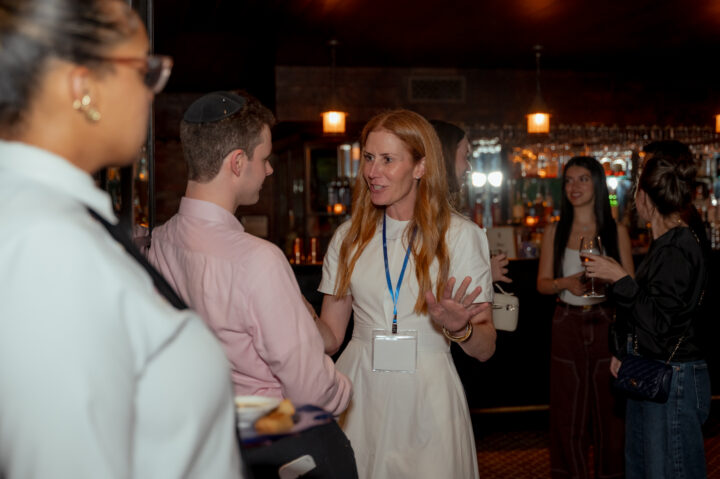
Erica Schwartz mingles with prospective users of The Well at the app's launch event on July 278, 2028, in Manhattan.


 Add JewishInsider on Google
When the biblical Abraham sought a wife for his son Isaac, he dispatched his trusted servant to the city of Nahor in Mesopotamia. The servant, Eliezer, stopped at a well and prayed for a sign: the right woman would offer water not just to him, but to his camels as well. Rebecca did exactly that — and became Isaac’s match.
That story now has a modern namesake. A new dating app called The Well, slated to launch in the coming weeks, exclusively matches Jewish day school alumni. It’s aiming to fill a void for the very affiliated Jews searching for their bashert but tired of swiping.
“As I started to watch the way the world — at least in my Modern Orthodox circle — was meeting or not meeting each other, something felt very broken to me,” Erica Schwartz, the app’s founder, told Jewish Insider on Tu B’Av, the Jewish holiday of love, which began at sundown on Tuesday.
“Back in my day, we’d go to a synagogue and you’d meet and mingle outside and somebody might give you a call. Now everything is through a matchmaker and people aren’t meeting in person so everything is moving to more formal apps or shidduch résumés.”
Schwartz graduated from the Modern Orthodox Ramaz School on Manhattan’s Upper East Side, where she now serves as board chair. She also sent all six of her children to Jewish day schools. She said the aforementioned methods of dating were not “speaking to what I look at as this large middle niche I’m putting under the banner of the day school crowd, where they have a Jewish background and identity so they’re not a random Jew out there on a dating site, and they’re also not the ultra-Orthodox dater who is going to, through a matchmaker, go on six dates and then get married.”
“In that middle camp are all these day school graduates who are looking to meet somebody,” continued Schwartz. “It seems like such a natural place of overlap and connection, they just need to become aware of each other. That’s what The Well is trying to do — build a niche area of Jewish dating.”
Unlike mainstream dating apps — including other Jewish ones — known for endless swiping, The Well features no swiping at all, which makes it feel more personal, said Schwartz. She describes the platform as “human intuition and wisdom working in tandem with technology.”
The Well enters a crowded field of established Jewish dating apps — swipe-based JSwipe, application-only Lox Club and older-skewing JDate. But it’s betting that its swipe-free, day-school-verified niche can reach daters that those other platforms don’t.
Users, who must be in their 20s and 30s, begin by filling out a profile form. The first thing they’re asked to note is the day school they attended and year of graduation. Day school graduates of all backgrounds — from pluralistic to yeshiva — are welcome to join, but users must submit two names of people who can vouch that they attended that school. “That’s our current verification system. We need to see how that works and are prepared to tighten it a bit,” said Schwartz.
The profile form then prompts users to speak with a chatbot named Elli — a nod to Eliezer from the biblical story.
Elli is trained to ask follow-up questions in nuanced ways and pick up the user’s personality, said Schwartz. It asks users to describe their religious beliefs, share their profession and include key dating details like height preference or college alma mater.
Users also have the option to fill out the form manually, but Schwartz said taking advantage of Elli is preferred.
The Well also offers a small, vetted cohort of matchmakers if users wish to open their profile to them. Daters can also book an individual phone session with a matchmaker for $180, but otherwise the app is entirely free of charge.
A team of about a dozen advisors and matchmakers has been involved since the app’s inception, including two Modern Orthodox rabbis: Rabbi Elie Weinstock, senior rabbi of the Jewish Center of Atlantic Beach on Long Island, and Rabbi Daniel Kraus, director of community education at Congregation Kehilath Jeshurun in Manhattan.
“The future of Jewish dating isn’t choosing between technology and people,” Kraus told JI. “It’s combining the best of both. There are many excellent dating apps today. But no single platform can serve every community equally well. Every week I meet remarkable young adults who are ready to build Jewish homes, yet many still struggle to meet the right person. The challenge isn’t a lack of commitment. It’s creating meaningful opportunities for the right introductions.”
“The Well’s model is especially compelling because it pairs the scale and intelligence of technology with the wisdom, intuition and personal touch of experienced shadchanim [matchmakers],” continued Kraus. “Technology broadens the possibilities. People bring the judgment that no algorithm can fully replicate.”
The name itself, said Kraus, is “deeply rooted in Jewish tradition.”
“Throughout Tanach, wells are places where lives change,” he said. “Rivkah, Rachel and Tzipporah each met their future spouse at a well. While the platform is new, the mission is timeless: to help more young Jews find one another and build the next generation of Jewish families.”
The Well features two levels of profiles: public and private. The private one is only seen by Elli or a matchmaker. There’s also a dashboard where matchmakers can discuss the profiles of their clients so they can make suggestions in addition to the ones Elli makes.
Names are drawn for users every Monday and Thursday — the days biblical Jews traditionally went to the market — and they have a certain amount of time to respond; they can say “pass” or can choose to start a conversation. They can also share someone’s profile with another user in their “village,” which is the equivalent of Facebook friends.
“Some of that we’re fine tuning to make sure we’re not infringing on privacy,” said Schwartz, adding that the platform uses vanishing pictures to ensure profiles aren’t screenshotted and sent around.
Since dating apps first launched in the 2010s, they have instantly put hundreds of profiles at users’ fingertips, making them the favored method for nearly half of Americans looking for love, according to a Forbes Health survey. But apps that claim credit for matches made five or ten years ago now face user burnout, with many people saying they prefer to meet in person rather than swipe through an endless pool of potential mates. Seventy-eight percent of users report dating app burnout, according to another Forbes survey conducted last year.
Addressing this, Schwartz said The Well also features an events section of the app that will advertise social gatherings for this demographic across the country. She described that as a “crucial” component.
Before officially going live, The Well hosted an invitation-only launch event Tuesday night at the swanky Bowery Hotel on Manhattan’s Lower East Side, timed to coincide with Tu B’Av, drawing some 200 young professionals eager to mingle and learn about the app.
“What makes The Well stand out is that it rejects the culture of infinite swiping and disposable connections,” Erez Kahan, a 35-year-old who works as a relationship manager in the family office space and attended the launch event, told JI. “Instead, by thoughtfully introducing just a couple of carefully considered matches each week, it encourages people to slow down, be present and give each connection the attention it deserves. It’s a refreshingly human approach — one that values individualized care, quality over quantity and genuine intention over endless choice.”
Kahan, a graduate of The Frisch School, a Modern Orthodox school in New Jersey, said he’s particularly drawn to the symbolism behind The Well’s name — something he expressed hope to experience through the app: “A chance meeting at a well became something guided by purpose rather than endless searching.”
The docudrama ‘David: King of Israel,’ which airs Thursday, follows the successful ‘House of David’ miniseries that aired on Amazon last year
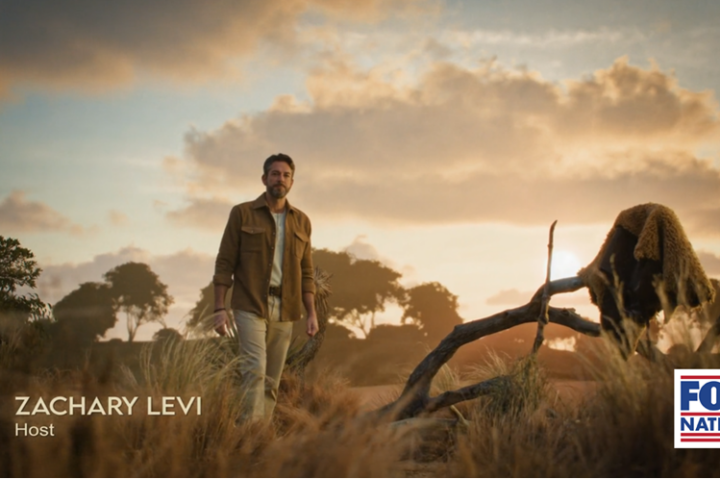
Courtesy Fox Nation
“David: King of Israel,” four-part Fox Nation docudrama
The first episode of “David: King of Israel,” a new four-part Fox Nation docudrama, premieres on Thursday, offering a dramatic reenactment of the biblical coming-of-age story of King David that provides relevant lessons in a time of conflict, actor Zachary Levi, the series’ host, told Jewish Insider.
“It’s unfortunately an evergreen [story] in that we as mankind find ourselves in conflict and war always. The only way to truly battle darkness is to battle it with light. David is an example that no matter how much we stumble, God can still love us and we can still be redeemed. I want to apply that to everyone across the world,” said Levi, a Christian who recalls “reading all of the stories in the Bible” as a child.
“David always jumped out at me. In some ways even more than the story of Jesus. It’s full of drama, intrigue, romance, betrayal and war. It’s like ‘Lord of the Rings’ in the Bible,” continued the award-winning actor, whose credits include roles in “Shazam!,” “Chuck” and “The Marvelous Mrs. Maisel.” This latest project sees him narrate from an LED stage in Los Angeles that allows for the appearance of being transported through biblical-era caves and villages.
The majority of the production, however, was shot in South Africa due to the country’s “long history with faith-based productions,” Jonathan Towers, vice president of development for Fox Nation, told JI. “As a result, there are biblical sets and costumes already available in-country, as well as a deep acting community that’s very experienced with such productions. The most visible sign of that robust acting community is Nahum Hughes, a South African actor who plays David,” said Towers.
Created by Warm Springs Productions, the series’ executive producers are David Cunningham, Marc Pierce, Chris Richardson and Bridger Pierce. The team consulted with historians and archaeologists, as well as biblical experts, both Jewish and Christian, including Rabbi Meir Soloveitchik, Rabbi Pesach Wolicki and Ze’ev Orenstein, director of the City of David in Israel.
Cunningham told JI that some “creative license” was taken with costumes “where the scriptures and historical evidence was unclear.”
“But areas where we had evidence, like the priests’ garments or Goliath’s armor, we did the best we could with the resources we had to honor historical accuracy. The same would be said for the art direction overall,” said Cunningham.
The docudrama’s premiere comes one year after Christian filmmakers Jon Gunn and Jon Erwin released the eight-episode “House of David” series, which quickly became the second-most watched show on Prime Video at the time. Levi said the new series “complements” “House of David” by “diving straight into the history and the biblical source” instead of taking “some creative license in order to be an entertaining show.”
Levi said in a 2016 interview that he frequently was turned down for roles for “being too Jewish,” despite being a practicing Christian, because casting directors made assumptions based on his stage name. (Levi is his middle name, while Pugh is his last name.)
Even as antisemitism and hostility toward Israel are on the rise in Hollywood, Levi said he has no concerns about backlash over working on the “King David” series. In fact, he thinks telling the story could bring interfaith unity. At the same time, Levi is surprised by Jewish people in the industry who have “seemingly turned their backs on their own heritage and lineage.”
“I walk to the beat of my own drum in Hollywood,” he said. “I believe when you stand for right and fight for the light you can’t be wrong. I am frustrated with not only Hollywood but the world in general at our inability to see reality sometimes. A lot of people in Hollywood are turned around and confused about all of this. I wish they could see the lies they are believing and perpetuating. We need to find a way to stop the poisoning of our minds. We are living in strange times. We need to be coming together and telling stories that are redemptive and full of hope.”
Please log in if you already have a subscription, or subscribe to access the latest updates.
 Continue with Google

 Continue with Apple