














































































The president made the comments on Fox News after the IRGC attempted a surprise ballistic missile attack on U.S. forces in the region
Brendan SMIALOWSKI / AFP via Getty Images
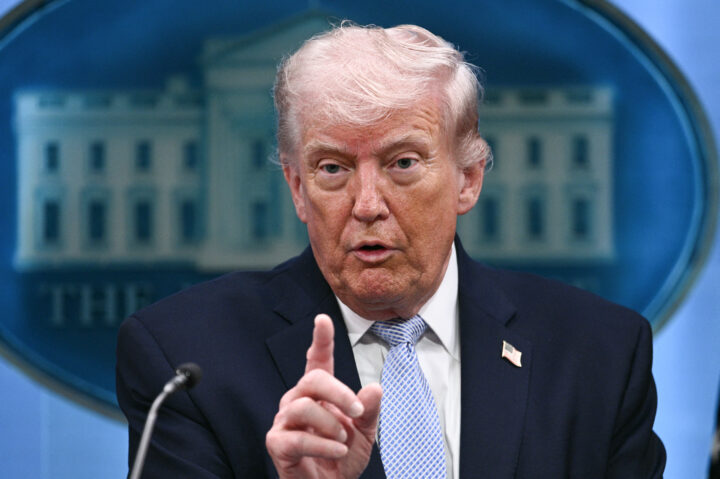
US President Donald Trump speaks about the conflict in Iran in the James S. Brady Press Briefing Room of the White House on April 6, 2026, in Washington, DC.


 Add JewishInsider on Google
President Donald Trump warned on Wednesday that the U.S. would “beat the f**king sh*t out of” Iran following an attempted surprise ballistic missile attack by the Islamic Revolutionary Guard Corps on American forces in the region, even as he signaled a willingness to keep diplomatic channels open.
“We’ll be hitting them hard,” Trump told Fox News’ Trey Yingst. “They’re going to get a beating.”
But Trump added that he’s “going to let them keep talking,” referring to ongoing indirect U.S.-Iran negotiations.
The president’s comments followed a spate of attacks on Tuesday evening into Wednesday morning by Iran and its proxies. In addition to the IRGC surprise attack, Iran also directed more than 30 drone attacks by its proxies in Iraq over several days on “U.S. forces and Saudi energy infrastructure,” CENTCOM said, leading the U.S. and Saudi Arabia to conduct joint strikes on logistics and weapons sites in eastern Iraq early Wednesday. The Jordanian military also announced that it had intercepted five missiles launched from Iran on Tuesday night.
The attacks ended a pause in hostilities between the parties, which began last Friday, and came after Trump’s disclosure on Monday that the U.S. remains engaged in “very deep talks” with Iran. But the president has repeatedly threatened to reengage in military action if diplomacy collapses.
Trump issued his first comments of the day shortly before 6 a.m. ET, posting on his Truth Social site that “Israel and Iran must immediately stop ‘shooting.’”

Wisam Hashlamoun/Anadolu via Getty Images
A missile leaves a fiery trail across the sky over the West Bank city of Hebron on June 8, 2026, amid missile launches from Iran toward Israel.
Millions of people across northern Israel heard a familiar sound from their phones late Sunday night: an alert from Israel’s Homefront Command, notifying them for the first time in two months, of an incoming ballistic missile attack from Iran.
Just after sunrise, residents of Israel’s center — from Tel Aviv to Jerusalem — received the same notification, and groggily huddled in shelters as Iran, joined by its Houthi proxy in Yemen, launched fresh salvos at Israel. Shortly after, Israel struck a petrochemical plant in southwest Iran.
Last night’s initial Iranian attack came in response to Israeli strikes in the Beirut suburb of Dahiyeh, a Hezbollah stronghold that had in recent weeks been off-limits to the IDF in accordance with a U.S.-brokered ceasefire with Lebanon that limited Israeli action to southern Lebanon, another Hezbollah stronghold.
What matters more than how the latest round of fighting started is what will happen next. The escalating tit-for-tat strikes have again brought the region to the brink of another all-out war that could return the U.S. to active fighting, despite two months of efforts by the White House to reach a deal with Tehran.
Israeli media reported that its overnight strikes on Iran had been coordinated with the U.S., even as President Donald Trump spent Sunday afternoon on the phone with reporters trying to publicly de-escalate the situation.
Shortly after Iran’s initial missile attack on Sunday, Trump told Fox News that the incident was “certainly not going to help” the ongoing negotiations between the U.S. and Iran. He continued, “What I would suggest to Iran: You’ve shot your missiles, that’s enough, get back to the table and make a deal.”
Speaking to Axios, Trump said, “I am going to call [Israeli Prime Minister Benjamin] Netanyahu right now and tell him not to strike back. … Each of them had their fun. Israel had its strike and Iran had its strike. We don’t need another one.”
In the hours that followed, both Israel and Iran disregarded the president’s comments and continued their strikes.
Trump’s comments could be taken at face value — or viewed with some skepticism in light of the Israeli media reports that the strikes were coordinated with Washington. It would not, after all, be the first time in which the U.S. and Israel publicly emphasized their differences while privately remaining aligned — even amid alleged fissures in the relationship. That includes leaks to NBC News and The New York Times over the weekend that the Defense Department’s Defense Intelligence Agency had raised its counterintelligence threat level for Israel to the highest level. The Times named three U.S. officials that were allegedly being tracked for information on the Iran negotiations: White House Special Envoy Steve Witkoff, the Pentagon’s Elbridge Colby and Colby’s deputy, Michael DiMino.
But things move fast in the Middle East. Recall that last June, after 12 days of intensive strikes between Israel and Iran, joined by the U.S., a ceasefire was announced mere hours after Iran launched missiles at a U.S. airbase in Qatar. Addressing the overnight escalation between Israel and Iran — and Iran’s continued intransigence in the region — is likely to be the White House’s top order of business today. Indeed, Trump issued his first comments of the day shortly before 6 a.m. ET, posting on his Truth Social site that “Israel and Iran must immediately stop ‘shooting.’”
Negotiations between the Trump administration and Iran thus far have yielded little concrete success. The Strait of Hormuz remains closed. Iran has continued to attack ships transiting through the waterway, as well as other Gulf countries — such as Kuwait, whose major airport suffered significant damage after an Iranian drone struck the passenger terminal, killing one and injuring dozens. Gulf states have increasingly had to find alternative export routes. The region exists in a state of paralysis, unsure if or when a new round of fighting will again disrupt everyday life, work and travel.
Yesterday morning, the president told NBC’s “Meet the Press” that his red line for resuming military action in Iran would be if he didn’t believe the parties could reach a deal in a timely manner. The latest escalation has the potential to bring the U.S. and Iran to an accord — and the war to a more finite end — regardless of what Israel wants. (Trump told the Financial Times that Netanyahu would have to accept a U.S. agreement with Tehran because Washington “calls the shots.”)
But the latest exchanges could also trigger a new round of active warfare, nearly a year to the date that the 12-day war began. All eyes will be on Washington today to see what will play out.
Please log in if you already have a subscription, or subscribe to access the latest updates.
 Continue with Google

 Continue with Apple