














































































A new poll from the Israel Democracy Institute found that less than half of Israelis believe Trump puts a premium on Jerusalem’s security, the lowest figure since he was reelected in 2024

JACK GUEZ/AFP via Getty Images
Commuters drive along a road in front of a billboard bearing the flags of the U.S. and Israel with a message in support of then-presidential candidate Donald Trump in Tel Aviv on October 30, 2024.


 Add JewishInsider on Google
The share of Israelis who believe the country’s security is a primary consideration for President Donald Trump has plummeted to a new low, according to a new poll, revealing a sharp shift in public attitudes as the U.S. and Israel diverge on their strategies and ultimate goals of the war with Iran.
The survey, conducted by the Viterbi Family Center for Public Opinion and Policy Research at the Israel Democracy Institute from May 31 to June 5, found that 44% of Israelis believe Israel’s security is a central consideration for the Trump administration, a decline from the 60% recorded in March at the beginning of the Iran war.
The drop was even more pronounced among Jewish Israelis, where confidence fell 23 points over the same period, from 64% to 41%.
The findings mark the lowest levels of Israeli trust in Trump since the center began tracking the metric when he was elected to a second term in November 2024, highlighting a rapid erosion of Israeli public confidence as the White House intensifies its pursuit of a deal with Iran.
The polling also reveals a stark collapse in public optimism regarding Israel’s ability to achieve its key objectives in the conflict. Roughly one-third — 32% — of respondents now believe the war’s outcome will include the elimination of Iran’s ballistic missile arsenal — down sharply from the 65% who held that view in March. Similarly, the share of Israelis who believe the conflict will weaken the Iranian regime has also been cut by nearly half, falling to 28% (from 55%) over the same period.
This pervasive skepticism aligns with deep public resistance to Washington’s current diplomatic track. Even as the Trump administration continues to seek an immediate cessation of hostilities and a negotiated settlement with Tehran, a majority of Jewish Israelis (58%) maintain that ending the war under its current conditions is fundamentally incompatible with Israel’s long-term security needs.
About one-quarter of Americans hold antisemitic attitudes, according to research from Robert Kraft’s Blue Square Alliance Against Hate
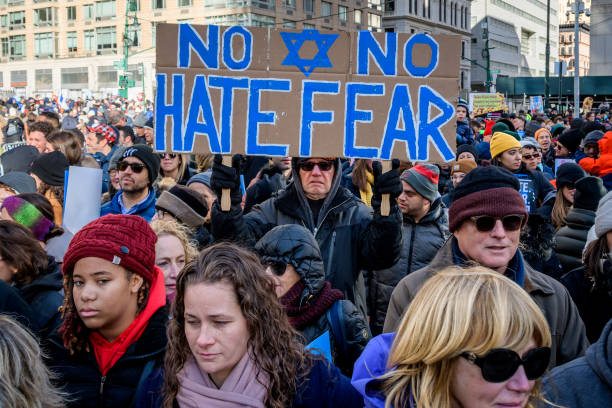
Erik McGregor/Getty Images
Participant holding a sign at the rally. Thousands of New Yorkers joined community leaders and city and statewide elected officials in Foley Square at the No Hate. No Fear. solidarity march in unity against the rise of anti-semitism.
Antisemitism in America has plateaued after a sharp rise in anti-Jewish hate incidents in the immediate aftermath of the Oct. 7, 2023, terrorist attacks in Israel — yet fewer Americans are pushing back against it, according to a survey released Thursday by the Blue Square Alliance Against Hate.
About 25% of the population has consistently held antisemitic attitudes since June 2024, the 2025 Antisemitism Landscape Survey reported. That’s a notable rise from the recent past, but the survey found that the growth of antisemitic views has slowed significantly.
The survey, which has been conducted twice a year since June 2023, polled 7,028 American adults from Aug. 1-Sept. 30. It found that 58% of respondents think antisemitism is a minor problem or not a problem at all, a sizable majority, though one that has remained fairly steady for the past two years.
“This is an alarming moment for the United States,” said Adam Katz, president of the Blue Square Alliance Against Hate, a nonprofit founded by New England Patriots owner Robert Kraft, which recently rebranded from the Foundation to Combat Antisemitism. “At a time when national data shows clear increases in antisemitic incidents and hate crimes, our survey results show a decline in the number of Americans who see antisemitism as a major problem.”
Katz called the stabilization of Americans expressing antisemitic attitudes a “glimmer of hope that hate is no longer spreading.”
At the same time, the report found that the number of Americans willing to speak out against antisemitic behavior is dropping compared to before Oct. 7.
The number of “allies” to American Jews — defined as “well informed and aware of antisemitism, already activated to stand up to Jewish hate” — stayed consistent at 9% between December 2024 and August 2025, though that’s down from 15% in June 2023.
The number of Americans categorized as “haters” — defined as “blatantly prejudiced against Jews and tend to be outspoken about it” — decreased slightly from 11% in 2024 to 10% in 2025, though that’s up from 6% in 2023.
Nearly half (46%) of Americans think Jews can “handle antisemitism on their own,” which has stayed largely consistent since 2024.
Only around a third (33%) of respondents expressed belief that other people will disapprove of them if they don’t stand up for Jews who are experiencing prejudice, a number that is consistent with the December 2024 poll and slightly less than 39% in December 2023.
Polling was conducted while the Israel-Hamas war was still underway, with many participants expressing the view that supporting Jews might be interpreted as siding against Palestinians.
Belief in classic antisemitic tropes — such as “Jews are penny pinchers” and “Jews run the media” — are softening slightly, the survey found, although they are still higher than 2023 numbers.
The last year has featured several high-profile attacks on Jews around the U.S., including the arson attack against Pennsylvania Gov. Josh Shapiro’s home, the Washington shooting of two Israeli Embassy staffers outside the Capital Jewish Museum and the Colorado firebombing of a hostage solidarity event.
Please log in if you already have a subscription, or subscribe to access the latest updates.
 Continue with Google

 Continue with Apple