












































































Assistant Attorney General Harmeet Dhillon warned last week that countries participating in boycotts of Israel could face U.S. retaliation
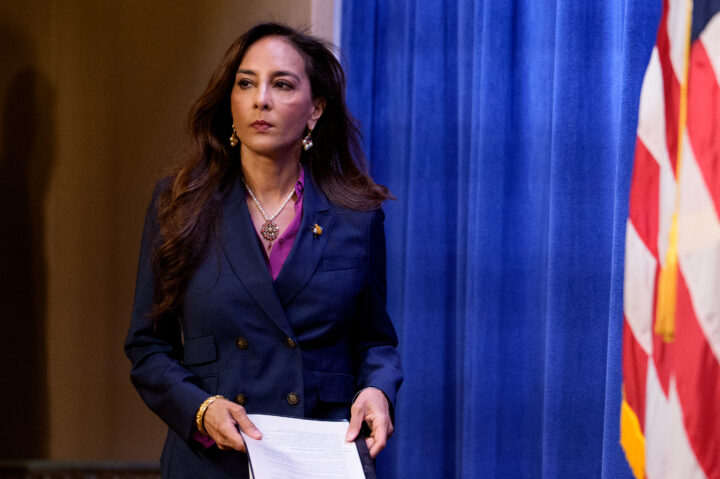
Andrew Harnik/Getty Images
Assistant Attorney General for Civil Rights Harmeet Dhillon arrives for a news conference at the Justice Department on September 29, 2025 in Washington, DC.


 Add JewishInsider on Google
The assistant attorney general for civil rights, Harmeet Dhillon, warned last week that countries participating in boycotts of Israel could face U.S. retaliation, raising the prospect of sanctions against Britain and other European governments.
But Washington still has yet to clarify its policy, and it remains unclear whether the Trump administration plans to move forward with retaliatory measures.
Speaking in Washington last week, Dhillon sharply criticized the measures taken by European countries, describing the actions as involvement in BDS and a form of antisemitism. European officials, however, have argued that the sanctions are different from the BDS movement.
“What we call this in the United States is the BDS movement. It is antisemitism,” Dhillon said while speaking in D.C. on Oct. 6. “And I think every country that is doing that is going to risk, while President Trump is in power, retaliatory or corresponding sanctions potentially.”
One Republican congressional source told Jewish Insider that Treasury Department and Commerce Department officials had told their office that the departments were prepared to add those countries that announced sanctions targeting Israeli settlements last month to the Treasury’s international boycott list, but the State Department was refusing to grant the clearance necessary to do so.
Reached for comment, a State Department spokesperson told JI: “We are not going to comment on internal deliberations speculated on by an anonymous source.”
The U.K. announced an import ban on settlement goods and sanctions on related entities on Sept. 9.
The Netherlands introduced stricter measures on Sept. 22, including penalties of up to six years in prison for violations. Israel responded by revoking the diplomatic credentials of Dutch envoys in Ramallah.
France, Canada and other countries have also enacted or pledged similar restrictions involving the West Bank, east Jerusalem and the Golan Heights. The measures have drawn condemnation in Israel. U.S. Ambassador to Israel Mike Huckabee has warned that Britain could face economic repercussions.
Secretary of State Marco Rubio had previously indicated that the U.S. would not join the sanctions. Republicans in Congress have also told JI they oppose them. Before Dhillon’s remarks, the administration had not publicly condemned the measures.
A former U.S. administration official, speaking on background, confirmed the sanctions are not yet “settled administration policy” and noted that Dhillon’s comments could be strategic.
“Dhillon’s comment does not necessarily reflect settled administration policy. A decision to impose such sanctions would need consideration by Treasury, State, USTR, and above all the President; it’s not a DOJ decision,” the former official said. “It may reflect a decision to sanction the UK, or a warning shot meant to deter others from following the UK, or her view but not a final policy decision.”
The distinction between the European measures and the broader BDS movement could also become significant as the administration determines how to respond. European governments have presented their restrictions as measures targeting Israeli settlements rather than participation in the broader BDS campaign against Israel.
Jonathan Ruhe, a fellow at the Jewish Institute for National Security of America, said the uncertainty comes against a complicated history of U.S. policy toward Israeli settlements and BDS.
“Israeli settlements have always existed in a gray area when it comes to U.S. opposition to BDS. President Obama excepted West Bank settlements from his enforcement of anti-BDS laws, and Biden sanctioned certain settler activities while officially opposing BDS.”
He said that ambiguity appears to have carried into the Trump administration as tensions between Israel and European governments over settlement policy have increased.
“This gray area now seems to be carrying over to the Trump administration, where coherent and consistent policymaking has never been a strong suit, precisely as the West Bank and U.S.-European ties become particularly tense more generally,” Ruhe said.
Ruhe also pointed to the administration’s previous responses to European actions targeting Israel as a possible indication of how Washington could respond to the latest measures.
“Though Amb. Huckabee repeatedly called settler violence ‘acts of terror’ and ‘criminal activity’ over the summer, Europe’s latest threats follow a pattern where the administration jumps at the opportunity to retaliate for sanctions, embargoes, and arrest warrants aimed at Israel from Europe,” Ruhe said.
Jason Greenblatt, who served as White House Middle East envoy in the first Trump administration, did not clarify whether he expects the policy to be officially implemented, however he noted that he would “strongly support such a policy.”
“Countries that do that should understand there can be consequences, even if they are long standing friends of the United States,” Greenblatt said. “When governments turn the BDS movement’s anti-Israel agenda and antisemitic ideology into policy, the United States has every reason to respond.”
Greenblatt further argued that just because certain countries are U.S. allies, it should not shield them from consequences when acting against Washington’s interests.
“Ambassador Huckabee publicly warned of consequences before Britain announced these measures last month, and Britain proceeded anyway,” he continued. “Friendship and history should not provide immunity when a government acts against U.S. interests and principles, and against one of our closest and most important allies.”
The assistant attorney general for civil rights urged students at the ICC summit to separate offensive expression from conduct that actually blocks access to education
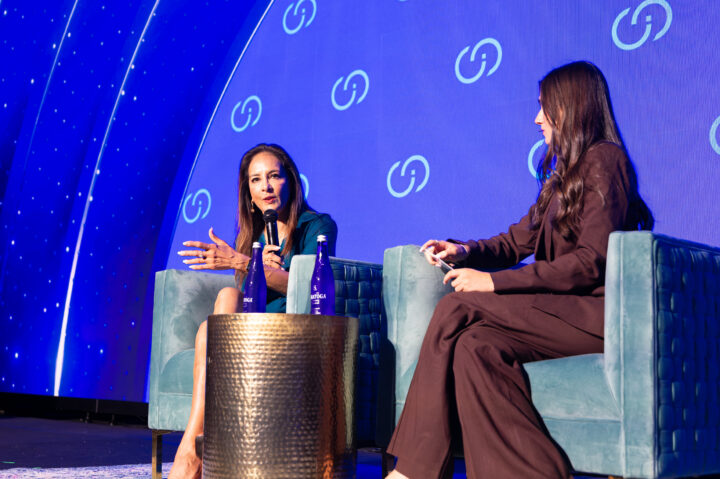
Israel on Campus Coalition
Harmeet Dhillon, the assistant attorney general for civil rights, speaks at the Israel on Campus Coalition’s National Leadership Summit on Aug. 4, 2026.
Harmeet Dhillon, the assistant attorney general for civil rights, urged pro-Israel college students to distinguish between protected speech and actionable discriminatory conduct — “people literally interfering with your ability to get an education” — when facing antisemitism on campus.
“[With] a lot of young people these days, there’s kind of a snowflake culture with ‘I feel unsafe.’ I feel unsafe everyday when I go to work and get a mean email from a colleague. Life is full of challenges,” Dhillon said on Tuesday at the conclusion of the Israel on Campus Coalition’s National Leadership Summit in Washington.
“Someone wearing a keffiyeh or shouting ‘from the river to the sea,’ it’s protected by the First Amendment,” Dhillon said. “Holding a red triangle over a student’s head in a mob setting and saying ‘Jews not welcome’ is much closer to not protected speech.”
“You have to sort out people being mean or rude to you versus people literally interfering with your ability to get an education,” she said.
Dhillon, who has led the Trump administration’s ongoing legal battles with a number of universities over their alleged failures to address antisemitism, added that the next hurdle will be fighting anti-Israel rhetoric from left-wing politicians.
“One of the new challenges, which I never would have predicted, is political leaders like [New York City Mayor] Zohran Mamdani or candidates on the ballot today in Michigan whose rhetoric isn’t something you would have seen five or 10 years ago,” said Dhillon. “The normalization of violent rhetoric about an entire population of people of a national origin and religion is something I didn’t see growing up in this country, and I grew up in the Deep South.”
“I have neighbors in my community in Sea Ranch, Calif., who are professors at UC Davis and I see them on television lock hands and block the Jewish students from going to campus,” she said. “And I see them at the grocery store. Am I supposed to treat them normally? They don’t think I should be treated normally. So these are some of the challenges we face in today’s society.”
It is unclear what incident Dhillon was referring to, though a similar incident did occur in April 2024 on UCLA’s campus, at which time students participating in an anti-Israel encampment moved in groups and shouted “human chain” in order to block students from moving through campus, according to DOJ findings.
Speaking at AJC’s Global Forum, the assistant attorney general highlighted antisemitic incidents at UCLA and Harvard: ‘This is outrageous behavior in America that this administration will not tolerate’
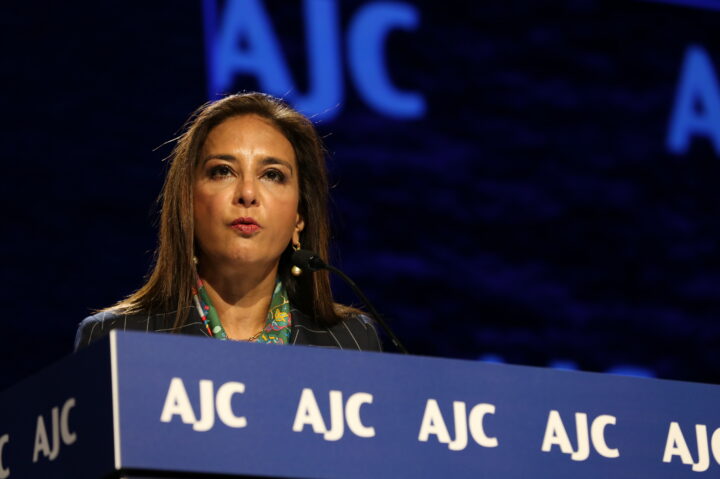
AJC
Assistant Attorney General for Civil Rights Harmeet Dhillon speaks at the American Jewish Committee's Global Forum in Washington on June 2, 2026.
Assistant Attorney General for Civil Rights Harmeet Dhillon said on Tuesday that the Trump administration will continue its legal battles against Harvard University and UCLA, accusing both institutions of continuing to neglect the civil rights of Jewish students and faculty.
Dhillon made the comments while appearing at the American Jewish Committee’s Global Forum in Washington, where she condemned what she described as “egregious examples of antisemitism that have transpired here at home on American soil” since Hamas’ Oct. 7, 2023, attacks on Israel as “devastating and antithetical to our values as a nation.”
The assistant attorney general highlighted the department’s most recent lawsuit against Harvard in March, saying that the Ivy League university had been “tolerating race and national origin discrimination against both Jewish and Israeli students.”
“After Oct. 7, antisemitic mobs at Harvard and other campuses harassed and intimidated these students all across the campus. Harvard failed to take meaningful action and it failed to enforce its own rules in an equal manner,” Dhillon said. “Its own presidential task force documented the exclusion of Israeli and Zionist students from social spaces and extracurricular activities, but these findings were ignored. Harvard’s actions are inexcusable, and it cannot continue to take taxpayer dollars while turning a blind eye to abuse against Jewish and Israeli students.”
Turning to UCLA, Dhillon noted that the Justice Department had filed suit against the school last week “for its deliberate indifference to race and national origin discrimination in violation of Title VI of the Civil Rights Act of 1964.”
She recounted visiting the Los Angeles campus in recent weeks, noting that “it almost brought tears to my eyes” to hear a recent UCLA School of Law graduate share how a student held up a large sign behind his head with an inverted red triangle, a symbol used by Hamas terrorists to mark Israeli targets.
“This is outrageous behavior in America that this administration will not tolerate,” she said of the incident, and vowed that the Justice Department would continue pursuing its litigation.
UCLA’s Initiative to Combat Antisemitism action group released a 42-page set of recommendations last month urging the university to intensify its crackdown on anti-Jewish harassment, which Chancellor Julio Frank said “makes clear that antisemitism and all other forms discrimination and bigotry have no place at UCLA.
“The Civil Rights Division will fight antisemitism in our American universities and elsewhere, wherever we will find it,” Dhillon told the crowd. “The fight for the Jewish community’s right to learn, worship or live freely is not a fight that I or the Civil Rights Division take lightly. It’s a fight that I’ve personally committed to, because no person in this country should ever have to live in fear because of his beliefs or where he came from. With every institution and individual we hold accountable, our Civil Rights Division fights tirelessly to protect America’s Jewish community.”
Leo Terrell will chair the new advisory panel while embarking on a 15-city swing to engage Jewish communities and local officials on combating antisemitism

Win McNamee/Getty Images
Leo Terrell at an event in the East Room of the White House on February 20, 2025.
The Justice Department announced on Tuesday that Leo Terrell, senior counsel to the assistant attorney general for civil rights and chair of the Department of Justice’s antisemitism task force, will oversee the creation of the DOJ’s Antisemitism Advisory Committee. As part of the role, Terrell will embark on a 15-city nationwide tour to connect with local faith leaders and law enforcement officials about combating antisemitism.
The department described the panel in a press release on Tuesday as “a new advisory body” that will recommend strategies to the attorney general and other department leadership “on coordinated, timely, and effective responses to antisemitism.”
The committee “will consist of citizen leaders dedicated to combatting antisemitism” and individuals nominated to serve will be “subject to approval by the president,” the release said. (The task force, by contrast, is solely composed of DOJ officials.)
“Members will come from a wide range of backgrounds but share a common goal of developing innovative solutions to address antisemitism across the country,” the department said of the “forthcoming launch” of the panel.
Terrell told Jewish Insider in an interview late Tuesday that he had submitted a list of nominees to President Donald Trump after receiving the green light from acting Attorney General Todd Blanche to launch both initiatives and was awaiting approval from the White House.
The tour, described by the department in a second press release as a “National Awareness & Action Tour to combat antisemitism,” will involve Terrell meeting with “individuals and local communities impacted by antisemitism” and “working to identify practical solutions to combat antisemitism at the local level.”
“This national tour is an important step in ensuring communities across the country know the federal government stands ready to work with them to confront antisemitic threats, protect public safety, and uphold civil rights,” Blanche said in a statement.
Terrell has not determined yet if the tour will include public appearances to engage with Jewish leaders. His schedule is in the process of being finalized, and the senior DOJ official told JI he is open to extending the number of cities beyond the initial 15 stops on the agenda.
As for who he will meet during his travels, Terrell acknowledged that he did not expect to receive much engagement from many leading Democratic officials in major cities, such as New York City Mayor Zohran Mamdani, Chicago Mayor Brandon Johnson or Los Angeles Mayor Karen Bass. Instead, he said he hopes to engage directly with Jewish community stakeholders in these places and urge Jewish Americans to get involved in local elections.
“We’re talking about going to Jewish communities, first of all, to light a fire under them, but also to ask how we resolve these issues when sometimes you’ve got an absentee district attorney, with an absentee mayor, with an absentee school board, with an absentee school superintendent?” Terrell said. “Most importantly, there’s going to be a great emphasis on taking back these school districts and local prosecutor jobs in elections. There’s going to be a focus on putting pressure on some of these politicians in local cities in towns.”
He told JI that his primary objective with both initiatives is to determine what solutions the Trump administration can implement to combat domestic antisemitism on a federal level, as well as ascertain what the federal government should encourage state and local officials to do to address the problem closer to home.
“My position is that antisemitism is a local issue. What I mean by that is, we see the results of failures to address it at the local level — in the cities, in the school districts and areas like that,” Terrell said. “Not all of the solutions are in Washington. The solutions are in Los Angeles, Detroit, Chicago, San Francisco, in big cities, small cities, mid-sized cities in the South.”
“How do we get prosecutors in local cities to address antisemitic content that is being ignored and protected under the umbrella of free speech? How do we stop the curriculum problems that are developing in K-12 schools by teachers’ unions that support antisemitic misconduct?” he added. “How do we stop the issues caused by what I call the ‘Jewish tax,’ where Jewish citizens have to pay exorbitant security fees in order to worship or to have events? These are things that are happening at the local level.”
Terrell said he is “wide open” to considering ideas from Jewish leaders across the country about solutions to the domestic antisemitism scourge, arguing that he believed “out-of-the-box thinking” was required at this moment.
Terrell said that he viewed the success of the federal programs he hopes to enact over the remainder of the second Trump administration as a necessity, arguing that those initiatives yielding tangible results would make it difficult for a future president to shut down.
“With this advisory committee, we’re going to work on the problem of antisemitism. We’re not going to be just talking, having hearings and things of that sort. This is not an advisory council that’s going to write a report that collects dust. I’m not in for that, I’m in for finding working solutions,” Terrell told JI. “Recognizing the problem is one thing. What to do is another.”
“I think that’s going to be the task of the commission, because I believe guardrails need to be put up before this president’s term in office is over,” he continued. “The president, in my opinion, has been the best friend that the Jewish American community has had in the White House. He’s committed. My biggest concern from here at DOJ is getting some guardrails up so the next president or the next White House will continue these programs.”
The assistant attorney general for civil rights emphasized that Nazis often had advanced degrees and impressive credentials
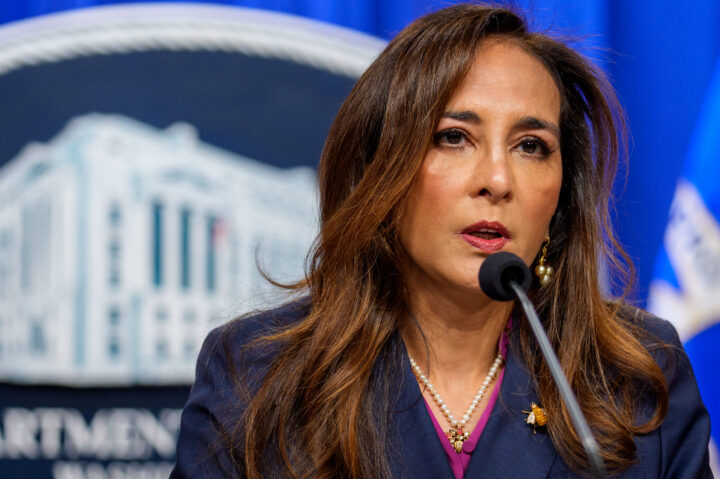
Andrew Harnik/Getty Images
Assistant Attorney General for Civil Rights Harmeet Dhillon speaks during a news conference at the Justice Department on September 29, 2025 in Washington, DC.
In a speech at a federal government commemoration of the Holocaust on Thursday, Assistant Attorney General for Civil Rights Harmeet Dhillon argued that the post-Oct. 7 wave of antisemitism in the U.S. resembles 1930s Germany and warned that modern bigotry is often perpetrated by “educated elites” under the cover of intellectual language.
Dhillon, drawing on a speech that the late Supreme Court Justice Antonin Scalia gave at a Holocaust remembrance event nearly three decades ago, said that Germany’s reputation as an intellectual and scientific hub in the 1920s and 1930s is closely connected to the development of the Holocaust.
“The road to Auschwitz was incremental and methodical. It began with excluding Jews through the legal, political, economic and social life of everyday society,” Dhillon said. “Many perpetrators of the Holocaust were often the most educated intelligentsia in Germany.”
She was speaking at the 33rd annual Federal Interagency Holocaust Remembrance Program, an event organized by and for federal government employees. It took place in the Justice Department’s Great Hall, and as attendees arrived, they walked up a staircase lined with portraits of historic legal experts, like the Babylonian king Hammurabi. One showed Moses, pictured with the twin tablets of the Ten Commandments.
The fact that the perpetrators of the Holocaust often had advanced degrees and impressive credentials is relevant for our understanding of contemporary antisemitism, Dhillon said.
“Today we are experiencing a rise in antisemitism in the world, including right here at home. As in the past, it often begins with social exclusion. On some university campuses, Jews have been blocked by mobs from entering certain spaces,” said Dhillon. “As in 1930s Germany, these actions are often perpetrated by the educated elites of our nation, framed in intellectual language, giving them a veneer of legitimacy.”
She called on federal workers to pledge to stand up against antisemitism and to defend Western values.
“The task in front of all of us here today as federal employees and people of conscience is a difficult but straightforward one. We must defend our values: our values as Americans, as Westerners, as heirs to this great civilization, our values that hold that all men are created equal,” she said.
The Trump administration, Dhillon stated, is committed to protecting Jews and fighting discrimination.
“The Department of Justice will confront anti-Jewish bigotry and ensure peace and security for all people of faith. We are and will continue to aggressively prosecute individuals and organizations who attack Jews, and we will ensure that our institutions of higher learning treat students and faculty with the dignity through which they are all entitled, and all of us are entitled,” she stated.
Other speakers at the event included Ellen Germain, the State Department’s special envoy for Holocaust issues, and Under Secretary of State for Economic Affairs Jacob Helberg, who spoke via video about his grandparents, who came to the U.S. after surviving the Holocaust.
“Their experiences impressed upon me that the opportunities we have today are not guaranteed. That sense of duty informs our work in government as public servants,” said Helberg. “Remembrance isn’t passive. It requires action. It requires us to ensure that the facts of the Holocaust remain accessible and that distortion and denial are confronted.”
Frank Cohn, a 100-year-old Holocaust survivor and U.S. Army veteran, shared his story.
At the end of the event, Germain warned that Holocaust distortion is “alarmingly on the rise these days.” She called on everyone in the room who survived the Holocaust, or who is a descendant of Holocaust survivors, to stand. They received a standing ovation from a crowd that included White House Jewish liaison Martin Marks, State Department antisemitism special envoy Yehuda Kaploun and representatives from more than two dozen foreign embassies.
The assistant attorney general for civil rights said the DOJ will pursue those funding, training and supporting groups such as American Muslims for Palestine
Andrew Harnik/Getty Images
Assistant Attorney General for Civil Rights Harmeet Dhillon arrives for a news conference at the Justice Department on September 29, 2025 in Washington, DC.
Harmeet Dhillon, the assistant attorney general for civil rights, said the Justice Department intends to pursue and ultimately shut down groups that have engaged in disruptive protests at synagogues and other antisemitic activities, as well as those supporting those groups.
“We are investigating, prosecuting, and we will bring these groups and these individuals to justice,” Dhillon said. “We intend to bring strong cases that dismantle these groups at their very root so that these unlawful attacks can be stopped once and for all.”
She said her division’s work includes pursuing those funding, training and supporting groups such as American Muslims for Palestine and the Party for Socialism and Liberation, which she said are engaging in “acts of domestic terrorism.”
Dhillon said that many of the groups behind antisemitic attacks are also involved in other activities, including “unlawful obstruction” of Immigration and Customs Enforcement officers.
The assistant attorney general said that Jewish communities around the country that she’s engaged with “feel like they’re under a coordinated attack and that authorities aren’t doing enough to help them,” adding that she is “ashamed as an American, to hear that groups have acted with impunity.”
She alluded to numerous pending investigations of disruptions at synagogues, of civil rights violations on campuses and of discrimination in zoning and land use approvals, vowing that the DOJ “will not let this stand.” She emphasized that the DOJ has been acting “swiftly and decisively” in response to acts of antisemitism and attempted attacks.
Dhillon said that the DOJ’s invocation of the Freedom of Access to Clinic Entrances (FACE) Act in prosecuting individuals for their involvement in a demonstration outside New Jersey’s Congregation Ohr Torah has become a model that has “paved the way” for its use in other cases to defend other synagogues and houses of worship for other groups. She said that there are more FACE Act investigations underway, related to both Jewish and Christian organizations.
The FACE Act bars the use of force, threats or obstruction to block access to reproductive health services or to obstruct the right to worship. It has previously been applied in cases of demonstrators blocking abortion clinics, but the DOJ under the Trump administration has applied it in cases of protesters blocking of houses of worship.
“For too long, groups and individuals acted as if they were above the law when attacking people of faith,” Dhillon said. “They engaged in a coordinated campaign designed to intimidate Jewish communities from even holding events at synagogues. Their methods are unlawful.”
Speaking at a conference on antisemitism organized by The George Washington University Program on Extremism, Dhillon also praised GW President Ellen Granberg “for standing up to these attacks and being a leader in this area,” pushing back on antisemitism on campus.
Dhillon, the assistant attorney general for civil rights, spoke at the Israel Hayom conference in New York City on Tuesday
Andrew Harnik/Getty Images
Assistant Attorney General for Civil Rights Harmeet Dhillon arrives for a news conference at the Justice Department on September 29, 2025 in Washington, DC.
Harmeet Dhillon, the assistant attorney general for civil rights at the Justice Department, defended Tucker Carlson’s hosting of neo-Nazi Nick Fuentes at the Israel Hayom summit on Tuesday.
Dhillon took part in a conversation at the gathering, which took place in Manhattan, with the outlet’s senior diplomatic correspondent, Ariel Kahana, about the Trump administration’s efforts to combat domestic antisemitism.
Asked about Carlson’s interview with Fuentes and what tools the U.S. had to prevent the spread of the antisemitic ideas from the far right, Dhillon distanced herself from Fuentes while calling Carlson a “friend.” She noted the importance of protecting free speech, though she did not condemn Carlson for his recent history of inviting antisemites and Holocaust deniers on his podcast.
“What we say in First Amendment world is: The antidote to speech that you don’t like is more speech. It isn’t shutting down speech,” Dhillon said. “So, I don’t agree with a single word that Nick Fuentes says or has to say, and the decision of whether or not to platform that person is one for my friend and former client, Tucker Carlson.”
“But we have a free country, still,” she continued. “Nothing is guaranteed, it is always one generation away from being lost. Thanks to Elon Musk acquiring Twitter, we have a free platform in America on X.” A study by the Jewish Council for Public Affairs earlier this year found that antisemitic content is rampant on X, more so than other social media sites.
Despite not pushing back on Carlson’s antisemitic embrace, Dhillon said Americans have an obligation to counter antisemitic and other hateful ideas through dialogue.
“The beauty of our country is that you can drown out negative views and viewpoints by simply speaking more,” she said, later adding: “It devolves on each of us as citizens to drown out those voices of hatred with our own voices, and have courage and stand up. The government can only do so much, and we are doing that.”
Earlier in the conversation, Dhillon lambasted New York City Mayor-elect Zohran Mamdani as an “antisemitic demagogue” who is incapable of changing his views.
“Look, the future mayor of New York is an antisemitic demagogue. That’s a fact,” Dhillon said. “There’s no persuading that kind of person, in a way. We will be responding with law enforcement to the extent that the city of New York fails to protect Jews in this city, and we see hate crimes, we see attacks or blockages surrounding houses of worship in this city.”
“The federal authorities, including the Department of Justice, FBI and others, are already actively investigating attacks in New York, New Jersey and elsewhere,” she continued. “Everywhere we find it in this country, we will step up and protect Jews.”
Please log in if you already have a subscription, or subscribe to access the latest updates.
 Continue with Google

 Continue with Apple