














































































Meta’s director of content policy spoke at a ‘Hack the Hate’ tech conference as the ADL released a report documenting antisemitism spreading unchecked on its platform Instagram
Shahar Azran/WJC
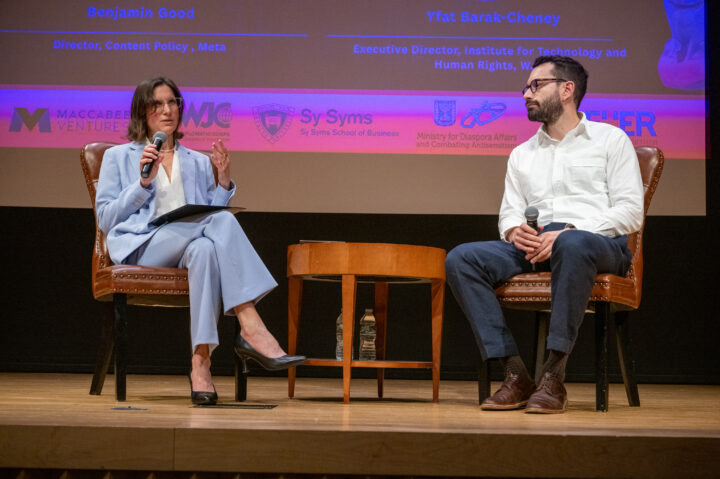
Ben Good, Meta's director of content policy, speaks at the 2026 Hack the Hate summit in Manhattan.


 Add JewishInsider on Google
Amid accusations that Meta’s moderation policies enable antisemitic content to circulate on its platforms, a Meta leader on Tuesday highlighted efforts to combat online Jew-hatred, including restrictions on Holocaust denial.
“We remove Holocaust distortion and denial, not because it’s false, which it is, but because it’s antisemitic. It is hate speech against Jewish people, so we’ve drawn a clear line against it,” said Ben Good, director of content policy at Meta, the parent company of Instagram, Facebook and WhatsApp.
Good spoke at “Hack the Hate NYC 2026,” an event at the Yeshiva University Museum in Manhattan spotlighting Israeli tech experts and Jewish leaders working to combat digital antisemitism.
Good, who leads Meta’s team that writes content policies — the rules for what can be posted to the platforms — spoke during a fireside chat with Yfat Barak-Cheney, executive director of the Institute for Technology and Human Rights at the World Jewish Congress.
“Those are policies that govern the global speech of 3 billion people, so we take the responsibility extremely seriously. We want to make sure people can express themselves maximally but we also have to keep our community safe,” said Good.
The event was held as Jewish communities in Israel and around the world marked Yom HaShoah. Barak-Cheney noted that it took four years of advocacy from groups like WJC for Meta to recognize Holocaust denial as antisemitism. In October 2020, the company updated its policies to explicitly prohibit content that denies, distorts or minimizes the Holocaust.
Even after that recognition, she said, the situation remains “especially alarming because it’s not just that we see a larger quantity of AI-generated material, but the quality is different, it’s getting better.”
“Holocaust denial is looking very realistic,” she said. “There’s fabricated quotes. I am worried that we’re losing our grip on the reality of the Holocaust. Does Meta see this as alarming from the inside as it is from our point of view?”
“I have seen new trends putting words in people’s mouths that were not said, having prominent Nazis say things that aren’t true. Those violate our policies. It’s hate speech and we remove it,” said Good. “The same goes for a lot of other conspiracy theories that are misinformation but really are about dehumanizing Jewish people. The most prominent one being the centuries-old tropes that Jewish people control the media or government. We know that underlies dangerous acts so we remove it.”
Good said that Meta, which uses AI-generated content moderation, has “tremendous potential to advance AI systems in dealing with what we call ‘integrity work’ in social media.”
He said that “traditional machine learning,” utilized about two years ago, required being fed “a ton of data, some content that violates [Meta policies], some that doesn’t and they begin to understand [and match] patterns.”
Modern LLMs are able to analyze context on their own, said Good, allowing for more accurate reasoning.
“That is extremely important in an area such as Holocaust denial because it’s very coded and can often be long-form speeches and text which can be hard to understand even for a human,” said Good. “The LLMs are really good at understanding coded language and context.”
But even as Meta has made strides in addressing Holocaust denial, the Anti-Defamation League released a new report on Wednesday revealing that Instagram failed to remove 93% of reported extremist and hateful content, tying the trend directly to Meta’s efforts to roll back content moderation last year.
A spokesperson for Meta told Jewish Insider after the report was released that “over two-thirds of the accounts and posts flagged by the ADL were removed prior to the publication of this report, while some did not violate our policies.” ADL told JI it gave Meta a two-week window from reporting the content to getting a response from the platform.
The January 2025 rollback of content moderation included ending the platform’s third-party fact-checking program and replacing it with a system modeled after the community notes feature on Elon Musk’s X.
At the time, some Jewish leaders expressed concern that the move would “open the floodgates to content” that could target Jewish communities and individuals, and called the decision a “step back” in the fight against rising antisemitism. Meta had said the relaxed guidelines aim to “allow more speech by lifting restrictions on some topics that are part of mainstream discourse.”
“The name of the game isn’t just relying on the magic of AI and setting it loose on our platform,” said Good. “Instead, we have to be extremely positive that it understands our written policies and will apply and enforce them. We don’t want to leave the guesswork to the technology. We will always be reporting our enforcement metrics. But this is a chance to bring contextual understanding to content moderation.”
Barak-Cheney asked Good what guardrails Meta, which produces its own AI system called Llama, has in place to stop its LLMs from generating content that might be antisemitic.
“We do train the models on our safety standards,” said Good. “The unique challenge with generative AI is that it’s interactive and adaptable. When we train the models to prevent harm, we’ve learned it’s not so much the ‘what’ but the ‘why.’ It’s not so much telling the model that it can or can’t say this, it’s explaining to the model why we have certain rules, prohibitions and standards and reasoning with it so it can extrapolate that reasoning into situations.”
“This can mean a number of things, but an old-school way of doing it would be to say ‘here are 500 words we consider slurs, don’t say them.’ A more dynamic rule might be ‘this is what a slur is, this is why we consider a word a slur and these are the circumstances in which you can say it,’ and let the model reason through various situations,” explained Good.
He added that “there’s no limit” to how much help antisemitism watchdogs can provide to Meta.
“To be clear, we understand that generally it’s our job to understand how problems manifest and address them, but when people who are on the ground in a given space give us reports and intel it allows us to validate our own research in a way that helps us make decisions better. The policy shouldn’t be a bunch of people in Silicon Valley deciding things. They should be decided collaboratively,” Good said.
The event, attended by some 150 Jewish leaders and innovators, opened with remarks from Rabbi Ari Berman, president of Yeshiva University. It was organized by Generative AI for Good and the 8200 Alumni Association, which preserves the legacy of IDF Unit 8200, in partnership with the Israeli Ministry for Diaspora Affairs and Combating Antisemitism, Gesher Israel, Maccabee Ventures, President Isaac Herzog’s Voice of the People Initiative, the World Jewish Congress’ TecHRI and Yeshiva University’s Sy Syms School of Business.
The report from Combat Antisemitism Movement found the platform has actively recommended this content to millions of users

Illustration by Jonathan Raa/NurPhoto via Getty Images
The Instagram logo is being displayed on a smartphone among other social media networks in this photo illustration in Brussels, Belgium, on January 22, 2024.
An AI-generated Instagram account portraying an Orthodox-looking rabbi is pushing antisemitic conspiracy theories to its more than 1.4 million followers, and it’s not the only one, a study published this week about antisemitic content on the social media platform has found.
An account called “Rabbi Goldman” “uses fake, AI-created authority figures to spread hate” in “a troubling and growing tactic,” according to the report, published on Wednesday by the Combat Antisemitism Movement.
The 12-page report, titled “Engineered Exposure: How Antisemitic Content Is Pushed and Amplified to Millions Across Instagram,” documents 100 posts that researchers described as antisemitic, pushed directly to Instagram accounts over a 96-hour period from March 19-22.
These posts, actively suggested by the platform’s recommendation systems, generated more than 5.3 million likes and 3.8 million shares, with an estimated reach of 150 to 280 million users, according to the report.
CAM defined antisemitic posts as ones that invoke conspiracy theories — such as Jews controlling the media or manipulating global conflicts — and posts that claim Jews, often referred to as “Zionists,” are linked to demonic forces or satanic imagery, all of which have been used to justify antisemitic violence.
The report raises particular concern around the creation of “closed content environments,” in which users are repeatedly fed similar antisemitic themes, with little or no countervailing content.
“This type of algorithmic clustering reaffirms dangerous beliefs, contributing to a process of radicalization that can have lethal real-world consequences,” the report states. Researchers identified 12 AI-generated “rabbis” with a combined following of 2.1 million Instagram users, all of which promote classic antisemitic stereotypes.
The “Rabbi Goldman” account features many of these, including one video in which the “rabbi,” wearing a tuxedo and seemingly seated in a luxury airplane, claims that Jews utilize empty private jets to evade taxes. The community note attached to the clip reads, “This is an AI generated rabbi who is trying to scam you by selling a fake 9$ get rich handbook. This account is ran by scammers based in south India.”

Meta, which is the parent company of Instagram — as well as Facebook and WhatsApp — did not respond to a request for comment from Jewish Insider about the report’s findings.
“Simply put, this is evidence of a broad systemic failure on the part of Instagram and Meta,” Sacha Roytman, the CEO of CAM, said in a statement. “When a platform actively recommends content that dehumanizes Jews to mass audiences, we are no longer talking about a simple oversight or a mistake in the algorithmic design. We are talking about infrastructure that normalizes hatred at scale that must be addressed immediately.”
“CAM is calling on Meta to go beyond basic enforcement and take real responsibility. What’s been uncovered here must be taken seriously. This isn’t a fringe problem. Rather, it points to a broader, systemic issue with global reach, shaping how millions of people encounter and engage with antisemitic ideas in 2026,” the report states.
Last year, Meta received pushback from Jewish leaders when it introduced a new community-driven fact-checking system, ending its third-party fact-checking program and replacing it with a system modeled after the community notes feature on Elon Musk’s X. Some Jewish leaders expressed concern that the move would “open the floodgates to content” that could target Jewish communities and individuals, and called the decision a “step back” in the fight against rising antisemitism.
Dangerous implications of social media have extended beyond the Jewish community, with a jury in Los Angeles ruling on Wednesday that Meta, as well as Google, are liable for creating addictive products that caused a teenager’s depression and anxiety. The verdict marks the first time juries have decided that tech companies are at least partially liable for distress online and offline.
The report warns that the trend also contributes to declining academic outcomes and increasing anti-American views

Getty Images
Political activists seeking to push extremist perspectives into the classroom are behind a nationwide acceleration of antisemitic content in K-12 classrooms, with increasingly active movements targeting school boards, district leadership and teacher organizations, according to a report published Monday by the North American Values Institute.
The group’s 58-page report, “When the Classroom Turns Hostile: A Strategic Response to Extremism and Antisemitism in K-12 Education,” shared exclusively with JI, found that in the aftermath of the Oct. 7, 2023, Hamas terrorist attacks in Israel, what it described as radical ideological frameworks have dominated key education institutions across the country. Ideologies such as “oppressor-oppressed” are common in schools of education, accreditation bodies, teacher unions and district bureaucracies, all of which shape classroom materials.
The paper highlights teachers’ unions and activist nonprofits as major sources of embedding radical views and ready-made anti-American content into professional development, much of which is able to bypass traditional oversight. It also raises concerns about “substantial” foreign funding flowing into Western education institutions to influence ciriculums by the Qatar Foundation International and Confucius Institutes in China.
The North American Values Institute, formerly the Jewish Institute for Liberal Values, is a nonprofit that monitors antisemitism in K-12 schools. It was founded by David Bernstein, a longtime Jewish nonprofit official who led the Jewish Council for Public Affairs from 2016-2021.
“We’re very concerned about the ideological activists taking over union leadership,” NAVI’s chief program officer, Dana Stangel-Plowe, told JI. “While that may not seem new, we’re seeing the DSA [Democratic Socialists of America] in particular taking a much more active role.” According to the report, DSA “urges members to enter the field in order to ‘transform our schools, our unions, and our society.’”
The report warns that these dynamics contribute not only to rising antisemitism, but also to declining academic outcomes and increasing anti-American views.
Attempts to combat this framework by promoting Holocaust or Jewish education have failed, the report’s authors argue.
Rather, the writers offer several suggestions for reforming K-12 education, including changing teacher preparation programs and accreditation standards, confronting politicized teacher unions and advocacy networks, strengthening standards around curricula, addressing foreign funding and influence in education, empowering parents and school boards and building multi-ethnic coalitions.
NAVI rebranded in February 2025 in an effort to detach from its Jewish roots to expand partnerships in fighting antisemitism with other ethnic communities.
At the time of the rebrand, Bernstein told JI that the Jewish community “has been reluctant to fight at the ideological level.”
A year later, Stangel-Plowe said that while there is still room for improvement, NAVI has increasingly been partnering with leading Jewish organizations.
The report comes two months after the House Committee on Education and the Workforce opened investigations into public school systems in Fairfax County, Va.; Berkeley, Calif.; and Philadelphia over alleged failures to address antisemitic incidents.
Federal investigations are “a good start but certainly not enough,” said Stangel-Plowe. “School districts are used to functioning without much accountability. We need more federal and state oversight.”
Still, she emphasized a need to address the root cause, rather than responding after incidents occur.
“K-12 education is being treated as a vehicle for social change and an oppressor-oppressed framework is dangerous to Jewish students, Jewish teachers, and teaches hostility towards Israel and more broadly Western values,” Stangel-Plowe continued.
We’re seeing active networks, [including] in New York City and Philadelphia,” she added. “We’re seeing radical political actors taking over union leadership and that has an influence on teachers unions which influences school board elections. The problem is embedded not just in the unions but the entire education system from teacher training, licensing and programs.”
“We can’t fix an institutional problem with more lessons or programs,” she said. “As important as education about the Holocaust and Jewish life is, institutional problems persist unless we have a real allocation of investments in a comprehensive solution across the ecosystem.
Please log in if you already have a subscription, or subscribe to access the latest updates.
 Continue with Google

 Continue with Apple