













































































The threat intelligence report detailed how Anthropic disrupted several actors running influence operations, building weapons guidance software and surveilling U.S. naval forces
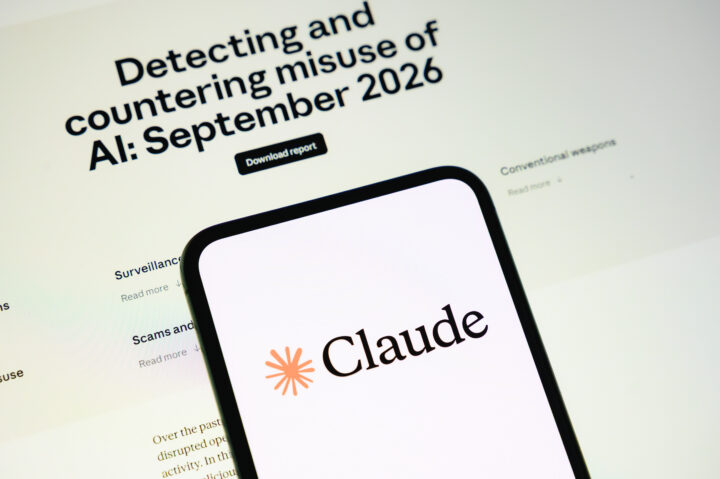
(Samuel Boivin/NurPhoto via Getty Images)
The Claude logo is displayed on a smartphone screen with the webpage of the company's report on malicious use in the background in Creteil, France, on September 11, 2026.


 Add JewishInsider on Google
Anthropic disclosed in a new report released on Thursday that it had over the past eight months disrupted efforts by Iran and other state-aligned groups and actors to use the AI giant’s artificial intelligence tools for “malicious activity” such as tracking U.S. forces, developing weapons guidance software and waging “cognitive warfare” to spread propaganda.
The 154-page report also said it had identified an “Iran-nexus threat actor” using Claude, Anthropic’s chatbot, to target “hundreds of individuals in Israel and the Jewish diaspora.” The report did not specify the purpose of the activity or confirm whether it had been disabled.
Such revelations come amid growing concerns over potential national security threats posed by burgeoning artificial intelligence tools. A researcher at Anthropic said on Tuesday that he was resigning, warning that the company and its top rival, OpenAI, were not “acting responsibly” and “gambling with our lives.”
The new risks detailed “aren’t typical misuse, but rather examples of the most notable and novel threat activity we’ve identified to date,” Anthropic clarified in its latest analysis.
The new threat report documented multiple instances in which Iran-aligned entities bypassed Anthropic’s security filters, including what the company called a “cell of threat actors” in northern Yemen — which is home to the Iran-backed Houthi terror group — that had used Claude to build guidance software for weapons including ballistic missiles.
The company said its “safeguards blocked many of their requests, but not all of them,” noting that “the actors used a variety of tactics to evade” detection.
The report revealed another so-called “Iran-nexus threat actor” that had likewise turned to Claude to target U.S. naval forces in the region using ship and aircraft transponders while compiling “vulnerability research on shipboard systems,” among other intelligence.
Anthropic confirmed it “banned the actor’s account” and “developed detections to reduce” other risks and shared its intelligence “with government authorities.”
Meanwhile, the report directly named several Iranian entities it said were running “state-aligned influence operations” using Anthropic’s tools, citing the Islamic Culture and Communications Organization, the Islamic Propaganda Organization and the Islamic Propaganda Office, the latter of which was amplifying narratives tied to the powerful Islamic Revolutionary Guards Corps, according to Anthropic.
“The people behind them were planning and prepping content to support what they called a ‘soft war’ or ‘cognitive warfare’ program,” Anthropic said. “In their own words, this was a non-military plan to shape public opinion at home and abroad.”
The company said it “banned the accounts associated with all three operations” and had shared its findings “with industry and research partners.”
In addition to the Iranian-linked threats, the report also referenced malicious accounts tied to China and Russia as well as several efforts to develop biological weapons that Anthropic said it had blocked.
The company withheld “the names of research institutions, the countries wherein the activity took place and the specific biological agents or research techniques involved,” it stated in its report, noting it was unclear if the scientists involved in the research “intended harm.”
Anthropic said that it was publishing its report “because we believe we have a responsibility to disclose malicious misuse of our services.”
“As models become increasingly capable,” the company added, “their risks will increase, unless AI developers and society’s defenders act to make them safer.”
Rabbi Mordechai Lightstone: ‘When we ascribe human attributes — emotions, consciousness and soul — to AI, we risk transforming a sophisticated instrument into an idol’
Getty Images
Illustrative
When Rabbi Joseph Potasnik, an Orthodox rabbi from Brooklyn, stepped up to the microphone in April to share his perspective on what Judaism has to say about artificial intelligence, his remarks resembled a sermon he might deliver on the bimah.
Except the audience for this talk was not congregants. It was interfaith religious leaders, and — more importantly — representatives of the Silicon Valley giants Anthropic and OpenAI.
Potasnik quoted the Book of Deuteronomy, when Moses delivers his final address to the Israelites before they cross into the Promised Land. “I call heaven and earth to witness against you today: I have put before you life and death, blessing and curse. Choose life, so that you and your offspring may live,” Moses says, channeling the words of God.
“Of course you’re going to choose life,” Potasnik said at the AI convening, comments he relayed to Jewish Insider this week. “But sometimes when you choose it, it also comes with certain dangers. If you look at the story of the Garden of Eden, for example, you are forbidden to eat of the tree of knowledge. Why? You can understand when you look at AI, because knowledge without guardrails, knowledge without a moral component, can be a very dangerous thing.”
Potasnik, who is the executive vice president of the New York Board of Rabbis, delivered this word of caution at the inaugural gathering of a new initiative called the Faith-AI Covenant, which argues that religious communities have something valuable to teach the companies developing the large language models that are reshaping the way many humans engage with knowledge and with the world around them.
A group of rabbis, educators and thinkers in the Jewish world is deeply engaged in considering related questions.
Some of them are theological, almost halachic: Should rabbis be allowed to use AI to write sermons? Can an AI chatbot be considered a havruta, or study partner, in place of an actual human? Should AI even be used for serious Jewish study?
DZ Kalman, a research fellow at the Shalom Hartman Institute who studies Judaism and technology, argued strongly against AI being used to write sermons. “I think people in religious communities would like to know that there’s at least one space in their lives when they are able to be free of machines, when they can actually just be humans interacting with other humans,” he said.
The Orthodox Union faced criticism from within its ranks after releasing a new app in March that uses AI to help people study Torah. Rabbi Netanel Wiederblank, an instructor of Talmud, halacha and philosophy at Yeshiva University’s rabbinical school, delivered a talk at YU where he criticized the app and said AI should not be used to resolve rabbinic debates.
“It’s true the OU says you shouldn’t rely on such an app for practical halacha, though one wonders what purpose there is in putting it out,” Wiederblank said.
Other questions are more philosophical in nature. How can Jewish wisdom guide people who are looking for meaning at a moment of massive technological and even societal upheaval, with the possibility of looming job loss? What is the value of God when AI comes across as all-knowing?
“We spent a few thousand years thinking really hard about what it means to be human and how to be human and how to live a purposeful life,” said Joshua Foer, the founder of Sefaria, an online library of Jewish texts. “At a moment when we’re going to be really challenged about how to be human, I think Judaism’s got a lot of compelling answers, and maybe this is the moment that we really need to stand up and be a light.”
And then there is the matter of whether LLMs should be shaped, in some way, by religion. They already are being built with certain parameters for morality.
Anthropic was created by several former OpenAI employees who were concerned about AI safety, and the company has built its brand on the idea that AI should be constructed responsibly. Anthropic employs Amanda Askell, a philosopher, to teach morality to Claude, Anthropic’s popular chatbot. In January, Anthropic published its 30,000-word “constitution” for Claude, which details how the company trained Claude and the values it hopes to imbue in the chatbot. “We want Claude to have good values,” the document states.
“A lot of people, I imagine, are very happy just to be told that they’re absolutely right, so I think that this could be an instance where potentially some Talmudic AI that’s more designed to offer a counter argument or multiple perspectives off the bat might be an interesting way to counter this default solipsism,” said Zohar Atkins, a rabbi and philosopher.
OpenAI also professes to value safety, and OpenAI founder Sam Altman told a Senate hearing in 2023 that people are “rightly anxious” about the technology. The company released a document in December described as its “model spec,” which discusses “our approach to shaping desired model behavior.” ChatGPT is taught to “love humanity,” and “humanity should be in control of how AI is used and how AI behaviors are shaped,” according to the model spec.
“All of [the chatbots] are interested in the question of how do you align the AI to not do bad things and to do good things, and then there’s obviously a lot of complexity under the hood of defining what the good is and what do you do when there’s ethical dilemmas,” Zohar Atkins, a rabbi and philosopher, told JI.
Atkins is building an AI chatbot called Yochai to help people engage with Jewish texts. Could there be a “Torah values AI,” he asked, where Jewish virtues like debate and humility are baked into the way a chatbot engages with users? He drew a contrast between that idea to the way most chatbots adopt a sycophantic approach, telling the user what they want to hear.
“A lot of people, I imagine, are very happy just to be told that they’re absolutely right, so I think that this could be an instance where potentially some Talmudic AI that’s more designed to offer a counter argument or multiple perspectives off the bat might be an interesting way to counter this default solipsism,” said Atkins.
This spring, Anthropic convened two major summits for faith leaders. The first, in March, was a two-day gathering for Christian leaders. Several weeks later, Anthropic hosted another two-day event featuring guests from several religious minorities: Confucian, Hindu, Jewish, Latter-day Saint, Sikh, Unitarian Universalist, African indigenous, Islamic and Taoist, according to Politico.
“As AI becomes more consequential for society, questions about the values and moral considerations that shape these systems are important ones, and we think they benefit from a wide range of perspectives,” an Anthropic spokesperson told Politico. (JI did not receive a response to a request for comment to Anthropic. OpenAI declined to comment for this article.)
“Increasingly powerful general purpose AI is not inevitable. It’s a choice, and moral choice as much as anything else. Just because you can build something, doesn’t mean you should build it,” said Alex Pascal, the executive director of Harvard’s Berkman Klein Center for Internet & Society and a former advisor to President Joe Biden on AI policy. “What I hope the faith leaders are communicating is that the potential impact of AI and the impact already of AI is gargantuan, and it’s really affecting almost everybody, and that the power to design and deploy the technology should not be in the hands of a very, very select few people.”
Kalman, who attended the April meeting, declined to share much, noting that it was conducted under the promise of privacy. But he described Anthropic as a new company that “has found itself with huge amounts of power and is trying to understand how to wield that power responsibly.” He entered the meeting with a good deal of skepticism, he wrote in a blog post afterward, but he left feeling hopeful.
Even if AI companies are engaging with the diverse users of their products in good faith, any guardrails placed on their LLMs come entirely at the discretion of the companies creating those products. That leads to potentially conflicting motivations — grow their product and build their bottom line, or err on the side of responsibility and safety?
“Right now, there’s gargantuan power asymmetry. It’s really a few people, at the end of the day, who are designing and deploying AI to all of us,” said Alex Pascal, the executive director of Harvard’s Berkman Klein Center for Internet & Society and a former advisor to President Joe Biden on AI policy.
“Increasingly powerful general purpose AI is not inevitable. It’s a choice, and moral choice as much as anything else. Just because you can build something, doesn’t mean you should build it,” Pascal continued. “What I hope the faith leaders are communicating is that the potential impact of AI and the impact already of AI is gargantuan, and it’s really affecting almost everybody, and that the power to design and deploy the technology should not be in the hands of a very, very select few people.”
Anthropic, for instance, recently said it would not release a new AI model called Mythos because it is too powerful, and runs the risk of severely undermining global security. But any decisions like this rest on the goodwill of the people running these companies, each of whom have their own biases and blind spots.
“The people creating this are going to introduce a certain level of their own worldview into what they’re creating,” said Rabbi Mordechai Lightstone, the director of Tech Tribe, a New York-based affiliate of Chabad Young Professionals that serves as a gathering place for Jews working in the tech sector.
Lightstone considers himself an advocate for the technology, but he has warned of the risks of putting too much faith in AI.
“When we ascribe human attributes — emotions, consciousness and ‘soul’ — to AI, we risk transforming a sophisticated instrument into an idol,” Lightstone wrote in a recent blog post. “Key to our harnessing AI is understanding it for what it is: A tool — an immensely powerful one — but not a being with a soul.”
One Jewish response to the almost-messianic belief that AI will usher in a utopia comes from Sefaria’s chief learning officer, Sara Wolkenfeld and Sam Arbesman, a scientist-in-residence at the venture capital firm Lux Capital. The pair wrote in Arc Magazine last month that a Jewish approach to AI might be rooted in the incremental approach of tikkun olam, repairing the world step by step.
They compared it to the Talmudic story of Rabbi Akiva, who “is said to have been inspired to reach for greatness after observing the power of water to wear away stone, drop by drop, as he drew water from the local well,” the Wolkenfeld and Arbesman wrote. “Therein lies the potential of artificial intelligence from a Jewish perspective — not as a far-off goal or panacea, but as a set of tools that provide each of us the means to chip away at barriers and obstacles and create an improved society.”
Last month, Pope Leo XIV released a 42,000-word document known as an encyclical that called for the safeguarding of human dignity as AI develops further and becomes even more integrated into people’s lives. Some rabbis have explored similar questions, but nothing has come close to exerting as much power or reach as the pope’s document. Some of that is by design; Judaism has no central leader of any kind. But some of it may be because many religious leaders have not fully comprehended the scope of the developing technology’s potential.
“A problem I’d say in the Jewish world right now is it’s not clear whose job it is to think about this,” Wolkenfeld told JI.
“I think the Jewish community needs to be actively grappling with a whole range of questions. What does it mean to be human? What are we outsourcing to technology versus retaining for ourselves? We’re going to be seeing massive job dislocation, and so what does that mean, first of all, socioeconomically in our communities?” Zvika Krieger, the rabbi of Chochmat HaLev, said. “Also, for so much of human history, people’s worth and their days were tied to their profession, and we’re seeing a fundamental change of how to build a meaningful life.”
Zvika Krieger is the rabbi of Chochmat HaLev, a progressive minyan in Berkeley, Calif. He does not have the typical resume for a rabbi: He was Facebook’s director of responsible innovation, and a State Department “ambassador” to Silicon Valley in the Obama administration. He now consults for Silicon Valley tech companies, including both Anthropic and OpenAI.
“Most of the leaders in the Jewish community don’t know much about AI, so it can feel like the blind leading the blind. I’m often the only person in the room for these conversations who’s actually worked in a tech company, and the knowledge gap limits how productive these conversations can be,” Krieger told JI.
He described AI as an “epochal technology that is going to fundamentally change the nature of humanity in a way that I think we haven’t seen since the printing press.”
“I think the Jewish community needs to be actively grappling with a whole range of questions. What does it mean to be human? What are we outsourcing to technology versus retaining for ourselves? We’re going to be seeing massive job dislocation, and so what does that mean, first of all, socioeconomically in our communities?” asked Krieger. “Also, for so much of human history, people’s worth and their days were tied to their profession, and we’re seeing a fundamental change of how to build a meaningful life.”
In some ways, conversations about AI are everywhere within the Jewish community — at congregations, at Shabbat dinner tables, at campus Hillels — because of how rapidly the technology has become a part of everyday life. But discussing how to best use specific tools is different than the biggest questions about life and society that AI prompts.
The Jewish conversation about AI needs to be “top-down and also bottom-up,” said Wolkenfeld. “I think every rabbi needs to be thinking about this.”
Potasnik, the New York rabbi who addressed the interfaith tech convening in April, agrees that AI is a transformative technology. But Potasnik, who is 79, remembers how other technological innovations have upended his rabbinate, too, a perspective he brings into his observations on AI.
“We used to think that the newspaper, the radio, those were the popular places for dissemination of information. Well, how many people listen to the radio for information [now]?” Potasnik said. “When I first became a rabbi, I said, ‘If you don’t know baseball, you can’t be a successful rabbi.’ Today, if you don’t know technology, you’re not going to be successful either. You’re going to be seen as ancient, not advanced.”
But Potasnik believes there is one thing that AI cannot replace that is at the heart of what it means to be Jewish.
“We have what’s called the theology of presence. You have to be present, you have to show up, that’s what people want,” Potasnik said. “I think AI cannot take that from us. We still need the human to hug, to hold. We need to see each other, listen and learn from each other. These are important, indispensable ingredients in our human relationships.”
Dario and Daniela Amodei, who are Jewish, are heading the AI giant as it sues the Department of Defense over its ‘supply-chain risk’ label

David Paul Morris/Bloomberg via Getty Images
Dario Amodei, co-founder and chief executive officer of Anthropic, left, and Daniela Amodei, co-founder and president of Anthropic, during the Bloomberg Technology Summit in San Francisco, California, US, on Thursday, May 9, 2024.
Siblings Dario and Daniela Amodei are like countless other Americans who have built a family business together. Except that the business they have built is artificial intelligence giant Anthropic, one of the fastest-growing companies in America — and in the five years since they left cushy jobs at rival OpenAI to start it, they have each amassed billions in wealth.
From the beginning, the Amodeis have said the principle driving their approach to Anthropic is safety. They think other AI companies are not paying enough attention to safety risks as the technology’s capabilities grow each day. Until now, that ethos has been a point of curiosity for the consumers playing around on the company’s Claude chatbot, and a selling point for the businesses spending large sums of money to employ Claude in enterprise settings.
But a dispute over Anthropic’s stated commitment to safety has now put the company squarely in conflict with the Trump administration. On Monday, Anthropic sued Secretary of Defense Pete Hegseth, Secretary of State Marco Rubio and several other Trump administration officials over Hegseth’s decision to designate Anthropic a national security “supply-chain risk” last month, after the company told the Pentagon that it would not allow its technology to be used for mass domestic surveillance or in fully autonomous weapons.
“I believe deeply in the existential importance of using AI to defend the United States and other democracies, and to defeat our autocratic adversaries,” Dario Amodei said in February. “However, in a narrow set of cases, we believe AI can undermine, rather than defend, democratic values. Some uses are also simply outside the bounds of what today’s technology can safely and reliably do.”
Amodei now finds himself facing off against President Donald Trump — an uncomfortable position for the CEO of a company that actively has hundreds of millions of dollars in contracts with the federal government, and that has said it wants to continue those working relationships. The complaints allege that the federal government’s actions targeting Anthropic go beyond what is legally allowed according to the supply chain statutes, and that the Trump administration is ideologically motivated in targeting Anthropic. (A Department of Defense spokesperson has said the organization does not comment on ongoing legal matters.)
Defense Secretary Pete Hegseth is “within his right to cancel the contract. But I think that the people in the Department of War, they’re trying to turn the screw. They’re trying to make it tough for Anthropic to survive,” Will Rinehart, a senior fellow at the American Enterprise Institute who researches tech policy, told Jewish Insider. “It’s one thing to say, ‘Hey, we no longer want to work with Anthropic.’ But it’s quite different to basically use this supply-chain risk designation and to then go after Anthropic, because that [designation] was developed to be basically weaponized against China.”
Dario and Daniela Amodei grew up in San Francisco with parents who wanted them to be engaged with the world. Their mother, Elena Engel, is Jewish, and she worked to build libraries in the Bay Area. Their father, Riccardo Amodei, was a leathersmith from Italy.
“They gave me a sense of right and wrong and what was important in the world,” Dario Amodei told journalist Alex Kantrowitz in 2025. They “imbu[ed] a strong sense of responsibility.”
Amodei initially went into the hard sciences. He went to college at Caltech, where he authored a memorable op-ed in the campus newspaper calling on his fellow students — including in the sciences — to be more engaged with world politics, and in particular to speak out against the Iraq war.
“We are distracted not by the sex scandals and sensationalism of the rest of the world, but by problem sets, computer games and bizarre arguments about the availability of donuts. We, who have so much power to influence the future, have bafflingly renounced our right to it,” Amodei wrote in 2003. “We have the privilege and duty to preserve the ethical integrity of our community, our nation and humanity.”
It’s an ethos he brought with him when he transferred to Stanford, and then to Princeton, where he earned a PhD in physics. Early in his career, he began working on AI technology. He worked as a deep learning researcher at Google, before spending nearly five years at OpenAI, rising to become its vice president of research.
Daniela Amodei, meanwhile, did not come from the STEM world. She worked in politics for a period, first on the campaign and then in the congressional office of former Rep. Matt Cartwright (D-PA). Then she worked for the payments company Stripe before joining OpenAI two years after her brother.
Over time, after raising concerns about the likely impacts of AI, Dario Amodei decided that the leaders of OpenAI were not taking his critiques as seriously as he hoped. So he and Daniela left the company to start Anthropic, where he is CEO and she is president.
Since then, Anthropic has been wildly successful. It launched Claude a year after OpenAI launched ChatGPT, which was the first time most people outside of the tech world began to use and understand generative AI. And while Claude has a fraction of the active users as ChatGPT, the company primarily focuses on selling its technology to businesses.
Even as Claude has grown, the Amodei siblings still talk about the potential dangers of AI. Dario Amodei famously said in 2025 that the tool could erase half of all entry-level white collar jobs in the next five years.
“I’m incredibly optimistic about the technology,” he said in December. “But nothing that powerful doesn’t have a significant number of downsides.”
Anthropic has framed itself as an advocate for greater safeguards on the technology. Amodei came to Washington in September to speak about the topic as the company doubles down on its lobbying efforts. The group plans to donate $20 million this year to congressional candidates who want to regulate the AI industry — via a political group that was created in direct opposition to fundraising efforts being supported by OpenAI.
“We’ve seen lots of bad things: We’ve seen teenagers being driven to commit suicide by LLMs,” Amodei said. “We can imagine much larger-scale catastrophe. So the thing we’ve always advocated for is basic transparency requirements around models.”
For a company that is so upfront about its values, a test of those battles was inevitable. But no one expected the foe to be the Pentagon.
The ADL ranked the leading large language models based on their ability to identify and counter ‘anti-Jewish’ and ‘anti-Zionist’ theories

Philip Dulian/picture alliance via Getty Images
Several AI applications can be seen on a smartphone screen, including ChatGPT, Claude, Gemini, Perplexity, Microsoft Copilot, Meta AI, Grok and DeepSeek.
Anthropic’s artificial intelligence system is strongest at detecting bias against Jews and Israel compared to its competitors, according to an evaluation of the leading large language models published by the Anti-Defamation League on Wednesday.
In its first-ever AI index, the ADL evaluated how six models responded to antisemitic and extremist content, based on more than 25,000 LLM chats, 37 topical sub-categories and assessments conducted by both human and AI evaluators.
The index broke antisemitism into subcategories: “anti-Jewish,” which includes classic antisemitic tropes, as well as “anti-Zionist,” which analyzes antisemitism that targets Zionists or Zionism. Another category, “extremist,” looked at how LLMs engage with biases, narratives and conspiracy theories, which sometimes overlap with antisemitism. Models were generally better at identifying and discrediting tropes such as “Jews control the media” than anti-Zionist content or extremist theories.
The index assessed OpenAI’s ChatGPT, Anthropic’s Claude, the Chinese model DeepSeek, Google’s Gemini, xAI’s Grok and Meta’s Llama.
Claude received the highest overall score (80 out of 100) in detecting and responding to anti-Jewish and anti-Zionist theories. Across a range of testing methods, Claude responded that statements it was asked to analyze “contain antisemitic conspiracy theories and historically inaccurate claims.”
ChatGPT ranked second with a score of 57. Grok came in last among the models tested, with a score of 21.
Still, every AI model tested demonstrated at least some gaps in addressing bias against Jews and Zionists and all struggled with extremist content.
“When these systems fail to challenge or reproduce harmful narratives, they don’t just reflect bias — they can amplify and may even help accelerate their spread,” ADL CEO Jonathan Greenblatt said in a statement. He called on AI companies “to improve their detection capabilities.”
“While one model performed better than others, no AI system we tested was fully equipped to handle the full scope of antisemitic and extremist narratives users may encounter. This Index provides concrete, measurable benchmarks that companies, buyers, and policymakers can use to drive meaningful improvement,” said Oren Segal, ADL’s senior vice president of counter-extremism and intelligence.
The research follows several recent studies from the ADL scrutinizing extremist content generated by AI models. In December, it published a study that found that several leading AI LLMs generated dangerous responses when asked for addresses of synagogues and nearby gun stores.
ADL conducted research for the index between August and October 2025. The antisemitism watchdog said it selected models from leading LLM companies that were most widely available at the time of testing. Testing was designed to reflect how average users — not bad actors — interact with AI systems in realistic scenarios. Models were tested across five interaction types: survey questions, open-ended prompts, multi-step conversations, document summaries and image interpretation.
Please log in if you already have a subscription, or subscribe to access the latest updates.
 Continue with Google

 Continue with Apple