














































































Reshef, an Oklahoma native, said her time growing up in the close-knit Oklahoma City Jewish community played a major part in her identity
Courtesy
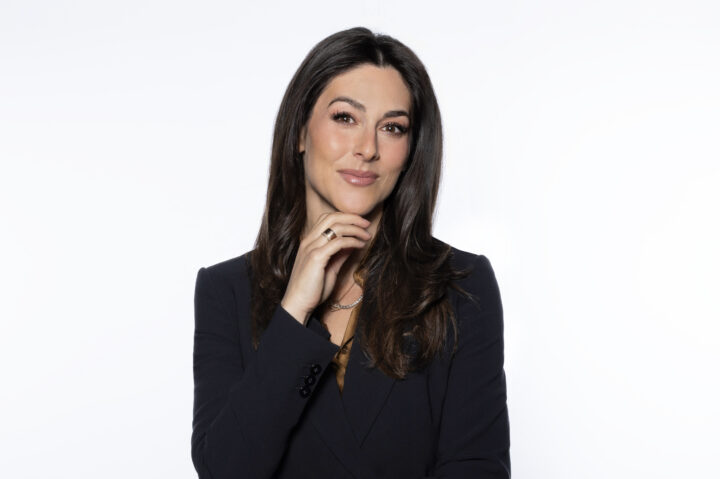
Erielle Reshef


 Add JewishInsider on Google
MS NOW anchor Erielle Reshef never planned to become a television journalist. After completing a master’s degree in diplomacy and conflict studies in Israel in 2010, she happened to be watching an English-language news program whose anchors were about to go on maternity leave. Her husband wrote down the email address on the screen and pushed her to apply.
Reshef, who had never worked in a newsroom or even read from a teleprompter, went in for a screen test. She was hired by the now-shuttered IBA English News, Israel’s Channel 1, the next day.
That chance opportunity launched a career that has taken Reshef from her hometown of Oklahoma City to local television, international news and eventually ABC News, where she spent eight and a half years, including as a national correspondent. Already accomplished in her career — having been one of the first reporters on the scene at the 2018 Tree of Life synagogue massacre in Pittsburgh — Reshef made another major leap last June.
She left the relative comfort of a network news reporting job to join MS NOW, formerly known as MSNBC, where she is now a fill-in anchor for daytime cable news shows for the first time. Along the way, her upbringing in a small but tight-knit Jewish community, her Israeli family ties and her years living in Israel have remained central to how she understands both the world she covers and her role as a journalist.
For Reshef, 42, those identities don’t conflict with journalism but are part of what she brings to the job. In an interview with Jewish Insider, Reshef said her Jewish values — particularly curiosity, rigorous debate and a commitment to understanding people on the margins — are the “scaffolding” of her journalism.
Reshef began reporting in Israel after she received a master’s degree from Reichman University in Herzliya. In her first newsroom job at IBA English News in Israel, where she covered the upheavals of the Arab Spring, Reshef reported from the Gaza border and anchored the night Egyptian President Hosni Mubarak was deposed.
But before she lived in Israel, where her father is from, her roots were planted in Oklahoma City, where Reshef was raised and where she later returned to report (reporting that won her a Heartland Emmy in 2017). Living in Oklahoma — and being part of a smaller Jewish community — deeply shaped her identity as a journalist, Reshef told JI.
“There’s nothing quite as special as being able to come back to your hometown and be a local journalist,” said Reshef. “I felt incredibly fortunate to be able to dig into the stories that really matter to the people that I grew up with. As far as being a Jew in Oklahoma City, it’s a small but mighty community. My mother was the head of the Jewish federation for several decades. I felt like the fact that it was a small Jewish community set me up to really understand my own faith and traditions in order to be able to explain those to my friends around me who had never been exposed to Jewish life.”
Those instincts now inform how Reshef approaches her newest professional chapter at MS NOW, a network whose audience skews progressive at a moment when such spaces have become increasingly critical of Israel. Since joining MS NOW last year, Reshef has sat behind the anchor desk across many of the network’s programs, including anchoring “Money, Power, Politics with Stephanie Ruhle,” “On The Line with Alicia Menendez,” “MS NOW Reports” and “The Moment with Katy Tur.”

Reshef does not view her background as something she needs to soften or hide. Instead, she told JI that her intimate knowledge of the region is an asset in a newsroom — while emphasizing that her ultimate obligation is to facts, rather than to a particular political or national perspective.
“I won’t hide my identity,” she said. “It’s a benefit in a newsroom to have someone like myself who has intimate knowledge of the conflict through my education and through living in the Middle East, living in Tel Aviv, and experiencing the realities on the ground and forging friendships with not only Jewish Israelis but Palestinians and Arab Israelis. The most important thing to me in the pursuit of journalism is truth and fact. Any concerns that I may have had post-Oct. 7 with editorial approaches or coverage, whether it be at my previous network or current, have not been because I’m Israeli or Jewish — it has to do with being a journalist that’s committed to facts.”
“I will allow the values of Judaism and the traditions and familial ties to guide my humanity in this business but ultimately I’m a journalist that’s committed to fact and truth,” she continued.
Reshef arrived at MS NOW as the network underwent a name rebrand last year under its president, Rebecca Kutler. Kutler said at the time that the network’s focus on news and commentary with a liberal perspective would remain intact.
“I find MS NOW to be a place where — yes, there are progressive voices — but a place that’s tethered to facts,” Reshef said. “Separate from that idea, I think it’s vital that we stay in the room and don’t retreat from places where we think we don’t have favor.”
“It’s fun to be part of a dynamic, ever-changing company in the context of a shrinking media landscape,” she added.
Reshef said her reporting has been met with broad audience approval.
“There’s a preconceived notion that people are inherently adversarial. What I’m finding is people want to find common ground. Part of my job is to challenge assumptions that are widely held but are not rooted in fact. When I do that, I have never experienced direct pushback in the newsroom.”
Online, her experience has sometimes been different. “For instance I covered the terror attack [in March] on a school and synagogue in Michigan — and in the week of that, I experienced vitriol online labeling me with all kinds of stereotypes, solely on the basis of who I am. That is an online reality so many journalists, and so many industries, face.”
Reshef has also earned strong praise from her colleagues. Scott Matthews, SVP of newsgathering for MS NOW, told JI, “Erielle is a natural storyteller. Her roots in local journalism show in the care she brings to each assignment, she gets close to the story, listens carefully, and never loses sight of the people at its center.”
Since the Hamas-led Oct. 7, 2023, attacks in Israel, Reshef has not only balanced her identity in the newsroom but also had to navigate the realities of raising two Jewish boys, ages 11 and 7, in New York City. A self-described “fiercely protective Jewish mom,” Reshef said she feels a responsibility to “raise my boys to develop the mental fortitude to be true to who they are, to do what is right and stand in their convictions, but they also have to have the knowledge to back up their beliefs and practices.”
“That’s a metaphor and parallel to how I see my responsibility in journalism,” she added. “It should be a net benefit to bring Jewish values and a Jewish voice to the newsroom, while also keeping an open mind and recognizing that we can all stand to learn from each other.”
Reshef describes her career story as a “tale of being nimble”: starting with covering the World Cup on Israeli television without ever having watched soccer, to now anchoring on cable news.
“It’s been great, at my career stage, to be tackling a steep learning curve and to be constantly absorbing more information and to be voraciously consuming news again in a unique way,” she told JI.
“Personally, I could have been very comfortable staying where I was,” Reshef said. “I was appreciated at ABC News. I had a great job. But I sensed in myself the fire to keep growing and to overextend myself. I’ve never been one to shy away from challenges. But it was tough to jump ship from a place that was comfortable after eight and a half years. The risk was well worth it, it has been incredibly rewarding.”
Eisen, who has been moderating panels at the Milken Institute conference, said the rise in anti-Jewish hate has been the ‘sideline conversation’ all week
Daniel Zuchnik/Sportico via Getty Images
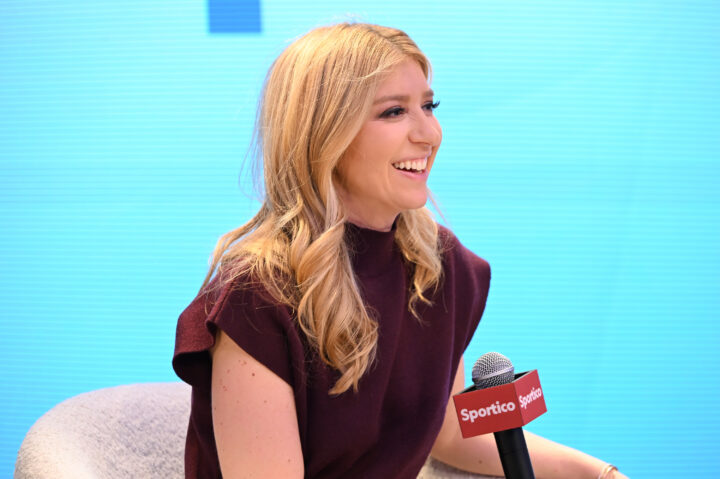
Sara Eisen at Sportico Invest in Sports New York 2025 at Nasdaq HQ on Nov. 4, 2025 in New York.
LOS ANGELES — CNBC anchor Sara Eisen is a fixture at the annual Milken Institute Global Conference in Los Angeles, where she moderates marquee events, such as a one-on-one interview on Tuesday with Ken Griffin, CEO of the hedge fund Citadel.
But the real reason that Eisen — along with scores of billionaire investors and business executives — comes to Beverly Hills for the exclusive annual gathering is for the conversations happening far from the main stages. And much of the conversation Eisen is hearing this week, she told Jewish Insider, has to do with the dramatic rise in antisemitism in recent years.
“To a large extent, I reflect a lot of what the sources that I speak to [say]. That’s investors, and it’s business leaders, and it’s private equity leaders,” Eisen said in an interview during the conference, after she wrapped up moderating a conversation with the CEO of Carlyle, the co-president of Morgan Stanley, the chairman and CEO of State Street and the CEO of the California Public Employees’ Retirement System.
“A lot of these people, Jewish and non-Jewish, talk to me about it. They know about my background. They know my perspective. They see what’s happening in the political world. They see what’s happening in geopolitics,” she continued. “This is the sideline conversation.”
The issue isn’t new for Eisen. Her grandfather was a Holocaust survivor, and he talked openly about his experiences. “I have always been someone with a really strong Jewish identity,” she said. But something began to change for her after the Oct. 7, 2023, Hamas attacks in Israel, and it seeped into her professional work.
“I think for a lot of us, after Oct. 7, it was a wake-up call that we need to speak out more about these issues. I try to use my platform to bring awareness and education to issues like antisemitism, because I care about it,” said Eisen.
During a guest appearance on “The View” in March, she criticized former Trump administration official Joe Kent, who resigned from his position as director of the National Counterterrorism Center in March, for blaming Washington’s war with Iran on Israel.
“It is a very old-school, antisemitic trope to blame the Jews and to blame Israel. It’s as old as time,” Eisen said on “The View.” “It is a classic case of quintessential antisemitism, and by the way it is a dangerous time to do that because the Jews are under attack, and we’re fortifying our synagogues and our schools.”
In an April interview with Sen. Elizabeth Warren (D-MA), Eisen pressed Warren on her support for Maine Senate candidate Graham Platner, despite the fact that the Democrat had a tattoo of a Nazi symbol and praised military tactics used by Hamas. “I’m just curious why you think he’s your ‘kind of man,’” Eisen said, referencing Warren’s description of Platner at a recent campaign event.
Warren defended Platner, noting that he apologized for the tattoo and his history of insensitive remarks. Eisen drilled down on Platner’s praise of Hamas tactics: “You guys want to be the party of inclusivity, right?”
“I want to be the party that stands up for hard-working people,” was Warren’s response. “I want us to be the party that actually delivers on lowering costs and that expands opportunities, and that’s what Graham Platner wants to do, and I’m there to stand with him and to help in that fight.”
Eisen is known as a no-nonsense TV anchor with an occasional snarky streak and an aptitude for finance and economic trends. She covers the news, and lately, she sees antisemitism in the headlines — and feels a particular obligation to cover it.
“I think that the world’s changed,” Eisen said. “There is now this raging outburst of antisemitism, and it’s a societal issue, and I have a background and a perspective on it. And I think it feeds directly into stories we’re doing about the economy and society and geopolitics.”
Reporters, Eisen argued, should not pretend they do not have backgrounds that affect the issues they cover. For her, that means talking about being Jewish, and spotlighting the rise in antisemitism. It stands out at a time when questions like the ones she asked Warren are not necessarily echoed by other top reporters at national outlets.
“As journalists, we’re also people. We have families, we have religions, we have backgrounds, we have history. I try not to inject those opinions, but I do think perspective matters,” she said. “Nobody wants to be interviewed by robots.”
The result is even more social media vitriol than she has always received as a prominent media figure. Only now, it’s antisemitic.
“I feel the heat, and that’s definitely a calculated risk, and it’s unfortunate and it’s unpleasant,” said Eisen. “But I also feel like if, if we’re not asking these questions and we’re not speaking up about these issues, then then nobody will. So we need to.”
Please log in if you already have a subscription, or subscribe to access the latest updates.
 Continue with Google

 Continue with Apple