












































































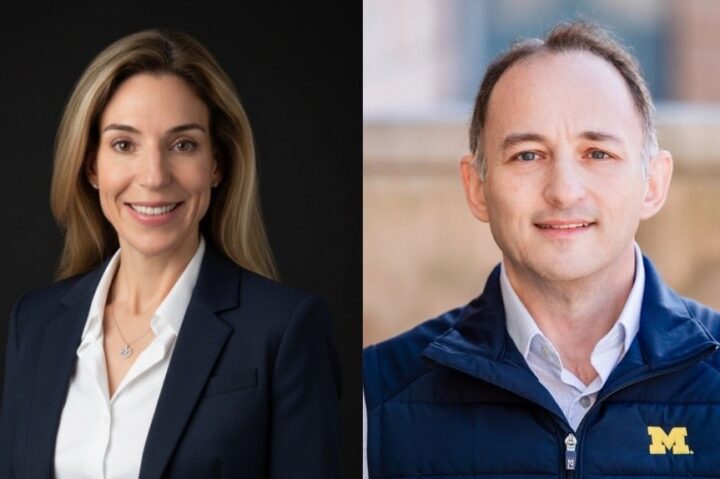
Republican nominees Lena Epstein and Michael Schostak, who both identify as Jewish, told JI they’re campaigning on fighting antisemitism at the school
Campaign website
Lena Epstein and Michael Schostak


 Add JewishInsider on Google
Michigan’s statewide election for two seats on the University of Michigan Board of Regents — the body that governs the state’s flagship university — has become a surprisingly contentious race in a swing state full of high-profile match-ups.
After Amir Makled, a trial attorney with a history of antisemitic and pro-Hezbollah social media posts, unseated incumbent Regent Jordan Acker at the Democratic Party nominating convention last month, the two Republican candidates running for the board see an opening to pitch themselves to Democrats and Independents.
Acker, who is Jewish, had spoken out against efforts to divest Michigan’s endowment from Israeli companies, and faced antisemitic harassment from pro-Palestinian campus activists, while Makled has promoted efforts to boycott Israel. (Acker and Brown campaigned together during the primary, but Acker did not respond to a request for comment about who he’s backing in the general election.)
Lena Epstein, an oil executive who chaired President Donald Trump’s campaign in Michigan in 2016 before running for regent, told Jewish Insider in a recent interview that reaching disaffected Democrats who are upset about Makled’s place on the ticket is a priority for her.
“There are the individuals that believe that I’ll be a fabulous regent and really great at the job and able to effect positive change over these next eight years, and for the long term,” said Epstein, who also ran for the board in 2022 and narrowly lost. “Then there’s the other folks that simply don’t want the other gentleman who is nominated to win, and we accept support from Democrats, independents and Republicans.”
Epstein has an MBA from Michigan, as does the other Republican on the ticket, Michael Schostak, the treasurer of Bloomfield Township, a Detroit suburb. Schostak told JI in an interview that since Makled’s nomination, Michigan alumni around the country who are now closely following the race have been calling him.
“They care about their alma mater and they want to make sure that it stays in good hands, and they’re very concerned about what they’ve seen from Amir Makled,” Schostak said. “I’m not running to be the Jewish candidate. I am Jewish, but that’s not why I’m running. I got into this race eight months ago because I cared about affordability of tuition and college costs.”
The two regents who are elected this November to serve on the eight-person board will join an ongoing search for a new university president following a tumultuous few years for Michigan, one of the top public universities in the country — and the school with the fifth-largest Jewish student population, according to Hillel International.
Both Schostak and Epstein identify as Jewish, though Epstein has at times described herself as a messianic Jew, meaning she believes in the divinity of Jesus. For that reason, the mainstream Jewish community considers messianic Jews to be Christian. She recently told the Forward that she is “100% Jewish,” and that her family belongs to a Reform synagogue in Bloomfield Hills.
Both Republicans say fighting antisemitism is a priority for them if elected to the board of regents.
“Antisemitism should never be minimized, normalized or explained away. Jewish students deserve the same protection and dignity as every other student on campus,” Epstein said. “One of the most troubling failures that we’ve seen at the University of Michigan is the hesitation to call antisemitism what it is.”
Schostak recalled conversations with Jewish students who were afraid to wear Star of David necklaces on campus or scared to walk to class during the anti-Israel encampments two years ago.
“I felt terrible, just sick to my stomach for the Jewish students on campus who had to live through that, and the pro-Israel students. There are a lot of pro-Israel students who are not Jewish,” said Schostak. “We’ve got to acknowledge them, who felt like they couldn’t express themselves because they were going to be harassed or followed or shouted at, or whatever, and the fact that all this was going on, the encampments, and people felt like it wasn’t safe.”
Both candidates said the university did a poor job of handling the firestorm of campus events in the 2023-2024 school year after Hamas’ Oct. 7 attacks and called for more clarity about rules surrounding campus protests.
“When it comes to protests on campus at U of M, peaceful protest has been a very long-standing tradition at this fine university,” said Epstein. “Students have every right to speak out. Students do not have the right to make other students feel unsafe walking to class. A university simply can’t function if rules are enforced selectively, depending on politics.”
Schostak and Epstein said they will emphasize support for free speech across all viewpoints at a school where they think intellectual diversity is lacking. But the response to anti-Israel protests, even hateful ones, cannot be shutting all protests down, according to Shostak.
“Free speech to me is very important, and they have the right to protest and make noise, as long as they don’t disrupt the university’s business,” said Schostak. “What I would tell the Jewish and pro-Israel students is, ‘Look, you need to be just as vocal in your beliefs and standing up for Israel and standing up for the Jewish people as they are standing up for the Palestinian people.’”
After a Michigan professor delivered an anti-Israel speech at commencement this month, Epstein and Schostak released a joint statement questioning the choice of the professor, Derek Peterson, as a speaker and criticizing his rhetoric. “There is a time and a place for emotionally charged debate. A commencement ceremony is not it,” they wrote.
Makled and Paul Brown, the other Democratic nominee who was first elected to the board of regents in 2018, have both criticized President Donald Trump’s approach to higher education, and pledged to push back on funding cuts where possible. Schostak expressed concern about the cuts as well, while noting that the regents should encourage the university to work to not get additional funding cut off.
“I am concerned,” Schostak said. “The university is going to have to tap dance around that to make sure that they abide by all the rules to make sure that our research funding isn’t cut off or any of our other funding isn’t cut off.”
Epstein has declined to say much on the issue. When asked about Trump’s adversarial approach to universities, she pointed out that Michigan is a public institution.
“We do accept public funds, and we do work in concert with the government based on those financial dynamics,” she said. “With that said, I believe that the University of Michigan should be an autonomous organization.”
Both candidates understand that to the extent to which Michigan voters are even paying attention to the race, most will not make a decision based on issues related to Israel or campus protests. So their focus remains on issues like college affordability and job opportunities.
“[Voters] care about sending their kids to college, being able to afford to pay for it, having their kids stay here when they graduate, so that we can provide an environment where they can thrive,” said Schostak. “That’s what they care about, and those are the issues that I’m going to be speaking to.”
‘I’m going to have a problem with any candidate — Democrat, Republican or independent — who shares antisemitic and hateful posts on social media,’ the Michigan senator said
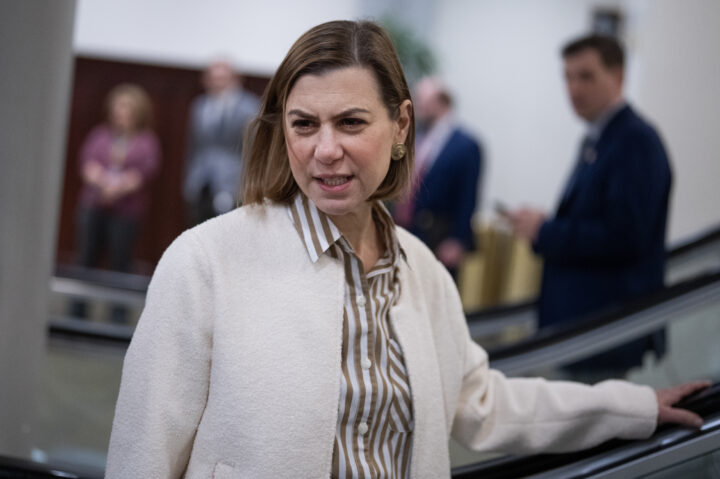
Tom Williams/CQ-Roll Call, Inc via Getty Images
Sen. Elissa Slotkin (D-MI) is seen in the U.S. Capitol on Thursday, March 26, 2026.
Sen. Elissa Slotkin (D-MI) joined other Michigan Democrats in condemning Amir Makled, a Democratic nominee for regent of the University of Michigan, over Makled’s past comments on social media expressing antisemitic sentiments and support for terrorism.
“I’m going to have a problem with any candidate — Democrat, Republican or independent — who shares antisemitic and hateful posts on social media. Especially when they refuse to disavow those comments or show remorse,” Slotkin said in a statement to Jewish Insider on Thursday, in response to a question about Makled.
Makled was nominated for the post at the Michigan Democratic Party convention last weekend, replacing Jewish and pro-Israel regent Jordan Acker, who has been repeatedly harassed and has had his home vandalized by anti-Israel campus activists.
The convention, which also featured aggressive heckling of pro-Israel speakers, has left prominent Jewish Democrats in the state feeling alienated and unmoored from their party.
Rep. Kristen McDonald Rivet (D-MI) similarly criticized Makled, and Sen. Gary Peters (D-MI) more broadly criticized the behavior of activists at the convention.
Dearborn attorney Amir Makled will proceed to the November general election, replacing Jordan Acker
Jose Juarez/AP
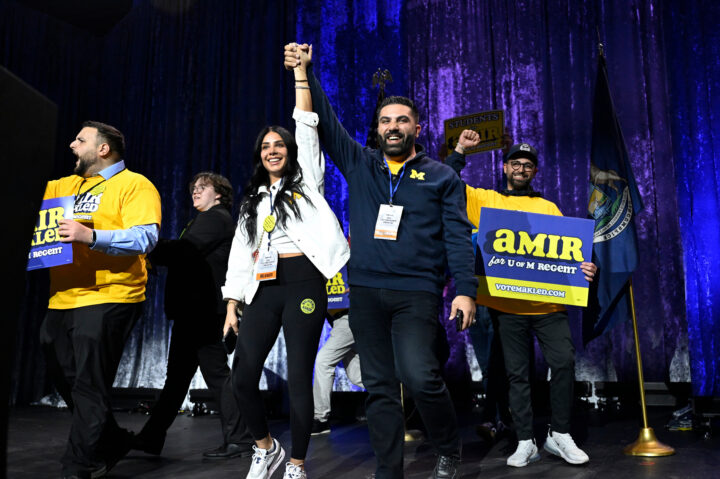
Amir Makled, right center, a candidate for the University of Michigan Board of Regents, walks with his wife, Nassrine Gomah Makled, after winning the party's nomination during the Michigan Democratic Party State Endorsement Convention, Sunday, April 19, 2026, in Detroit.
Michigan Democrats on Sunday nominated insurgent candidate Amir Makled, an anti-Israel attorney, for the University of Michigan Board of Regents over incumbent Jordan Acker, a Jewish regent who had been targeted by far-left activists over his support for Israel.
Acker was actively campaigning for reelection alongside Paul Brown, both of whom were first elected in 2018. But only Acker was targeted by Makled’s backers, even though both Acker and Brown had supported disciplining anti-Israel student activists and opposing efforts to divest from Israel. Brown was also nominated by the Democratic Party on Sunday, and he and Makled will now advance to the November general election.
The positions are statewide elected offices, and regents are tasked with governing Michigan’s flagship public university. Two of the board’s eight seats are up for election this November.
Makled has argued in his campaign that the university should divest from Israel. A trial attorney based in Dearborn, Makled previously represented a University of Michigan student who was arrested during the 2024 anti-Israel encampment.
He faced criticism earlier this month after the Detroit News documented Makled’s history of sharing pro-Hezbollah and antisemitic tweets, which he has since deleted but not addressed. Those revelations prompted SEIU, the labor union, to pull their endorsement of Makled.
In 2024, Acker’s home was targeted by anti-Israel activists on multiple occasions in incidents that university leadership and Michigan politicians described as antisemitic.
Amir Makled, who is hoping to unseat Jewish regent Jordan Acker, was found to have praised Hezbollah in deleted social media posts

Bill Pugliano/Getty Images
Students walk across the University of Michigan campus in Ann Arbor, Michigan.
The Michigan arm of the powerful SEIU labor union announced on Tuesday that it had rescinded its endorsement of Amir Makled, an attorney running for the University of Michigan board of regents, in light of Makled’s deleted social media posts praising the terrorist group Hezbollah.
“This decision follows new information that was not available at the time our endorsement was made,” the statement read. “As an organization, we hold our endorsed candidates to a high standard and expect alignment with our values and the interests of our members.”
Makled is a Dearborn trial lawyer who represented an anti-Israel protester who was arrested during the 2024 anti-Israel encampments at UM’s flagship Ann Arbor campus. A Detroit News report found that Makled had deleted posts praising Hezbollah’s leaders and retweets of antisemitic messages from the far-right influencer Candace Owens. Makled did not comment on the matter in the Detroit News report, and he did not immediately respond to a request for comment from Jewish Insider on Tuesday.
Makled is running an insurgent campaign to be one of two Democratic nominees for UM regent. Two seats are up for election in 2026, and both of them are held by Democrats — Jordan Acker and Paul Brown — who were first elected in 2018. Makled is singling out Acker, who is Jewish and has faced antisemitic attacks from anti-Israel activists at the university. The regents play a key governing role for the university, including on matters including student protests and divestment.
The two Democratic nominees for the statewide position will be decided at a Michigan Democratic Party convention in Detroit on April 19.
Please log in if you already have a subscription, or subscribe to access the latest updates.
 Continue with Google

 Continue with Apple