










































































Kaploun said countries including the Dominican Republican, Colombia, Guatemala, Paraguay, Costa Rica and Chile are all considering adopting the definition
Emily Jacobs
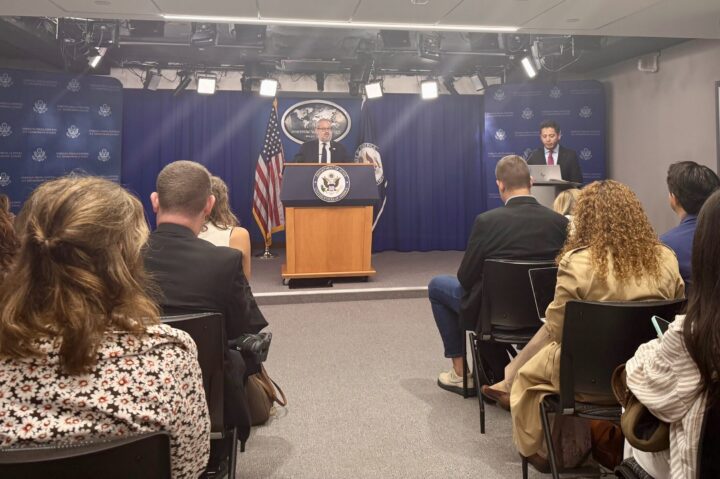
Amb. Yehuda Kaploun speaks to the press at the State Departmnet on Oct. 5, 2026.


 Add JewishInsider on Google
Ambassador Yehuda Kaploun, the State Department’s antisemitism envoy, revealed on Monday that the U.S. expects several Latin American countries to adopt the International Holocaust Remembrance Alliance’s working definition of antisemitism in the coming months.
Kaploun made the comments at a press conference about the Trump administration’s efforts to combat antisemitism ahead of the third anniversary of Hamas’ Oct. 7, 2023, attacks on Israel, after being asked to analyze how regional leaders have responded to the rise in anti-Jewish hate.
“There’s a conference in November where we expect to have more Latin American countries to join the IHRA Accords,” Kaploun said. “The Dominican Republic just announced that they’re joining the IHRA Accords. Colombia is revisiting that. Guatemala, Paraguay, Costa Rica, Chile are all in discussions. This is a chance to have a transformative region where people are united against hate.”
“As we say in our office, and we say this often, a country is judged by how it makes citizens feel welcome, how it protects its citizens,” he added. “That’s the first and foremost duty of every single country: Protect your own citizens. That includes the Jewish community, and some countries are failing miserably in that.”
Critics of the IHRA definition say it stifles political speech by designating it as antisemitism.
Kaploun pointed to Argentina’s embrace of Israel under President Javier Milei, noting that the Argentine leader spearheaded the Isaac Accords initiative with Israeli Prime Minister Benjamin Netanyahu earlier this year aimed at boosting ties between Israel and Latin American countries. He also mentioned the pro-Israel shift taking place in Colombia after President Abelardo de la Espriella, a conservative, was sworn in last month.
“You see how a country can transform itself to positive actions. You see how a country, with the right leadership, is able to stand up and confront hatred,” Kaploun said. “Latin America is transforming right before our eyes.”
“You see a country like Argentina, that 32 years ago had bombings that were done by Iranian terrorists to the Israeli Embassy and a Jewish community center, and now you see Jews have no fear in the street and people are walking with respect and dignity,” he continued, referring to the AMIA bombing, the deadliest terror attack in Argentine history.
“Colombia, just two months ago, changed their leadership. At the same time, they’ve restored relations with Israel. They’ve restored much better relations within the Jewish community there in Colombia. They’ve made it very, very clear that Colombian Jewish community members are welcome, which wasn’t always the case in the previous administration.”
The comments, made last month at the annual board meeting of the Claims Conference, have left experts in the field dubious, given complex diplomatic hurdles
Marc Rod
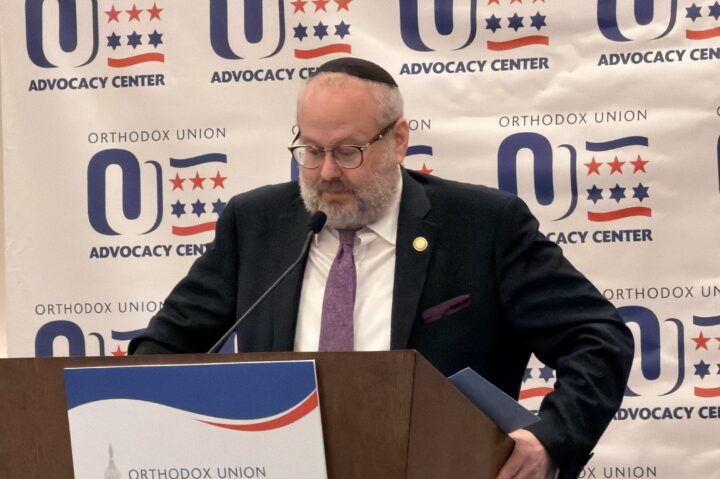
Ambassador Yehuda Kaploun, the Trump administration’s special envoy to monitor and combat antisemitism, speaks at an Orthodox Union conference, June 22, 2026
Ambassador Yehuda Kaploun, the State Department’s antisemitism envoy, said last month that he would be able to resolve all remaining Holocaust restitution issues within the next two and a half years, before the end of the Trump administration, two sources with knowledge of the remarks told Jewish Insider.
The assertion — made during the July annual meeting of the board of the Conference on Jewish Material Claims Against Germany, better known as the Claims Conference, in New York last month — has left experts in the field skeptical. The U.S. has been pursuing Holocaust restitution issues for decades.
The comments also come amid deliberations inside the State Department over the potential merger of the office of the State Department’s special envoy for Holocaust issues, who has historically been the U.S. lead on Holocaust restitution matters into Kaploun’s office. Those efforts at consolidation have divided Jewish community organizations.
Kaploun, in a speech, told attendees at the Claims Conference meeting that because of his contacts and connections, he personally, in cooperation with others in the Trump administration, would be able to resolve the long-standing diplomatic struggles that have hampered restitution efforts.
A State Department spokesperson emphasized the administration’s commitment to Holocaust-related issues.
“The Administration is committed to holding governments accountable for failures to return or provide restitution or compensation for Nazi-stolen assets,” the spokesperson said. “The Administration continues to advance this commitment, including through efforts to combat antisemitism and address Holocaust-era issues.”
The spokesperson noted that Kaploun, since taking office, had secured Armenia and several Latin American governments’ willingness to join the International Holocaust Remembrance Alliance, attended memorials at the Jasenovac concentration camp and Donja Gradina memorial and spoke at the March of the Living.
“Secretary Rubio has been clear: 81 years is too long to achieve a measure of justice for the victims and their families,” the spokesperson continued. “Around the world, Ambassador Kaploun continues to reiterate [the] unprecedented commitment of the Trump Administration to these issues.”
But in the room, the comments were met with skepticism.
“The tone … was basically, ‘I’m coming in, and I know what needs to be done, and I’m going to do it my way despite whatever anybody else feels or does because I have the backing of the administration,’” one source, granted anonymity to speak candidly about the meeting, explained.
The individual said that the comment “surprised” many people present.
“These are thorny issues that people have been working on for decades. We all wish that progress would be very fast, but there are complicated political, legal, economic and moral issues that sometimes require a lot of negotiation, a lot of research,” the source said, “not necessarily things that could be done in a matter of months.”
A second individual, also granted anonymity, said that the comments were met by the Claims Conference meeting attendees with “a large amount of eye-rolling,” skepticism and general dismissal.
In a statement to JI, Mark Weitzman, chief operating officer of the World Jewish Restitution Organization, the leading organization in the Jewish world overseeing restitution issues, thanked the administration for its focus on Holocaust restitution issues.
“We very much welcome the continued commitment from the US Administration to treat Holocaust restitution as a top and urgent priority. As survivors pass away, time is not on our side,” Weitzman said.
Claims Conference President Gideon Taylor offered similar sentiments.
“The renewed commitment from the Administration to put its full weight behind outstanding restitution issues is critically important,” said Claims Conference President Gideon Taylor.
Michael Bazyler, a law professor focused on Holocaust and human rights at Chapman University who has worked for years on Holocaust restitution issues, explained to JI that Poland has been the biggest remaining obstacle to such efforts, as it is the only EU country that hasn’t passed a law setting out procedures for restitution, despite facing pressure to do so.
Survivors have sought restitution through the Polish court system but have been consistently rejected, Bazyler said, even when providing comprehensive documentation.
During President Donald Trump’s first term, Secretary of State Mike Pompeo raised the issue while in Poland and Congress passed the Justice for Uncompensated Survivors Today Act, leading to a State Department report that spotlighted issues with Poland.
Secretary of State Marco Rubio, who at the time was serving in the Senate, was one of the lead sponsors of the JUST Act and a prominent advocate on the subject of Holocaust restitution while he was on the Hill. He also led a letter while in the Senate calling on Poland to pass legislation to create a restitution mechanism.
The State Department spokesperson highlighted Rubio’s work and focus on the issue, noting that he has said in the past, “We must fight for justice and restitution and ensure that the truth of the Holocaust is taught to every generation.”
The U.S. has sought for years, under successive administrations, to exert diplomatic pressure on Poland to create a restitution process, but Poland has had “absolutely no interest” in doing so and sees no “reason … to do this right now,” Bazyler said.
“Let me just say this: When Ambassador Kaploun says, ‘I can solve this,’ I have no idea what he’s talking about,” Bazyler said.
“This is incredibly delicate, incredibly sensitive,” Menachem Rosensaft, a Cornell University adjunct law professor involved for years in post-Holocaust issues, told JI. “You can’t go with a sledgehammer on countries like Poland, like Lithuania, that have been reluctant or unwilling to provide restitution for all kinds of reasons, and the effort is one of diplomatic subtlety, diplomatic finesse.”
Rosensaft said that the notion that such issues could be resolved in a year or two is “illusory.”
“I concede to his good intentions. I don’t question his sincerity,” Rosensaft said. “But I … don’t think anybody can deliver in that framework.”
The exact amount of restitution Poland owes is undefined, but could total in the billions of dollars, Bazyler said, given that, in Warsaw alone, major urban development is taking place in an area once owned primarily by Jews. He said there’s also no central database or registry of outstanding restitution claims, either for Poland or globally.
Please log in if you already have a subscription, or subscribe to access the latest updates.
 Continue with Google

 Continue with Apple