














































































Dermer: ‘I would love to live in a world where it’s values that drive international relations … That is not the world we live in’
Courtesy ICC
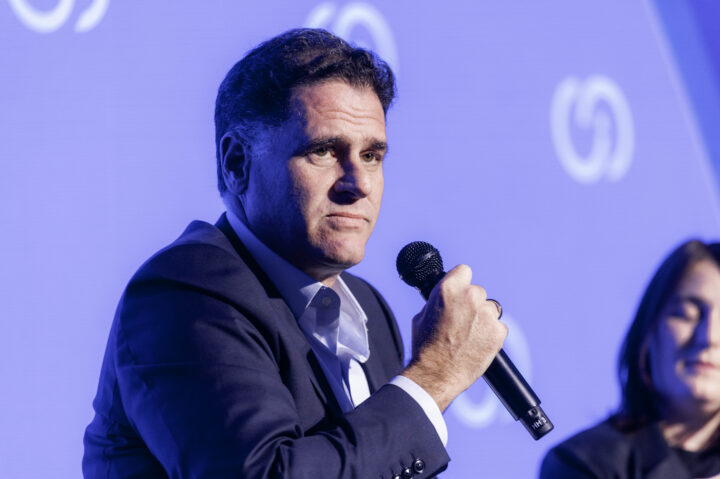
Ron Dermer, Israel’s former minister of strategic affairs, speaks at the Israel on Campus Coalition’s conference in Washington, August 3, 2026


 Add JewishInsider on Google
Israel’s relationship with the U.S. depends on mutual interests, not shared values, Ron Dermer, Israel’s former minister of strategic affairs, said on Monday at the Israel on Campus Coalition’s conference in Washington.
“The problem people have is they romanticize the U.S.-Israel relationship. People think the U.S. has always been a strategic ally from day one,” Dermer said. “Israel’s main strategic ally for its first 15 years was France.”
“I would love to live in a world where it’s values that drive international relations. I believe Israel would be the world’s superpower, no doubt,” Dermer told a crowd of some 1,000 pro-Israel college students. “That is not the world we live in and it’s not the world anybody has ever lived in.”
Rather than the shared democratic values and ideological alignment that Israeli leaders have frequently cited to define the U.S.-Israel partnership, Dermer asserted that “it’s actually generated interest” that aligns counties long term, such as security cooperation or economic benefit.
“Interest is what drives stakes over time,” he said.
“It’s always good to have good public opinion, they can be shock absorbers when problems arise, but ultimately being important to that country becomes more critical than whether or not they think they have shared values,” continued Dermer.
“Don’t get me wrong, Israel has shared values with the United States. But that’s not what drives relations between states,” said Dermer.
“So you ask me, ‘What’s going to be with the U.S.-Israel alliance long-term?’ Values is not what drives the alliance — It’s actually the interests that make the difference,” Dermer said.
In his comments, Dermer also urged “every pro-Israel Jewish organization” to “draw a line in the sand that anybody who says that Israel perpetrated a genocide in Gaza has to be completely shunned.”
He argued that those hostile to the Jewish state — including New York City Mayor Zohran Mamdani — are making accusations of Israeli genocide a loyalty test for left-wing politics.
“The enemies of Israel and the enemies of Jews — and right now you’ve got both in Gracie Mansion in New York — they want to turn this into the litmus test of progressive politics,” said Dermer.
“If you don’t say Israel perpetrated genocide, [they] want nothing to do with you. Let them do what they’re gonna do. We have to in the Jewish community, and pro-Israel community, do what we have to do. We have to say, ‘If you say those words, we are done.’ It’s a threat not just to Israel, it’s a threat and a clear and present danger to Jews everywhere.”
A DOE spokesperson told JI that Israel's "significant offshore gas resources, strong innovation and cybersecurity capabilities" make it a "central partner" in the coalition
Mark Felix/Bloomberg via Getty Images
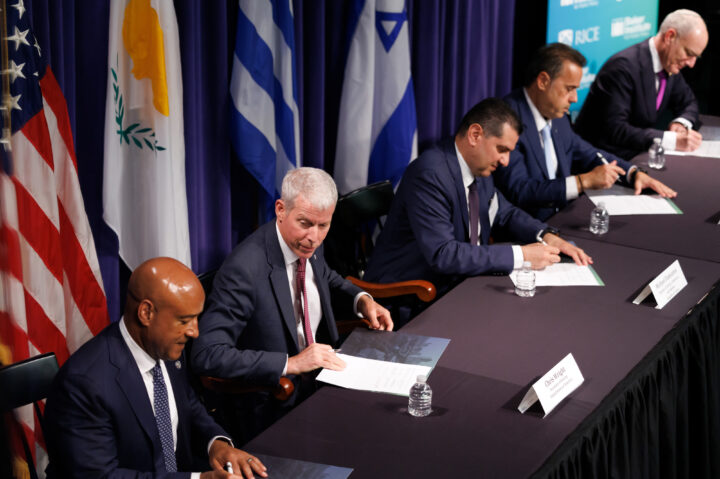
Reginald DesRoches, president of Rice University, from left, Chris Wright, US energy secretary, Michael Damianos, Cyprus' energy and commerce minister, Stavros Papastavrou, Greece's environment and energy minister, and Yechiel Leiter, Israel's ambassador to the US, during a signing ceremony at Rice University in Houston, Texas, US, on Thursday, June 11, 2026.
The Department of Energy is leaning on Israel’s offshore gas resources and cybersecurity prowess to help an emerging Eastern Mediterranean energy alliance, with officials telling Jewish Insider that Israeli participation uniquely “strengthens” the newly formed coalition.
Earlier this month, the U.S., Cyprus, Greece and Israel formalized the partnership, announcing the establishment of the Eastern Mediterranean Energy Center (EMEC) on the campus of Rice University in Houston. Energy Secretary Chris Wright signed a declaration of intent alongside Israeli Ambassador to the U.S. Yechiel Leiter, Cypriot Energy Minister Michael Damianos and Greek Environment and Energy Minister Stavros Papastavrou.
The center will serve as a permanent hub for research, policy dialogue, technical cooperation, and public‑private partnerships focused on infrastructure, investment, emerging technologies, and regional connectivity, according to the department.
A spokesperson for the Department of Energy told JI that the agreement was part of a “longstanding effort to deepen cooperation” and that Israel’s involvement in the newly established EMEC partnership is vital to the coalition’s geopolitical objectives.
“Israel brings strategic geography, significant offshore gas resources, strong innovation and cybersecurity capabilities, and a dynamic technology ecosystem,” the spokesperson said. “Israel is also a key U.S. ally and a central partner in the broader Eastern Mediterranean’s energy and security architecture. Israel’s inclusion strengthens EMEC as a platform for cooperation on energy security and related regional priorities.”
The spokesperson added that the participation of Leiter “reflected Israel’s importance to the success of this initiative and underscored the strength of the 3+1 partnership,” which entails periodic meetings between the alliance’s energy ministers to coordinate regional security. The group last met in Athens in November 2025.
The agreement directly builds on a core objective of the Eastern Mediterranean Security and Energy Partnership Act, a bipartisan framework passed by Congress in 2019 during the first Trump administration in an effort to counter Russian and Chinese influence in the region.
“This agreement directly advances the Eastern Mediterranean Security and Energy Partnership Act by implementing one of its central ideas: establishing a U.S.–Eastern Mediterranean Energy Center to anchor long‑term cooperation among the United States, Greece, Cyprus, and Israel,” the department spokesperson said. “It sought to counter malign influence, strengthen democratic partners, and use energy cooperation as a tool for regional stability.”
Locating the center in Houston is also a key component of that strategic objective, according to the department.
“Houston is the energy capital of the world and home to many U.S. companies partnering with Cyprus, Greece and Israel to develop their energy resources,” the spokesperson said. “Locating the EMEC in Houston connects the partnership to the world’s leading energy ecosystem and the expertise of industry leaders.”
For the U.S., the department argued that the agreement will achieve key goals of the Trump administration, such as strengthening partnerships across the region.
“For the United States, EMEC deepens energy partnerships with key regional allies, expands opportunities for American energy development and innovation, and reinforces U.S. leadership in shaping the landscape in the Eastern Mediterranean,” the spokesperson said. “The Trump administration remains focused on strengthening these energy relationships to enhance global energy security and advance a more secure and prosperous future for the region and for the United States.”
Jewish and pro-Israel groups seem at pains to clarify how they are now assessing an issue that has long been key to their advocacy — particularly as the conversation around funding and the possibility for a new MOU has rapidly evolved in recent months
Joe Raedle/Getty Images
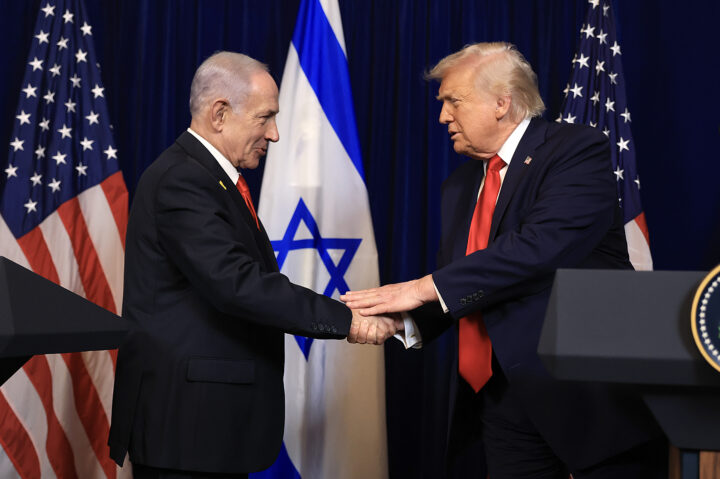
President Donald Trump shakes hands with Israeli Prime Minister Benjamin Netanyahu during a press conference at his Mar-a-Lago club on December 29, 2025 in Palm Beach, Florida.
Late last month, AIPAC circulated what seemed at first glance like a relatively anodyne memo stressing its support for the current 10-year memorandum of understanding between the United States and Israel, which guarantees $3.8 billion in annual military aid and missile-defense funding to Israel through 2028.
“Congress must fulfill America’s commitment by providing full security assistance and missile defense funding to Israel for the remainder of the MOU,” the group wrote in its missive published on April 28.
The memo was notable, however, for what it left out: calling to negotiate a follow-up MOU — the future of which has been a topic of ongoing speculation among analysts and lawmakers beginning to think about the contours of a potential new agreement in a changing political landscape.
That AIPAC had only urged the implementation of the final two years of the current deal was in many ways a tacit acknowledgement of shifting attitudes against U.S. military aid even among supporters of Israel.
The omission, intentional or not, was otherwise reflective of uncertainty around an agreement that has drawn scrutiny not only among Israel critics on the far left and right but also moderate defenders of Israel in both parties who are openly questioning the necessity of U.S. military assistance to a longstanding Middle East ally.
Meanwhile, Israeli Prime Minister Benjamin Netanyahu has called for winding down U.S. financial aid over the next decade, saying that the Jewish state has “come of age” and matured economically to continue on its own. In an interview with CBS’ “60 Minutes” earlier this month, he confirmed that he wanted to immediately begin the process of weaning Israel off of U.S. aid, noting the future of the U.S.-Israel alliance should be focused on joint projects equally funded by Israel and the United States.
“Each U.S.-Israel MOU to date — negotiated by Presidents Clinton, Bush and Obama — has laid the framework for the decade ahead, strengthening an alliance that advances American interests, supports a strong and capable ally in an unstable region, and drives a remarkable ecosystem of joint development and cooperation between two reliable allies,” Deryn Sousa, a spokesperson for AIPAC, told Jewish Insider in a recent statement.
Some pro-Israel Republican lawmakers — including Sens. Lindsey Graham (R-SC), John Thune (R-SD), the Senate majority leader, and Roger Wicker (R-MS) — have welcomed the idea, even as the GOP has long touted its staunch support for such funding. Rahm Emanuel, the former Chicago mayor and Democratic presidential prospect who holds close personal ties to Israel, has advocated for immediately ending military aid to Israel, arguing it is not worth expending the “political capital” to promote spending that is facing mounting opposition in Congress and among voters.
But Jewish and pro-Israel groups seem at pains to clarify how they are now assessing an issue that has long been key to their advocacy — particularly as the conversation around such funding and the possibility for a new MOU, which remains an open question, has rapidly evolved in recent months.
“Each U.S.-Israel MOU to date — negotiated by Presidents Clinton, Bush and Obama — has laid the framework for the decade ahead, strengthening an alliance that advances American interests, supports a strong and capable ally in an unstable region, and drives a remarkable ecosystem of joint development and cooperation between two reliable allies,” Deryn Sousa, a spokesperson for AIPAC, told Jewish Insider in a recent statement.
She added, “We appreciate the Trump administration working closely with the Israeli government toward a new agreement that will strengthen and define the mutually beneficial partnership in the years ahead.”
“We’re figuring it out ourselves,” said Michael Makovsky, the president and CEO of the Jewish Institute for National Security of America, adding that he believed Israel “made a mistake” in choosing to forgo U.S. financial aid. He suggested that the U.S. sign “one more” MOU with Israel to cover the next 10 years and help Israel replenish its munitions stocks amid the war against Iran, which he believes is key to advancing American interests in the region. “It zeroes down at the very end,” he explained to JI.
In lieu of an agreement, Makovsky floated “non-monetary” alternatives, for instance, a U.S.-Israel mutual defense treaty — though he questioned whether such a pact could gain enough support in the Senate, where most Democrats recently voted in favor of resolutions to block arms sales to Israel.
Former U.S. and Israeli officials have also recently called for building closer technological ties between the two countries, in anticipation of an era in which financial aid is not a defining feature of the alliance.
“The model in which Israel is assisted by the United States and receives aid has a very small chance of continuing under any future administration,” former IDF intelligence chief Amos Yadlin said this month while promoting a new strategic technology alliance with Tom Nides, a former U.S. ambassador to Israel. “And perhaps even under the Trump administration, so we need to find a new basis for the relationship that is a transition from aid to partnership.”
Even as analysts had indicated last year that the U.S. should begin considering what the next MOU entails, it is unclear if the process is now seriously underway, as Netanyahu’s remarks have complicated the effort. One Hill staffer to a pro-Israel House member told JI he had no knowledge of discussions at the moment.
President Donald Trump was initially surprised when Netanyahu first proposed winding down U.S. funding late last year and did not immediately lend support to the move, JI has previously reported.
A White House spokesperson declined to comment on the prospects for a future MOU, the framework for which first went into effect in 1998 during the Clinton administration. The current agreement was finalized in 2016 near the end of the Obama administration — which touted the deal as “the largest single pledge of military assistance in U.S. history” at the time.
Tal Naim, a spokesperson for the Israeli Embassy in Washington, referred JI to Netanyahu’s comments to “60 Minutes” this month.
Looking ahead, Brian Romick, the president of Democratic Majority for Israel, said “there can and should be a discussion about how the U.S.-Israeli security relationship should change with the times, how our partnership must evolve as Israel’s own capabilities grow and its security needs change, and how we can align on a long-term vision for the region.”
“While a new MOU should reflect that Israel’s economy has grown, it should also recognize that Israel’s defense requirements have too, and Israel may struggle to fill the gap in its defense budget that the loss of FMF would create,” Justin Leopold-Cohen, a senior research analyst at the Foundation for Defense of Democracies’ Center on Military and Political Power who specializes in U.S.-Israel security cooperation, said.
But, he added, “that debate must bring a serious analysis grounded in prioritizing America’s interests and Israel’s security. It cannot shift with political changes or in the middle of a war, especially when American troops are actively deployed in the region. Ultimately this will be a negotiated agreement between two democratically elected governments.”
A spokesperson for the American Jewish Committee likewise used broad strokes to discuss a future MOU, saying it is “far more than a financial commitment.”
The agreement “is a cornerstone of a broader strategic relationship that advances both U.S. and Israeli national security interests, strengthens deterrence against shared adversaries, and reinforces America’s commitment to the security of its closest ally in the Middle East,” the spokesperson told JI. “At a time of growing regional volatility and evolving security threats, maintaining strong and sustained U.S.-Israel security cooperation remains critically important.”
Justin Leopold-Cohen, a senior research analyst at the Foundation for Defense of Democracies’ Center on Military and Political Power who specializes in U.S.-Israel security cooperation, said that “there will likely be a new, heavily modified MOU following the current agreement’s expiration.”
Netanyahu, he told JI, “already revealed his desire to phase out American military aid, granted primarily as Foreign Military Financing,” which typically must be used to purchase U.S. defense products and services.
“While a new MOU should reflect that Israel’s economy has grown, it should also recognize that Israel’s defense requirements have too, and Israel may struggle to fill the gap in its defense budget that the loss of FMF would create,” Leopold-Cohen said.
Dan Shapiro, a U.S. ambassador to Israel in the Obama administration who served as a top defense official in the Biden administration, speculated that “the next MOU — if there is an MOU — will look very different from the current one.”
“It will likely phase out FMF, which both Prime Minister Netanyahu and Americans from the left and right are calling for,” Shapiro added. “It will likely emphasize joint research and development, sharing technological advances, and expanded co-production to answer President Trump’s question of what’s in it for the United States. To garner bipartisan support, it should include a consultative mechanism to ensure U.S. weapons are only used in ways consistent with American laws and values and that minimize civilian casualties.”
Daniel Silverberg, a former top foreign policy advisor to Rep. Steny Hoyer (D-MD), characterized the MOU as “mutually beneficial,” saying that “it does not need to be exclusively assistance-based.”
“There are many ways to expand cooperation that involve more than giving aid,” he said. “The MOU is a key framework to do so, and it’s crucial to spell that out for a skeptical U.S. audience.”
But, he emphasized to JI, “We can’t want the MOU more than the Israelis want it.”
The emerging partnership is being sharpened by a rival alliance between Pakistan and Saudi Arabia
(Press Information Bureau (PIB)/Anadolu via Getty Images)
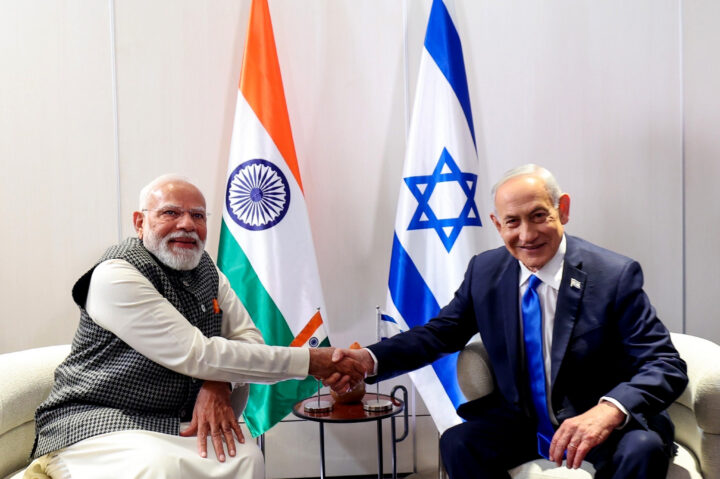
Indian Prime Minister Narendra Modi meets with Prime Minister of Israel Benjamin Netanyahu in New Delhi, India on February 25, 2026.
While some geopolitical relationships have been tested by the Iran war, others have been strengthened: Emerging alignments between Israel, the United Arab Emirates and India are creating new opportunities for cooperation among three countries increasingly bound by shared defense and economic interests, experts said.
During the war, Israel provided the UAE with an Iron Dome defense battery and IDF operators to help protect the Gulf nation from Iranian attacks, officials have confirmed. But India also moved to support the Emiratis, establishing an air bridge to allow the country to import and export goods amid disruptions caused by the closure of the Strait of Hormuz, according to Hussain Abdul-Hussain, a research fellow at the Foundation for Defense of Democracies.
The growing cooperation between India and the UAE predates the war, experts said, but the conflict has accelerated it. On Friday, the two countries agreed on the framework for a strategic defense partnership, a step that could deepen ties between New Delhi and Abu Dhabi amid the regional fallout from the war.
Abdul-Hussain told Jewish Insider that the partnership also extends to Israel, which has remained a key ally of both countries. He said the emerging alignment is rooted in overlapping economic and strategic interests and shared adversaries.
“Absolutely there’s an alliance that’s emerging,” Abdul-Hussain said. “I think the three of them are like three pieces of a puzzle that fit neatly together.”
Abdul-Hussain said the UAE’s expected expansion of oil production could bring it even closer to India, one of the world’s largest energy importers. He argued that the UAE’s departure from OPEC and its ambition to increase oil output could position India as Abu Dhabi’s “biggest customer.”
He said the partnership is also driven by the defense and technology strengths of India and Israel, as well as the UAE’s position as a regional hub.
“If you add all these things together — energy and technology and military, and the size of the population of India, the dynamic technological economy of Israel, and then you put the UAE in the middle between them — I think the three of them can really help one another and push each other up,” Abdul-Hussain said. “They have a lot of mutual interests and they can get a lot of benefits from the cooperation.”
Edmund Fitton-Brown, a former British diplomat and senior fellow at FDD, said the new strategic defense framework between India and the UAE could allow New Delhi to provide Abu Dhabi with “significant help” in several areas, including cyber, communications, training and technology.
He said the partnership could include “joint patrols to defend against Iranian threats to cables and shipping lanes,” as well as broader military cooperation.
Experts also said the deeper significance of the emerging alignment lies in how Israel, the UAE and India are responding to rival powers that are increasingly coordinating in ways that threaten their interests. For India and the UAE, Pakistan has become a key point of overlap: New Delhi views Islamabad as its chief regional adversary, while Abu Dhabi has grown increasingly wary of Pakistan’s ties to Iran and its deepening defense relationship with Saudi Arabia.
“They understand that there’s an alliance of enemies,” Abdul-Hussain said, pointing to Iran and Saudi Arabia as UAE adversaries, Pakistan and Iran as Indian adversaries and Iran and Turkey as Israeli adversaries. “Each one in this alliance is happy to be in this alliance because they understand that their enemies are also ganging up together against them.”
Jonathan Ruhe, a fellow at the Jewish Institute for National Security of America, similarly said the new alignment “reflects how shared threats from Iran are driving deeper cooperation within, and beyond, the region.”
“Recent deals to strengthen Emirati-Indian trade, technology and security cooperation pick up on initial progress that preceded Hamas’ Oct. 7 attack and its disruptions to regional integration,” Ruhe said. “They also reflect how our Middle East partners don’t automatically look to American leadership like they used to.”
Abdul-Hussain pointed to the UAE’s shifting posture toward Pakistan as an example of how the war has reshaped regional alignments. Before the conflict, he noted that Abu Dhabi had grown closer to India while still avoiding an explicit break with Islamabad — a calculus that has since changed.
“Until this war, the UAE, even though they had become close with India, had not really taken sides between India and its traditional rival Pakistan,” he said. “Shortly after the war stopped, the Pakistanis had $3 billion in loans from the Emiratis that had matured, and the Pakistanis asked the Emiratis to extend the time or to reissue the debt again, and the Emiratis refused,” he said.
Abdul-Hussain said Pakistan’s warm ties with Iran, including its role hosting mediation between Washington and Tehran, added to Abu Dhabi’s frustration.
“We know that Pakistan is — even though they’re hosting the mediation between the U.S. and Iran — much closer to Iran,” he said. “They’re friends with Iran, and I think this friendship didn’t go well with the Emiratis.”
Ruhe said there is “logic to the Pakistan-Saudi angle of closer UAE-India ties,” but argued that China remains “India’s abiding concern here.” He pointed to Beijing’s weapons sales to Islamabad, which he said “inflicted real damage on Indian forces last year.”
Simon Henderson, a senior fellow at The Washington Institute for Near East Policy, was more skeptical, saying the “so-called pact seems to be words rather than substance” and that the current state of Gulf politics remains “hard to define.”
“Everything has been thrown up in the air and we are waiting to see how they land,” Henderson said.
Please log in if you already have a subscription, or subscribe to access the latest updates.
 Continue with Google

 Continue with Apple