









































































Qatar applauded the gathering for its effort to ‘preserve [Jerusalem’s] Islamic and Christian identity’
Government of Qatar
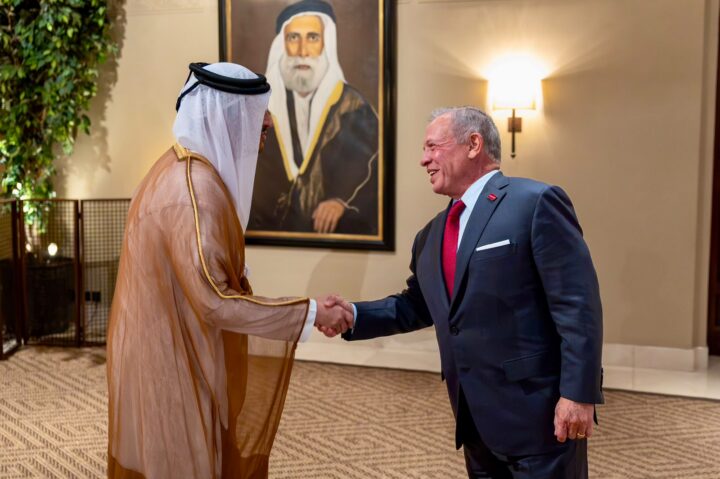
Qatari Prime Minister Sheikh Mohammed bin Abdulrahman Al Thani greets Jordanian King Abdullah at foreign ministers summit.


 Add JewishInsider on Google
A coalition of foreign ministers from Arab and Muslim countries met in Jordan on Wednesday to launch a coordinated campaign against Israeli policies in Jerusalem — a gathering marked both by the notable absence of key regional players and rhetoric that dismissed Jewish ties to the city.
The meeting brought together diplomats from Jordan, Egypt, Saudi Arabia, Qatar, Algeria, Iraq, Tunisia, Somalia and Morocco, alongside representatives from the Arab League, Indonesia, Pakistan, Turkey and Malaysia. Missing from the Amman summit were several close U.S. allies including the United Arab Emirates, Bahrain and Kuwait.
In a joint statement, the group denounced what it called an “unprecedented Israeli escalation in occupied Jerusalem and its Islamic and Christian holy sites,” accusing Israel of trying to alter “the Arab Islamic and Christian identity of occupied Jerusalem and its legal and demographic status” — omitting any mention of Jewish historical or religious ties to the city.
The ministers also claimed that Israel “has no sovereignty” over east Jerusalem.
The statement accused Israel of discriminatory practices against Christians, including “restrictions on access to the Church of the Holy Sepulchre and the observance of religious rites therein; interference in the affairs of churches and restrictions imposed on their institutions and properties; and attacks targeting clergy, worshippers and religious symbols.”
The ministers also warned that “Israeli attacks against Islamic holy sites in occupied Jerusalem constitute a blatant provocation to the sentiments of around two billion Muslims worldwide, and push towards a religious conflict with repercussions that will extend beyond the region and threaten regional and international peace and security.”
To operationalize their response, the ministers announced a coordinated international campaign — including a dedicated media platform — to document alleged Israeli violations against holy sites with a plan to present them to international organizations.
Qatar’s Foreign Ministry lauded the meeting, where it said the countries discussed “the Israeli escalation in occupied Jerusalem, and the joint efforts to preserve its Islamic and Christian identity.”
Israel’s Foreign Ministry forcefully denounced the joint statement, noting its exclusion of Jewish ties to the city.
“The declaration endorsed by the Foreign Ministers of the Arab Ministerial Committee, convened by Jordan, is built on false accusations, historical distortions, and a complete disregard for the facts,” the ministry said.
“It is particularly cynical to accuse Israel of violating freedom of worship while declaring that the entire Temple Mount is a place of worship exclusively for Muslims, ignoring the Jewish people’s historic connection to Jerusalem and its holiest sites,” the statement continued. “Under Israeli sovereignty, Jerusalem, the eternal capital of the State of Israel, has never been more open and accessible to worshippers of all faiths. Israel remains committed to preserving freedom of worship, maintaining the status quo on the Temple Mount, and taking all necessary measures to ensure public order and the safety of all visitors.”
Tricia McLaughlin, the DHS assistant secretary for public affairs, made the comments shortly after a federal appeals court ruled Khalil could be rearrested
Spencer Platt/Getty Images
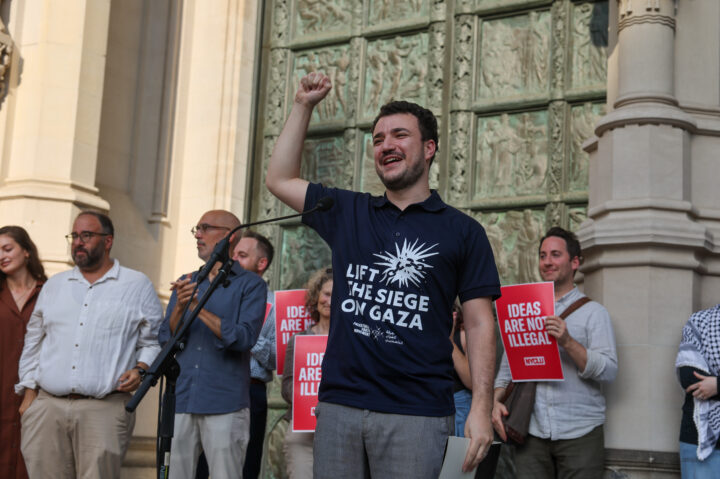
Palestinian activist Mahmoud Khalil, who was released from ICE detention, speaks during a rally on the steps of the Cathedral of St. John the Divine in Manhattan on June 22, 2025 in New York City.
Former Columbia University graduate student Mahmoud Khalil, a leader of the school’s anti-Israel protest movement, will likely be rearrested and deported to the North African country of Algeria, a top Department of Homeland Security official said Wednesday.
Khalil was released in June from the Immigration and Customs Enforcement detention center in Louisiana, where he had been held for three months. Last week, a federal appeals court ruled that he could be rearrested, instructing the lower court to dismiss Khalil’s habeas petition, a court filing that challenged his incarceration and eventually secured his release. His deportation proceedings had been paused.
Asked by Katie Pavlich on NewsNation on Wednesday whether there are plans to rearrest Khalil and move forward with deportation, Tricia McLaughlin, DHS assistant secretary for public affairs, said “it looks like he’ll go to Algeria. That’s what the thought is right now.”
“It’s a reminder for those who are in this country on a visa or on a green card. You are a guest in this country — act like it,” said McLaughlin. “It is a privilege, not a right, to be in this country to live or to study.”
New York City Mayor Zohran Mamdani said at a press conference on Thursday that Khalil “is a New Yorker. He should remain in New York City.”
“We have seen this attack on him as part of a larger attack on the freedom of speech that is especially pronounced when it comes to the use of that speech to stand up for Palestinian human rights. I will make that clear to everyone. He deserves to be in the city just like any other New Yorker,” Mamdani said.
Khalil, who grew up in Syria but is of Palestinian descent, first came to the U.S. on a student visa, and later married a U.S. citizen and received a green card. While a graduate student at Columbia in 2024, he led campus protests against the war in Gaza and subsequent negotiations with university administrators.
The federal government sought to deport Khalil on the basis of his failure to disclose crucial information in his green card application, including his former employment by the U.N. Relief and Works Agency that works with Palestinians, as well as his membership in the unofficial campus group Columbia University Apartheid Divest, which was banned from Instagram last year for promoting violence.
Immigration authorities arrested Khalil at his home in March. He was not charged with a crime. The White House said at the time that the government had authority to arrest and deport Khalil based on the 1952 Immigration and Nationality Act, which states that if the secretary of state has “reasonable grounds” to believe that a migrant poses “potentially serious adverse foreign policy consequences,” that person is eligible for deportation.
A memo submitted in May to the court in Louisiana and signed by Secretary of State Marco Rubio cited the president’s authority to expel noncitizens whose presence in the country could have adverse foreign policy consequences, regardless of whether they have committed a crime. It stated that Khalil’s arrest and planned deportation were based on his “participation in antisemitic protests and disruptive activities, which fosters a hostile environment for Jewish students in the United States.”
Please log in if you already have a subscription, or subscribe to access the latest updates.
 Continue with Google

 Continue with Apple