














































































The network is adding a channel, 33 programs, AI infrastructure and expanding in the U.S. in a year the emir says Qatar's revenue fell 42% and ministries reportedly have lost up to 30% of their operating budgets
Getty Images
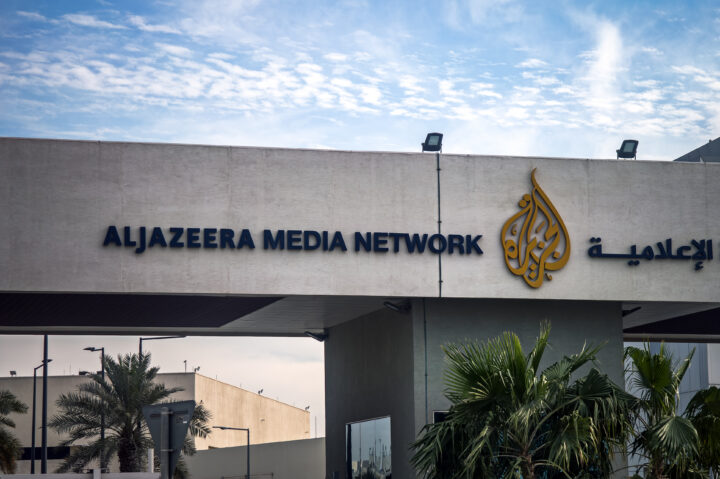
The headquarters of the Al Jazeera TV channel in Doha, Qatar. February 1, 2025


 Add JewishInsider on Google
Even as Qatar cuts government spending across multiple sectors in response to a steep decline in government revenue following attacks from Iran on its energy infrastructure, Al Jazeera, the influential media network owned by the Gulf state, is undertaking a sweeping expansion of its broadcasting and digital operations.
The move underscores what observers say is the network’s strategic value to Qatar, a country roughly the size of Connecticut with just over 3 million people, in projecting influence far beyond its borders.
The network announced on Oct. 29, ahead of its 30th anniversary this past weekend, a revamp of its Arabic-language operations, including the launch of Al Jazeera Now, a new channel dedicated to continuous breaking-news coverage. The expansion also includes a revamped Al Jazeera Arabic channel focused on in-depth reporting and analysis, and Al Jazeera Mubasher, which broadcasts live events. Al Jazeera is introducing 33 new programs, including investigative documentaries and political discussions, while expanding its digital platforms and investing in artificial intelligence technology.
The expansion extends to Al Jazeera English, which is pursuing a five-year strategy to push deeper into Africa, Asia and the United States, the channel’s managing director, Issa Ali, told Qatar’s The Peninsula on Sunday. Ali called the U.S. “one of our top priorities” and said the network would build on its existing broadcasting operations in Washington, while developing dedicated programming for African and Asian audiences.
The network, founded in Doha in 1996 with financial backing from Qatar’s ruling family, marked its anniversary on Sunday with a ceremony at its headquarters attended by Qatari Emir Sheikh Tamim bin Hamad Al Thani, who toured its new studios and newsroom.
Speaking at the celebration on Sunday, Al Jazeera Media Network Chairman Sheikh Hamad bin Thamer Al Thani recalled a conversation with Qatar’s former emir and founder of the network, Sheikh Hamad bin Khalifa Al Thani, about its growing international reach.
“The idea was to establish Al Jazeera as an Arab news channel that would have a presence across the Arab world, but for it to reach the position it has today was never something I had imagined,” the former emir said, according to the chairman’s account.
The expansion comes as Qatar has taken a severe financial hit from the ongoing war with Iran, which has disrupted its lucrative liquefied natural gas exports and damaged critical energy infrastructure. In an Oct. 13 address to Qatar’s Shura Council, Sheikh Tamim said government revenues had fallen 42% during the first half of 2026, while public expenditures declined 14% following the closure of the Strait of Hormuz and damage to the country’s energy facilities.
The Financial Times reported in August that some Qatari government departments faced operating-budget cuts of up to 30%, while overseas aid funding had been reduced by approximately 85%. Qatar’s Foreign Ministry disputed aspects of the report, saying the reductions concerned operating expenses rather than salaries or capital projects.
Despite the financial setbacks, experts told Jewish Insider that Qatar remains an exceptionally wealthy country with substantial financial resources to sustain its investment in the network. They said, however, that Al Jazeera’s continued expansion amid spending reductions elsewhere reflects the government’s longstanding reliance on a network it sees as an instrument of “soft power” influence.
Steven Cook, a senior fellow at the Council on Foreign Relations, noted that while Qatar had been “hit hard” during the Iran war, Doha remained unlikely to undermine its commitment to Al Jazeera.
“Al Jazeera is incredibly important to the country as a means of influence and power projection,” Cook said. “I think Al Jazeera is … a resource that the country has that they [Qatar] will, regardless of what their financial situation is, continue to nurture just because it’s so important in terms of influence and power projection.”
Cook said the network’s strategic value helps explain why Qatar would continue investing in its reach even as it makes spending cuts in other areas.
“Because Al Jazeera has been so successful and so helpful for [Qatar] globally, it strikes me that they would be willing to sacrifice in other places in order to continue the channel’s success,” Cook said.
Jonathan Schanzer, executive director of the Foundation for Defense of Democracies, similarly argued that Qatar’s wealth and relatively small citizen population would allow it to continue supporting the network despite the financial pressures.
“I still believe they have more money than they know what to do with,” Schanzer said. “It’s one of the wealthiest countries [in the] world, and a crisis in the Persian Gulf is not going to change that.”
Schanzer said the network has historically offered Qatar a relatively inexpensive way to reach international audiences compared with the country’s extensive investments in American institutions, businesses and other ventures.
“The thing that needs to be understood when you talk about Qataris is [that] soft power is their game,” Schanzer said. “If that is becoming expensive, Al Jazeera is how to do it on the cheap. It is the way in which the Qataris can reach wide audiences with minimal investments, and in fact, this is how the Qataris began influencing abroad when they created Al Jazeera in 1996.”
The network’s influence, Cook said, is rooted in its widespread reach throughout the Middle East, where it remains a major source of news even among audiences in countries whose governments have strained relations with Qatar.
He recalled seeing televisions tuned to Al Jazeera in homes and public spaces throughout the region during the war in Gaza, illustrating what he described as the network’s enduring influence over regional news consumption. That reach, Cook argued, gives Qatar an ability to shape how audiences understand regional events that is particularly valuable for a country with a small population but considerable financial resources.
“It’s the way it has become a frame for many people in the Arab world, and that’s worth much more than whatever money they’re putting into it,” Cook said.
Schanzer described Al Jazeera as a cornerstone of Qatar’s foreign policy strategy, arguing that its expansion during a period of financial pressure illustrates just how highly Doha values the network.
“I think Al Jazeera has always been the crown jewel of the Qatari government,” Schanzer said. “They’ve always seen this as one of their most important means of garnering influence. … This is the ultimate way to influence [people] abroad.”
The network’s strategic importance became particularly apparent during the 2017 Gulf diplomatic crisis, when Saudi Arabia and several neighboring countries demanded that Qatar shut down Al Jazeera as a condition for restoring relations, a move that Doha refused.
Schanzer suggested that the current expansion could reflect a renewed emphasis on the network as Qatar curbs some of its more expensive international expenditures.
“I think that it is interesting to see that some of the more lavish expenditures seem to be getting curbed right now, and a return to the tried-and-true of influence through the media appears to be the strategy,” Schanzer said. “There is something historically … fitting about this decision.”
He also raised concerns about the potential influence of Al Jazeera’s growing digital operations on artificial intelligence systems, suggesting that the production of additional media content could increase the prominence of Qatari perspectives in AI-generated responses.
“We are now in the age of AI, and the sourcing for AI responses is dependent in part on the volume of stories reflecting a certain perspective,” Schanzer said. “I would argue that the Qataris, by producing more media content, are ensuring that more of it appears in the answer to AI queries.”
Al Jazeera’s relationship with the Qatari government has also faced scrutiny in Washington. In September 2020, the Justice Department under the first Trump administration determined that AJ+, the network’s digital media subsidiary, was required to register under the Foreign Agents Registration Act because of its ties to Qatar. Al Jazeera contested the determination, which the Justice Department subsequently withdrew in May 2022 under President Joe Biden.
The network has also garnered longstanding concern from some U.S. lawmakers over its relationship with the Qatari government. Rep. Josh Gottheimer (D-NJ), who has previously called for greater scrutiny of Al Jazeera under the Foreign Agents Registration Act, criticized the network’s expansion in comments to JI.
“Al Jazeera is a foreign, state-controlled network that Qatar is investing in as one of their ‘most valuable public and diplomatic tools,’” Gottheimer said. “Consequently, Al Jazeera has spent years injecting misinformation into the veins of young Americans.”
“We need to recognize the difference between foreign propaganda and independent media,” he continued, “which is why I led my colleagues in calling on the DOJ to investigate whether Al Jazeera should be registered under FARA.”
The Ireland-based Abubaker Abed has been a contributor to Drop Site News, Al Jazeera and The Guardian
Leon Neal/Getty Images
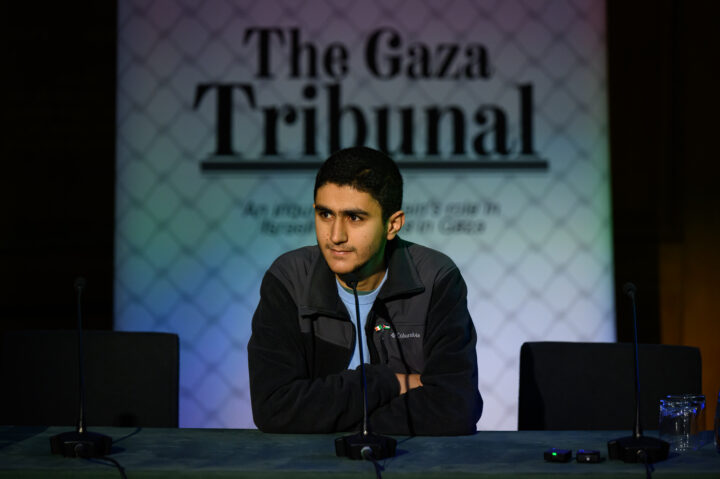
Palestinian journalist Abubaker Abed addresses the Gaza Tribunal on September 04, 2025 in London, England.
An Ireland-based Palestinian journalist who has contributed to outlets including The Guardian, Al Jazeera, Drop Site, Middle East Eye, The New Arab and The Electronic Intifada shared posts on his Instagram story encouraging violence against an Irish pro-Israel commentator, Druze Israeli politicians and Israelis generally.
Abubaker Abed had been based in Gaza and was evacuated during the war, ending up in Ireland. He began his career as a soccer reporter and commentator before shifting to focus on the war when it began in October 2023. Press TV, an Iran state-backed media outlet, named him “Journalist of the Year” last year.
According to screenshots of Abed’s Instagram stories shared by others on X, he called for violence against Israelis and against Rachel Moiselle, a popular pro-Israel Irish commentator, in response to Israel’s passage this week of a death penalty law for Palestinian terrorists. The screenshots are no longer active on Abed’s account and could not be independently verified by Jewish Insider. Abed did not respond to a request for comment.
“We need a woman in Ireland to shut this sellout’s mouth,” Abed posted, sharing a screenshot of a post by Moiselle — despite Moiselle, in the post, expressing full-throated opposition to the death penalty law.
Abed also called for executions of Druze Israeli Knesset members who voted for the death penalty bill, saying, “Weed out the traitors. Execute them wherever they are.”
And, sharing a video of Israel’s far-right national security minister, Itamar Ben-Gvir, celebrating the law’s passage — an action that garnered criticism from many Israeli and pro-Israel observers — Abed called for Israelis to be hunted down and murdered globally.
“Wiping out Israel off the planet is not enough revenge. Israelis mustn’t feel safe anymore,” he said. “Haunt them and go after them where they go. These terrorist parasites must be removed from our planet.”
Moiselle said she fears for her safety after the post.
“I have purposefully never interacted with or commented on this Hamas-affiliated Palestinian journalist based in Dublin, as it is quite clear he is dangerous,” Moiselle said on X. “I have now been subjected to a very explicit post by him inciting violence against me. It is very strange that I have received this due to a post I made unequivocally condemning Israel’s death penalty bill.”
She said that the post about her is a sign of “how toxic and dangerous the anti-Israel climate has become in this country” and of why she doesn’t feel safe in Ireland and plans to move by the end of the year.
Drop Site reporter and co-founder Ryan Grim brushed off the criticisms. Abed published his most recent story for Drop Site on Tuesday, but last previously wrote for the outlet in early 2025, recounting the story of his evacuation from Gaza.
“This is a note to Fox News and all future outlets who ask for comment on whether a tweet or IG reel from one of our contributors represents our editorial position: No, it doesn’t, that’s not how our editorial operation works, but we also are never going to police the language of anyone who survived a genocide,” Grim said on X.
Grim also defended the sentiments expressed by Abed, saying that Holocaust survivors “held views about regular German and Polish people and spoke about them in ways that we would not consider appropriate in polite society but I would absolutely never tell a Holocaust survivor how to talk about Germans or Poles.”
While the agreement’s details are vague, experts said Google’s backing brings a perception of legitimacy to the Qatar-backed media network
Getty Images
The headquarters of the Al Jazeera TV channel in Doha, Qatar. February 1, 2025
A recently announced AI partnership between Google and Al Jazeera, the Qatar-backed media network, is raising concerns among some national security experts who say the arrangement helps to legitimize a state-controlled news organization long criticized for its sympathetic coverage of Hamas and hostility to Israel.
The agreement, announced in December, allows Al Jazeera to use Google Cloud as its main technology provider powering the network’s newly launched AI initiative, known internally as “The Core,” according to a press release.
Though vaguely characterized, the collaboration will help Al Jazeera produce editorial content that draws on Google’s AI platforms including Gemini, a major component driving a key program called “AJ-LLM,” which the network describes as its “editorial brain.” The effort, which uses a large language model built on Al Jazeera’s archives, is among several so-called “pillars” of the media company’s AI project seeking to embed the technology in its workflow and output.
The deal represents a “major expansion” of Google’s deepening partnership with Al Jazeera that extends back to 2017, the press release says, as other leading U.S. tech companies — such as Microsoft and Cisco — have also forged closer ties to the media network.
But some experts are warning that Google’s new partnership in particular will help lend a sheen of institutional credibility to a channel that has faced accusations of spreading misinformation in service of promoting Qatar’s preferred narrative on a range of sensitive topics including the Israeli-Palestinian conflict.
Toby Dershowitz, a senior advisor at the Foundation for Defense of Democracies, an organization highly critical of Qatar, said that Al Jazeera “positions itself as an independent media outlet” even as it is “actually funded by and editorially governed by an authoritarian country,” noting the Department of Justice has required AJ+, its social media offshoot, to register as a foreign agent. “So far,” she said, “it has not obeyed the law.”
“Well-regarded Western big tech companies have a responsibility to ensure they are not colluding in Al Jazeera’s information capture, whether through the use of algorithms, AI or other methods,” she added in an interview with Jewish Insider on Wednesday. “Google’s expanding partnership with Al Jazeera is therefore deeply concerning.”
Dershowitz, who recently published an analysis investigating the Google partnership, suggested that “big tech companies like Google are being used to help amplify often compromised information and transform it into legitimate sources, allowing it to flow throughout the news ecosystem,” all “without proper labels.”
“Because it’s a black box, consumers don’t fully understand what is happening,” she explained.
Other critics have aired similar reservations about the agreement with Google, especially as Al Jazeera has emerged as a top source on such widely used AI assistants as Gemini for news summaries regarding Israel and Gaza, according to a recent analysis.
While it is unclear if the partnership will end up influencing Gemini’s broader public output, some observers say that Al Jazeera’s plan to train the AI tool with its own archives is a red flag.
“Those archives are not neutral,” Simone Rodan-Benzaquen, a Middle East analyst and former managing director of the American Jewish Committee’s European division, wrote of Al Jazeera in a recent Substack newsletter entry. “They encode years of narrative framing: legitimization of Islamist actors, systematic delegitimization of Israel, conflict framed as oppression versus resistance.”
Google’s role in the agreement, Rodan-Benzaquen argued, “adds a crucial layer of legitimacy.” Even as it “does not endorse Al Jazeera’s editorial line,” the tech company’s “infrastructure confers neutrality.”
“A tool hosted on Google Cloud is perceived as technical, professional, objective,” she concluded.
The Doha-based network, which broadcasts in Arabic, English and other languages, has drawn criticism from U.S. lawmakers in both parties who have called it a “state-controlled propaganda arm” used “to incite violence, glorify terrorist killers as ‘martyrs’ and broadcast hateful, extremist content.”
Al Jazeera has also faced bans from several Middle Eastern countries including Egypt, the United Arab Emirates and Israel, the latter of which has accused the network of acting as a “mouthpiece of Hamas,” whose leaders have been hosted in Qatar. Last year, the Palestinian Authority temporarily suspended Al Jazeera from the West Bank over accusations it was “inciting sedition” as well as “interfering in internal Palestinian affairs.”
A spokesperson for Google referred JI to its recent press release announcing the partnership but did not respond to additional questions about the new arrangement. Al Jazeera did not return a request for comment.
Michael O’Hanlon, the director of research at the Brookings Institution’s foreign policy program, told JI on Wednesday that he had reservations about the agreement, even as he suggested he was receptive to engaging with Al Jazeera. (Brookings has previously received funding from Qatar but says it chose to end the financial arrangement in 2017.)
“I have generally felt that in most cases it’s best to work with Al Jazeera,” he said. “That said, a formal partnership is a different matter. I’m not quite sure I’d do that.”
Please log in if you already have a subscription, or subscribe to access the latest updates.
 Continue with Google

 Continue with Apple