














































































Israeli officials have increasingly indicated that Jerusalem is ready to return to military action if it determines that circumstances demand it
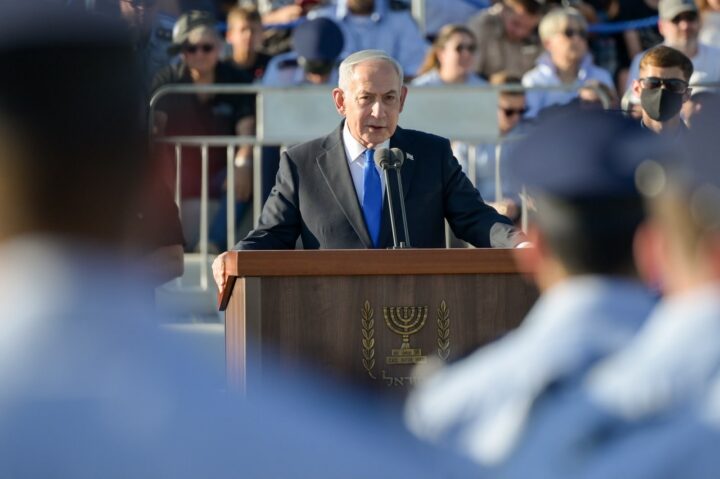
Ma'ayan Toaf (GPO)
Israeli Prime Minister Benjamin Netanyahu speaks at the graduation ceremony of the IAF pilots' course, July 9th, 2026


 Add JewishInsider on Google
After several days of watching from the wings as the United States has conducted strikes against Iran, Israeli officials have increasingly indicated that Jerusalem is ready to return to military action if it determines that circumstances demand it.
Israeli Ambassador to the U.S. Yechiel Leiter told CNN on Thursday that Jerusalem is “supportive of the position of the United States” and would “fly alongside U.S. aircraft” if called on to do so.
At an Israeli Air Force graduation ceremony the same day, Defense Minister Israel Katz said the IDF is prepared to “regain air superiority and carry out ‘blue-and-white’ [Israeli] strikes in Iran to remove threats — even for a third time,” warning that it would be with “even greater force” than before. Meanwhile, IDF Chief of Staff Lt. Gen. Eyal Zamir told graduates that “on the drawing board are new plans. Major operations are still expected to lie ahead of us. Be prepared.”
Prime Minister Benjamin Netanyahu reinforced that message in his remarks at the ceremony. While celebrating the outcome of Operations Rising Lion and Roaring Lion, he made clear that Israel does not view the conflict with Iran as settled. “Our policy is clear: With an agreement or without an agreement, Iran will not have nuclear weapons,” Netanyahu said. He added: “The war is not yet over. Alongside old challenges, new ones are emerging. Axes fall, and axes rise. We are turning our attention to this. We are prepared for any scenario.”
Security analysts say the messaging reflects a desire to preserve military pressure without committing to another immediate campaign. Yoni Tobin, a senior political analyst at the Jewish Institute for National Security of America, told Jewish Insider, “While Israel isn’t exactly clamoring for more combat with Iran, particularly after nearly three years of multifront war, it is certainly ready for it.” Tobin noted that “Israel will likely feel comfortable acting against Iran if the United States does so as well, and if the two countries are aligned on objectives and strategy.”
David May, a senior research analyst at the Foundation for Defense of Democracies, said the memorandum of understanding “should be seen as part of the process of ending the fighting between the United States and Iran, not the final agreement.”
“Washington needed the Strait of Hormuz opened urgently, but Iranian provocations have prevented the strait’s return to normal. Iran has always tried to cheat on the margins of deals with the United States — even with favorable agreements — to test American resolve,” May continued. “With the terms of the MOU so favorable to Iran, Tehran would have been wise to abide by the deal but didn’t, thanks in part to internal divisions. The renewed fighting will hopefully lead to the MOU being scrapped and replaced by a more reasonable peace agreement.”
“Israel has enjoyed the relative quiet and is feeling a bit shaky over its exclusion from ceasefire talks,” May posited. “But open conflict with the Islamic Republic remains a likely possibility.”
At the same time, the current situation may be more complicated than the public rhetoric suggests. Ran Zimmt, director of the Iran and Shiite Axis research program at the Institute for National Security Studies, wrote in an op-ed for Ynet that both Washington and Tehran would prefer to avoid a return to full-scale war.
“In this reality, the most likely scenario at this stage appears to be a continuation of the current situation: not a full-scale war, but also not a long-term diplomatic arrangement,” Zimmt wrote. “From Israel’s perspective, this reality seemingly has clear advantages. The military option remains on the table, and Iran does not enjoy a broad package of economic benefits that could strengthen the regime and allow it to invest significant resources in rebuilding its power.”
Zimmt warned, however, that while the status quo “may be preferable in the short term,” it does not “provide a stable solution, but at most a temporary pause,” during which Iran can rebuild its military capabilities.
IAF strikes centrifuge and weapons production sites after 25 Iranian missiles intercepted with no casualties in Israel

KHOSHIRAN/Middle East Images/AFP via Getty Images
Smoke rises from locations targeted in Tehran amid the third day of Israel's waves of strikes against Iran, on Sunday, June 15, 2025.
Israel struck a centrifuge production site in Tehran early Wednesday, after successfully intercepting more than two dozen missiles launched by Iran toward Israel in the preceding hours.
Over 50 Israeli Air Force jets flew to Iran, where they struck a facility in which centrifuges were manufactured to expand and accelerate uranium enrichment for Iran’s nuclear weapons program, the IDF Spokesperson’s Office said.
”The Iranian regime is enriching uranium for the purpose of developing nuclear weapons. Nuclear power for civilian use does not require enrichment at these levels,” the IDF said.
The IDF also said it struck several weapons manufacturing facilities, including one used “to produce raw materials and components for the assembly of surface-to-surface missiles, which the Iranian regime has fired and continues to fire toward the State of Israel.” Another facility that the IDF struck manufactured components for anti-aircraft missiles.
IDF Spokesperson Effie Defrin said on Wednesday that the IDF “attacked five Iranian combat helicopters that tried to harm our aircraft.”
“There is Iranian resistance, but we control the air [over Iran] and will continue to control it. We are deepening our damage to surface missiles and acting in every place from which the Iranians shoot missiles at Israel,” Defrin added.
Defrin said on Tuesday evening that, as a result of Israel’s air superiority in western Iran and the Tehran area, the Islamic Republic’s military efforts “have been pushed back into central Iran. They are now focusing their efforts on conducting missile fire from the area of Isfahan.”
Defense Minister Israel Katz said that “a tornado is passing over Tehran. Symbols of the regime are exploding and collapsing, from the broadcast authority and soon other targets, and masses of residents are fleeing. This is how dictatorships collapse.”
Most of the projectiles fired from Iran toward northern and central Israel overnight were intercepted, and no injuries or fatalities were reported.
In addition, Iran launched over 10 drones at the Galilee and the Golan on Wednesday morning, all of which the IDF intercepted.
The Wall Street Journal reported on Wednesday that Israel is running low on Arrow interceptors used to shoot down long-range ballistic missiles from Iran. Israel also uses the David’s Sling system against Iranian missiles. The Arrow is manufactured by Israel Aerospace Industries. The U.S. has augmented Israel’s air defenses with its THAAD system, but is concerned about its own stock of interceptors. The IDF told the Journal that “it is prepared and ready to handle any scenario.”
Iranian Supreme Leader Ayatollah Ali Khamenei wrote on X that Iran “must give a strong response to the terrorist Zionist regime. We will show the Zionists no mercy.” On his Persian X account, Khamenei evoked Khaybar, the site of a massacre of Jews by Muslims in the 7th century, along with an image of a man with a sword entering a burning castle.
Iran’s Islamic Revolutionary Guard Corps claimed that it shot Fatah-1 hypersonic missiles at Israel, which move faster than the speed of sound and cannot be detected by missile defense systems. However, there is no evidence on the ground in Israel of that being the case.
Iranian state media reported on Wednesday the interception of an Israeli drone near Isfahan, with footage of an aircraft that looks like an IAF Hermes 900. The IDF declined to comment.
Israeli Foreign Minister Gideon Sa’ar wrote a letter updating the U.N. Security Council on Israel’s Operation Rising Lion against Iran. The operation is “aimed to neutralize the existential and imminent threat from Iran’s nuclear weapon and ballistic missile programs” and “specifically targets military facilities and critical components of Iran’s nuclear weapons program, as well as key individuals involved in Iran’s efforts to achieve nuclear weapons.”
Sa’ar noted the Islamic Republic’s “public threats to eliminate the State of Israel, in stark violation of the UN charter, and its continued attempts to achieve the means to accomplish this by rapidly developing military nuclear capabilities, as well as its ballistic missile program.” He pointed out that the International Atomic Energy Agency censured Iran in a recent Board of Governors decision for its non-compliance with the Non-Proliferation Treaty.
Sa’ar’s letter came after two missives from Iran to the UNSC about Israel’s strikes on the country.
Also Wednesday, the first Israeli rescue flights arrived from Cyprus, meant to help some of the over 100,000 Israelis stuck abroad while Israel’s airspace is closed. Israel Airports Authority said that 2,800 Israelis were expected to return on Wednesday. Israeli airlines El Al, Arkia, Israir and Air Haifa will be making further emergency flights to repatriate Israelis.
China’s foreign ministry said that it was telling citizens to leave Israel and Iran, and Russia’s ambassador to Israel, Anatoly Viktorov, said that the families of Russian diplomats left Israel via Egypt on Tuesday.
Iran has launched about 400 ballistic missiles and hundreds of drones at Israel, hitting 40 impact sites since the beginning of the operation on Friday, according to the Israeli Government Press Office. There have been 24 fatalities and over 804 injured, eight of whom are in serious condition. About 3,800 people have been evacuated from their homes and 18,766 damage claims were submitted to the Israel Tax Authority.
Trump's 'policies have frankly made us less secure,' says Gina Ortiz Jones

Gina Ortiz-Jones
Gina Ortiz Jones is hoping that two years will make all the difference. The former Air Force intelligence officer and former advisor to the Executive Office of the President on economic and national security issues is aiming to win the chance in today’s Democratic primary to try and flip Texas’s 23rd Congressional District come November.
Flashback: In 2018, Ortiz Jones narrowly lost 49.2% to 48.7% — a margin of 926 votes — to incumbent GOP Rep. Will Hurd. This time, Hurd is not seeking re-election in the district, which includes much of southwest Texas.
The incumbent: Hurd, a moderate Republican and the only black Republican in the House of Representatives, has held the seat since 2015. He has frequently voted against his party on key issues like LGBT rights, gun control and the repeal of the Affordable Care Act. “I think Will Hurd would agree I have the stronger chance this time, that’s why we scared him out of this race,” Ortiz Jones told Jewish Insider.
Money lead: In terms of fundraising, Ortiz Jones holds a towering lead over her four Democratic primary competitors. She’s raised nearly $2.7 million so far, compared to just over $16,000 by the next largest Democratic fundraiser.
Healthcare focus: Ortiz Jones said that healthcare is “by far the number one issue” in her district, because of rising costs, fear in the Hispanic community about seeking out healthcare services, poor infrastructure and lack of medical personnel. She said she supports a public option for health insurance.
Looking south: Ortiz Jones — whose district includes a significant stretch of the U.S.-Mexico border — lambasted President Donald Trump’s border wall. “His policies have frankly made us less secure,” she said. “This president finds it okay to declare a fake national emergency so he can steal from the military to build a wasteful wall — it’s abhorrent and it’s a waste of resources.”
On immigration: “I look forward to making sure that we’ve got national security and foreign policies that reflect our values and actually keep us safe,” she said. While it’s important to secure the border, “we can also treat people with humanity and with respect, she added. Ortiz Jones also characterized immigration as “an opportunity… [and] an economic imperative,” which could help address issues like the dearth of medical workers in her district, and she said foreign policy programs could help address the economic and security issues in the countries from which immigrants are fleeing.
Israel: Ortiz Jones said she supports a two-state solution, and expressed support for the U.S.-Israel alliance. “They’re a key partner — will always be. I think, though, a two-state solution does the most to respect both sides’ rights to self-determination and security.”
Trump’s intelligence community: Ortiz Jones was particularly critical of Trump’s decision to appoint Ambassador to Germany Richard Grenell as acting director of National Intelligence, and of the perceived politicization of the U.S. intelligence apparatus. “The fact that you would appoint a partisan hack part-time to lead the world’s most powerful intelligence community, most capable intelligence community, suggests that there’s not nearly sufficient respect for the sacrifice that those men and women make, to be able to ensure that our national security leaders have the information they need to keep our country safe,” she said. She added that she’s concerned that allies may become wary of trusting the U.S. and sharing their intelligence.
General election: Politico and the Cook Political Report have predicted that, with Hurd’s retirement, the district now leans Democratic, meaning that Ortiz Jones has a shot at winning in November if she emerges victorious from today’s Democratic primary.
Please log in if you already have a subscription, or subscribe to access the latest updates.
 Continue with Google

 Continue with Apple