






































































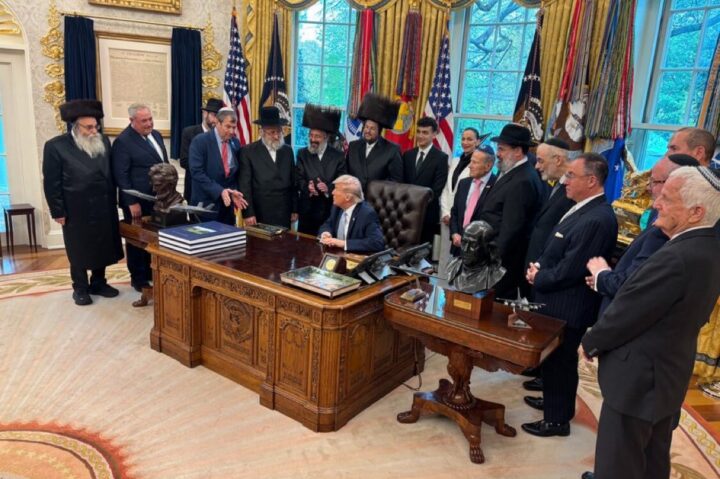
The president dialed in his daughter and son-in-law to speak to guests at an informal pre-gathering over speakerphone


 Add JewishInsider on Google
Prominent Jewish figures and senior Trump administration officials gathered at the White House on Monday afternoon for an event hosted by President Donald Trump commemorating the Passover holiday.
Administration officials in attendance at the event, which was closed to the press and took place in the Indian Treaty Room, included Commerce Secretary Howard Lutnick; White House Staff Secretary Will Scharf; James Blair, the White House deputy chief of staff for legislative, political and public affairs; Jacob Reses, chief of staff to Vice President JD Vance; Environmental Protection Agency Administrator Lee Zeldin; Martin Marks, the White House Jewish liaison; and Rabbi Yehuda Kaploun, the Trump administration’s special envoy to monitor and combat antisemitism.
Marks delivered comments to the crowd remarking on the holiday and the Trump administration’s record of support for Israel, according to an attendee.
Others spotted at the event were Rabbi Moshe Margaretten, president of the Tzedek Association; Matt Brooks, CEO of the Republican Jewish Coalition; William Daroff, CEO of the Conference of Presidents of Major American Jewish Organizations; Jeff Miller, chairman of the United States Holocaust Memorial Council; Jonathan Burkan, United States Holocaust Memorial Council member; Rabbi Levi Shemtov, the executive vice president of American Friends of Lubavitch (Chabad); Paul Packer, the former chairman of the U.S. Commission for the Preservation of America’s Heritage Abroad, Rabbi Chaim Dovid Zwiebel, executive vice president of Agudath Israel of America and Rabbi Meir Soloveichik, member of the Religious Liberty Commission and vice chair of the United States Commission on International Religious Freedom.
Jerry Wartski, a Holocaust survivor, and freed Israeli American hostage Edan Alexander were also in attendance.
Prior to the official reception, Trump invited about 20 guests to join him in the Oval Office. During the brief gathering, the president called Jared Kushner, an informal advisor to the White House and his son-in-law, and his daughter Ivanka. Kushner, who is Jewish, and Ivanka Trump, who converted to Judaism, spoke to attendees over speakerphone, one guest told Jewish Insider.
Defense official Michael Duffey called recent comments by Erdogan ‘atrocious’ but said the issue falls outside his purview
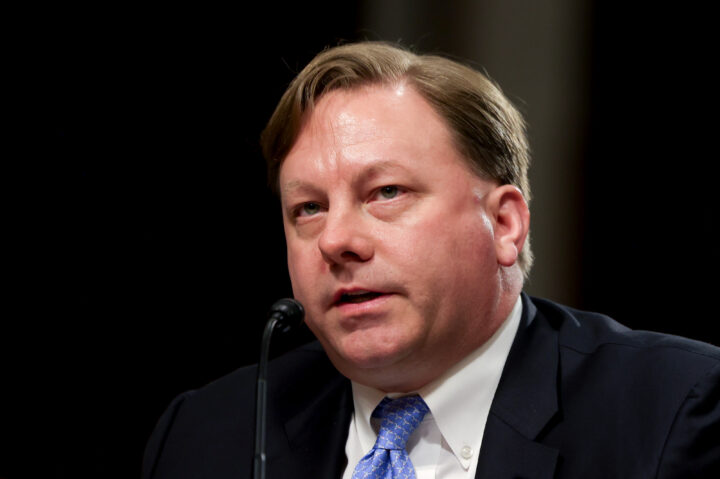
Tierney L. Cross/Bloomberg via Getty Images
Michael Duffey, under secretary of defense for acquisition, during a Senate Armed Services Committee confirmation hearing in Washington, DC, on March 27, 2025.
Administration officials dodged questions about weapons sales to Turkey during a House Foreign Affairs Committee hearing Tuesday, despite calling antisemitic statements from Turkish President Recep Tayyip Erdogan “atrocious.”
“The president of Turkey, President Erdogan, has said, less than one year ago, ‘May Allah make Zionist Israel destroyed and devastated,’” Rep. Randy Fine (R-FL), a hard-right Jewish lawmaker, said during the hearing. He also referenced other comments, such as Erdogan calling Israelis “murderers to the point that they kill children who are five or six years old. They are murderers to the point they drag women on the ground to their death.”
“Why does the Department of War [Defense] think it’s a good idea to sell American weapons to a country whose leader makes these statements?” Fine added. “Do you think it’s a good idea to be selling weapons to a country that made these statements about Jews and Israel?”
The U.S. has maintained extensive defense ties with Turkey, a NATO ally, through years of foreign military sales. In May 2025, the Trump administration approved a $304 million missile sale to Ankara as part of broader efforts to sustain security cooperation. Between 2020 and 2024, the U.S. agreed to up to $21.67 billion in foreign military sales to Turkey under the Biden administration.
Critics have argued that Ankara’s hostile posture toward Israel and American interests, including support for the Muslim Brotherhood, should draw scrutiny over arms sales to the country.
Michael Miller, director of the Defense Security Cooperation Agency, said the issue falls out of his purview.
“It is certainly a fact that Turkey, historically, has been one of our largest purchasers through foreign military sales,” Miller said. “In terms of the decision of whether or not to sell to Turkey, that would be the department of state’s direction on behalf of the president.”
Michael Duffey, the undersecretary of defense for acquisition and sustainment, also sidestepped the prompt, replying: “My response is similar to Director Miller.”
“I don’t endorse any of the statements [from Turkey]. I think they’re atrocious,” Duffey said. “But in terms of making a decision, it’s not within my expertise or knowledge set to make a balanced decision about whether or not that is the advantage of the United States national security to sell weapons to Turkey.”
'We are going to succeed, we’ll bring them all home,' Netanyahu said, repeatedly acknowledging hostage family members in the room
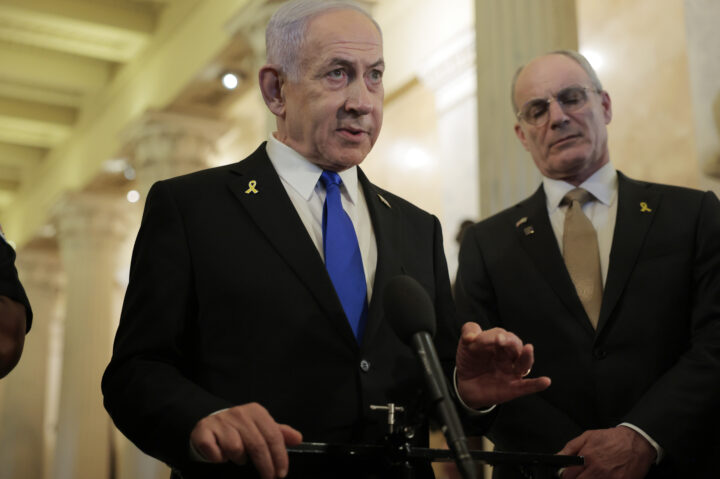
Anna Moneymaker/Getty Images
Israeli Prime Minister Benjamin Netanyahu speaks to reporters after meeting with U.S. Speaker Mike Johnson (R-LA) at the U.S. Capitol on July 8, 2025, in Washington, D.C.
Israeli Prime Minister Benjamin Netanyahu hosted senior administration officials, leaders from Jewish and pro-Israel Christian groups and hostage families for a reception last night at Blair House during his third visit to the United States this year.
Netanyahu was introduced by Paula White-Cain, the senior advisor to the White House Faith Office. “Israel, you are never, never alone,” she told the audience, pledging that evangelicals “will always stand with Israel.”
The Israeli prime minister spoke about efforts to free the hostages, both living and deceased, held in Gaza, saying, “We’re committed to getting every last one out … we don’t leave this sacred mission for a second.” He said he’d arrived a few minutes late because he had been speaking with the Israeli delegation engaging in hostage talks in Doha, Qatar, adding that he and President Donald Trump had spoken extensively about those efforts.
“We are going to succeed, we’ll bring them all home,” Netanyahu said, repeatedly acknowledging hostage family members in the room. “Each family has their own history of suffering, of hope, of prayer. … We do not forget, we will not relent, we’ll get them all home. All of them.”
Netanyahu also said that Iran would have had nuclear weapons within a year if Israel and the U.S. had not struck its facilities. He suggested that the U.S.’ show of force should also put to rest any questions about continued American supremacy in the 21st century, which “bodes well for the future.”
He honored Gen. Erik Kurilla, the outgoing head of U.S. Central Command — a rare public appearance in D.C. for the military leader. Netanyahu said Kurilla is a “commander without peer” whose successor would have “gigantic shoes” to fill, adding that Kurilla’s support has been “truly remarkable.” Netanyahu presented Kurilla with a sculpture made from a piece of an intercepted Iranian missile, featuring a map of Israel, a tree and a dove of peace, which Netanyahu said symbolized “peace through strength.”
Others in the crowded room — forced indoors by a torrential downpour and tornado watch in D.C. — included Education Secretary Linda McMahon, Commerce Secretary Howard Lutnick, Labor Secretary Lori Chavez-DeRemer, Small Business Administrator Kelly Loeffler, Under Secretary of Defense Elbridge Colby, U.S. Ambassador to Israel Mike Huckabee, Rep. Randy Fine (R-FL), Justice Department Senior Counsel Leo Terrell and Israeli Ambassador to the U.S. Yechiel Leiter. Brett McGurk, from the Biden administration’s National Security Council, was also in the crowd.
Jewish leaders in attendance included William Daroff, Elliot Brandt, Jonathan Greenblatt, Nathan Diament, Rabbi Moshe Hauer, former Sen. Norm Coleman (R-MN), Halie Soifer and Brian Romick. Christian leaders who attended included pastors Robert Jeffress, Mike Evans and Mario Bramnick.
The reception was the marquee event between the Israeli leader and officials from American Jewish groups during this visit. During recent visits to the U.S., Netanyahu skipped traditional sit-downs with Jewish leaders. Netanyahu has prioritized engagement with pro-Israel evangelical Christians and political conservatives, sometimes at the expense of more liberal-leaning American Jews.
He said he’s been working on the issue with top administration officials and acknowledged, ‘It’s already been held up too long’

Andrew Harnik/Getty Images
Sen. James Lankford (R-OK) speaks during a news conference on Capitol Hill on May 1, 2024 in Washington, DC.
Sen. James Lankford (R-OK), one of the leading Senate advocates for the Nonprofit Security Grant Program, told Jewish leaders on Wednesday that he is working with administration officials to ensure that NSGP funding moves forward quickly, but acknowledged that it had already taken too long.
Though the administration recently released freezes on reimbursements for past NSGP grants, it still has yet to announce awards for a supplemental grant round for which nonprofits applied in the fall of 2024, and has not yet opened the application for 2025 grants.
“That funding is not at risk. It is going to be let go, and it should be let go very, very quickly,” Lankford told an advocacy group organized by the Jewish Federations of North American and Conference of Presidents of Major American Jewish Organizations.
He continued, “We do have wide agreement to be able to say this needs to be done. It needs to be done faster, rather than slower. It’s already been held up too long. It’s June, almost July. The decision should have already been made to be able to move this.”
The Oklahoma senator, a co-chair of the Senate antisemitism task force, said he’s been in regular contact with Office of Management and Budget Director Russ Vought — seen as a key fiscal hawk inside the administration — about moving the funding ahead.
“He has assured me again that it is moving,” Lankford said, who spoke to Vought on Wednesday. “They are getting all the details worked out. They continue to be able to work with DHS to be able to make sure that funding is moving. That is not at risk. It is caught up in all the initial – we’re holding everything to be able to look at it. But that funding is not at risk.”
Lankford said he’s continuing to engage with the OMB and other parts of the administration, communicating “this is just common sense, that we need to be able to do this.” The senator urged advocates to keep calling their representatives to continue pushing the issue.
Rep. Virginia Foxx (R-NC), the chair of the House Rules Committee and former chair of the Education and Workforce Committee, also addressed the group, and said she plans to introduce legislation regarding Boycott, Divestment and Sanctions policies on college campuses, which is “going to hold the schools responsible for any BDS activity.”
Rep. Randy Fine (R-FL) warned that he plans to excoriate the president of Georgetown University at a congressional hearing next month if the school hasn’t fired a university professor who urged Iran to attack U.S. forces in retaliation for the U.S. strikes on Iran.
Rep. Haley Stevens (D-MI), who is mounting a bid for Senate, told the group that she’s a “proud Zionist” who “stand[s] with the Jewish community to call out rampant antisemitism, disgusting and egregious antisemitism.”
“My name is Haley Stevens, and you will always have a fierce ally in me,” she said.
She said she’s working to increase funding for the NSGP, noting that an attack like the one in Boulder, Colo., could happen at a synagogue in her district or anywhere in the country.
Other lawmakers who attended the meeting included Reps. Jim Jordan (R-OH), Greg Landsman (D-OH), Lisa McClain (R-MI), Josh Gottheimer (D-NJ), Celeste Maloy (R-UT), Gabe Amo (D-RI), Jake Auchincloss (D-MA), Darrell Issa (R-CA), Brad Sherman (D-CA), George Latimer (D-NY), Shri Thanedar (D-MI), Scott Franklin (R-FL), Joe Morelle (R-NY), Randy Weber (R-TX), Gary Palmer (R-AL) and Lois Frankel (D-FL).
CNN reported that an early intelligence assessment by the Pentagon found that the core components of Iran’s nuclear program were still intact

PIROSCHKA VAN DE WOUW/POOL/AFP via Getty Images
President Donald Trump talks to the media during a meeting with NATO Secretary General at the NATO summit of heads of state and government in The Hague on June 25, 2025.
President Donald Trump and other administration officials denied a report that U.S. strikes on Iranian nuclear facilities had only set Iran’s nuclear program back by several months, continuing to insist the nuclear sites were “completely destroyed” and “obliterated.”
CNN reported on Tuesday night that an early intelligence assessment by the Pentagon found that the core components of Iran’s nuclear program were still intact and the regime could continue seeking a nuclear bomb, according to seven people briefed on the matter.
Speaking from the NATO Summit in the Netherlands on Wednesday, Trump told reporters, “That was a perfect operation. … And also, and nobody’s talking about this, we shot 30 Tomahawks from submarines … and every one of those Tomahawks hit within a foot of where they were supposed to hit. Took out a lot of buildings that Israel wasn’t able to get. … This was a devastating attack and it knocked them for a loop. And, you know, if it didn’t, they wouldn’t have settled. … If that thing wasn’t devastated, they never would have settled.”
“I don’t want to use an example of Hiroshima. I don’t want to use an example of Nagasaki, but that was essentially the same thing that ended that war,” he said later. “This ended that with the war. If we didn’t take that out, they’d be fighting right now.”
“It was obliteration,” he said of the U.S. strikes in Iran. “And you’ll see that, and it’s going to come out. Israel is doing a report on it, I understand. … You know, they have guys that go in there after the hit, and they said it was total obliteration.”
“I don’t think they’ll ever do it again,” Trump continued, referring to Iran’s enrichment of uranium. “They just went through hell. I think they’ve had it. The last thing they want to do is enrich.”
The president also posted on Truth Social earlier, saying, “FAKE NEWS CNN, TOGETHER WITH THE FAILING NEW YORK TIMES, HAVE TEAMED UP IN AN ATTEMPT TO DEMEAN ONE OF THE MOST SUCCESSFUL MILITARY STRIKES IN HISTORY. THE NUCLEAR SITES IN IRAN ARE COMPLETELY DESTROYED! BOTH THE TIMES AND CNN ARE GETTING SLAMMED BY THE PUBLIC!”
Middle East envoy Steve Witkoff, speaking to Fox News shortly after the CNN report was released, called the leak “treasonous” and said, “There is no doubt that it [Iran’s nuclear program] was obliterated. So the reporting out there that in some ways suggests that we didn’t achieve the objective is just completely preposterous.” He said it was “not even conceivable” that Iran could still achieve a nuclear weapon within months.
Secretary of State Marco Rubio similarly denied the report but offered a more measured assessment of Iranian nuclear capabilities, telling Politico on the sidelines of the NATO Summit on Wednesday that, “The bottom line is, they are much further away from a nuclear weapon today than they were before the president took this bold action. That’s the most important thing to understand — significant, very significant, substantial damage was done to a variety of different components, and we’re just learning more about it.”
White House Spokesperson Karoline Leavitt said, “This alleged ‘assessment’ is flat-out wrong and was classified as ‘top secret’ but was still leaked to CNN by an anonymous, low-level loser in the intelligence community. … Everyone knows what happens when you drop fourteen 30,000 pound bombs perfectly on their targets: total obliteration.”
A CNN spokesperson said in a statement to Jewish Insider, “CNN stands by our thorough reporting on an early intelligence assessment of the recent strikes on Iran’s nuclear facilities, which has since been confirmed by other news organizations. The White House has acknowledged the existence of the assessment, and their statement is included in our story.”
David Albright, president and founder of the Institute for Science and International Security and an expert on the Iranian nuclear program, called the report “hard to believe” and “misleading.” Among other analyses, he said Iran has “likely lost close to 20,000 centrifuges at Natanz and Fordow, creating a major bottleneck in any reconstitution effort. Moreover, there has been considerable damage to Iran’s ability to build the nuclear weapon itself.”
Please log in if you already have a subscription, or subscribe to access the latest updates.
 Continue with Google

 Continue with Apple