









































































The ad features an Iranian American who pressed El-Sayed to condemn Iran’s Islamic Revolutionary Guard Corps
Getty
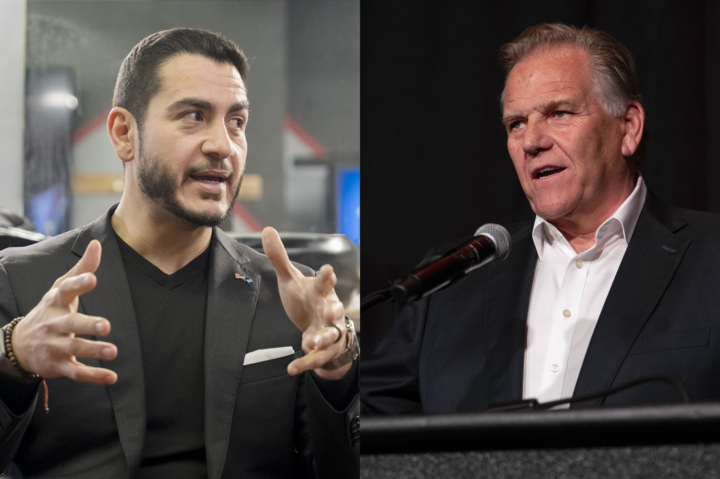
Michigan Senate candidates Abdul El-Sayed and Mike Rogers.


 Add JewishInsider on Google
Mike Rogers, the Republican nominee for Senate in Michigan, released a new ad featuring the University of Michigan student who confronted his Democratic opponent, Abdul El-Sayed, over his positions on Iran and its repressive Islamic Revolutionary Guard Corps in a viral exchange last week.
In the 30-second campaign ad posted on Friday, Iman Dashti, who identifies as Persian American, says that his family “escaped oppression in Iran and found freedom in America,” before calling El-Sayed “a real threat to our national security and our values.”
“Abdul raises money from dangerous people who finance terrorist networks, and his family has been linked to the Muslim Brotherhood and al-Qaida,” Dashti alleges. “I know the threats of radical Islam, and I know Abdul El-Sayed can never, ever be a U.S. senator.”
A spokesperson for Rogers’ campaign confirmed to Jewish Insider the seven-figure ad buy, launched in conjunction with the National Republican Senatorial Committee, is running statewide on digital platforms and will begin airing on TV on Saturday.
The ad comes after Dashti had confronted El-Sayed during a town hall last week at the University of Michigan, pressing the Democrat to unequivocally condemn the Iranian regime. He also voiced dismay over leaked audio in which El-Sayed admitted he did not want to comment publicly on the assassination of Ayatollah Ali Khamenei, Iran’s supreme leader, after he was killed during U.S.-Israeli airstrikes in February at the start of the Iran war.
“That silence had a gaping hole in our community,” Dashti said, asking El-Sayed if he stands “unequivocally against the IRGC,” the Islamic Republic’s hardline military force.
In his response, El-Sayed did not explicitly denounce Iran or the IRGC even as he also clarified during a heated back-and-forth that he wants “freedom and democracy for the people of Iran — no question.”
El-Sayed further confirmed that he will “always stand for and with democratic movements,” but clarified he did not “believe that we were in the right to go to war to topple the government of Iran,” reiterating his criticism of President Donald Trump’s decision to launch a war against the Islamic Republic.
While El-Sayed’s comments drew applause at the town hall, his answers soon faced backlash after they had circulated online. Dashti later went on Fox News to speak out against El-Sayed before shooting the ad for Rogers.
In a social media message accompanying the ad, Rogers said that Dashti “and his family deserve better than someone connected to the Muslim Brotherhood and Al-Qaeda.”
“They deserve someone who stands up to the IRGC, not someone who defends it,” he added. “Michigan deserves better.”
A spokesperson for El-Sayed did not respond to a request for comment about the ad, the latest in a series of attacks from Rogers seeking to cast his opponent as a terrorist sympathizer aligned with extremists.
Rogers, a former congressman who unsuccessfully ran for Senate last cycle, has long been a vocal critic of Iran and had initially backed Trump’s decision to attack the Islamic Republic.
But as the war has emerged as a vulnerability for Republicans amid voter dissatisfaction with rising prices, Rogers has more recently called for an end to the conflict — underscoring a rare point of alignment with El-Sayed in their bitterly contested race to win a key battleground state.
“The war in Iran needs to end, and end quickly,” Rogers argued in an ad his campaign released last month. “When it does, energy costs will plummet — but Michigan families can’t afford to wait for that to happen.”
Stefany Shaheen, the daughter of Sen. Jeanne Shaheen, accused her congressional primary opponent of taking $300,000 in donations ‘bundled from AIPAC donors’
Tom Williams/CQ-Roll Call, Inc via Getty Images
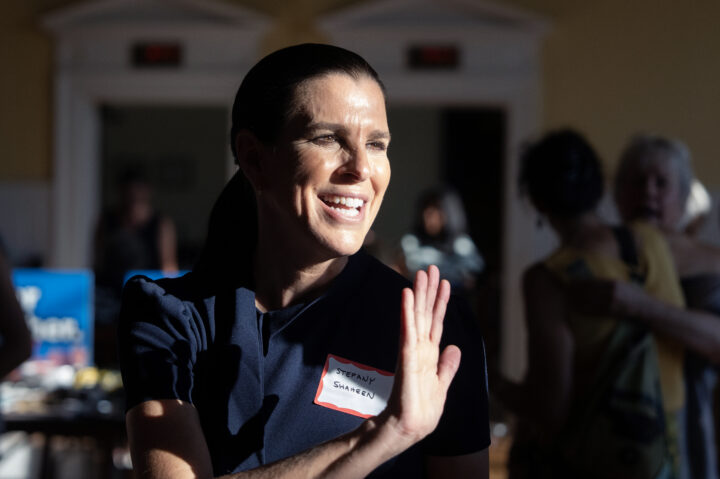
Stefany Shaheen, Democratic candidate for New Hampshire's 1st Congressional District, at City Hall in Dover, N.H., on August 13, 2026.
Stefany Shaheen, the daughter of Sen. Jeanne Shaheen (D-NH) and a candidate for New Hampshire’s 1st Congressional District, launched a TV ad this week hitting her opponent for receiving support from pro-Israel donors.
The ad claims Maura Sullivan, a military veteran, has taken $300,000 in donations “bundled from AIPAC donors,” in addition to support from Jeff Bezos and a contractor for Immigration and Customs Enforcement. The attacks come even as Sullivan has shifted left on Israel policy issues during the campaign.
“Let’s show them New Hampshire’s not for sale,” the ad declares.
The donations referenced in the ad appear to be from individual donors who have previously contributed to AIPAC, referencing a story in the New Hampshire Union Leader. Despite the claims, AIPAC itself has made no endorsement and has not been directly involved in the race — although the grassroots pro-Israel group NORPAC did hold a fundraiser for Sullivan earlier this year.
“Maura has not received any money from AIPAC and would not accept its endorsement if offered,” Emmett Avery, a spokesperson for Sullivan, told HuffPost. Avery also said that Sullivan wants to see a “full reevaluation of the U.S.-Israel security relationship” and that the U.S. can no longer provide a “blank check for offensive weapons.”
Though Sullivan has outraised Shaheen $3.3 million to $2.2 million, limited public polling of the race had put Shaheen ahead until this week. The most recent poll, from St. Anselm College conducted, had the two at a statistical tie, with Sullivan at 26% and Shaheen at 24%. The survey suggests Sullivan is gaining ground — the same poll put Shaheen seven points ahead, 22-15%, in late June, with nearly 50% of voters remained undecided.
The stance expressed by Sullivan’s spokesperson is a shift from her position in an interview with Jewish Insider in 2025, when Sullivan said she would not support efforts to cut off U.S. aid to Israel, and emphasized the importance of the U.S.-Israel relationship even as she criticized the humanitarian situation in Gaza.
Shaheen has said she would have supported an amendment led by Rep. Thomas Massie (R-KY) to cut off $3.3 billion in U.S. aid to Israel in 2027 and her campaign has repeatedly hit Sullivan over alleged ties to AIPAC.
Emma Greenberg, a spokesperson for Shaheen’s campaign, accused Sullivan of being “beholden” to AIPAC and said that Shaeen “supported the Massie amendment to stop sending endless weapons to Netanyahu because she knows change is critical.”
The AIPAC-affiliated super PAC accused El-Sayed of ‘helping Trump win,’ in a continuation of its messaging strategy hitting far-left candidates over their opposition to the Biden administration
Evan Cobb for The Washington Post via Getty Images
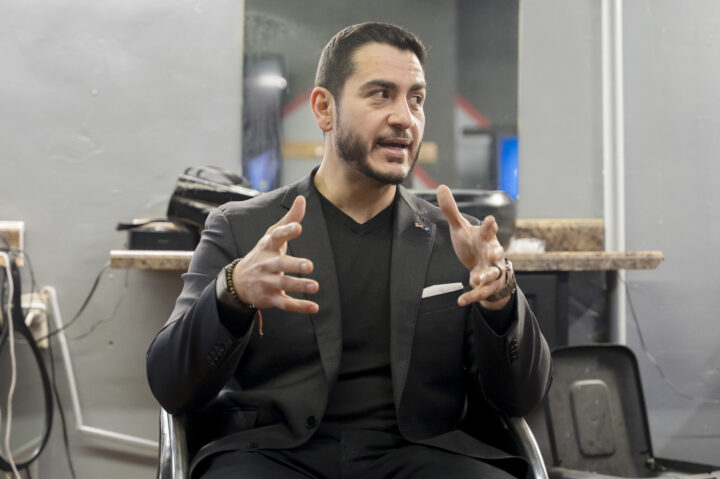
Michigan Senate candidate Abdul El-Sayed speaks with customers and barbers at Blazin Wade Cuts in Grand Rapids, Michigan, on Saturday, Feb. 21, 2026.
United Democracy Project, the AIPAC-affiliated super PAC, is running a new ad targeting Abdul El-Sayed, a far-left Democrat in Michigan’s closely contested Senate primary, over his past support of the “uncommitted” movement and his criticisms of popular Democratic leaders — a messaging strategy the group has used as an effective attack line against anti-Israel opponents in previous election cycles.
The 30-second TV spot, released on Tuesday in advance of the Aug. 4 contest, cites comments in which El-Sayed had criticized Barack and Michelle Obama while accusing El-Sayed of “helping Trump win” the election in 2024 because of his promotion of the “uncommitted” effort that urged Democratic primary voters to leave their ballots blank as a protest against former President Joe Biden’s support for Israel amid the war in Gaza.
“With our democracy on the line against Donald Trump in 2024, El-Sayed told Democrats to vote ‘uncommitted,’ even after Gov. Whitmer warned those efforts would help elect Donald Trump,” the narrator says, referring to Michigan Gov. Gretchen Whitmer, who last week endorsed El-Sayed’s rival, Rep. Haley Stevens (D-MI), a pro-Israel Democrat backed by AIPAC.
“Disrespecting women. Attacking the Obamas. Helping Trump win. That’s the real Abdul El-Sayed,” the ad concludes.
While UDP has invoked similar rhetoric in other ads hitting El-Sayed, the new spot is the first to mention his ties to “uncommitted,” a campaign first launched in Michigan that is emerging as a key point of tension for the insurgent candidate — particularly with Black leaders who believe the movement helped contribute to former Vice President Kamala Harris’ defeat in the battleground state.
An image of Harris is shown in UDP’s new TV ad, but the former vice president is not named directly by the narrator.
UDP is also running two new digital ads — aimed at younger voters ages 18-25 who have been drawn to El-Sayed’s anti-establishment bid — that accuse him of making sexist remarks toward women and saying he was “one of the reasons Trump won,” again referring to his “uncommitted” activism.
Earlier this month, Stevens likewise highlighted El-Sayed’s alignment with “uncommitted,” while alleging he called Harris’ campaign “nauseating.”
El-Sayed, for his part, has sought to downplay his association with the movement, claiming in a recent campaign ad that he was “the first Muslim American leader to endorse Kamala Harris for president,” even as fact-checkers have deemed that statement inaccurate.
In a statement to Jewish Insider on Tuesday, Patrick Dorton, a UDP spokesperson, called El-Sayed “a bad Democrat” who “has repeatedly advocated positions that lose elections for Democrats.”
“That’s why Republicans are desperate to have him be the nominee,” Dorton said. “They know they can beat him.”
A new poll commissioned by the Michigan Education Association, which has not made an endorsement in the primary, found Stevens leading former Rep. Mike Rogers (R-MI), the Republican nominee, by two points in a hypothetical general election matchup, making the race a toss-up. El-Sayed, by contrast, was trailing Rogers by seven points in the open-seat race to succeed retiring Sen. Gary Peters (D-MI), which Democrats see as key to control of the Senate, according to the poll.
El-Sayed, an outspoken critic of Israel, has made AIPAC’s investment in the race a centerpiece of his messaging, as the group has grown increasingly toxic among Democrats. UDP’s spending to help Stevens has so far exceeded $30 million.
The pro-Israel group is also targeting former Rep. Cori Bush (D-MO), who is seeking a rematch in next Tuesday’s House primary in St. Louis against Rep. Wesley Bell (D-MO) — after he unseated her last cycle with a significant financial boost from UDP.
In recent weeks, UDP has run ads attacking Bush for past comments criticizing Biden and Harris, echoing the messaging it deployed two years ago to help oust the former Squad member who was among the most strident critics of Israel in the House.
A new TV ad released by UDP on Tuesday further dinged Bush as an absentee lawmaker who passed “zero bills” in Congress and called her opposition to the bipartisan infrastructure package in 2021 a vote “against Democrats.”
“Cori Bush has her own agenda, and it hurts St. Louis,” the ad claims.
The ad, which is part of a $15 million campaign, will also be featured during NBC’s Olympics coverage

Chris Unger/Getty Images
New England Patriots owner Robert Kraft
For New England Patriots owner Robert Kraft, Sunday’s Super Bowl is about more than his team’s 12th chance at the title. It’s also a national platform for his latest 30-second ad aimed at tackling antisemitism, with more than 100 millions viewers set to tune in.
Titled “Sticky Note,” the commercial features a Jewish student who is bullied in the halls of his school. As he takes off his backpack, he sees a sticky note reading “dirty Jew” was placed on it. In a show of allyship, a classmate approaches the student and puts a blue square piece of paper over the note. “Do not listen to that,” he says.
“I know how it feels,” the student, who is Black, tells his Jewish classmate. As the ad concludes, a statistic reads: “2 in 3 Jewish teens have experienced antisemitism.”
The commercial is the third annual Super Bowl ad produced by The Blue Square Alliance against Hate — the nonprofit founded by Kraft, which rebranded in October from the Foundation to Combat Antisemitism. Since its launch in 2023, the group has popularized blue square pins as a symbol in the fight against antisemitism.
Last year’s ad sparked criticism from some Jewish activists for not focusing on — or even mentioning — antisemitism, as rapper Snoop Dogg and iconic quarterback Tom Brady exchanged deliberately vague insults. Kraft defended the ad in an interview with Jewish Insider at the time, saying, “The challenge is that we just can’t explain the complexity of Judaism or antisemitism in a 30-second ad. But what we can do is invite Americans into a conversation about something they do have experience with: hate.”
This year’s ad takes a more direct approach.
“For the third straight year, the Blue Square Alliance Against Hate is proud to show up on sports’ biggest stage and speak directly to more than 120 million Americans with an urgent message: stand up for each other and stand up to hate wherever you see it,” Kraft said in a statement.
The commercial will also air during the Winter Olympics and is part of a $15 million campaign that additionally includes digital advertisements and billboards.
Please log in if you already have a subscription, or subscribe to access the latest updates.
 Continue with Google

 Continue with Apple