






































Plus, the freshmen of Oct. 7 are seniors now
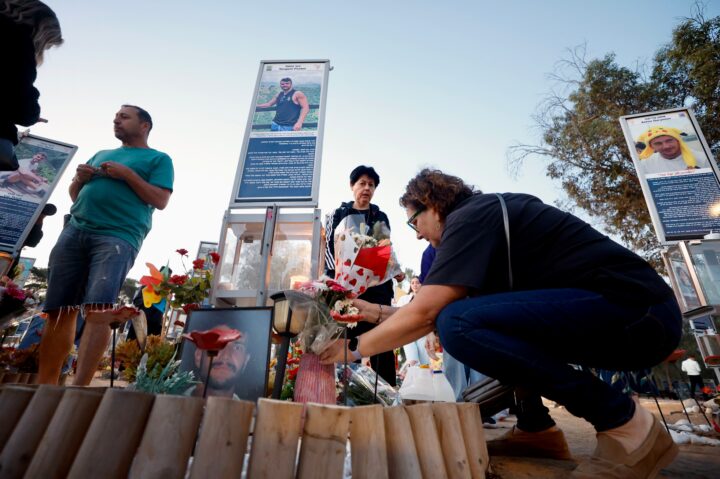
(Jamal Awad/picture-alliance/dpa/AP Images)
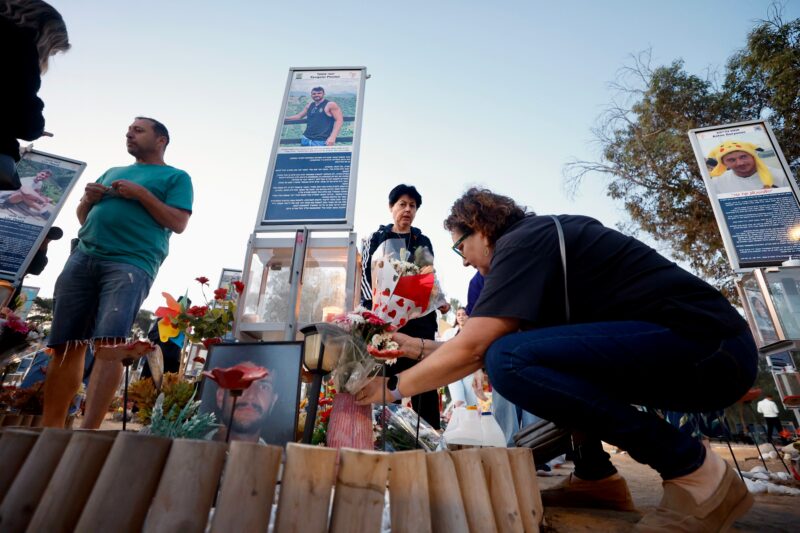
07 October 2026, Israel, Re'im: Mourners place flowers beneath portraits of victims during a memorial at the site of the Nova music festival in Re'im.


 Add JewishInsider on Google
Good Wednesday morning.
In today’s Daily Kickoff, we look at how Israel’s security landscape has changed in the three years since the Oct. 7, 2023, Hamas terror attacks, interview former hostages Keith and Aviva Siegel and Shoshan Haran, and talk to Jewish college seniors about how the events of Oct. 7 and ensuing war in Gaza shaped their university experiences. Also in today’s Daily Kickoff: Sen. Chris Coons, Kevin Roberts and Danielle Bernstein.
Today’s Daily Kickoff was curated by JI Executive Editor Melissa Weiss, with assists from Tamara Zieve and Danielle Cohen-Kanik.
Today’s Agenda
Today marks the three-year anniversary of the Hamas-led Oct. 7, 2023, terror attacks. In Israel and around the world, communities will mark the day with solemn ceremonies and memorials. Ceremonies on individual kibbutzim and at the site of the Nova music festival began as early as 6:29 a.m. local time, marking the minute that the attacks began three years ago.
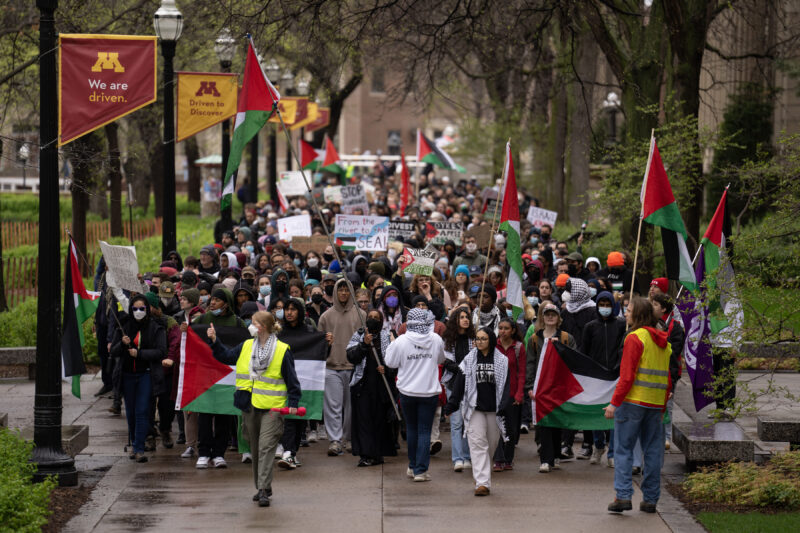
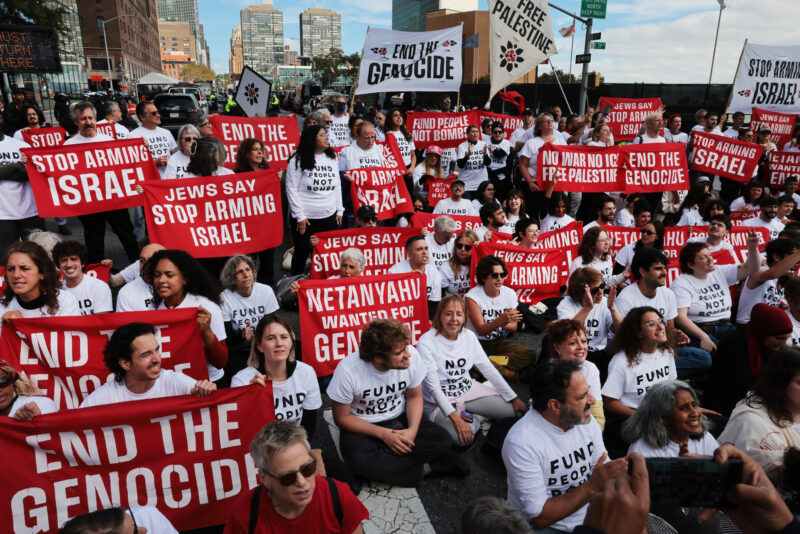
Meanwhile, some will be marking the anniversary by protesting against the Jewish state, including on several college campuses and at New York City Hall, where anti-Israel groups including PAL-Awda, Within Our Lifetime and the youth chapter of the New York City Democratic Socialists of America are promoting a rally with a flyer that features the phrase, “Glory to the martyrs, victory to the resistance.”
Former hostages will be speaking at events marking the day. In Israel, Eli Sharabi is co-hosting a memorial ceremony in Tel Aviv, where he will be joined by other former hostages. In New York, Omer Shem Tov is slated to speak tonight at Yeshiva University, while Or Levy will address a commemoration ceremony on Long Island. Eliya Cohen and his wife, Nova survivor Ziv Abud, are speaking in Boston, and Yosef Chaim Ohana, along with Nova survivor Daniel Sharabi, is speaking at a community memorial in Denver. In France, Omri Miran will speak at the European Union’s official commemoration event.
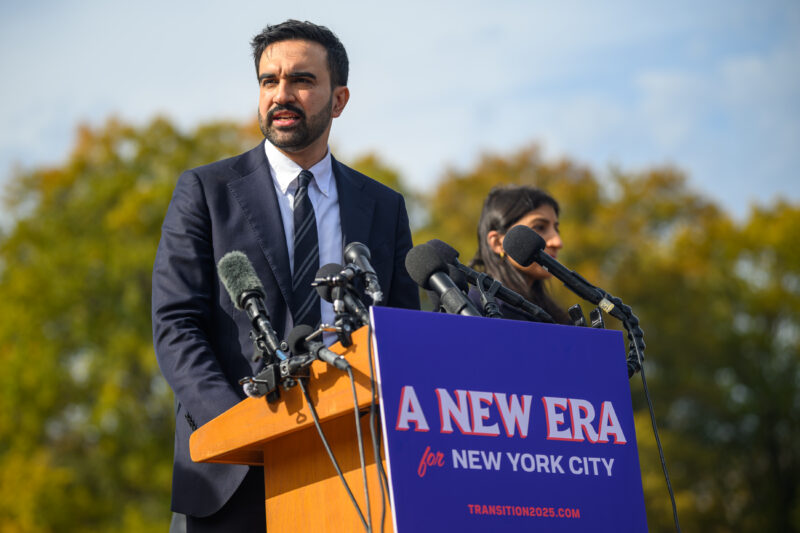
Speaking at a press conference yesterday alongside New York City Mayor Zohran Mamdani, NYPD Commissioner Jessica Tisch vowed that “Jewish institutions will not be left to protect themselves without a strong partner in the NYPD” amid the demonstrations.
Mamdani, for his part, is slated to attend an Oct. 7 vigil today before meeting with Palestinian New Yorkers, according to his official schedule.
One Thing To Know
ANALYSIS
This year, three years since the Oct. 7, 2023, Hamas-led terror attacks, Israelis are marking the first anniversary in which no hostages remain in Gaza. Daily life has shifted to a new phase: one in which fewer reservists are being called up, Tel Aviv’s Hostages Square sits quiet on Saturday nights and Israelis tuning into the evening news normally see something other than war — usually election coverage.
Israelis now face a reckoning on the heels of last week’s FlyDubai attempted hijacking and ahead of the first election since Israel’s south was invaded by thousands of terrorists. The questions that loomed in the wake of the Oct. 7 attacks regarding the security of Israelis and the key role the government plays in that security are again front and center.
The terror attack on a FlyDubai flight bound for Israel, foiled by a miraculous set of events and the bravery of the Indian captain and Israelis on board, serves as a reminder of the threats that Israelis still face — and of the ways in which the institutions designed to protect them failed their societal covenant to do so.
The Big Reads
lessons learned?
On the third anniversary of the Oct. 7, 2023, Hamas-led terror attacks on Israel, the Jewish state’s borders are more secure, but there are still dangers looming and lessons to be learned, according to military and national security analysts. Dan Diker, president of the Jerusalem Center for Security and Foreign Affairs, told Jewish Insider’s Lahav Harkov on Tuesday that Israel “is in a better place in terms of its security. Kinetically, militarily, in counterterrorism and on the battlefield, we are in a much better place,” he said. “We have defensible borders. That’s an important point. It’s not only in Judea and Samaria [the West Bank], but we have them 10 kilometers deep into Lebanon, security zones in [Syria] up to 20 kilometers, and some strategic depth in Gaza. We have multi-border strategic depth that we need to survive, and a consensus that we’re not going anywhere.”
life after captivity
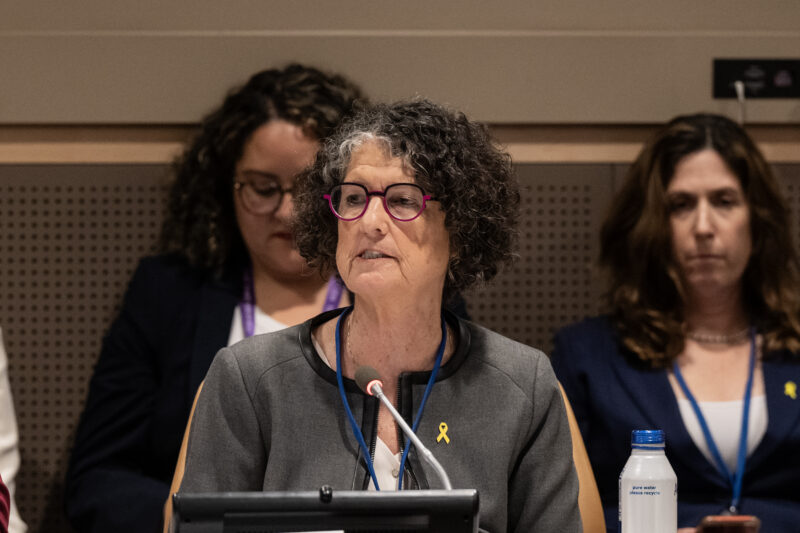
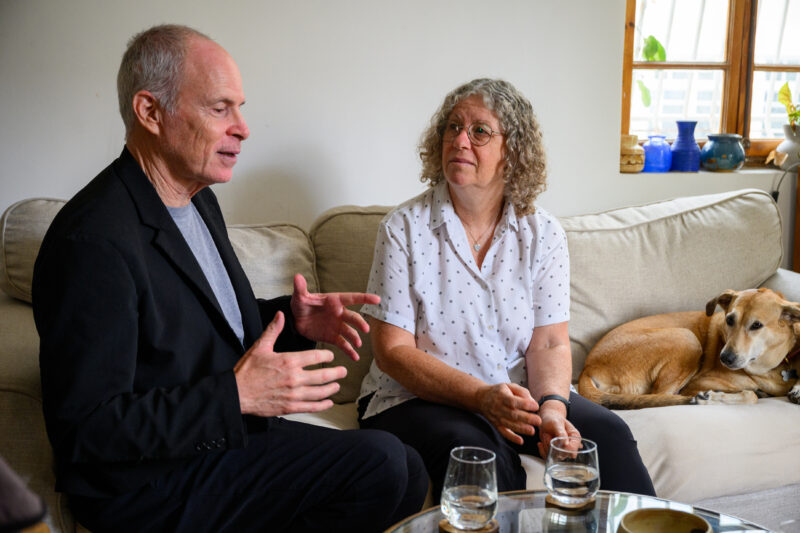
Keith Siegel was held captive by Hamas for 484 days. Of those, 433 were spent apart from his wife, Aviva, who was taken hostage with him but released after 51 days in captivity. “Every day counts,” he was quick to point out on Tuesday, when he and Aviva met with Jewish Insider’s Melissa Weiss in Tel Aviv ahead of the third anniversary of the Oct. 7 Hamas attacks on Israel. “Maybe every hour.” In part to deal with the trauma of her abduction and ordeal in Gaza, Aviva wrote a book about her experiences, Survived to Tell: A Hostage’s True Story of October 7 and 51 Days in Captivity. “I remember thinking, ‘I have to leave all these words for our grandchildren, because if Keith doesn’t come home, and he might never ever come home alive, that they’ll be able to read the love between us and how amazing Keith was,’” Aviva reflected.
Next chapter: On the third anniversary of the attacks, and with every hostage either returned alive or brought home for burial, Kibbutz Be’eri survivor Shoshan Haran, who was, like the Siegels, taken hostage, is allowing herself to think about what comes next. “This is the first anniversary that we can start looking at the future,” she told JI’s Haley Cohen. Her new memoir, Mission in Captivity: One Woman’s Struggle to Survive and Save Her Family in Gaza, is part of that next chapter — an effort to document what she experienced, mourn what she lost and make her voice heard about the events of Oct. 7 and their aftermath.
campus chronicles
Seven months after Hamas’ Oct. 7, 2023, attacks in Israel, Erica Ho stood beneath a Chabad tent on Harvard’s campus and became a bat mitzvah on her 20th birthday. Growing up in Albuquerque, N.M., with a Chinese father and Jewish mother, Ho lived miles away from the nearest synagogue and felt disconnected from the local Jewish community. For Ho and other members of the college class that arrived on campus just weeks before Oct. 7 — most of whom are now seniors — the three years since have become a defining chapter of their Jewish lives. As the third anniversary of Oct. 7 approached, Jewish Insider’s Haley Cohen spoke with three Jewish students who entered college weeks before the attacks.
The Rundown
education consternation
survey says
speaking out
fundraiser fallout
chesapeake challenge
On Our Radar
● The Live Briefing. Word on the street, clips, podcasts and quick updates — the items we’re tracking all day in our Live Briefing on the app (on Apple and Android) and website.
The White House stood by comments made by President Donald Trump on Monday that Iran could “take out” major California cities, including Los Angeles and San Diego; Trump’s comments prompted condemnation from Gov. Gavin Newsom and other state officials…
Vice President JD Vance said that Iran would have to make a “meaningful” change to its enrichment capacity in order to reach an accord with the U.S. to end the war, adding, “If you don’t want a nuclear weapon, then why do you need 60% enriched fuel? And if you want to show commitment to not building a nuclear weapon, don’t build highly enriched fuel. That’s a very basic threshold issue”…
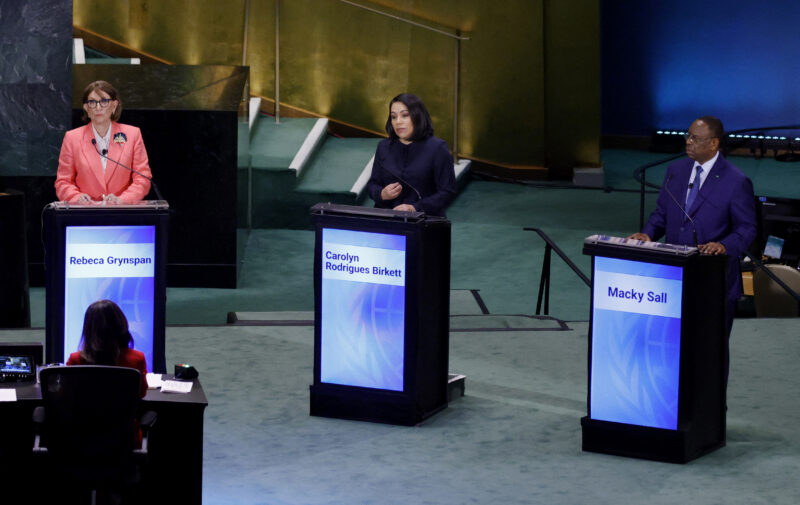
During Maine’s Senate debate last night, Sen. Susan Collins (R-ME) said she supports continued aid at current levels to Israel, while Democratic challenger Troy Jackson said he does not want “any more offensive weapons going to murder people in Palestine”; he added that he believed that Israeli Prime Minister Benjamin Netanyahu is a “war criminal, but Sen. Collins likes him”…
The Cook Political Report shifted its ratings of three key Senate races — in Kansas, New Hampshire and North Carolina — to further favor Democrats…
Heritage Foundation President Kevin Roberts, who had previously defended far-right commentator Tucker Carlson over his friendly interview with white nationalist Nick Fuentes — prompting a series of resignations from the right-wing think tank — told The New Yorker in an exposé on Heritage that he now believes Carlson is “exacerbating antisemitism in America”…
The Wall Street Journal profiles WeWoreWhat founder Danielle Bernstein, who has amassed a large social media following even as she has courted controversies that have garnered her the tabloid nickname “America’s most hated influencer”…
Politico profiles Berlin mayoral candidate Elif Eralp, whose Left Party has galvanized younger supporters even as it faces antisemitic incidents within the party; media have dubbed Eralp the “Berlin Mamdani,” owing to her progressive politics and campaign style, which were influenced by political consultant and Mamdani advisor Morris Katz, who is also advising Eralp…
The New York Times spotlights former hostages Gali and Ziv Berman, twins from Kibbutz Kfar Aza who were among the last living hostages to be released, as they adjust to life post-captivity…
The Wall Street Journal interviews young Americans who chose to immigrate to Israel following the Oct. 7 attacks…
British Airways is set to resume daily nonstop flights between London and Israel on Oct. 25…
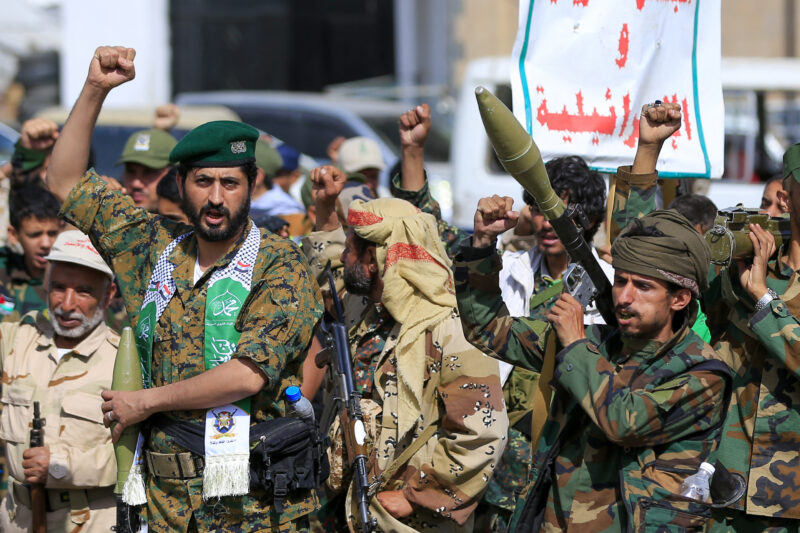
The Iran-backed Houthis in Yemen struck two airports in Saudi Arabia overnight amid a Riyadh-backed effort by Yemen’s internationally recognized government to retake areas claimed by the Houthis…
Counterterrorism officials in the U.K. arrested a seventh man in connection with an investigation into a security incident near the country’s RAF Fairford base, which had been used by the U.S. during its operations against Iran…
Actor Eva Marie Saint, known for her role in “Exodus,” died at 102…
Worthy Reads
Find more Worthy Reads in our Live Briefing via our app (on Apple and Android) and website.
Foreign Influence Peddling: In The Washington Post, Sander Gerber and Eugene Kontorovich argue that the government has a role to play in addressing covert foreign influence operations on social media. “Most of us calibrate our opinions at least in part by watching our neighbors. When a foreign government floods our Instagram feed with counterfeit neighbors, real citizens see a consensus that may not exist — and subconsciously adjust toward it. The deception lies in trying to pass off foreign (and often foreign-based) — and perhaps not even human — messages as apple-pie American.” [WashPost]
Seeing Red Over the Greens: In The Free Press, former U.K. Prime Minister Tony Blair raises concerns about the rise of the country’s Green Party, amid its vote over the weekend in favor of a single Palestinian state. “For most of its history, the Green Party was a party on the margins. Today it is a significant force in British politics. It won its best-ever results in this year’s local elections, and its membership has almost tripled. And it has moved itself, and many of its supporters and sympathizers, from condemnation of Israel’s conduct in the Gaza war to a full-on denial of the State of Israel’s right to exist.” [FreePress]
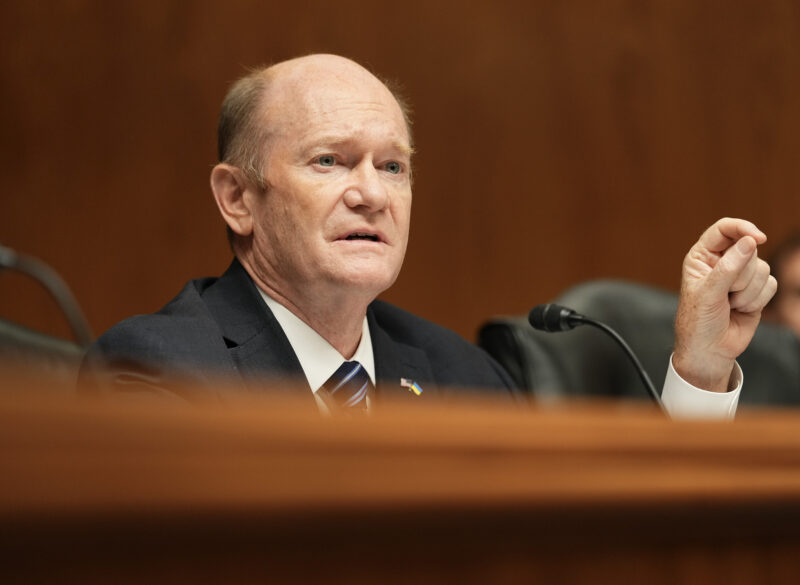
Coons’ New Tune on Israel: Politico’s Daniella Cheslow looks at Sen. Chris Coons’ (D-DE) political evolution on Israel in the three years since the Oct. 7 attacks as he positions himself to assume control of the Senate Foreign Relations Committee if Democrats flip the Senate. “Coons depicted his approach as providing moral clarity to an ally in an uneasy time. Oct. 7, Coons said, made Israelis ‘dramatically more concerned about security and less willing to tolerate or engage in conversations about a two-state solution or a path towards peace with Palestinians.’” [Politico]
Picture of the Day
Birthdays

Matthew Sklar, composer for musical theater on Broadway and the West End, television and film, turns 53
JOHN NACION/GETTY IMAGES
Robert Ian Kaufelt, former owner of Murray’s Cheese, the nation’s leading purveyor of artisanal cheese, turns 79
Allan Nelkin, retired chairman and CEO of Halco Lighting Technologies
Margery Nyberg, Highland Park, Ill., resident
Barry Curtiss-Lusher, co-founder, chair and former CEO of energy company Nexus BSP, he is a former national chair of the Anti-Defamation League, turns 75
Jill Smith, former chair of the Jewish Foundation for Education of Women and chair of the Prize Committee of the Genesis Prize Foundation, turns 73
Bruce Lawrence Bialosky, founder of the Republican Jewish Coalition of California and a former member of the U.S. Holocaust Memorial Council, turns 73
Ron Vosatka, former deputy director of community security at the Jewish Federation of Palm Beach County
Michael W. Sonnenfeldt, entrepreneur and political activist, he co-founded the Israel Policy Forum in 1993, turns 71
Kenneth L. Marcus, founder and chair of the Louis D. Brandeis Center for Human Rights Under Law, he served as assistant secretary of education in the Trump administration, turns 60
Eli Saulson, president of Detroit’s Imperial Management and a board member of the William Davidson Foundation
Gabriele Corcos, creator, host and producer of “Extra Virgin” on the Cooking Channel, turns 54
Rabbi David-Seth Kirshner, rabbi of Temple Emanu-El in Closter, N.J.
Arie Lipnick, political fundraiser and strategist, advisory board chairman of the Combat Antisemitism Movement
Michael Malchieli, member of the Knesset for the Shas party and former minister of religious affairs, turns 44
Natalie Lascar Lefkowitz, SVP of the leadership institute at AIPAC
Adam Teitelbaum, founder of Level III Industries after holding roles at the Jewish Federations of North America, AIPAC and AEPi
Daniel Mael, CEO of Holbrook, N.Y.-based MW Impressions
Tayla Harris, executive assistant for global client operations at WPP
Barbara Martinez, an original Politico staffer, now a manager of editorial and content strategy for the U.S. Holocaust Memorial Museum
Sam Schear, principal on the real estate team at Korn Ferry
Tamara Harel-Cohen, co-founder and chief growth officer at Riseup
On the third anniversary of the attacks, and weeks before the first election since, a foiled midair hijacking has revived the question of whether Israel's institutions can protect its citizens
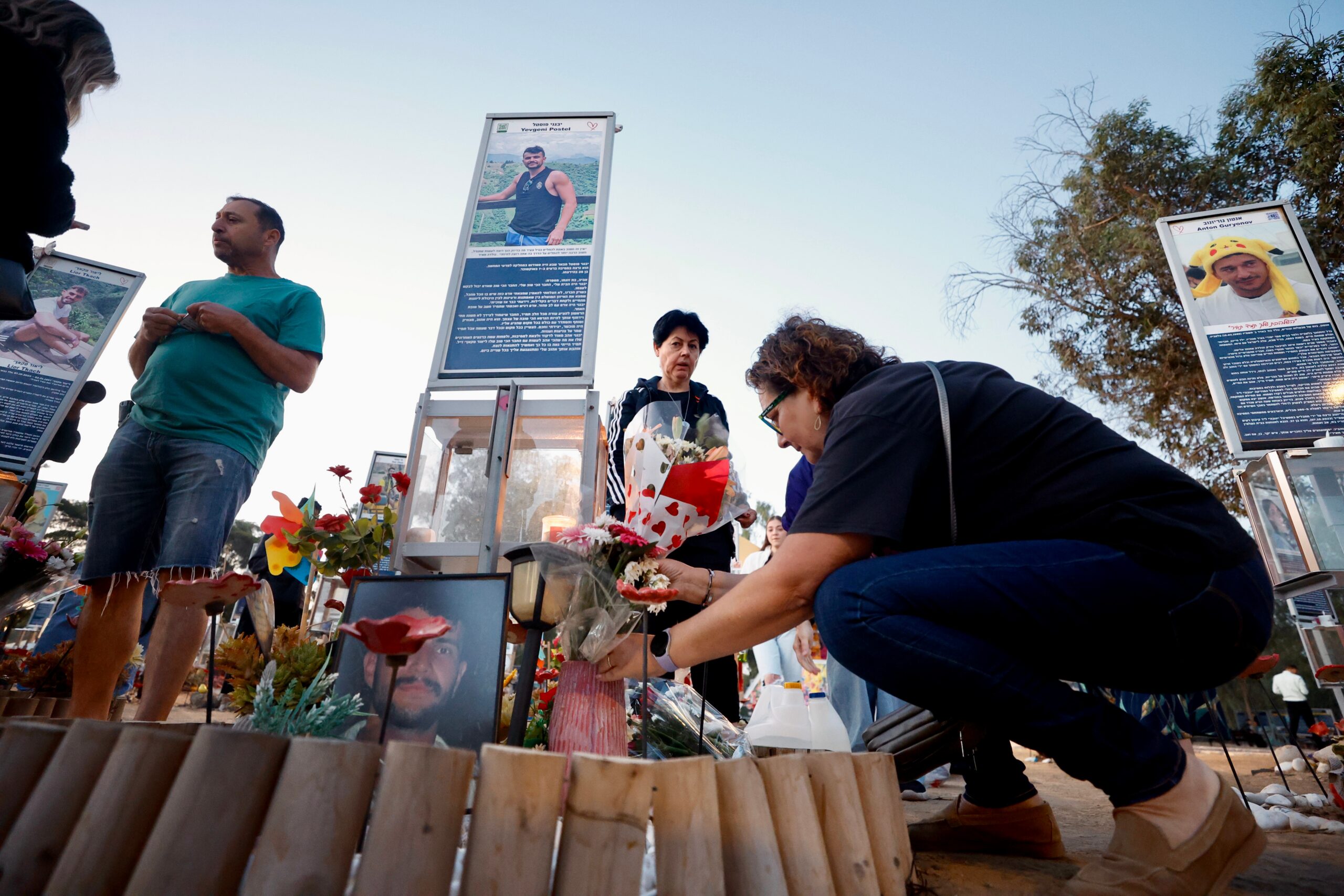
(Jamal Awad/picture-alliance/dpa/AP Images)
07 October 2026, Israel, Re'im: Mourners place flowers beneath portraits of victims during a memorial at the site of the Nova music festival in Re'im.
This year, three years since the Oct. 7, 2023, Hamas-led terror attacks, Israelis are marking the first anniversary in which no hostages remain in Gaza. Daily life has shifted to a new phase: one in which fewer reservists are being called up, Tel Aviv’s Hostages Square sits quiet on Saturday nights and Israelis tuning into the evening news normally see something other than war — usually election coverage.
The threats, too, have shifted. Just over a month after the return of the body of the last remaining hostage in Gaza in January, Israelis faced six weeks of war with Iran, which shuttered schools and businesses and sent many Israelis scrambling — again — to find a way out of the country, some for the duration of the war and some more permanently.
In that year since, many of the pre-Oct. 7 debates in Israeli society have reemerged: judicial reform, Haredi enlistment, cost of living, Israeli Prime Minister Benjamin Netanyahu’s corruption case and the ongoing strife between religious and secular that plays out in myriad ways.
On the heels of last week’s FlyDubai attempted hijacking and ahead of the first election since Israel’s south was invaded by thousands of terrorists — Israelis face a reckoning. The questions that loomed in the wake of the Oct. 7 attacks regarding the security of Israelis and the key role the government plays in that security are again front and center.
The terror attack on a FlyDubai flight bound for Israel, foiled by a miraculous set of events and the bravery of the Indian captain and Israelis on board, serves as a reminder of the threats that Israelis still face — and of the ways in which the institutions designed to protect them failed their societal covenant to do so.
On Oct. 7, 2023, Israelis across the south found themselves vulnerable and defenseless — a particularly jarring feeling for a country that believes itself to be a military superpower in the region. Warnings about potential border threats from both within, and as recently reported, from Arab states in the region, had gone unheeded — in some cases, summarily dismissed by senior military intelligence officers as impossible, only to be proven painfully accurate. Some of the soldiers previously stationed in the Gaza border region had been reassigned to the West Bank to protect settlers during the holiday season.
And in the days and weeks after, it was not the government, but ordinary people, who stepped up. The communications professionals who gathered hostage families into a more coordinated voice. The restaurants that turned into assembly lines, packing meals for displaced Israelis. The therapists who provided grief counseling to survivors. The Jewish federations that provided emergency grants to displaced communities. The Diaspora Jews who paid for plane tickets so Israeli reservists could fly home and join their units. The Zaka volunteers, forensic teams and medical professionals, who took on the grimmest tasks: collecting, identifying, cataloguing and burying the remains of the nearly 1,200 people killed that day.
Not all of these civilian efforts were necessarily effective — amateurs can be expected to make amateurish mistakes — but at a time when survivors and victims were not receiving the governmental help they desperately needed, ordinary people stepped in to fill that void.
Today, a week after the FlyDubai attack, details are emerging about the security lapses — Emirati, Omani and Israeli — that led a co-pilot who had been banned from flying by a previous employer over his extremist, Islamist beliefs to be assigned to a flight to Israel.
As more information is revealed about last week’s midair melee, a similar feeling is emerging: that the government institutions meant to protect citizens fell short, forcing ordinary folks — an Indian captain, a dentist, a plumber with a penchant for watching air-disaster reality TV — to act in extraordinary ways to avert disaster.
Oman Air officials failed to elevate their concerns about Hamam al-Hammami, who was assigned to a desk job and forced to take a reeducation program. FlyDubai appeared not to have contacted Oman, though it did conduct a background check. He was hired by the low-budget airline earlier this year.
Last week, as is standard practice, Emirati officials gave the flight’s manifest to Israeli authorities, whose job is, ostensibly, to make sure that those flying to the Jewish state do not intend to cause harm to the people there, or on board. But Israel’s Tax Authority, which has since 2023 received the lists and put them in a database, did not share the information with the Ministry of Transportation, under whose purview FlyDubai and other foreign carriers rest. The Ministry of Transportation, for its part, says that it did not think it had the ability or authority to vet foreign flight crews.
Netanyahu tasked the National Security Council with appointing an investigator to probe the incident, a move that garnered criticism from former National Security Advisor Eyal Hulata, who said blame for the incident lay in part with the NSC itself, which had in 2024 and 2025 issued warnings that the government had not been adequately vetting the manifests of foreign airlines.
Hulata said that Netanyahu has “the same outlook” on the FlyDubai incident as he did on the Oct. 7 attacks, for which no state commission of inquiry has been established. Netanyahu’s refusal to authorize an official inquest into the Oct. 7 attacks has been a frequent criticism made by, among others, survivors of the attacks, relatives of those killed and Netanyahu’s political opponents.
The most recent annual Democracy Index from the Israel Democracy Institute, released in December 2025, found that the Israeli government, the Knesset and the country’s political parties had the lowest levels of trust among Israeli respondents, falling below the Israeli president, Israel Police and even the media.
Can the Israeli institutions entrusted with protecting the Israeli people actually do so? The FlyDubai attack has resurfaced that question as Israelis prepare to choose their first new government since Oct. 7.
When Israelis head to the polls in 20 days, many will ask themselves not just, “Am I better off now than I was four years ago?” but, “Am I safer now than I was four years ago?” It’s a question that is less about Hamas, Hezbollah, Iran, the Houthis and the many other threats facing Israelis and Jews around the world, and more about the government’s ability to act as a protector. Oct. 7 and the FlyDubai attack prompted ordinary Israelis to fill the voids left by government failure. When voters head to the polls later this month, one question they will have to answer is whether they believe they should still have to.
Three students who arrived on campus weeks before the attacks describe how the past three years reshaped their Jewish identities, through religious observance, community and activism

(Courtesy Erica Ho)
Erica Ho celebrates her bat mitzvah at Harvard Chabad
Seven months after Hamas’ Oct. 7, 2023, attacks in Israel, Erica Ho stood beneath a Chabad tent on Harvard’s campus and became a bat mitzvah on her 20th birthday.
Growing up in Albuquerque, N.M., with a Chinese father and Jewish mother, Ho lived miles away from the nearest synagogue and felt disconnected from the local Jewish community. When she arrived at Harvard in September 2023 — never having celebrated a bat mitzvah — she described herself as “technically Jewish.”
For Ho and other members of the college class that arrived on campus just weeks before Oct. 7 — most of whom are now seniors — the three years since have become a defining chapter of their Jewish lives.
As the third anniversary of Oct. 7 approached, Jewish Insider spoke with three Jewish students who entered college weeks before the attacks, expecting the next four years to be defined by the ordinary milestones of young adulthood.
Instead, on campuses from Cambridge to Los Angeles to Washington, D.C., the historic rise in antisemitism and protests over Israel that followed the attacks and the ensuing war in Gaza thrust students into Jewish communities and political fights they had not expected to join — reshaping their college experiences and, in some cases, their plans for life after graduation.
According to Jewish Federations of North America data, college students are a key driver in the nationwide rise of Jewish engagement since the fall of 2023, which the group has dubbed “the surge,” even as reported antisemitic incidents on campuses have also surged.
For Ho, an environmental science and economics major, the transformation began almost immediately after the attacks. A week after Oct. 7, Harvard Chabad held its annual “Shabbat 1,000” dinner, bringing hundreds of students together at a moment when many were unsure whether it was safe to gather publicly as Jews. Ho remembers weighing the risks before deciding to attend.
“There’s a camp that was, ‘This is not the event to sit out,’” she recalled. “If there’s anything to do right now, it’s to gather and show Jewish people are resilient.”
Ho had not come to Harvard looking for a Jewish community. But in the months that followed, she became increasingly involved with Chabad, joining its board as a sophomore and participating in weekly Torah learning. In May 2024, she celebrated her 20th birthday by becoming a bat mitzvah on the Cambridge campus — an experience she describes as a commitment to Judaism for the rest of her life.
Her experience was distinct from that of many Jewish students who came to Harvard with a strong sense of Jewish identity. Because Ho is half Chinese and does not consider herself visibly Jewish, she said she did not personally experience much of the antisemitism that roiled the Ivy League campus and made other students seek out Jewish spaces for safety. Instead, she was drawn in by what she saw as a newfound confidence and solidarity within the Jewish community.
“I think what Chabad, and other Jewish campus communities, did a good job of after Oct. 7 was not retreating into hiding,” she told JI. “I remember there being a huge amount of support and vocalism.” That atmosphere, she said, made Jewish spaces feel “much more vibrant” — and helped give her the confidence to claim an identity she had once barely felt connected to, one she wants to continue pursuing post-graduation.
For Delilah Hirshland, a history and political science major at the University of California, Los Angeles, her path into activism began not with a Jewish gathering but with the shock that came from learning that people she had just met in her first weeks of college justified the attacks on Israel, bringing about a desire to surround herself with like-minded peers instead.
“Oct. 7 happened at the end of my second week here. For those first two weeks before, I spent a lot of time getting to know people in my dorm and people in my majors — very much in the humanities sphere,” she told JI. “After the attacks, the people I had met started to post things saying that Hamas was justified. It was shocking for me. It quickly threw me into this world of Israel activism and Jewish life.”
Hirshland serves as co-president of UCLA’s Students Supporting Israel chapter. “SSI, Hillel events and Jewish life in general have been my main support system over these years,” she said.
“I don’t think I would be involved in Jewish life and Israel advocacy if the attacks didn’t happen. I think about that a lot. I personally became more conscious of my identity and of my beliefs,” Hirshland said, noting that she also saw a shift in the school administration’s attitude towards pro-Israel students.
“At first, they were hesitant to publicly take our side — especially later in freshman year with the encampments. Our new chancellor [Julio Frenk] is very supportive of us,” said Hirshland.
For Jacob Intrator, Oct. 7 and its aftermath ultimately changed the course of his college career, and what comes next.
Intrator arrived at Georgia Tech in fall 2023 with little connection to Jewish campus life. But after Oct. 7, he began reconsidering what he wanted from college and ultimately transferred to Georgetown, a Catholic university where he said, ironically, he found what he had been missing: a Jewish community and, amid increasingly intense battles over Israel, a cause he felt compelled to fight for.
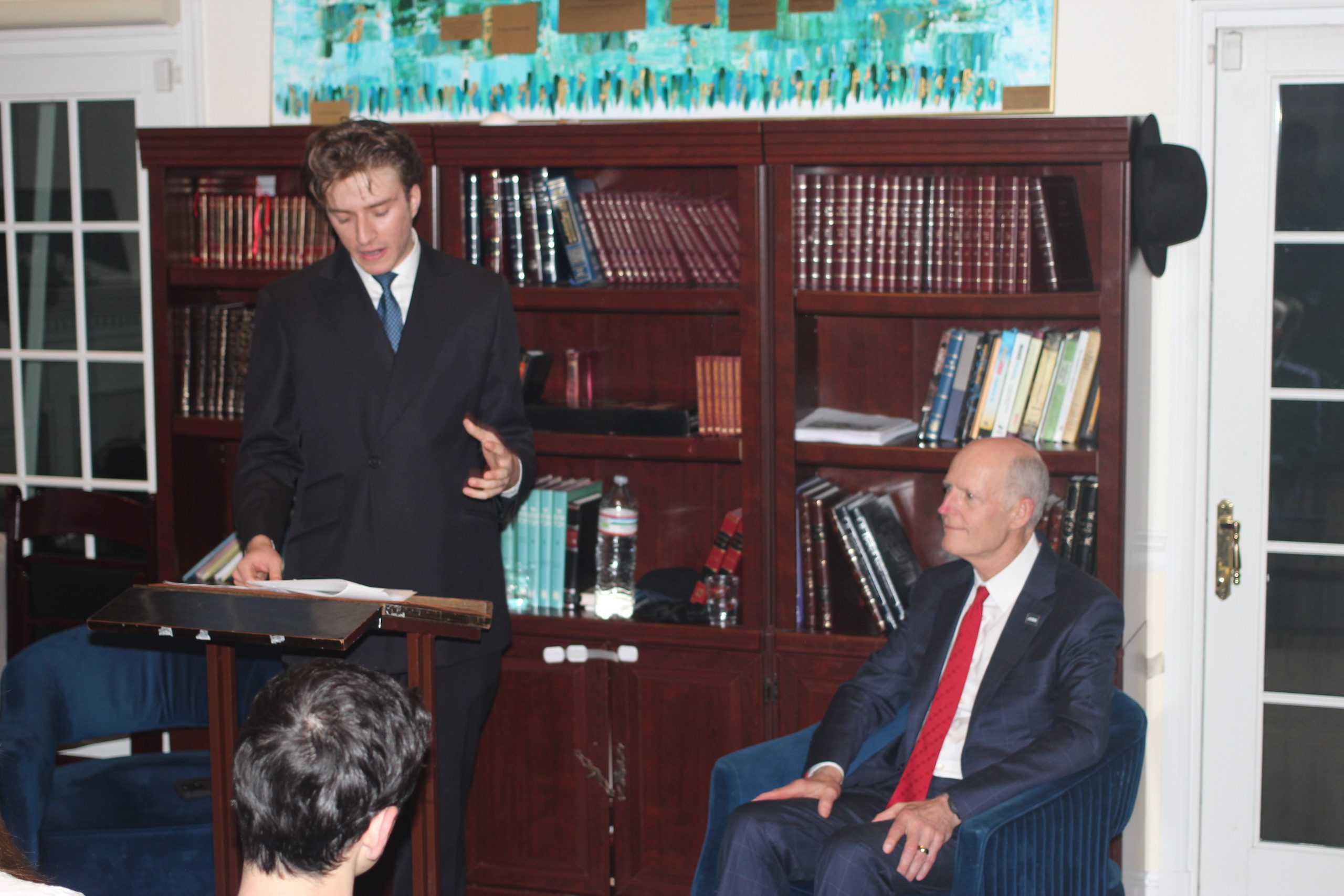
When he arrived at Georgetown in spring 2025, a student government referendum calling for the university to divest from Israel became an early challenge. Intrator, then new to the campus, organized against the referendum, writing to administrators that the measure had been passed in violation of student government rules. The letter attracted the support of members of Congress and ultimately helped spur the university to reject the referendum.
But Intrator didn’t stop there. He became president of the campus chapter of Students Supporting Israel, then ran a slate of candidates for student government, arguing that students who opposed the referendum needed a voice in the body that had passed it. The slate won, and Intrator became vice speaker of student government.
“[My advocacy] really only originated once I got to Georgetown,” Intrator, a government and economics major, told JI. “I saw more passion for pro-Israel politics here, but I’ve also seen a lot of hatred for it, and a lot more antisemitism than I had ever seen before. Unlike when I was at Georgia Tech, here I saw it as my duty to fight for Israel.”
“At Georgia Tech, I was studying engineering. My life now is quite a reversal,” he continued.
Intrator is considering a future in politics, motivated in part by what he sees as a need for younger voices to engage in debates over Israel and antisemitism.
“After I graduate, I have an interest in getting involved in politics outside of college. When you look at polls, you see the numbers in which young Americans are turning against Israel and in many ways against the Jewish people. People complain about having 60-year-old politicians lecturing the 30-year-old generation. They want younger people who understand the problems they have. That’s animating my involvement in politics,” he said.
“I want to be a voice and a platform for my generation.”
For all three students, Oct. 7 became a defining moment in their college careers. The aftermath became about more than responding to a moment of crisis: It pushed them to define their Jewish identities in ways they had not anticipated when they arrived on campus — whether through religious observance, Jewish community or political activism — suggesting that for a generation of Jewish students, the campus upheaval of the last three years may have lasting consequences far after graduation.
Their experiences are part of a broad shift that Rabbi Hirschy Zarchi, who leads Harvard Chabad, has watched unfold on his campus and others since Oct. 7. Students who arrived with varying levels of connection to Judaism, he said, have emerged with a stronger sense of Jewish identity and responsibility.
“In this challenging period for our people and the world, I observed young people deepen their Jewish identity and belonging, and double down on their Jewish pride and responsibility,” Zarchi told JI. “The Jewish future will be led by the young, courageous leaders who have emerged at this time.”
Michael Needham said the 9/11 attacks and Oct. 7 were flashpoints in an ongoing ‘battle between civilization and barbarism,’ at an event commemorating the third anniversary of the Hamas attacks

Marc Rod
Michael Needham, the deputy U.S. national security advisor, addresses an event organized by the Israeli Embassy in Washington to commemorate the third anniversary of the Oct. 7 Hamas-led terror attacks, Oct. 5, 2026
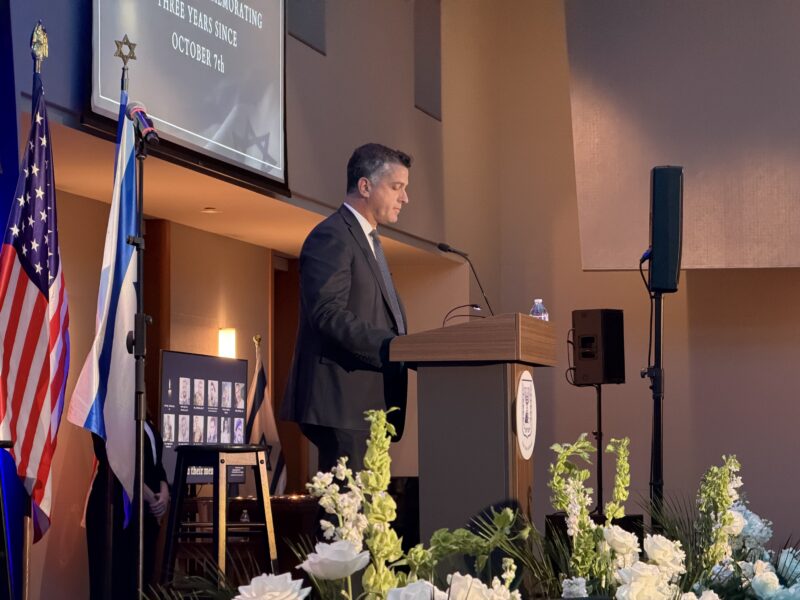
Michael Needham, the deputy U.S. national security advisor, said on Monday that the Oct. 7, 2023, Hamas-led attacks on Israel and their aftermath are part of a shared civilizational war pitting the United States, Israel and other allies against enemies of the West.
The Oct. 7 attacks were met with praise and “gleeful celebration of inhuman barbarism, savagery and death” both in Gaza and around the world, Needham said in remarks at an event organized by the Israeli Embassy in Washington to commemorate the third anniversary of the attack.
“What was clear then is that each of our countries is locked in a battle between civilization and barbarism,” Needham said. “That the war between the people of Israel and the terrorists of Hamas is a war that is playing out in various forms, here in the United States and in Europe and across the whole of the Western world.”
He said that the 9/11 attacks and Oct. 7 are just a few flashpoints in that ongoing war.
“The question that all of us face is not merely whether we are on the side of civilization; it is what cost are we willing to pay to defend it?” Needham said. “For the people of Israel, this is not a hypothetical question; it is one you have answered in full. In the aftermath of Oct. 7, the people of Israel revealed themselves to be a nation whose citizens were willing to answer the call, to lay down their lives if necessary, when their country needed them.”
Needham described that spirit as the essence of patriotism, to stand up for one’s nation “precisely when it calls on him to sacrifice the things that he holds most dear.”
“The forces of barbarism worship death; they seek it out as an end unto itself. Those who choose to defend civilization may be willing to die for our cause, but it is only because we love and value life that we choose to sacrifice everything to defend it,” Needham said. “Over the last three years, the people of Israel have chosen life to fight and suffer and sacrifice for it, and civilization will continue to prevail so long as our nations are blessed by heroes.”
Needham described Israeli Ambassador to the U.S. Yechiel Leiter — who remains in Israel caring for his son, who was critically injured in an attack last month while serving in the West Bank — and his family as a “living testament” to that spirit of patriotism. Leiter lost another son who was killed in November 2023 while serving in Gaza.
The event, hosted by Washington Hebrew Congregation, also featured a candle lighting by Bureau of Alcohol, Tobacco, Firearms and Explosives Director Robert Cekada, remarks by Israeli Deputy Chief of Mission Nevo Barchad and a former spokesperson for the Israeli Defense Forces, as well as a musical performance by musician Gilad Segev and his group, Project Heroes, which commemorates victims and heroes of Oct. 7.
The audience of several hundred included American Jewish leaders, other administration officials, military officials and international diplomats, among others.
Like Needham, Barchad emphasized that the ideology of Hamas was “glorified even in the free world.” He said that Leiter had been hoping to speak about the way that anti-Israel and antisemitic hate has proliferated through schools, social media, courtrooms, government and more.
“Facts don’t matter anymore,” Barchad said. “Hamas’ attempted genocide was minimized, and immediately Israel stood accused of genocide. Israel is then accused of deliberately starving Gaza, no matter how much humanitarian aid we facilitated into the strip.”
He also emphasized the role that Iran and Hezbollah had played in supporting the Oct. 7 attacks.
“Together with America, our greatest ally, we have worked to dismantle the threat,” Barchad said, adding that going forward, Israel must dismantle terrorist groups rather than attempt to constrain them; must work to reform education in the Palestinian territories to stop indoctrination; and cannot overlook attempts to delegitimize Israel in the United Nations, online, on college campuses and in Congress.
“We now know that many Western leaders do not understand that appealing to their domestic political bases by vilifying Israel threatens their own societies, just as it threatens ours,” he said. “The West and moderate Muslim countries must confront terrorism by pursuing terrorists, designating terrorist organizations, disrupting their funding and prosecuting those who support or enable them.”
But he also said that the attack and the ensuing war have shown the strength of Israelis and the Israeli youth — “the greatest generation of Israelis ever” — and that Israel’s enemies cannot destroy it or its “resolve, courage or resourcefulness.”
The event was scheduled to take place Sept. 30; plans for rescheduling remain unclear

CHANDAN KHANNA/AFP via Getty Images
Pictures of Oct. 7 hostages and victims are seen President Donald Trump speaks during a remembrance event to mark the first anniversary of the Hamas attack on Israel at Trump National Doral golf club in Miami, Florida, on October 7, 2024.
The State Department on Monday postponed a memorial event for the Oct. 7, 2023, Hamas attack on Israel that was scheduled for Sept. 30.
The memorial event, organized in collaboration with the American Jewish Committee and at the urging of the families of former American hostages held in Gaza, was set to focus on the 46 Americans killed on Oct. 7 and in Hamas custody in the years following the attack.
The State Department did not immediately respond to a request for comment on the reasons for the delay or when it plans to reschedule the event.
The American Jewish Committee is helping to bring victims to Washington for the Sept. 30 event
CHANDAN KHANNA/AFP via Getty Images
Pictures of Oct. 7 hostages and victims are seen President Donald Trump speaks during a remembrance event to mark the first anniversary of the Hamas attack on Israel at Trump National Doral golf club in Miami, Florida, on October 7, 2024.
The State Department is planning a memorial ceremony for American victims of the Oct. 7, 2023, Hamas attacks on Israel, currently scheduled for Sept. 30.
The event is being planned in collaboration with the American Jewish Committee, which is helping to bring families of the victims to Washington to attend the ceremony in Foggy Bottom, an AJC spokesperson told Jewish Insider.
Ruby Chen, father of Itay Chen, an American citizen killed by Hamas on Oct. 7 whose body was taken hostage in Gaza for more than two years, has been advocating for a memorial for the 46 Americans killed on Oct. 7 and in Hamas custody.
Chen told JI earlier this month that he had been in touch with senior members of the administration about a potential memorial, and that they had expressed support.
The potential presidential contender said he could give Piker ‘a two-by-four upside his head’ over his comments that pro-Israel Jews invite violence against themselves
Bryan Bedder/Getty Images for Theodore Roosevelt Presidential Library
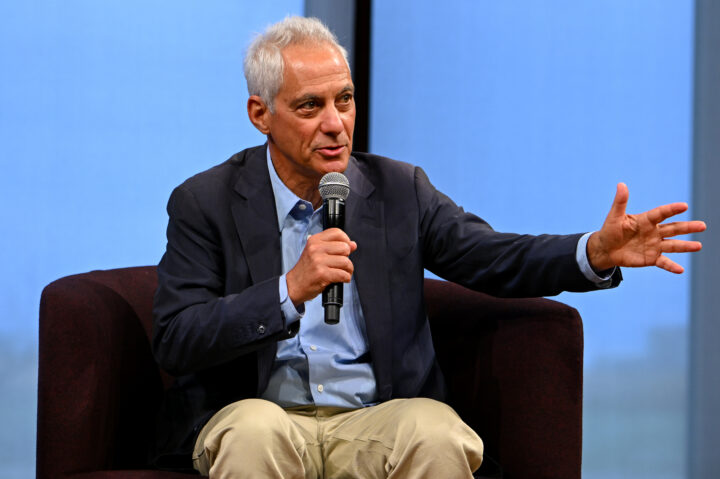
Rahm Emanuel speaks at the Theodore Roosevelt Presidential Library on July 3, 2026 in Medora, North Dakota.
Rahm Emanuel, the veteran Democratic operative and former mayor of Chicago who is now mulling a presidential bid in 2028, said he would go on Hasan Piker’s Twitch show to give the antisemitic streamer “a lesson in what he is perpetuating and the advocacy and the rhetoric of what he’s doing.”
“I can give him a two-by-four upside his head because of what he said,” Emanuel said in a CNN interview on Monday, referring to recent comments in which Piker had claimed that Jews who support Israel are inviting violence against themselves.
Emanuel’s characteristically tough-talking rhetoric came months after he confirmed to Politico in March that he was open to appearing on Piker’s show, with a spokesperson saying at the time he “is always willing to have difficult conversations with anyone about the future of the country, and to tell people he disagrees with why they’re wrong.”
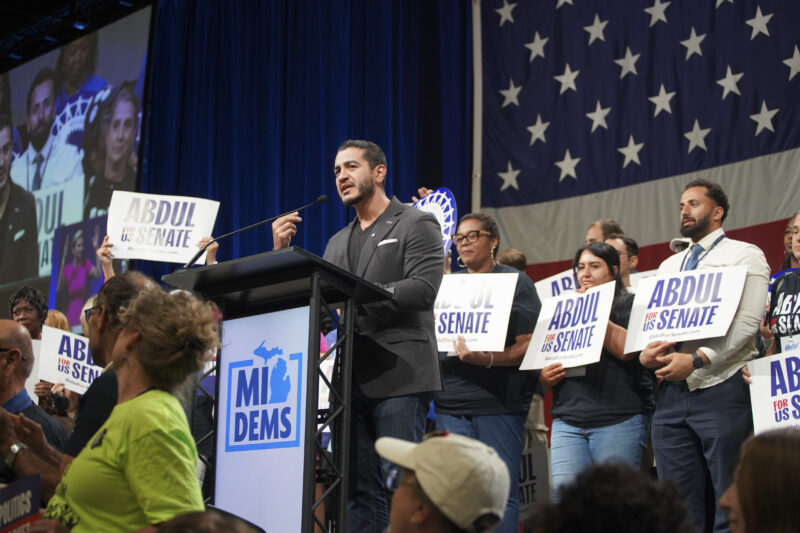
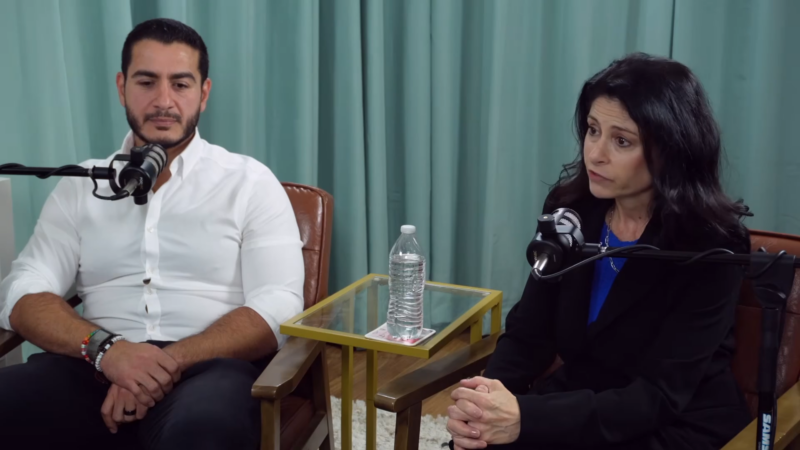
Piker’s relationship to the party has emerged as a Democratic flashpoint, most notably in Michigan’s heated Senate race, where the Democratic nominee, Abdul El-Sayed, has recently sought to distance his campaign from the controversial streamer as he has faced widespread backlash over his comments about pro-Israel Jews.
“What he said the other day, I think I’m glad he said it,” Emanuel said of Piker, “because it’s out front that somehow we invited the violence against ourselves.”
Emanuel, who is Jewish, said Piker “needs to be challenged” over such claims. “Anybody associated with that rhetoric needs to disassociate with them, because if it was any other group in America — any other group — people would be worked up and in a tizzy, appropriately.”
“Now, if this was any other constituency, the party would deal with this,” he added in the interview with CNN’s Kasie Hunt on Monday. “But everybody seems to be like, ‘Oh, this is OK, whatever.’ You also have a person who thinks 9/11 is OK,” a reference to Piker’s assertion that America deserved 9/11, comments the streamer has since said used “imprecise” language.
Though many Democrats have rejected Piker, others have defended the streamer or downplayed his ties to the party, calling such debates a distraction or a Republican talking point.
But in a moment of rising antisemitism in both parties, Emanuel said Democrats are discrediting themselves if they cannot unanimously condemn Piker for his offensive statements. “If I can’t say it about him, you clearly can’t attack people who go around chanting ‘the Jews will not replace us,’ and have a president of the United States saying ‘there are good people on both sides,’” he argued, alluding to the violent neo-Nazi rally in Charlottesville, Va., in 2017.
“My point is we need to deal with this out front,” Emanuel said, adding: “But everybody seems to get tongue-tied when it comes to antisemitism, and that to me is unacceptable.”
Despite his words of warning, Emanuel bristled at the suggestion that Jewish Democrats feel alienated within a party they have long called home, saying the surge of antisemitism transcends traditional partisan boundaries.
“It’s not a party problem,” he explained, citing FBI statistics showing Jews are the most-targeted group for religion-based hate crimes. “If you segregate it as somehow ‘this is political or partisan,’ you’re actually allowing it a pass.”
Even as he has grown more openly skeptical of Israel in recent months, Emanuel, a former chief of staff in the Obama administration, has increasingly criticized his party’s far-left flank.
In other recent interviews, for instance, he has said that the ascendant Democratic Socialists of America, which has promoted candidates accused of spreading antisemitism, is not a part of the Democratic Party.
“The Democratic Party is not open to being taken over,” he said on “Fox News Sunday” this weekend.
Nearly half of likely Pennsylvania voters surveyed in the NYT/Siena poll called Shapiro's Israel stance 'about right,' while only 14% said he is too supportive
Matthew Hatcher/Getty Images
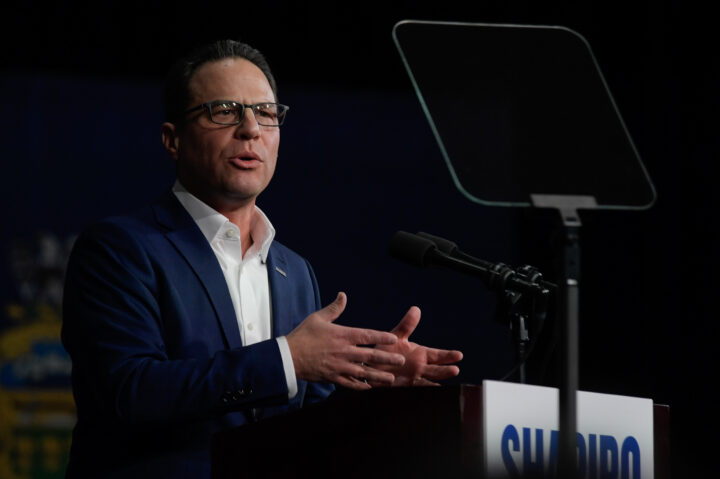
Pennsylvania Gov. Josh Shapiro speaks at a rally on January 8, 2026 in Philadelphia, Pennsylvania.
A new poll found that nearly half of voters in Pennsylvania view Gov. Josh Shapiro, a Jewish Democrat mulling a presidential bid in 2028, as “about right on support of Israel,” even as he has faced skepticism from the far left over his positions on the Jewish state.
The New York Times/Philadelphia Inquirer/Siena University poll, released Tuesday, showed that 47% of voters approve of Shapiro’s stances on Israel, with 14% saying he is “too supportive” and 19% feeling he is “not supportive enough.”
Forty percent of respondents under 30 said Shapiro is too supportive of Israel, underscoring a generational divide on the issue. 59% of Democrats still believe he is “about right” in his approach, according to the poll; 39% of Republicans said the same, while another 40% said he is not supportive enough.
The survey results indicate that Shapiro, a popular centrist who led his Republican gubernatorial rival, Stacy Garrity, by 16 points in the poll, could be well positioned as he mulls a presidential campaign.
Even as the Democratic Party has recently become more hostile toward Israel, Shapiro has continued to voice support for upholding ties to the key U.S. ally, while remaining outspoken against Prime Minister Benjamin Netanyahu and his right-wing governing coalition.
With a growing number of Democratic lawmakers calling for an end to U.S. aid to Israel, Shapiro has reiterated his commitment to such assistance, while otherwise arguing it should be used to exert leverage over the country’s use of American-made weapons.
More broadly, the poll showed that while half of likely voters in Pennsylvania, a key battleground state, believe the Democratic Party is too far to the left, 29% said they felt the same about Shapiro. The poll surveyed 760 likely voters in Pennsylvania and was conducted Aug. 17-21.
The poll stands in contrast to findings concerning voter sentiment toward Israel in a survey released Monday by the far-left IMEU Policy Project that was conducted by YouGov. That poll found broad Democratic support for sanctioning Israel and cutting off U.S. weapons sales among primary voters in the six states recently chosen to lead off the 2028 Democratic presidential nominating contest — South Carolina, Nevada, New Hampshire, New Mexico, Michigan and Virginia.
The Times/Siena poll also showed Pennsylvania voters largely back Sen. John Fetterman’s (D-PA) outspoken defense of Israel, with 41% saying he is “about right,” 29% saying he is “too supportive” and 7% saying he is “not supportive enough,” though 51% of Democrats surveyed believe he is “too supportive.”
The survey found that Fetterman is viewed far more favorably among Republican voters than Democrats as he has continued to publicly spar with members of his own party as he accuses them of moving too far to the left. While his criticism has stoked speculation over whether he will formally cross the aisle, he has denied that he intends to switch parties.
Ahmed Fouad Alkhatib, a Gaza native who lost 33 family members in Israeli airstrikes, argues in his new book that Hamas bears primary blame for Palestinian suffering and political stagnation
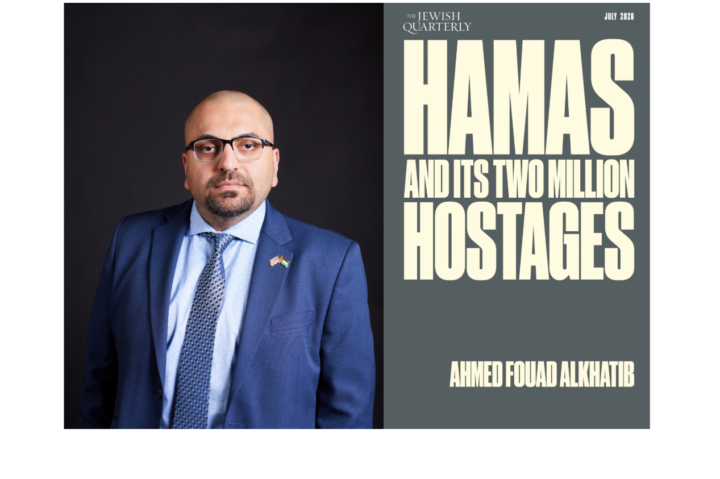
Ahmed Fouad Alkhatib, who lived in the Gaza Strip from the age of 10-15, describes himself as an advocate for the Palestinian people. Since the Oct. 7, 2023, Hamas-led terror attacks in Israel, 33 of Alkhatib’s immediate and extended family members have been killed. But in his latest book, Hamas and Its Two Million Hostages, Alkhatib argues that Hamas — rather than Israel — bears primary responsibility for the suffering and political stagnation of the people of Gaza.
Alkhatib is a resident senior fellow at the Atlantic Council, where he directs Realign for Palestine, a project focused on pragmatic, nonviolent Palestinian advocacy. There, he denounces Hamas and advocates for Palestinian statehood alongside a secure Jewish state.
On Friday, Alkhatib spoke with Jewish Insider about his new book, his experiences growing up in Gaza and his outspoken criticism of Hamas. He also discussed the backlash he has faced from within his own community and why he believes that, ultimately, the terrorist group will have no role in the enclave’s future.
This interview has been condensed and edited for clarity.
Jewish Insider: What inspired you to write Hamas and Its Two Million Hostages, and what does your book add to public debate on this issue that isn’t already out there?
Ahmed Fouad Alkhatib: I wanted to weave in elements of my personal story with Gaza’s contemporary history, and add a human dimension to what I felt was Hamas’ devastating impact on the Palestinian people, their destructive role in setting back the Palestinian national project and the radicalization of the society.
I felt that there’s a consistent gap in the discourse from a Palestinian self-interested point of view. Even though many Palestinians and Arabs and Muslims will tell you privately how devastating Hamas is, there’s a disconnect in the discourse outside of Gaza versus inside Gaza — where you’ll find a ton more willingness to speak out, not just because of the consequences of Oct. 7, but because of the totality of the last 20 years of their rule.
One of the things that’s really frustrating is how there is this persistent narrative that Gazans are all Hamas, Gazans support Hamas. It’s very difficult for the other side, for the Israelis and the pro-Israel folks, to see the humanity of Palestinians because they so fundamentally believe that Gaza is inseparable from Hamas. Nevertheless, I argue and maintain that directly and indirectly, Hamas has taken Gaza captive and is holding 2 million people as hostages.
For the pro-Palestine folks, the goal is to burst the bubble of Hamas, which has been getting normalized since Oct. 7, getting called “resistance” or at best receiving token critique. It’s like a check the box: “Oh, I’m not with Hamas, but let’s keep going on Israel, and Israel this and everything is Israel’s fault.” At its worst, it’s actually been lionizing Hamas — refusing to call for the release of hostages, refusing to acknowledge the pain and suffering they’ve caused for the Palestinian people … Hamas has been a disaster. It has destroyed the seams of the Palestinian society and the fabric, and it’s been part of this devolution.
I also made it a short book deliberately for the average casual reader … I wanted to target a lot of younger audiences … because with the avalanche of new entrants to the scene since [Oct. 7], you have people that quite simply don’t know about Hamas, about the Palestinian people or about Gaza. I believe the theme of this book is that within the imbalance of power dynamics between Israel up here and the Palestinians down here, believe it or not, there is plenty of space for Palestinian agency, responsibility and accountability. That’s not blaming the victims or self-hatred — that’s actually the first step to empowering the Palestinians.
JI: You reflect in the book on your own experiences and those of your family in Gaza. How did these experiences shape the way you approach this book, and how did they shape your understanding of Hamas? Did you find that other Gazans shared your sentiments?
AFA: Well, in some ways, my lived experiences are very central to where I’ve arrived. My family are very devout Muslims and committed Palestinians. My family grew up in a Gaza context, and they were not immune to some of the broader trends. So on one hand the family context was helpful and relevant, and on the other hand it was not necessarily responsible for where I’m at right now because my family was kind of an average lower middle class that engaged in this topic. Very educated, but also not the most politically engaged. Very independent, very willing to stay clear and interested in staying clear from Fatah, from Hamas, from all the other different factions, and I think that was very key.
I remember the hope and optimism of the tail end of the Oslo [Accords] years in the ’90s — flying into Gaza’s airport, these shiny new Palestinian passports, the Palestinian airlines, the cell phones, the industrial zone, the kind of renaissance and the sense of hope and optimism and the march toward statehood. In the midst of all of that, Hamas’ counter-narrative was, “Oh no, the Palestinian Authority and the [Palestine Liberation Organization] sold out, they gave up 78% of historic Palestine, and we are going to bring you something better.”
And I just remember being like, “What’s there that’s better than the opportunity to travel freely, an airport, an incoming seaport, the beginning of the symbol of sovereignty and statehood?” On top of all of that, Hamas said, “We’re going to bring you the whole of Palestine from the river to the sea,” but then said, “Oh, by the way, we need to take this detour so let’s go burn a bar that has liquor, let’s control how women dress, let’s make the society more Islamist.” I distinctly remember [saying to] my parents and my uncles, “This is a detour that has nothing to do with negotiating a better outcome or achieving better results for the Palestinians.”
I tell the story of one time going to a summer camp that turned out to be a Hamas summer camp, and neither my family nor I knew that. I must have been 11, and I just remember being like,
“What is any of this?”
There was a very robust pushback against Hamas and against this trend, but parts of the society ultimately either acquiesced or essentially had no option but to go along because Hamas moved the Overton window — including for the moderate and secular Palestinian Authority and [former PLO and PA leader Yasser] Arafat, who had to accommodate Hamas and incorporate elements of Islamism and resistance culture. That is the theme I try to convey: Hamas slowly and gradually shifted the Overton window of what’s acceptable discourse, not just for itself, but for the entirety of Palestinian society, its national project and its political atmosphere.
JI: You talked to CNN earlier this week about what you described as the “troubling persistence of support” for Hamas among some Palestinian activists and diaspora communities, noting that 44% of American Muslims told Pew Research that they support Hamas. Why does support for Hamas persist in these activist circles, and how do you reverse that trend?
AFA: There are many Palestinians, Palestinian Americans, Muslim Americans and Arab Americans who, when you speak to [them] privately, will tell you that Hamas is a gift to the far right in Israel, that Hamas is gross, that Hamas is disgusting. They don’t want to live under a regime that resembles Hamas — they want to live a normal life. But when you step back in a communal dynamic — whether it be the clergy, elements of the community in academia or parents who are guilt-ridden — you have sociological factors and identity crises that contribute to this trend.
Then there is a much more sinister element: elements of academia, journalism and the “social justice” far left who are not Palestinian or Arab or Muslim, who have concocted a variety of frameworks for how you see these conflicts. They want to map out Israel and Palestine to existing frameworks in domestic discourse around immigration, abortion rights, LGBT issues and Black Lives Matter.
You have modern-day anti-Zionism regularly devolving into antisemitism, and a departure from the broad framework of two peoples, two states. Right now, it is very much so a “river-to-the-sea” eliminationist discourse. Israel is seen as an extension of the United States — whether due to the presence of Ashkenazi Jews that are white-presenting, even though half of Israel are Mizrahi Jews of essentially brown origin and darker origin from Arab lands and from the Middle East, whether it be Israel’s founding being considered a purely European Zionist-led colonial project and not something that has anything to do with Jewish peoplehood and heritage and connection to the land, and so there are just these overly simplistic narratives that are not conducive to productive dialogue.
Part of this support for Hamas is an overcorrection to what people felt was an effort by parts of the pro-Israel community to suppress legitimate critique of Israeli actions. But when the pendulum swung, it didn’t swing toward narrow, targeted advocacy for Palestinian freedom and self-determination next to a safe, secure, recognized Jewish Israel. It swung to, “No, actually, we need resistance to eliminate the Zionist entity.”
Hamas very much so cared about the public relations war and narrative warfare because it thought this level of activism would not only delegitimize Israel, but also coerce Israel into stopping the war. Neither happened. Palestinian suffering was irrelevant to a lot of these communities, because they didn’t react when I and many others in Gaza were saying what was necessary for this suffering to end: closing the page on Hamas taking 2 million people as hostages in its suicidal jihadi nihilism.
JI: Have you faced criticism from within your community for placing so much attention on Hamas in your book rather than Israel, and how are you navigating that?
AFA: It is very frequently that I face critique. People say that I’m obsessed with Hamas, that I’m a nutjob, I’m a Zionist, I’m paid by Israel. Now they’ve shifted to saying that I’m a traitor and a sellout.
I see no shortage of people talking about what Israel has done and what Israel is doing right now in Gaza — including Prime Minister [Benjamin] Netanyahu, whom I acknowledge potentially worsened this situation through direct support for Hamas via Qatari funding. I have no illusions about the fact that Israel bears responsibility in worsening multiple aspects of the discourse, whether it be not empowering the Palestinian Authority, the aggressive expansion of settlements or the recent activities under the current coalition.
My goal is not to simply repeat what people who are even smarter than I am are out there talking about, often speaking in circles to their own choirs. I want to address a gap — and a significant one at that. That gap is that my family and tens of thousands of Palestinians would still be alive had Hamas simply kept its terrorists at home on Oct. 7.
Hamas is treated as an extra on a movie set when it needs to be one of the main antagonists in this whole film. Hamas is a central player in this whole devastation that has befallen Gaza. I see the rightward shift in Israeli society that everybody talks about all the time as inseparable from Hamas and what it did in Gaza and the suicide bombings and what it did to radicalize the Palestinian people in Gaza and in the West Bank.
JI: What do you believe Hamas will look like in the years ahead? Do you believe it is possible for Gaza to have a future without Hamas — and one that is different for both sides of this conflict?
AFA: I don’t believe there can be any coexistence with Hamas. I think they need to be effectively banned from the scene. When people say Hamas can’t be defeated, it absolutely can be defeated. I don’t care about Hamas’ ideology per se. The Nazi ideology lives on all these years. Al-Qaida is alive and well after [Osama] bin Laden. ISIS is alive and well, even though they don’t theoretically control mass territories like they once did.
What I care about is three metrics through which you can judge and assess Hamas’ ability to remain relevant and be defeated: Do they control territory? Do they have an executive force on the ground that can have a monopoly on violence and force and act as an administrative body? And do they control resources — financial, taxation, access to aid and incoming resources, or smuggling? In those three metrics, Hamas has been significantly rolled back.
More likely than not, it is my belief that Hamas is going to be largely irrelevant in Gaza. Hamas is not going to govern like it once did. The days of Hamas reigning supreme and controlling Gaza are over. Hamas may try to remanufacture itself as a political body, as a political entity, but in terms of controlling Gaza like it once did, I see that as incredibly unlikely. Their inventory of weapons and arsenal is very finite. They’re not smuggling weapons like they once did, and a lot of their supplies, workshops and spaces have been destroyed and rolled back. Whether it be through disarmament, Israeli elimination or decay — I think Hamas’ arsenal is going to recede to where it not only no longer constitutes a threat to Israel, but it no longer is adequate to entirely rule the Gaza Strip.
My concern is that Hamas is moving to Turkey. The Turks might be trying to help them reinvent themselves as a political organization. If they enter Palestinian elections, will they then further ruin democratic life? Will they evolve their so-called armed resistance narrative into something that can introduce political stalemate?
Right now, largely speaking, Hamas, Israel, the Board of Peace, the Trump administration and regional and international partners are in agreement over the next steps as far as disarmament, which is a prerequisite to get any kind of withdrawal or reconstruction happening in Gaza. However, now we’re in a space where the disarmament issue is actually logistical in nature. Logistics can make or break a war, a campaign or an effort, and right now, logistically, the disarmament plan is just — it’s not there. It’s not there. That’s what concerns me.
Jewish conservatives voiced their concerns about the fundraiser on social media as the invitation surfaced online Thursday
Fabrice Coffrini / POOL / AFP via Getty Images
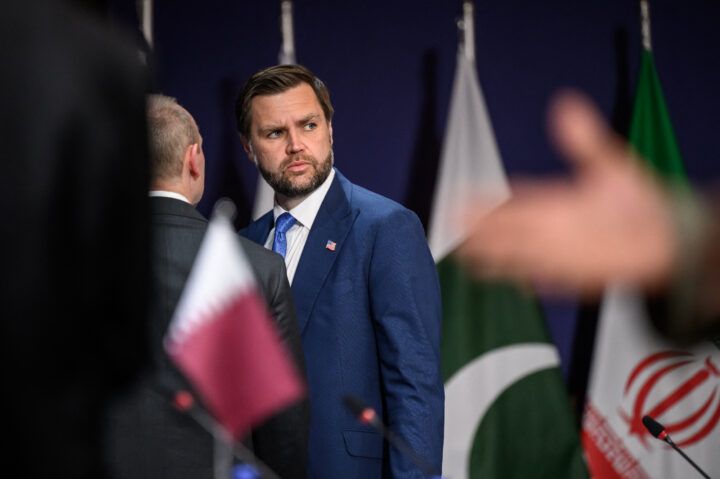
Vice President JD Vance looks on prior to a quadrilateral meeting between the United States, Iran, Pakistan and Qatar at the Burgenstock luxury hotel complex overlooking Lake Lucerne, Switzerland, on June 21, 2026, as part of high-level talks aimed at advancing a deal to end the Middle East conflict.
A fundraiser hosted by Vice President JD Vance in the Hamptons on Wednesday is raising red flags among some Jewish Republicans who continue to harbor concerns over his likely intention to run for president in 2028.
The event, first reported by Axios, was notably held in the home of Omeed Malik, the Iranian American investor who was an important early backer of Tucker Carlson’s media company. The fundraiser highlights Vance’s ongoing ties to Carlson’s network — even as the far-right commentator has faced backlash for his regular promotion of antisemitic conspiracy theories about Jews and Israel.
Carlson also recently pledged to help start a third political party after breaking with President Donald Trump over the war with Iran, which Vance himself has reportedly privately opposed.
As Vance mulls a presidential bid, the fundraiser — where he reportedly raised $5 million — shows how he is building a coalition of younger donors from the populist right who are poised to meaningfully shape the upcoming campaign to define a post-Trump era.
In addition to Malik, the fundraiser also reportedly included Donald Trump Jr., a close ally of Vance as well as Carlson. Malik is a business partner of Trump Jr. in their investment firm 1789 Capital, which raised significant funding from Middle East and other foreign investors and has done business with the Qatar Investment Authority. In January, Malik appeared with Trump Jr. and Carlson at the Doha Forum in Qatar, following the May 2025 Qatar Economic Forum where Trump Jr. and Malik spoke on a joint panel session titled “Investing in America.”
The event underscores the anxieties among some traditional Republicans who are skeptical of Vance’s indulgence of antisemitic forces on the far right and commitment to a strong relationship with Israel that has long been a key GOP value but is now waning among the party’s younger voters.
Jewish conservatives voiced their concerns about the fundraiser on social media as the invitation surfaced online Thursday.
A senior Republican official defended Vance’s appearance at the fundraiser, saying it was a function of the vice president’s role as finance chairman of the Republican National Committee.
“As RNC Finance Chairman, it’s the vice president’s job to raise money for the Republican Party, and that’s exactly what he did at this event,” the official told Jewish Insider. “The vice president has raised tens of millions of dollars not for himself, but for the RNC’s efforts to hold the House and Senate. All of the hosts for the event were strong supporters of President Trump’s 2024 campaign and we’re happy that they’re continuing that support for Republicans in the midterms.”
Vance has in recent months stepped up his criticism of Israel — alleging Israeli influence campaigns have been “manipulating” U.S. opinion of the Iran war, for instance, while publicly rebuking Israeli officials over disagreements regarding negotiations with Tehran.
Many Jewish Republican donors remain wary of Vance as speculation mounts over who will run for president in 2028 and whether he would be the front-runner.
While the vice president has made some overtures to Jewish Republicans, the Wednesday night fundraiser indicates he is embracing a potential route that could increasingly alienate the pro-Israel community.
Alleged straw-donor masterminds are selling tickets to an event with the Montana Republican — who says he’s not attending
Bill Clark/CQ-Roll Call, Inc via Getty Images
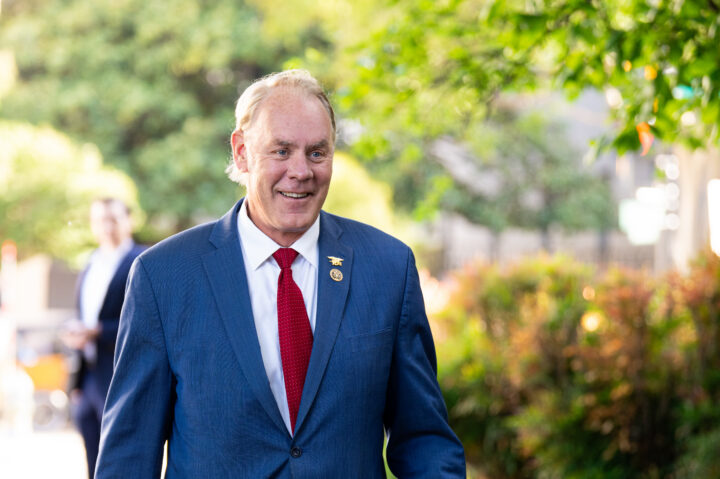
Rep. Ryan Zinke (R-MT) arrives for the House Republican Conference caucus meeting at the Capitol Hill Club in Washington on Wednesday, May 13, 2026.
A Turkish-tied organization that launched in 2023 with an alleged straw-donor fundraiser for former New York City Mayor Eric Adams has spent recent weeks selling tickets for a Sept. 20 gathering listing Rep. Ryan Zinke (R-MT) as a “featured speaker ” — even as Zinke’s office insists he’s not attending the event.
The CEO Club New York and Turkish-American Business Association have posted materials online and created a listing on Eventbrite advertising the “World Business Summit New York & Award Ceremony 2026,” to take place at a venue inside The New York Times building during the U.N. General Assembly next month. Prominently displayed is the name and photo of the retiring Montana congressman, who served as secretary of the interior during the first Trump administration.
“We’re bringing together global business leaders, entrepreneurs, investors, innovators, and decision makers for a day of meaningful conversations, networking, and collaboration,” CEO Club Founder Jimmy Cuneyt Gurkan wrote on LinkedIn, adding that Zinke was “already confirmed” to appear along with a roster of private sector guests.
Previous reporting has identified Cuneyt Gurkan as the unnamed, unindicted “public relations representative” in the criminal complaint against Adams who plotted to illegally funnel large amounts of money from a Turkish-American businessman into the then-mayor’s later-aborted reelection campaign — and the CEO Club’s inaugural gathering in October 2023 has been identified as the event used to mask the donations as lawful gifts from attendees.
Prosecutors described the “public relations representative” as an associate of a “Turkish official” who directed foreign money into Adams’ campaign coffers and arranged perks from state-owned Turkish Airlines in exchange for favorable treatment.
The New York Times and other publications have outed that official as Reyhan Özgür, the former Turkish consul general. The indictment states that Özgür and a Turkish Airlines official shared a donation link for the 2023 CEO Club event.
Cuneyt Gurkan and the CEO Club did not respond to repeated inquiries for this story. The Times Center, the event space in the paper’s Manhattan headquarters, told Jewish Insider that it has “been in touch with” the CEO Club about using the space in the 9 a.m. to 2 p.m. slot listed in the promotions but does not yet have a contract in place.
But, after initially avoiding answering questions about whether Zinke would attend the event, the congressman’s team told JI that he will not be there. Asked if the congressman had ever intended to participate in the event, and if he will be in New York City on that date, his office would only answer that it was never on his official schedule and that his House staff never interacted with the CEO Club.
Zinke has a mixed history with Turkey — but has had past contact with the network allegedly involved in the Adams bribery scheme. Foreign Agent Registration Act filings show that as a congressman he has had contact with lobbyists for Turkey’s government and ruling political party both before joining the first Trump administration and since returning to the Hill.
As interior secretary, Zinke came under fire from ethics watchdogs in 2018 for bringing an official security team on a vacation to Turkey, a trip that also included a stop in Greece.
While that controversy received broad coverage, few U.S. outlets reported that Zinke’s wife — who had previously lived in Turkey — received an award from Turk of America magazine and TOA Consulting. Turk of America’s publisher was Cuneyt Gurkan’s co-conspirator in the CEO Club’s straw-donor scheme for Adams, while Cuneyt Gurkan at the time served as TOA Consulting’s chief operating officer, according to LinkedIn and media appearances.
Personally presenting the award to Lola Zinke was another key figure in the Adams scandal: Turkish Airlines executive Cenk Ocal. Cuneyt Gurkan took a selfie with the interior secretary at the event, and the secretary lauded the U.S. partnership with Turkey.
“Certainly, they’re regional and strategic partners, and the people of the United States and Turkey, they love each other, as shown here,” video posted to YouTube shows Zinke saying. “Look at our mutual values and our core strengths, and it’s about the people, that there’s a long-time bond and a relationship between the Turkish people and the United States.”
Just months later, however, the Republican was briefly the target of retaliatory Turkish sanctions after the U.S. sought to penalize the Mediterranean nation for detaining an American pastor. Experts attributed the move against Zinke to confusion by Turkish President Recep Tayyip Erdoğan over the U.S. Department of the Interior’s remit, as a similarly named ministry in Ankara handles domestic security.
Back in Congress, Zinke — who sits on the House Foreign Affairs Committee — has coupled praise for Turkey as a NATO ally with concern about Ankara’s support for Hamas. In a markup session last fall, he opposed an amendment that would compel consideration of Israeli military advantage when making arms sales to the country, a standard applied to all other Middle Eastern countries.
A clear divide is emerging in the prospective 2028 presidential field over the issues of the U.S.-Israel relationship and dealing with rising antisemitism
Israel Hadari
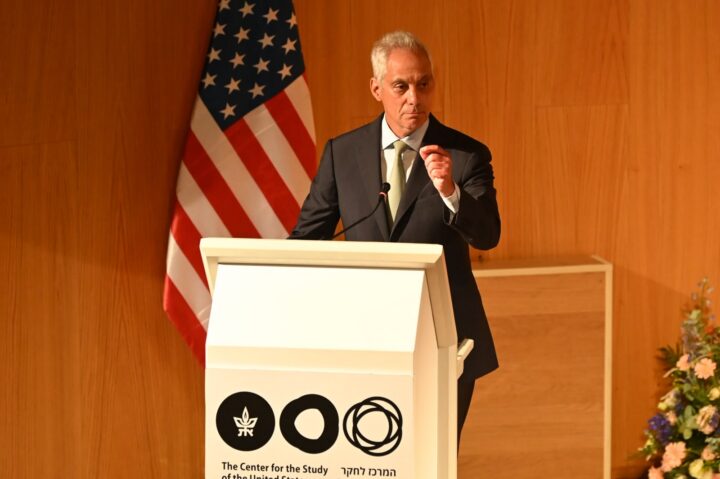
Rahm Emanuel speaks at Tel Aviv University on July 8, 2026.
A quarter century ago, when the late Sen. Joe Lieberman was tapped by Al Gore, the Democratic nominee for president, to be his running mate on the 2000 ticket, the question around many a Shabbat table was, “Is he too Jewish to be in the White House?”
There’s a different question being asked, largely in Democratic circles, of today’s Jewish presidential candidates: “Is he the ‘right’ kind of Jewish candidate to be president?” — a question that is almost entirely centered around a candidate’s position on Israel and how openly he identifies with his religious faith.
A long list of Jewish candidates are considering a presidential campaign or are being touted as credible contenders, ranging from moderates like Pennsylvania Gov. Josh Shapiro, Sen. Elissa Slotkin (D-MI) and former Chicago Mayor Rahm Emanuel to progressives like Illinois Gov. JB Pritzker and those who straddle the ideological divide, like Sen. Jon Ossoff (D-GA).
In both 2026 and 2028, the debate over Israel is on the ballot: Congressional primaries are pitting pro-Israel candidates against those who don’t acknowledge Israel’s right to exist as a
Jewish state, and already a clear divide is emerging in the prospective 2028 presidential field over the issues of the U.S.-Israel relationship and dealing with rising antisemitism.
Even in races where Israel policy is not front-and-center, invoking AIPAC has become something of a catch-all slur for progressives attacking the role of outside money in Democratic primaries. California Gov. Gavin Newsom, a likely 2028 hopeful, proudly proclaimed in February that he’d never taken AIPAC money — which of course he hasn’t, given that AIPAC and its affiliated super PAC historically focus on federal, not state, races.
Since soft-launching his presidential campaign last month (in Tel Aviv, no less), former Chicago Mayor Rahm Emanuel has made the Jewish state — and its relationship with the U.S. — one of his top issues in speeches and interviews. Even when his views are well within the mainstream, his signaling that he’s talking tough against Israel is a sign he recognizes his long-standing pro-Israel record is a vulnerability in a Democratic presidential primary.
A week after his Tel Aviv speech, Emanuel appeared on the Council on Foreign Relations’ “The Spillover” podcast in an episode titled “Rahm Emanuel Talks Israel, Midterm Elections, and the Democratic Party.” Two days later, The New Yorker’s “Radio Hour” podcast aired an interview with Emanuel in conversation with David Remnick titled, “Rahm Emanuel Says Israel’s Path Is ‘Not Sustainable Politically.’” Earlier this week, Emanuel appeared on the podcast of anti-Zionist Peter Beinart for a conversation largely focused on Israel.
The polling reality is that despite his lengthy and impressive resume — a former U.S. ambassador, congressman, Chicago mayor and White House chief of staff — Emanuel’s record is out of step with the ascendant progressivism that’s taken hold within the party. (He is currently polling at 0% in most 2028 Democratic primary polls.)
Emanuel could be using his skill as a straight-talking political operative to push his party to the center on antisemitism and Israel, akin to the way former New Jersey Gov. Chris Christie used his anti-Trump bromides against the MAGA-aligned candidates during the 2024 presidential debates. But Emanuel’s candidacy has thus far been an opportunity to push the party leftward on Israel — in essence, kashering an increasingly unfriendly approach to the U.S.-Israel relationship — and throw jabs at Israeli Prime Minister Benjamin Netanyahu, with whom Emanuel has a long and less-than-amicable history.
Both Emanuel and Newsom’s approaches reflect what they see as a political reality as the 2028 race comes into view: criticizing Israel might garner some support, while backing it is a losing argument.
Other leading Jewish Democrats who are considering 2028 bids are opting not to make Israel — and the future of its relationship with the U.S. — a cornerstone of their campaigns. Some, such as Shapiro, attempt to pivot when pressed on Israel questions, focusing instead on the domestic impact of the war with Iran or on U.S. national security. And when they do talk about Israel, criticism is largely focused on Israel’s government and not the country as a whole.
Shapiro, whose Israel stance was reportedly one reason former Vice President Kamala Harris opted against selecting him as her running mate in 2024, has frequently criticized Netanyahu while also legitimizing Israeli security concerns.
“I don’t think that if you are critical of Benjamin Netanyahu, you’re an antisemite,” Shapiro said on the “Higher Learning” podcast earlier this year. “By the way, I’m critical of Benjamin Netanyahu. And I have been for years and years and years, even predating Oct. 7. I think his approach has made Israel less safe.”
Pritzker has similarly kept the message — largely — focused on Netanyahu. In an in-depth New York Times interview in March, Pritzker said he felt Israelis had erred in selecting Netanyahu, saying that his leadership has led the country into “additional wars” and caused excess death and destruction in Gaza. On AIPAC, the Illinois Democrat, who previously supported the group, explained to The Times that his efforts to distance himself from the group were because it had become increasingly partisan and “pro-Trump,” rather than because of Israeli policy itself.
And then there’s Ossoff , who has always held positions on Israel that fall to the left of the others. We wrote last month that many Peach State Jews find themselves in a political no-win situation as Ossoff, who has voted to block weapons shipments to Israel, defends his seat against Rep. Mike Collins (R-GA), who has a history of inflammatory right-wing rhetoric — and a son-in-law who openly espouses white nationalist, antisemitic propaganda.
While all four have tacked left on Israel, they have done so to varying degrees — for example, Shapiro has expressed support for some aid to Israel to be conditioned, while Ossoff has voted to block weapons sales to Israel and Emanuel has called to immediately end all military aid to Israel.
2028 candidates rightfully sense that the party is shifting, not just on Israel but on a range of policies. When Lieberman was on the ticket a quarter century ago, the question was whether Americans were ready to elect a Jewish president (or vice president). Now, the question facing potential Jewish 2028 contenders is different: What do they have to say about Israel to persuade primary voters they are the “right” kind of Jew to become president?
Bashing Israel and a tolerance for antisemitism wasn’t really part of the woke equation in the first iteration of the left’s social justice activism. It’s now a litmus test in this new era, with major implications for American Jews
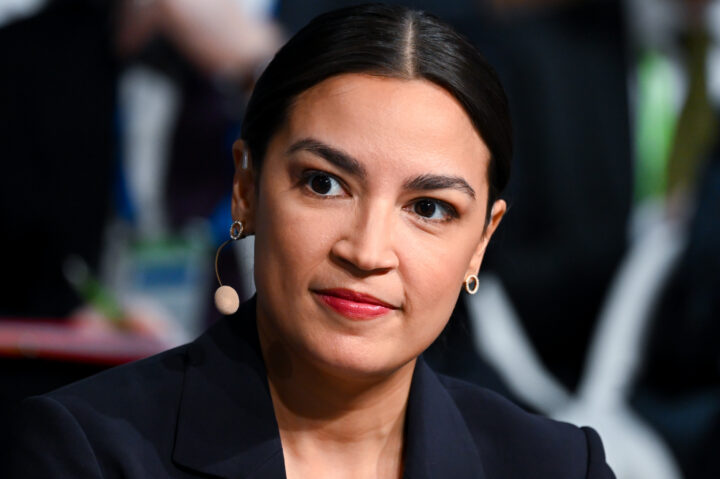
Sven Hoppe/picture alliance via Getty Images
Rep. Alexandria Ocasio-Cortez (D-NY) takes part in the Munich Security Conference.
Rep. Alexandria Ocasio-Cortez (D-NY), openly considering a presidential campaign in 2028, made waves over the weekend when she declared that “Woke 1.0 was crazy” in a nationally televised ABC News interview where she distanced herself from the most unpopular elements of the progressive movement.
Left unsaid during the conversation is what specific policies in the party’s last activist wave does she think were crazy, and does she still agree with any of them? After all, the platform of the Democratic Socialists of America currently outlines many of the same issues that played a role in Democrats’ defeat in 2024 — from progressive candidates’ support for defunding the police to the Biden administration’s open-ended immigration policy that led to the second Trump administration’s harsh crackdown on refugees and undocumented immigrants.
Presumably, she’ll be asked to answer more of the specifics in subsequent interviews. But the implication of her comments was that it’s hard for Democrats to publicly embrace the panoply of left-wing issues that became liberal conventional wisdom around the time of the pandemic without suffering a significant political penalty. Democrats aren’t exactly speaking the language of climate change activists or transgender advocates or supporting watering down penalties for criminals anymore, as was commonplace in 2020.
But they aren’t confronting the far-left forces that drove these issues to the forefront of the conversation for much of the last decade, either. The scandal surrounding Francesca Hong’s view of Thanksgiving as a “colonizer holiday” and Abdul El-Sayed’s comments bashing football, July 4 fireworks and Mackinac Island only underscore the impression that their deeply-held views are at odds with a majority of Americans.
And meanwhile, the DSA faction is as influential as ever in Democratic Party politics.
How did that happen, even as a prominent progressive like AOC now acknowledges the excesses of the far left? It’s because the activists have refocused their attention away from their (still deeply held) unpopular social and cultural positions, and are now singularly focused on demanding candidates label Israel’s war against Hamas in Gaza as a genocide. That’s the biggest litmus test right now. And their efforts are aided by the overall decline in support for Israel within the Democratic Party that’s accelerated in the last year.
By focusing on a foreign policy issue that is less impactful to many Americans than the economy or crime, they’re hoping they won’t suffer as much backlash as they did when they alienated a broad swath of the electorate with outside-the-mainstream proposals that affected people’s day-to-day lives.
Progressive activists have also reframed their socialist messaging around more politically palatable issues, aiming to capitalize on the backlash against data centers, corporate excess and income inequality. You can see that strategy in Abdul El-Sayed’s catchy slogan “get money out of politics, money in your pocket, and pass Medicaid for All.” (It’s the last part — supporting a government-run health care system — that has historically been political poison for Democrats.)
The handful of general election contests pitting mainstream Republicans against activist-aligned Democrats — the Michigan Senate race being the biggest one — will offer a clear test of whether this rebranded (if more radical) iteration of wokeness, focusing on anti-Israel hostility and an accompanying tolerance for antisemitic rhetoric, business bashing and socialized medicine will garner more political support. Historically, these views have also been a tough sell with average Americans.
When AOC is talking about the latest iteration of woke, this is what she’s referring to. Bashing Israel and a tolerance for antisemitism wasn’t really part of the woke equation in the first iteration of the left’s social justice activism. It’s now a litmus test in this new era, with major implications for American Jews.
Meanwhile, pro-Israel state Sen. Jeremy Moss comfortably prevailed against a far-left challenger in the Michigan district of Rep. Haley Stevens

Robert Cohen/St. Louis Post-Dispatch via AP
Wesley Bell addresses the crowd after winning the Democratic congressional primary against Rep. Cori Bush on Tuesday, Aug. 6, 2024 at the Marriott Grand Hotel in downtown St. Louis.
Rep. Wesley Bell (D-MO) easily brushed off a comeback attempt by former Rep. Cori Bush (D-MO), whom he defeated in 2024, in a race where AIPAC spent over $3 million to help reelect the pro-Israel incumbent.
Bell’s race was called by the Associated Press just over an hour after polls closed. With about one-third of the vote in, Bell held a commanding 69-27% lead, winning huge margins in the suburbs of St. Louis County and a healthy margin among Bush’s base in the city of St. Louis, as well.
Bell is on track to easily outpace his five-point victory over Bush in 2024, the year he ousted the far-left, scandal-plagued Democrat from Congress.
The AIPAC-linked United Democracy Project super PAC spent a total of $3.1 million in the race boosting Bell, helping him to dominate the airwaves in Missouri’s 1st Congressional District. Bell also tripled Bush in campaign fundraising.
Bush’s allies, including the Justice Democrats, did not intervene to boost her campaign or help her match Bell’s advertising advantage.
Bush focused her message heavily on criticism of Israel and Bell’s support from AIPAC, while Bell accused her of being more focused on the Middle East than her own district at home.
“What we’ve seen over and over is talking about an issue that is not impacting folks right here in St. Louis, and while we take those issues seriously, you know, the M in Missouri doesn’t stand for Middle East. It stands for Missouri,” Bell said on Election Day.
Both Bell’s campaign and UDP hit Bush as an ineffective and absentee representative more focused on fighting with other Democrats, including opposing then-presidential candidate Kamala Harris.
“I am honored and grateful that the people of Missouri’s First Congressional District have continued to put their trust in me to represent them in Congress,” Bell said in a statement declaring victory.
“Two years ago, St. Louis voted for better and more accountable representation. We have kept that promise, whether it’s bringing federal resources home to our neighborhoods, standing with working folks when they needed someone in their corner, or helping families cut through red tape. That work does not stop tonight.”
Despite expected setbacks in Michigan’s Senate race, where Abdul El-Sayed is holding the lead over Rep. Haley Stevens (D-MI), pro-Israel Democrats are cheering the victory by state Sen. Jeremy Moss, a Jewish Democrat strongly supportive of the Jewish state, for winning his nomination in Stevens’ district. Moss leads far-left challenger Aisha Farooqi by 15 points, with most votes counted.
Please log in if you already have a subscription, or subscribe to access the latest updates.
 Continue with Google

 Continue with Apple