











































































While Democrat Analilia Mejia comfortably won the special election to succeed Mikie Sherrill, Jewish voters swung to the right
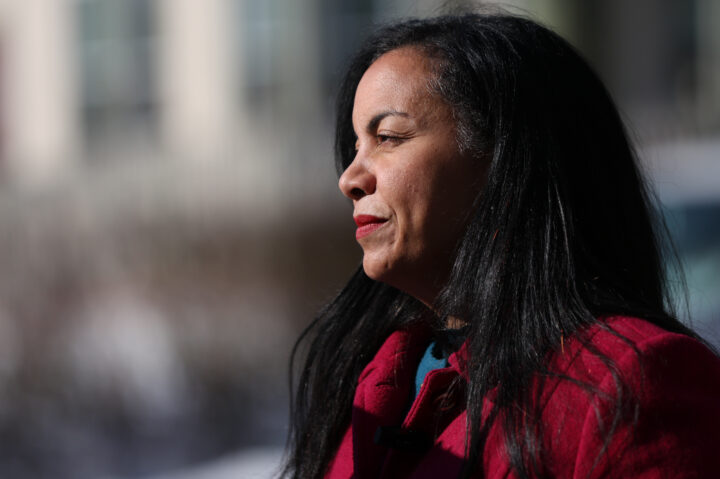
Heather Khalifa/Bloomberg via Getty Images
Analilia Mejia, US Democratic House candidate for New Jersey, speaks to members of the media outside of the Montclair Municipal Building on the first day of early voting in Montclair, New Jersey, US, on Thursday, Jan. 29, 2026.


 Add JewishInsider on Google
Rep.-elect Analilia Mejia (D-NJ) cruised to victory in last Thursday’s special election for New Jersey’s 11th Congressional District, but the results showed notable defections among Jewish Democrats — an early warning sign for both the left-wing Mejia and her party.
Mejia ran significantly behind other recent Democratic candidates in two municipalities that have traditionally strongly favored Democrats — Livingston Township and Millburn Township — both areas with significant Jewish populations. In Millburn, Mejia lagged 22 percentage points behind former Vice President Kamala Harris’ performance in the 2024 presidential election, and 17 percentage points behind Harris in Livingston.
Dan Cassino, the director of the Fairleigh Dickinson University Poll, said that, given that Livingston favored Democrats by 34 percentage points but Mejia won it by just two, “you could count [that] as a 32-point underperformance.”
Joe Hathaway, the GOP nominee against Mejia, worked during his campaign to attract Jewish voters, casting himself as a moderate centrist and Mejia as an antisemitic extremist.
Jeff Grayzel, the deputy mayor of Morris Township who ran in the Democratic primary against Mejia, said that the special election presented an “actual Sophie’s choice” for Jewish Democrats.
“Some Jews surely voted for her because of their anger with President [Donald] Trump. But many Jewish Democrats I spoke to refused to support Mejia because of her genocide position,” Grayzel, who had hoped to rally support from Jewish voters across the district in the primary, said. Mejia accused the Jewish state of genocide shortly after the Oct. 7, 2023, Hamas attacks on Israel.
“So some Jewish Democrats voted for Hathaway, which was evidenced by the result in Livingston, and others simply stayed home,” Grayzel continued. “We will see from voter turnout data how many Jews actually sat out this election. Unfortunately, our voice is our vote, and declining to vote will only hurt the Jewish community in the long run.”
Jason Shames, the CEO of the Jewish Federation of Northern New Jersey, said “it’s disappointing to see someone representing New Jersey or any district in America who not only doesn’t fight antisemitism but seemingly aligns with those who delegitimize Israel. Her comments on Israel’s self defense to the horrific terror attack by Palestinians [are] alarming and should not be dismissed.”
Cassino said that while Mejia outperformed other Democrats who have run in this district, she “did slightly worse than we would have expected from a generic Democrat in the special election,” given that the environment strongly favored Democrats.
Cassino said that it’s a “reasonable hypothesis” that attacks on Mejia’s stance on Middle East policy drove Democrats in Millburn and Livingston to vote for Hathaway.
“I would be really cautious, though, about saying that her stance on Palestine, or any other issue, cost her any particular number of votes, because all of these numbers are conditional on turnout,” he added, noting that all of the voters who turned out for Mejia might not have turned out for a different Democratic candidate.
Cassino said that strategists are likely to read the results to mean that attacks on Mejia’s stance on Israel were effective.
“Maybe the most important thing here is that strategists — Democrats and Republicans alike — are going to look at these results and conclude that the attacks on Mejia worked, and ramp them up in November,” he added. “They’re also likely to try and use them against any candidate where they might plausibly stick. So, I hope voters liked those ads, because they’re going to be seeing a lot more of them.”
Micah Rasmussen, the director of the Rebovich Institute of New Jersey Politics at Rider University, said that the apparent protest votes in the Jewish community “could … matter in a different election,” but this time, “Mejia picked up other votes in their place.”
“A lot is being made about these 900 or so votes, and I want to be balanced about how I see them. Yes, they were certainly noticeable. Yes, you can never take any voting bloc for granted,” Rasmussen added. “But electoral coalitions do shift. What can’t be denied is that Mejia’s current margin of 19.5 percent is larger than any other candidate for federal or statewide office since [former Rep.] Rodney Frelinghuysen’s (D-NJ) 25.2 percent win over Mark Dunec in 2014.”
The only debate in the race — held during Passover — came as Jewish voters are up for grabs in the special election
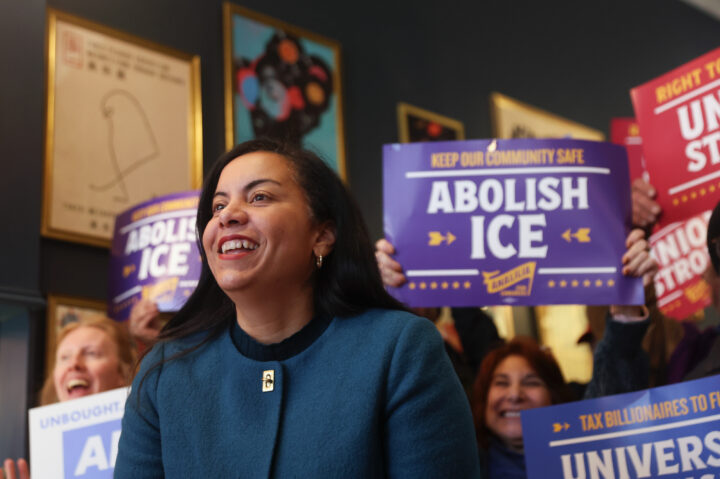
Analilia Mejia, US Democratic House nominee for New Jersey's 11th District, speaks to supporters and members of the media at Paper Plane Coffee Co. in Montclair, New Jersey
Joe Hathaway, the Republican nominee in the special election in New Jersey’s 11th Congressional District, repeatedly accused Democratic nominee Analilia Mejia, a progressive organizer, of espousing antisemitism and taking stances that would make the district’s sizable Jewish community unsafe, during their sole debate earlier this week.
Hathaway, in his opening statement, said that Mejia would “demonize thousands of members of our Jewish community.” The Randolph, N.J. city councilman has leaned into outreach to Jewish voters during the campaign.
Mejia, who won the special election primary in part because of significant United Democracy Project spending against the frontrunner, former Rep. Tom Malinowski (D-NJ), is favored to win in a district that backed Kamala Harris by eight points.
Though she had described the war in Gaza as a genocide less than a month after the Oct. 7, 2023 Hamas attack, Mejia stopped short of using that word during the debate. Instead, she said that “many individuals are feeling conflicted about what we are seeing in Gaza,” while accusing Israel and its prime minister of having committed war crimes.
“I believe that criticism of Benjamin Netanyahu and his administration is not anti-Israel any more than criticism of Donald Trump is anti-American,” Mejia said. “Neither man deserves a blank check or a blind eye.”
Hathaway responded by highlighting past instances in which Mejia has accused Israel of genocide, in spite of her dodge on the issue during the debate, and said that her positions are “radically out of touch with a district that has a thriving Jewish community that is made less safe, more dangerous by this extreme rhetoric. It has to stop.”
He accused Mejia of blaming Israel for the Oct. 7, 2023 Hamas attacks — something she denied. On Oct. 10, 2023, Mejia said that “Every fiber of my being is horrified beyond words at what is furthering in Gaza. Yet again we see how oppression & dehumanization leads to despair & unthinkable destruction,” without making direct mention of Hamas’ attack.
He also highlighted that she said during a primary candidate forum that she felt “incredible discomfort” with the idea of Israel being a Jewish state.
“I’ll stop calling you an antisemite when you stop saying things that are antisemitic and when you stop taking money from people … who shout that Jews in Israel are the same things as Nazis in Germany,” Hathaway said. “You take money from these people, you support their policies. It is completely out of touch with this district that has a thriving Jewish population. This isn’t a district where you can make those kinds of comments and people are going to be okay with it.”
He claimed that his campaign is seeing mass defections from Democratic voters “because the Jewish people of this district know there’s only one candidate they can vote for if they care about their safety and their children’s safety.”
Mejia responded by accusing Hathaway of “fearmonger[ing]” and misrepresenting her record and past statements.
“I would say it’s laughable except it’s one of the most serious topics,” Mejia said. “As a member of Congress, I would use every legislative power at my disposal to protect the rights of Jewish constituents and convene spaces to educate and to fight antisemitism because I know it’s real. … But that doesn’t mean that we cannot call the question on violations to international law and human rights.”
“We should be able to criticize the actions of a government without being called a person of hate,” she said. “We should be able to support freedom and protect our nations without turning to the very thing that we say we fight against. We have to uphold human rights, and if that’s the worst thing that I could be accused of, then I will stand with it, because I believe we have to fight for the freedom and justice of every human being.”
Hathaway fired back that “antisemitism is a bad thing to be accused of.”
Mejia responded, “and that is why I am disgusted by the fact that you are unable to see that criticism of a prime minister does not equal hate. It is disgusting and it is beneath you.”
The two candidates also debated the issue of congressional war powers, in the context of the ongoing war in Iran.
Mejia said she would not support “illegal and endless wars” or wars “without a plan to keep Americans safe.” She focused her comments primarily on the Trump administration’s posture toward America’s European allies, highlighting that the administration had lifted sanctions on Russian oil.
“I believe that we have to fight [Iran’s] nuclear threat, but more bombs do not equate [with] peace. We have to ensure that we’ve exhausted diplomacy and sanctions to keep Americans safe,” she said.
Hathaway said that Iran cannot have nuclear capabilities and that he would like to see diplomacy work, but that he supported the military action the U.S. took when diplomacy failed, praising the effectiveness of the U.S. operations.
He said he’s hopeful that the war will end soon and said he would not support deploying U.S. ground troops. He alleged that Mejia’s stance on Israel “renders her completely unable to make the right decisions for America and for our allies in Israel when it comes to a nuclear-capable Iran.”
Throughout the debate, Hathaway characterized Mejia as a radical leftist out of step with the district, and himself as a moderate who will work across the aisle. Mejia denied that she identifies as a socialist, emphasizing her longtime role as a Democratic county committee member.
Former Lt. Gov. Tahesha Way announced she would not run for the seat, allowing Mejia to run essentially uncontested in the upcoming regular election Democratic primary
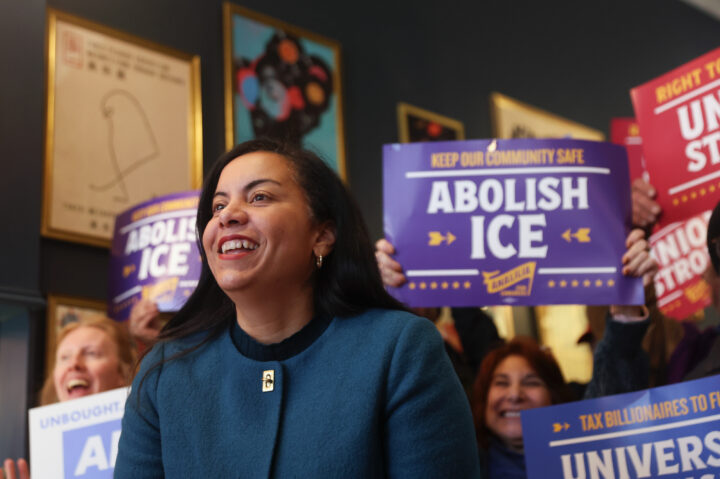
Heather Khalifa/Bloomberg via Getty Images
Analilia Mejia, Democratic House candidate for New Jersey, speaks to supporters and members of the media at Paper Plane Coffee Co. in Montclair, N.J., on Jan. 29, 2026.
Analilia Mejia, a progressive activist and organizer who won a surprise victory in the special election primary in New Jersey’s 11th Congressional District, looks to be on track to win the district’s regular election Democratic primary after several of her potential opponents declined to run.
In the days after Mejia’s surprise victory over former Rep. Tom Malinowski (D-NJ) and other more moderate candidates, there was speculation over whether she might be vulnerable to a one-on-one challenge in the regular primary on June 2. United Democracy Project, the AIPAC-linked super PAC that inadvertently helped boost Mejia, teased the possibility of further involvement in the subsequent primary.
But former Lt. Gov. Tahesha Way announced Sunday that she wouldn’t run against Mejia for the seat, leaving Mejia with no major Democratic competition; other moderate candidates in the special election primary also declined to run again, and Assemblywoman Rosaura Bagolie briefly considered a run, but decided not to pursue a bid as elected Democrats in the state quickly coalesced behind Mejia.
Several of the other Democratic special election candidates pledged not to run for the full term if they lost the special election — but Way had not made such a promise.
“Since the special primary, I have been deeply humbled by the outreach of so many who encouraged me to run in the June primary for Congress in NJ-11,” Way said in a statement. “The confidence and belief so many friends and neighbors have placed in me means more than I can say. After many conversations with my family, who are my greatest calling, and a lot of prayer, I have decided that this is not the right moment for another campaign. But make no mistake: I am not going anywhere.”
Even as the Democratic field has cleared for Mejia, her campaign has in recent days found itself at odds with the League of Women Voters.
The nonpartisan organization canceled its scheduled district-wide candidate forum — set to feature Mejia and Republican nominee Joe Hathaway, the former mayor of Randolph, N.J. — because the LWV and Mejia “could not reach an agreement with Mejia’s campaign and still maintain the League’s nonpartisan debate policy,” according to an LWV statement.
Mejia asserted that the LWV had refused to commit to diversity among the debate moderators; the LWV refuted her claim, stating its moderator is indeed a person of color but Mejia wanted to personally approve of them, which it would not allow. Hathaway accused Mejia of trying to “mislead voters and frame it as a diversity issue.”
Mejia’s stance has elicited criticism even from some fellow Democrats, including Bagolie, who criticized her comments about the LWV.
“If someone believes a debate is not worth their time, say that, it’s honest. But throwing the League under the bus is not okay,” Bagolie said. “I understand the instinct to rally behind a Democrat at all costs. I do. But we cannot excuse behavior that mirrors what we say we are fighting against.”
Hathaway, in a long-shot bid for the blue seat, has leaned into efforts to attract Jewish and pro-Israel voters in the district, and is pitching himself as a moderate with cross-party appeal.
The progressive activist ran as a pro-Israel candidate in a neighboring swing district, but is now walking back her support as she runs to succeed Rep. Bonnie Watson Coleman

Courtesy
Sue Altman
Progressive activist Sue Altman shook up the race in New Jersey’s 12th Congressional District earlier this month when she announced she was entering the already packed field of Democratic candidates to replace retiring Rep. Bonnie Watson Coleman (D-NJ) in the House.
Altman ran as a pro-Israel progressive when she was the Democratic nominee in the neighboring district, where she lost to Rep. Tom Kean Jr. (R-NJ). She served as Sen. Andy Kim’s (D-NJ) state director before announcing her campaign to succeed Watson Coleman in a district that’s decidedly more liberal than Kean’s.
The question remains whether Altman will re-calibrate her views on Israel as she seeks to win a crowded Democratic primary in a farther-left district. In audio shared by the far-left publication Drop Site, Altman said she’s reassessing elements of her position toward Israel from 2024 and working on a new position paper.
“A lot has happened since then. It has been a horrific tragedy,” Altman said, in an unknown setting. “I always looked up to Israel as a young person. … Israel is an important ally to the United States, but what has happened in Palestine is just horrific, and I don’t want our taxpayer money being used to kill children and women who are innocent.”
She said that people she’s spoken to feel that the war in Gaza is a “betrayal that they feel is beyond the pale.” (The war had been taking place for nearly a year when she ran for Congress in the 2024 cycle.)
Altman also said she believes that “[Israeli Prime Minister Benjamin] Netanyahu and the State of Israel are not one and the same and that there’s nuance on all sides here.”
She said she would be “at least as far left as [former Rep. Tom Malinowski, the Democrat who lost his seat to Kean in 2022] if not more so” on the issue, and said she expected AIPAC and other groups might come after her, as AIPAC did with Malinowski in the recent special election in New Jersey’s 11th Congressional District.
“AIPAC and countless SuperPACs are destroying our democracy by polarizing and misleading the public,” Altman said on X last week. “They tried (and failed!) in NJ-11, and now they’re trying again in [Illinois]. We need to get dark money out of politics to prevent billionaires from controlling us and getting richer!”
In the comments released by Drop Site, however, Altman appeared to mischaracterize Malinowski’s stated position. Malinowski did not rule out supporting special, specific conditions to be applied only to aid to Israel. Altman claimed that Malinowski was only seeking to enforce existing conditions that apply to all U.S. aid globally — which already apply to aid to Israel — and that AIPAC had come after him for that stance.
Middle East politics have already entered the race in other ways, with Watson Coleman saying she would not weigh in on the race other than telling voters not to support East Brunswick Mayor Brad Cohen, who is Jewish, calling him a “hard-line supporter” of Netanyahu.
Cohen held a substantial fundraising lead as of the end of the year — though he was surpassed by Altman in her first day in the race — and is likely to receive the support of the Middlesex County Democratic establishment. Middlesex voters made up around 40% of the district’s voter population in recent elections, according to Micah Rasmussen, the director of the Rebovich Institute for New Jersey Politics at Rider University.
Also running are other local officials, including Plainfield Mayor Adrian Mapp and state Rep. Verlina Reynolds-Jackson, both of whom are likely to pick up the support of local Democratic officials in their areas.
The candidacy of Adam Hamawy, a physician and veteran who volunteered as a doctor in Gaza and has been an acerbic critic of Israel, could be of particular concern to the district’s Jewish community.
Dan Cassino, the executive director of the Fairleigh Dickinson University poll, said that Altman became the immediate front-runner upon entering the race, and that her biggest weakness in the 7th District, where she was perceived as too liberal to win a swing district, will not be an issue in this district.
“She can also raise lots of money, which might help to box out some other potential challengers, as it did when she ran in the 7th last cycle,” Cassino said.
Rasmussen said that Altman is hoping for a “divide-and-conquer” strategy — relying on other candidates such as Cohen, Mapp and Reynolds-Jackson to be siloed in their counties and hoping she’ll be able to win support across county lines.
Rasmussen added that if Altman is able to turn out progressive voters like Analila Mejia did in the 11th District special election primary, she’d be well-positioned to win.
But, unlike Mejia, who ultimately had the progressive lane largely to herself in the 11th District, Altman will have serious competition, including Reynolds-Jackson and Hamawy.
“What we don’t know is, are they going to have to share [the progressive lane] or is [Altman] going to be able to consolidate?” Rasmussen said. “You can have a really solid progressive record, but get out-organized and out-worked, then that record won’t count for much. … What Altman has in common with Mejia is both are organizers in that movement, know who to reach and how to fire them up and get them interested in voting.”
He said that attacks on Altman as a carpet-bagger don’t seem especially viable, noting that they were not particularly salient against Malinowski in the 11th District special election, and the district is already large and geographically diverse.
Among the field of nearly 20 candidates, Rasmussen said that Hamawy would be the one he would assess as most likely to have a surprise breakout from the field in a way similar to Mejia in the 11th District. “Given his very interesting life story, his very interesting professional background, I would say there’s a chance that captures people’s attention, that captures people’s interest.”
Generally, Rasmussen said, the county Democratic establishment might be able to push a favored candidate, such as Cohen, over the line but it will take serious dedication and effort, which is not guaranteed. Recent elections have shown the establishment no longer has the heft it once did.
After Malinowski conceded the race, Mejia was endorsed by N.J. leaders including Gov. Mikie Sherrill, Sen. Cory Booker and Sen. Andy Kim
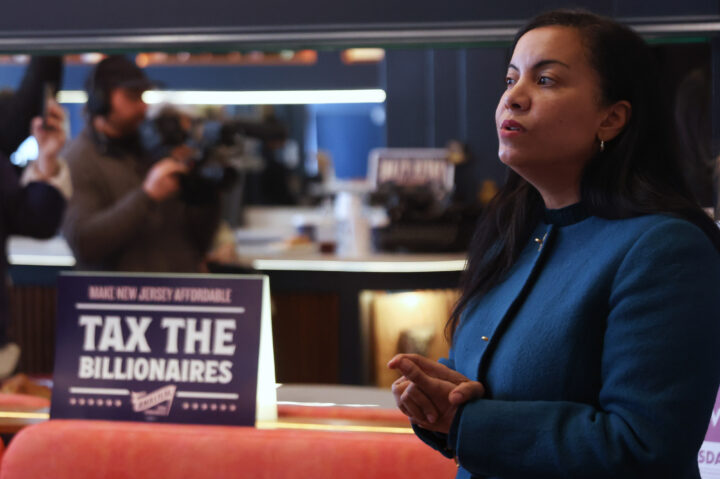
Heather Khalifa/Bloomberg via Getty Images
Analilia Mejia speaks to supporters and members of the media at Paper Plane Coffee Co. in Montclair, N.J., on Thursday, Jan. 29, 2026.
Top New Jersey Democrats lined up behind far-left, anti-Israel activist Analila Mejia on Tuesday in New Jersey’s 11th Congressional District — even as a moderate Jewish state assemblymember publicly is mulling a bid against Mejia in the June regular election primary.
Gov. Mikie Sherrill, who previously held the seat, and Sens. Cory Booker (D-NJ) and Andy Kim (D-NJ) all endorsed Mejia, the surprise winner of last week’s special election primary race. Former Rep. Tom Malinowski (D-NJ), who conceded the race to Mejia Tuesday morning, also backed her, as did several members of New Jersey’s House delegation.
Sherrill said in a statement she is “very proud to endorse” Mejia’s campaign.
“New Jersey’s 11th District has gone from a Trump district to once again showing the country that a commitment to working families and our Democratic values is a winning playbook,” Sherrill said. “I am grateful to the talented field of Democrats who stepped up to take on the threats and chaos coming from Washington. Now, we must turn to the critical work at hand: ensuring that we keep this seat blue and standing up to Trump’s attacks on our rights and economic opportunity.”
Booker, a pro-Israel Democrat, said Tuesday that the district “deserves a representative who will stand up against the harm Trump and Republicans are doing to our state.”
“I’m proud to support Analilia and her people-powered campaign to ensure we keep the 11th district blue on April 16th,” he continued.
Kim also backed Mejia, taking a veiled shot at the AIPAC-linked United Democracy Project’s spending against Malinowski, as well as the New Jersey political machine.
“NJ politics is clearly in a new era where the voters get to decide instead of having the choice made for them,” Kim said. “Let’s keep fighting against machine politics and dark money and get [Mejia] into Congress. There is so much at stake in our country.”
In a later joint statement, Booker and Kim explicitly endorsed Mejia in the June primary as well.
Malinowski, in his statement, praised Mejia for her campaign, but traced his loss in large part to the ad campaign against him by UDP, which spent more than $2 million to oppose him.
“The outcome of this race cannot be understood without also taking into account the massive flood of dark money that AIPAC spent on dishonest ads during the last three weeks,” Malinowski said in a statement. “I wish I could say that this effort, which was meant to intimidate Democrats across the country, failed in NJ-11. But it did not.”
Malinowski said that “if AIPAC backs a candidate — openly or surreptitiously — in the June NJ-11 Congressional primary, I will oppose that candidate and urge my supporters to do so as well. The threat unlimited dark money poses to our democracy is far more significant than the views of a single member of Congress on Middle East policy.”
New Jersey Democratic Reps. Rob Menendez, Bonnie Watson Coleman and LaMonica McIver also endorsed Mejia in a joint statement, offering their backing both in the special general election and the June primary.
“Analilia is the fighter the 11th District needs — from taking on the Trump Administration to championing workers’ rights — and we are proud to support her as the next Congresswoman for this district,” the statement reads. “Unifying behind Analilia is critical to our efforts for a Democratic House majority and defeating House Republicans’ agenda of chaos and terror. We should all be united in our support for her as she joins our delegation in the battle for the soul of our nation.”
Democratic National Committee Chair Ken Martin also offered Mejia his congratulations and support.
Meanwhile, Assemblywoman Rosaura Bagolie, who is Jewish and an immigrant from the Dominican Republic, told Politico on Monday that she was considering a challenge to Mejia in the June primary, with few if any of the candidates who ran against Mejia in the February primary likely to run.
Bagolie said that she is “definitely considering” a bid for the seat, calling Mejia “not representative of the moderate Democrats of this district,” and saying that a race between her and Mejia would be an “election is between two women who come from the same walk of life and have a different view on politics.”
UDP indicated following the primary last week that it would be considering further spending in the June primary. Bagolie told Politico that she would “actively not be seeking” support from any outside groups.
It’s unclear whether the near-unified support for Mejia from state Democratic leaders will impact her plans.
In the state Assembly, Bagolie, who represents Livingston, Montclair and Milburn, has been one of the lead sponsors of legislation codifying the International Holocaust Remembrance Alliance’s working definition of antisemitism into state law, and was the lead sponsor of a 2024 resolution offering support for Israel after Hamas’ attacks.
Alongside other legislators, she visited Israel in March 2024.
Speaking with hostage families and visiting the sites of Hamas’ attacks, Bagolie said she felt “anger, triggered by the acknowledgment of humans committing profoundly evil acts, stems from our compassion and the innate pursuit of justice and mercy. Confronting this darkness challenges our belief in humanity’s inherent goodness.”
In a speech at a celebration of Israel’s 77th Independence Day, Bagolie described Israel as a “miracle” and a “homeland reborn from the ashes of history. A beacon of democracy, innovation and resilience in a region that too often only knows turmoil. A place where Jewish lives thrive, no matter where you come from, and where people of all faith identities can live with dignity. Israel is not just a place on a map. It’s a living, breathing promise that the Jewish people would never again be without a home, and we will continue to fight every day to maintain our home.”
She said that supporting a “strong, secure Israel” is good for the United States’ national interests as well.
Bagolie said she felt it was important for her to visit Israel in person “so that when those try to convince me that I’m wrong, or that what I am feeling and seeing is wrong, I can tell them I’ve walked it. I’ve lived it. I’ve seen it. And I feel it in my heart till this day, and you are not going to change my mind.”
She said she felt a particular connection to Edan Alexander, the hostage who grew up in New Jersey, seeing similarities between him and her own son. “Seeing the video of the torture Edan is going through and having held his mother in my arms … my heart fell.”
She also vowed not to be silent about the antisemitism growing in the state, arguing that fighting antisemitism and supporting Israel cannot be partisan issues. She highlighted the pervasive fear and threats that her family and the entire Jewish community face.
Former Lt. Gov. Tahesha Way, who was endorsed by Democratic Majority for Israel in the special election primary and had not ruled out running in the June primary as other special election candidates did, has not announced her plans, and did not respond to multiple requests for comment.
The AIPAC-linked super PAC said it may get involved in the June NJ-11 primary for the next full term
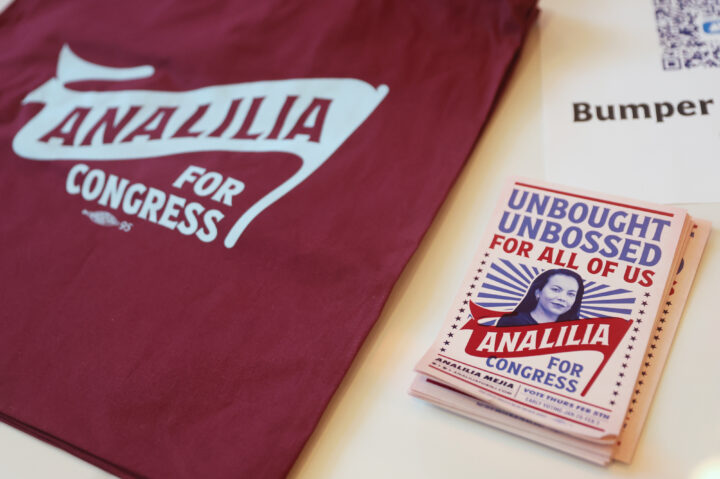
Heather Khalifa/Bloomberg via Getty Images
Campaign stickers for Analilia Mejia, US Democratic House candidate for New Jersey, at Paper Plane Coffee Co. in Montclair, New Jersey, US, on Thursday, Jan. 29, 2026.
The AIPAC-linked United Democracy Project said in a statement Friday that it had anticipated the potential elevation of a far-left candidate who has accused Israel of genocide in New Jersey’s 11th Congressional District as a possible outcome of its spending against former Rep. Tom Malinowski (D-NJ), but indicated it may undertake further spending in the district.
The group spent $2.3 million attacking Malinowski over his support in 2019 for Immigration and Customs Enforcement Funding and stock trading while in Congress.
Though ballot-counting has not yet finished, progressive activist Analilia Mejia, who is well to the left of Malinowski on Israel issues, currently holds a narrow lead in the primary — an outcome that frustrated New Jersey Jewish leaders attribute at least in part to UDP’s attacks on Malinowski.
“The outcome in NJ-11 was an anticipated possibility, and our focus remains on who will serve the next full term in Congress,” UDP spokesperson Patrick Dorton said in a statement Friday. “UDP will be closely monitoring dozens of primary races, including the June NJ-11 primary, to help ensure pro-Israel candidates are elected to Congress.”
Thursday’s race was a special primary to fill the remainder of Gov. Mikie Sherrill’s term in the House, through January 2027. The winner will still face a general election against Republican Joe Hathaway, the mayor of Randolph, N.J. The progressive Mejia could be uniquely vulnerable in the general, though the district favors Democrats.
There will also be a second primary race in June, on which Dorton suggested that UDP is focused, for the next full term in the House.
Former Lt. Gov Tahesha Way, rumored to be AIPAC’s preferred candidate and endorsed by Democratic Majority for Israel, looks poised to finish in third, with around 17%, in Thursday’s special election primary.
Mejia, who would likely win with less than 30% of the vote, could be vulnerable in the June primary if moderate voters — split amongst Malinowski, Way and Essex County Commissioner Brendan Gill in Thursday’s race — coalesce behind Way in the June regular primary.
Way and Malinowski did not immediately respond to requests for comment on whether they plan to run in June. Gill’s team confirmed that he does not plan to run.
The fact that a candidate as far to the left as Mejia could prevail in one of the most affluent, suburban districts in the country speaks volumes about the state of the party
Heather Khalifa/Bloomberg via Getty Images
Analilia Mejia, Democratic House candidate for New Jersey, speaks to supporters and members of the media at Paper Plane Coffee Co. in Montclair, N.J., on Jan. 29, 2026.
The results in New Jersey’s 11th Congressional District last night may not make national headlines, but should be sending a shock wave across Democratic campaigns and pro-Israel institutions.
Analilia Mejia, the far-left, Bernie Sanders-endorsed activist, narrowly led in a crowded field of Democratic candidates in a primary election for an affluent, moderate-minded district, despite long odds.
With most votes counted, Mejia leads former Rep. Tom Malinowski (D-NJ), who was considered the favorite, 29-28%. Former Lt. Gov. Tahesha Way, favored by pro-Israel groups and endorsed by Democratic Majority for Israel, finished in third place, winning just 17% of the vote.
Mejia’s apparent primary victory is another sign that the socialist wing of the Democratic Party — as exemplified by New York City Mayor Zohran Mamdani’s out-of-nowhere success across the Hudson River — is ascendant. Mejia was the only candidate to call Israel’s war against Hamas in Gaza a “genocide” and condemned Israel just days after Oct. 7 without making a mention of Hamas’ terror attack against the Jewish state.
As early as Oct. 10, before the Israeli invasion of Gaza began, Mejia said: “Every fiber of my being is horrified beyond words at what is furthering in Gaza.”
The fact that a candidate as far to the left as Mejia could prevail in one of the most affluent, suburban districts in the country speaks volumes about the state of the party. This is a district, based in Morris County, filled with Wall Street bankers, venture capitalists and other wealthy white-collar workers that was a reliably Republican area not long ago.
Mejia is also beating the party machine-backed candidate, Essex County Commissioner Brendan Gill, on his home turf — an unprecedented dynamic for an underdog with next-to-no institutional support.
The decision by the AIPAC-aligned United Democracy Project (UDP) to spend over $2.3 million in ads attacking Malinowski is also looking highly questionable. The money, spent on ads attacking Malinowski for funding Immigration and Customs Enforcement (ICE) during his time in Congress, served its role in knocking down the front-runner.
But the playbook failed to do enough to boost Way, their closest ally, and clearly played an unintended role in Mejia’s strong showing, potentially elevating the fringe candidate into Congress. The lobby group was upset that Malinowski, who was generally a pro-Israel vote in Congress, had called for conditioning aid to Israel during the lengthy war in Gaza — and wanted to demonstrate that his criticism carried a cost. Their all-out push for the best possible result led to the worst possible outcome.
“If I was an AIPAC official, I’d be wondering, ‘How am I going to go to the same donors that I got money from to run this whole campaign against Malinowski and now I’m going to have to do the same thing to take out the person that I accidentally got elected?’” one Jewish leader said, presuming a Mejia win.
That said, there will be two opportunities for pro-Israel groups and moderate forces within the party to mobilize against Mejia, presuming she holds on for the nomination. Given that the New Jersey seat is a fairly competitive district — it backed Kamala Harris by eight points in the 2024 election — Mejia is not a lock to win the general special election (for the remainder of the term) against Republican Joe Hathaway, the mayor of Randolph Township.
It’s hard to imagine Democrats, running in a very favorable political environment, losing the general election. But you couldn’t find a more-problematic candidate than a socialist running in a capitalist-minded district.
In addition, there will be a separate June Democratic primary for the regular term. There’s a strong chance Mejia would face credible opposition from a more mainstream Democrat, even if elected to Congress, though it’s possible multiple opponents could end up challenging her.
But the fact that Mejia isn’t yet a sitting lawmaker offers little consolation to pro-Israel leaders, who are looking warily at upcoming primary fields — from Illinois to Maine to Minnesota — where Democrats could nominate a slate of far-left, anti-Israel candidates that, if elected, would dramatically change the image and ideological disposition of the party.
The pro-Israel group spent over $2.3 million to block occasional Israel critic Tom Malinowski from getting elected — but it may have unwittingly gotten a far-left radical nominated instead.
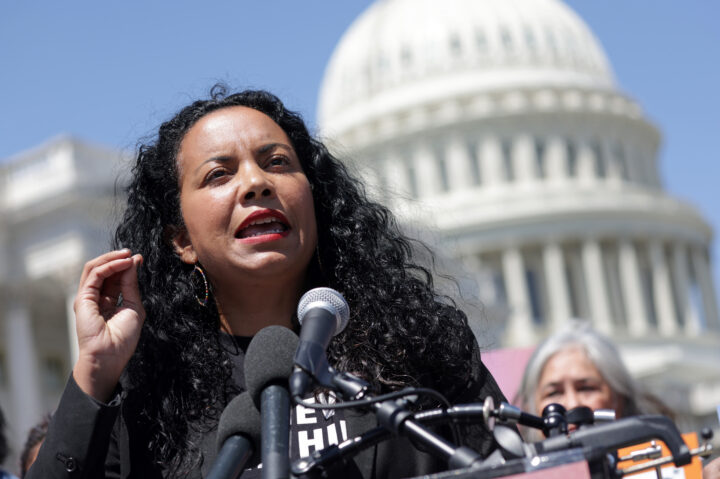
Alex Wong/Getty Images
Analilia Mejia, co-executive director of Center for Popular Democracy, speaks during a news conference outside the U.S. Capitol on April 19, 2023 in Washington, DC.
In New Jersey’s 11th Congressional District, the AIPAC-linked United Democracy Project made a $2.3 million bet against former Rep. Tom Malinowski (D-NJ). It was clear early in the evening that the bet wasn’t paying off — but now the race could end up in what local Jewish leaders are calling a worst-case scenario.
After some outlets initially called the special primary election race for Malinowski, far-left progressive activist Analilia Mejia surged, and took a narrow lead as of the end of the evening, with most saying the race is now too close to call.
Malinowski maintained a largely pro-Israel record while in office but expressed openness during his latest congressional bid to backing policies conditioning or restricting aid. A former State Department official, he was also a leading and influential voice on foreign policy issues among colleagues.
Mejia’s views on Middle East politics are well to the left of Malinowski’s — she indicated support during a candidate forum for an offensive weapons ban, accused Israel of genocide less than a month after the Oct. 7, 2023, attacks and, as early as Oct. 10, before the Israeli invasion of Gaza began, said, “Every fiber of my being is horrified beyond words at what is furthering in Gaza.” At the same time, she has expressed support for Israel’s “right to both exist and defend itself.”
Mejia was endorsed by a laundry list of vocal Israel critics, including Sen. Bernie Sanders (I-VT) and Rep. Alexandria Ocasio-Cortez (D-NY).
Even without a final call, the results are already emboldening other Israel critics on the left, who are declaring that the results show that AIPAC has lost its sway, including candidates running against moderate, pro-Israel candidates in two key Illinois primaries.
Though some were concerned about Malinowski’s growing criticism of Israel since leaving office, other Jewish leaders had been puzzled by UDP’s decision to attack a lawmaker they saw as an ally during his previous congressional term — particularly when a more strident Israel opponent such as Mejia was in the race.
Now, some believe that UDP’s attacks on Malinowski, which attacked the former congressman’s vote in 2019 for Immigration and Customs Enforcement and his stock trading while in office, may have pushed voters toward Mejia, rather than toward a more moderate candidate, leaving pro-Israel advocates in an even worse position than if it had not intervened.
“Some of the worst fears of the Jewish community in New Jersey have been realized,” one Jewish leader said, referring to Mejia’s surge. “This was a possible byproduct of them stepping into the race. I don’t know how much of this is to blame on AIPAC specifically, but I think there needs to be a serious after-action report if the intent to push out Malinowski had this unintended consequence of propping up a very, very progressive candidate. … If she were to win, this would be far worse than Malinowski winning.”
The leader added that Jewish and moderate voters were ultimately split among former Lt. Gov. Tahesha Way, who was rumored to have AIPAC’s tacit backing and was endorsed by Democratic Majority for Israel, and Essex County Commissioner Brendan Gill — a longtime New Jersey political hand and the anticipated frontrunner, who ultimately failed to carry his home county.
While attacking Malinowski, UDP did not air positive messaging about any of the candidates to push voters toward its preferred choice.
“Jewish organizations need to rethink their strategy, or I fear that they are slowly pushing themselves into irrelevance,” the leader continued, pointing to the New York City mayoral race as a similar result when Jewish and moderate voters failed to coalesce to stop a far-left candidate. “People are winning elections without their support — they’re basically beating them.”
Another said AIPAC and UDP had “played it wrong in every step” — raising money for Way, whom the source said always had little chance of winning, and then spending heavily to go after Malinowski despite the Jewish community’s largely positive relationship while he was in office, potentially pushing Malinowski further left.
“If AIPAC’s definition of pro-Israel now excludes even someone like me, who passionately supports Israel but won’t commit to a blank check for anything [Israeli Prime Minister Benjamin Netanyahu] might want, there won’t be enough pro-Israel people left in America to sustain the relationship,” Malinowski said when UDP first began running ads against him.
In a statement, UDP spokesperson Patrick Dorton said the group had anticipated a potential Mejia victory but suggested UDP may get involved in the upcoming June primary for the next full term. Thursday’s primary election was only for the remainder of Gov. Mikie Sherrill’s term in the House, through January 2027.
“The outcome in NJ-11 was an anticipated possibility, and our focus remains on who will serve the next full term in Congress,” Dorton said. “UDP will be closely monitoring dozens of primary races, including the June NJ-11 primary, to help ensure pro-Israel candidates are elected to Congress.”
Mejia gained attention relatively late in the shortened race, and was not initially viewed as a major contender. Additionally, turnout in the race — expected to be low for a Thursday special election primary with poor road conditions from a recent winter storm — ended up surpassing the 2024 primary election.
Should UDP be interested in trying to take another swing at the Democratic nominee, it may have two opportunities to do so: the upcoming special general election, where the far-left Mejia might be uniquely vulnerable to a GOP challenge, or the primary for the November midterm election. Beating Mejia in the latter primary would likely require consolidation among moderate Democrats.
“If I was an AIPAC official, I’d be wondering, ‘How am I going to go to the same donors that I got money from to run this whole campaign against Malinowski and now I’m going to have to do the same thing to take out the person that I accidentally got elected?’” one Jewish leader said, presuming a Mejia win.
The result could also raise questions about AIPAC and UDP’s strategy in other upcoming races. In Illinois’ 9th Congressional District, a Jewish activist in the community raised concerns to JI weeks ago that pro-Israel attacks on Evanston Mayor Daniel Biss could ultimately end up peeling off voters to far-left influencer Kat Abugazaleh, who is avowedly anti-Israel.
But thus far, the strategy in that race appears to be different. An outside group that many in the community believe to be backed by pro-Israel donors recently began running positive ads boosting the pro-Israel favorite, state Sen. Laura Fine, rather than attacking her challengers.
Please log in if you already have a subscription, or subscribe to access the latest updates.
 Continue with Google

 Continue with Apple